
茶 FIRST IMPRESSIONS
茶 REVIEW OF BOOKS & FILMS
[FIRST IMPRESSIONS] “My Name Is Not Eileen: Geck Geck Priscilla Ang’s Ah Girl” by Ken Lam
Geck Geck Priscilla Ang (director). Ah Girl, 2026. 99 min.


Childhood here is not scaled-down adulthood; it is a distinct cinematic language.
Ah Girl opens in a tunnel at night, its title rendered in wobbly blue bubble letters that look as though a child might have drawn them. It is an apt beginning: enclosed, ever-shifting, and already seen at a child’s scale. Set in Singapore in 1994, the film examines a terrifying fact of childhood: the lack of agency in a life choreographed by towering, indecisive adults.
Ang uses the era’s chewing-gum ban and the Michael Fay case not as cheap nostalgia, but as atmospheric texture for a quieter question: what agency remains for a seven-year-old when the adults orchestrating her life are paralysed by their own failures?
We find the answer on Swee Swee’s first day of Primary One. A teacher calls, “Eileen Ang Swee Swee.” A small hand hesitates, then rises. Asked for her preferred name, the child issues a polite correction: “I am Swee Swee. My name is not Eileen.”
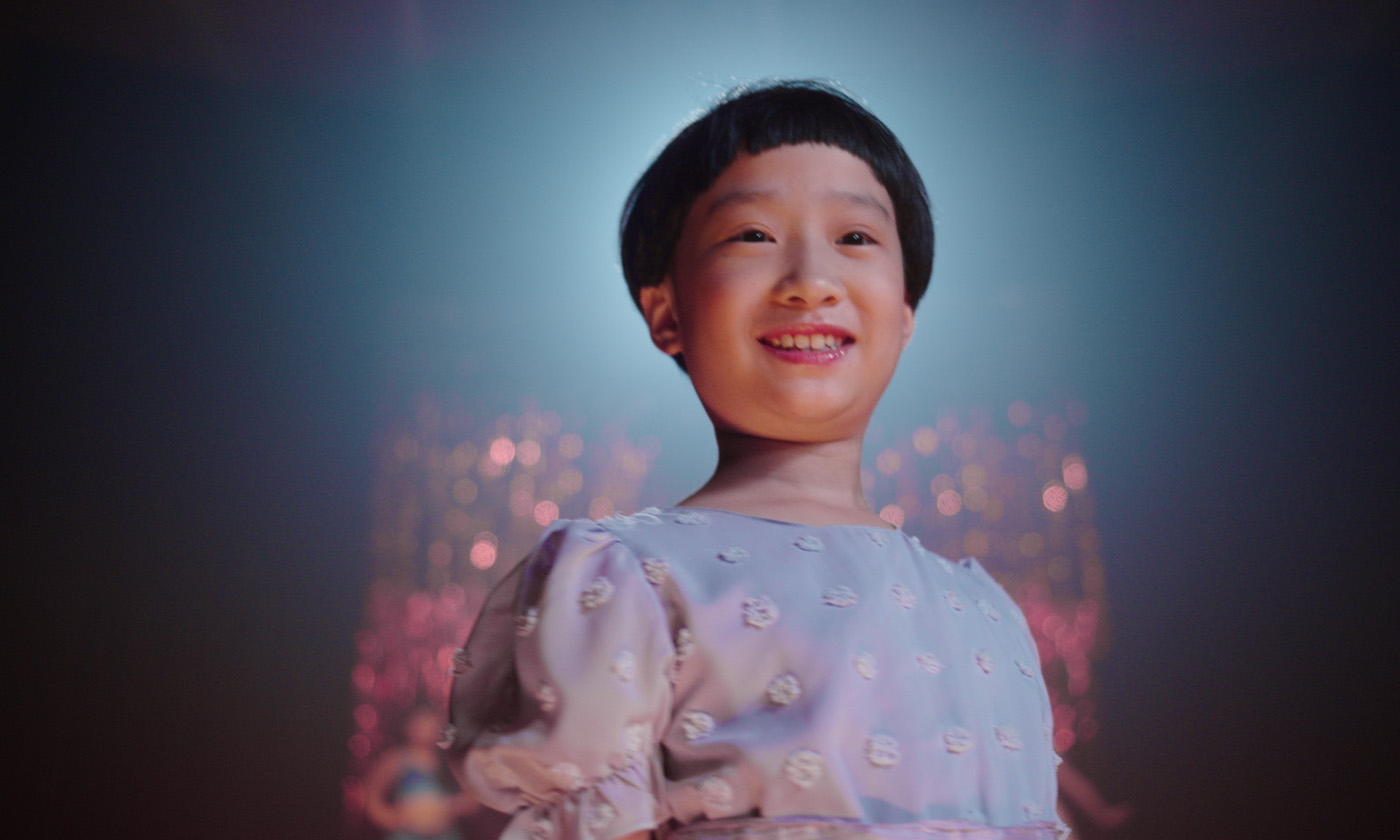
Played by the extraordinarily talented Ong Xuan Jing, Swee Swee makes that distinction feel less like dialogue than an act of self-possession. Ong’s stillness, watchfulness, and flashes of mischief give her an interior life far larger than her seven years. Even her silences feel like decisions.

Ong Xuan Jing as Swee Swee
Ang makes visible the identities a child did not choose. “Eileen” is the English name on the school register. “Ah Girl” is the familial endearment, assigning her a role rather than an identity. Swee Swee is the self she claims. The film is about how children invent small territories of sovereignty amid adult confusion.
The sisters have one such territory: a secret language of their own. Where adults negotiate through promises, omissions, and half-truths, the sisters communicate without translation. Their language gives them something the household rarely does: a space in which they already belong.
Meanwhile, the adults are trapped in purgatory. A mother promises a larger flat and a reunited family, yet the siblings remain scattered. A father treats minor purchases as agonising moral dilemmas. His eventual nuptials sit within the family’s web of obligations and past selves. The children cannot quite name this accumulation; they simply notice that what adults say rarely matches what they do.
Swee Swee’s response is action, culminating in the film’s most audacious sequence. Faced with Ah Tian’s departure for Australia, she attempts to stash her sibling in a rubbish bin. It is a brilliant inversion of the childhood threat, “Behave, or we’ll put you back in the rubbish we found you in.” Swee Swee does not use the bin to discard her; she uses it to anchor her.
Ang maps this struggle over autonomy onto her formal choices. Cinematographer Lim Teck Siang’s camera remains at a child’s eye level. The boxy 4:3 frame creates visual confinement; adults become looming, fragmented figures. The world is measured in sensory details: the rush of water, the swing, the bright smear of oil pastels. Childhood here is not scaled-down adulthood; it is a distinct cinematic language.
For local audiences, Ang layers the household with multiple languages and registers. Hokkien belongs to the adults; Mandarin moves across generations; English governs school and the wider public world. The film’s varieties of Chinese, like its varieties of English, are never simply interchangeable: each language marks a relationship, a generation, and a place to belong.
Mediacorp veterans Carrie Wong and James Seah embody precisely this dynamic. Speaking with the melodramatic cadence of Channel 8 serials, they bring Singapore’s television culture directly into Swee Swee’s world. They also become part of the film’s realism: these are beautiful people who happen to be Mum and Dad.
The film’s historical memory is equally complex, especially in its treatment of Japan. Across three generations, Japan changes shape: it represents Occupation trauma and aspirational travel for the grandmother, a livelihood for the tour-guide mother, and the source of illicit chewing gum, as well as the trusted “Aunty Japan”, for Swee Swee. That layered inheritance makes Shinji Somai’s Moving (1993) a more revealing ancestor than the inevitable comparison with Anthony Chen’s Ilo Ilo. Like Somai, Ang allows adult failures to expand through a child’s consciousness until realism begins to fracture into the poetic.
The banned chewing gum, finally, becomes more than a prop for mischief. In the climax involving a piggy bank, the gum, and the principal’s office, Swee Swee is covering for an adult. Her choices do not free her from adult decisions; they become the tools of her survival. I thought about this while watching from Toronto. I remembered waking at six in pitch darkness and making my own breakfast: a fried egg on a metal plate, with kaya spread over white bread.
The film ends where it began: in a tunnel. By then, even Swee Swee’s father has committed to a choice, his Malay wedding. With a dance, a talisman, and a bus disappearing into the dark and then into white, Ang allows the film to move from observation towards something closer to vision.

How to cite, Lam, Ken. “My Name Is Not Eileen: Ang Geck Geck Priscilla’s Ah Girl.” Cha: An Asian Literary Journal, 29 Sept. 2026. chajournal.com/2026/09/29/ah-girl


Ken Lam is a writer and translator born in Kyoto and raised in Singapore. His writing appears or is forthcoming in Seventh Wave, Voice and Verse Poetry Magazine, Porch Literary Magazine, Quarterly Literary Review Singapore, and the video-game anthology Free to Play. He divides his time between New York and Toronto.