
茶 FIRST IMPRESSIONS
茶 REVIEW OF BOOKS & FILMS
[FIRST IMPRESSIONS] “Hungry as a Ghost: Compassion and Cruelty in From the Diary of Madame Mao” by Marsha McDonald
All entries in Cha
on Madame Mao.
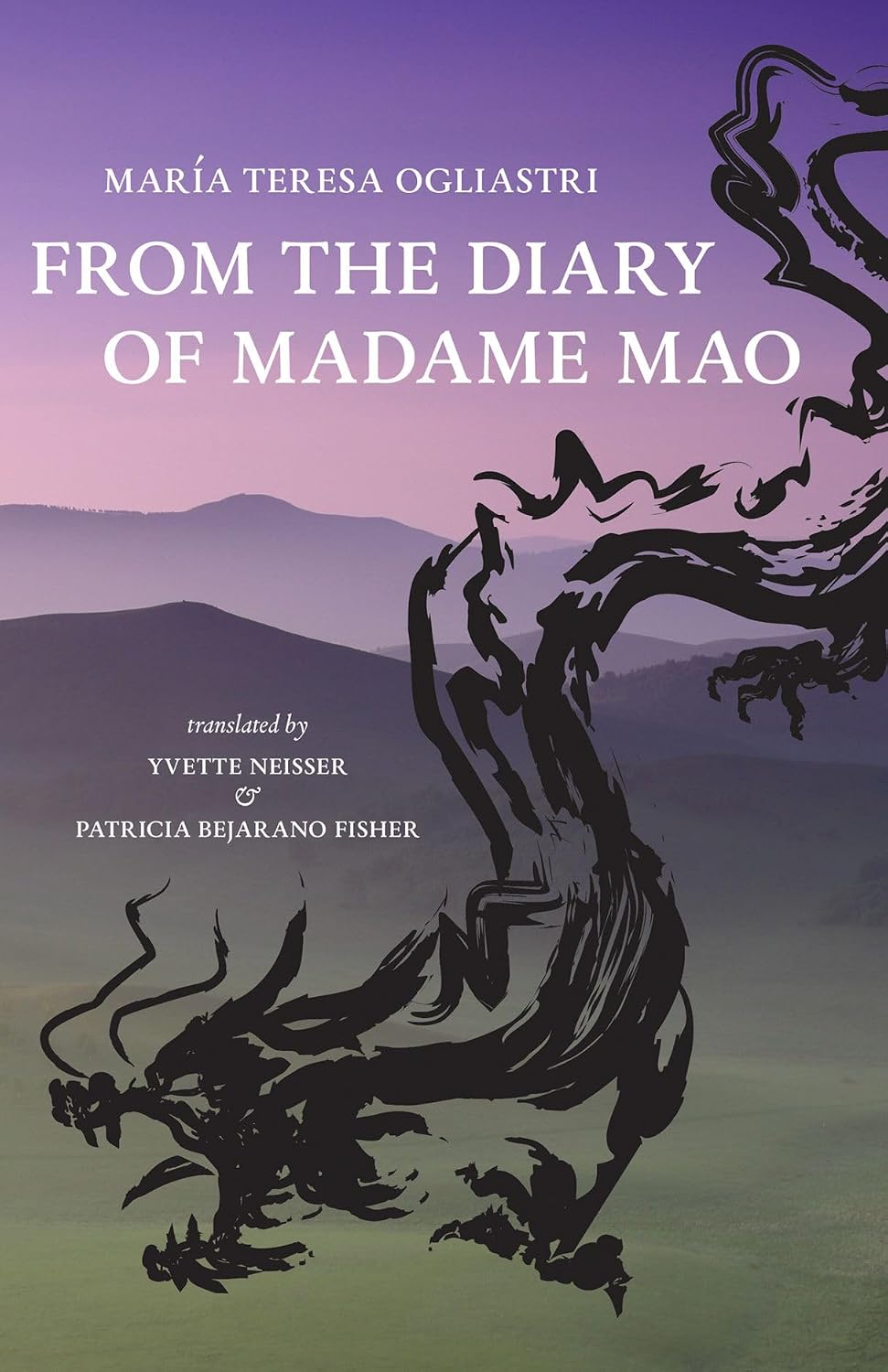
María Teresa Ogliastri (author), Yvette Neisser and Patricia Bejarano Fisher (translators). From the Diary of Madame Mao. Carnegie Mellon University Press, 2026. 136 pgs.


There is a white-hot hunger ever-present in María Teresa Ogliastri’s book of poems, From the Diary of Madame Mao. It gnaws, claws and roars its way through the book.
Madame Mao, or Jiang Qing, the fourth wife of Chairman Mao Zedong, rose to power during the Cultural Revolution. Her ferocious appetite for transforming China’s cultural landscape (she had spent part of her youth as an aspiring film actress), together with her unrelentingly cruel enforcement of government policies, is infamous.1

“The brief and scandalous film career of Madame Mao”
In China, an entire generation was profoundly affected by her cruelty. Some still bear emotional and physical scars from their experiences during the Cultural Revolution.2
Ogliastri considers the psyche of her Madame Mao, someone capable of deliberately and systematically hurting so many people. Jiang Qing was no mythical monster. She was a human being.
I find myself agreeing with the poet’s assertion in her introduction that this book “is an invitation to discover compassion toward this individual. She is part of me and part of us all, the part that is tempted by the abyss” (p. 15).
The inner life of Ogliastri’s Madame Mao is intriguing, brutal, at times sorrowful and deeply strange.
But after reading these poems, will I honestly be able to feel compassion for Jiang Qing?
)
Through each vividly visual poem, we bear witness to Madame Mao’s imagined inner life. We follow her complex transformation from a vulnerable, impoverished girl longing for agency into a despised, disgraced and ageing leader.
Madame Mao has written these poems for us, for anyone who will listen to or read them, in a prison diary. The book feels more like a memoir or testament than a private journal.
She has been convicted of treason and of sanctioning atrocities committed against her own people. Jiang awaits her fate in a small, dirty cell. She has come full circle, returning to the poverty of her childhood. Abandoned to her fate, she has only a silkworm for company.
In verses from “Into the Void”, she displays no remorse. She offers excuses and accepts no responsibility for the cruelties attributed to her:
the ingratitude of the masses
is opaque glass
now that vengeance is a boomerang
they want me to catch the master’s bone
why should I pay for those deaths?
I’m not a woman scared by those empty tombs
(“Into the Void”, p. 105)
“My Daughter Na’s Visit” presents a manipulative, self-pitying portrait of Madame Mao as a needy, elderly widow beseeching her daughter to intervene on her behalf:
daughter help me
save me from a bullet to the head
why are you ashamed of me?
a widow is a bird with just one wing
when you come to say good-bye bring cellophane
to wrap my heart tender and throbbing
Yet in “Speak to Me Tree”, Jiang reappears as a defiant, formidable elder. She believes that she is owed respect for who she is and what she has accomplished:
The crane’s white wings
against the blue of sky
today my 77th birthday
I must speak before the jury
hard to explain why I must drag my fame
on this cart of manure
Ogliastri’s poems are powerful and beautifully written. Yet, as expressions of a cultural revolutionary’s inner voice, they are curiously anachronistic. The poems abound in images and allusions drawn from China’s long folkloric and literary history. This intentional juxtaposition heightens the ambivalence that a reader may feel towards Madame Mao.
)
Despite the beauty of the language, something unsettling and ominous occurs in each poem. A very young Jiang Qing recalls a tortured crab that taught her she had a taste for brutality (“Since Then I Have No Mercy”). A failed appeal for beauty and fortune manifests itself in untouched rice cakes and visions of beheadings (“Lotus Feet”). Fairies and concubines intermingle (“Fallen Fairies”).
In prison, she watches insects copulate and devour one another (“My Entertainment”), or meditates upon the flightless fate of the silkworm in her cell (“Feather-Winged”).
The poems feel unsteady, creating a kind of vertigo in the reader. Ogliastri perceives and describes a disconnection within the mind of her Madame Mao.
We were forewarned in the preface that Lady Macbeth, like Madame Mao, became intoxicated by power, was utterly devastated by defeat and descended into madness. In these poems, Madame Mao ends her days deluded and confused.
For that suffering, for her lost mind, hungry as a ghost, I found compassion.
From the Diary of Madame Mao is a fascinating imaginary recollection of a seminal female figure in modern China. Jiang Qing participated in the courageous but bloody passage through which modern China emerged. Yet both the historical Jiang Qing and Ogliastri’s fictional Madame Mao remain deeply flawed and deadly figures.
Footnotes
- “Madame Mao’s Nietzschean Revolution”, Palladium Magazine. ↩︎
- “Chronology of Mass Killings during the Chinese Cultural Revolution”, Sciences Po. ↩︎

How to cite: McDonald, Marsha. “Hungry as a Ghost: Compassion and Cruelty in From the Diary of Madame Mao.” Cha: An Asian Literary Journal, 9 Sept. 2026, chajournal.com/2026/09/09/diary-madame-mao.


Marsha McDonald lives in Vilar de Andorinho, Portugal. An artist and writer, she works and exhibits between North America, Europe, and Asia. She has received grants from the Pollock-Krasner, Puffin, Mary Nohl (travel), Lynden Sculpture Garden, Gallery 224 Artservancy (artist working within conserved land in Wisconsin USA), and a New York Fellowship. Her writing has appeared in Otoliths (Australia), The Drum and The Cantabrigian (Cambridge MA), Voice & Verse Poetry Magazine, Cha (Hong Kong), and La Piccioleta Barca (Milan). She has collaborated with artists and writers in the UK, France, Spain, Germany, Portugal, North America, and Japan. In 2024, she will be an arts resident at the Tyrone Guthrie Centre in Ireland and Studio Kura in Kyushu, Japan. Visit her website for more information. [All contributions by Marsha McDonald.]