
茶 FIRST IMPRESSIONS
茶 REVIEW OF BOOKS & FILMS
[ESSAY] “(En)Gendering Japanese Literature and Translation: Joan E. Ericson’s Be a Woman” by Catherine Regina Borlaza
Click here to read all entries in Cha
on Be a Woman
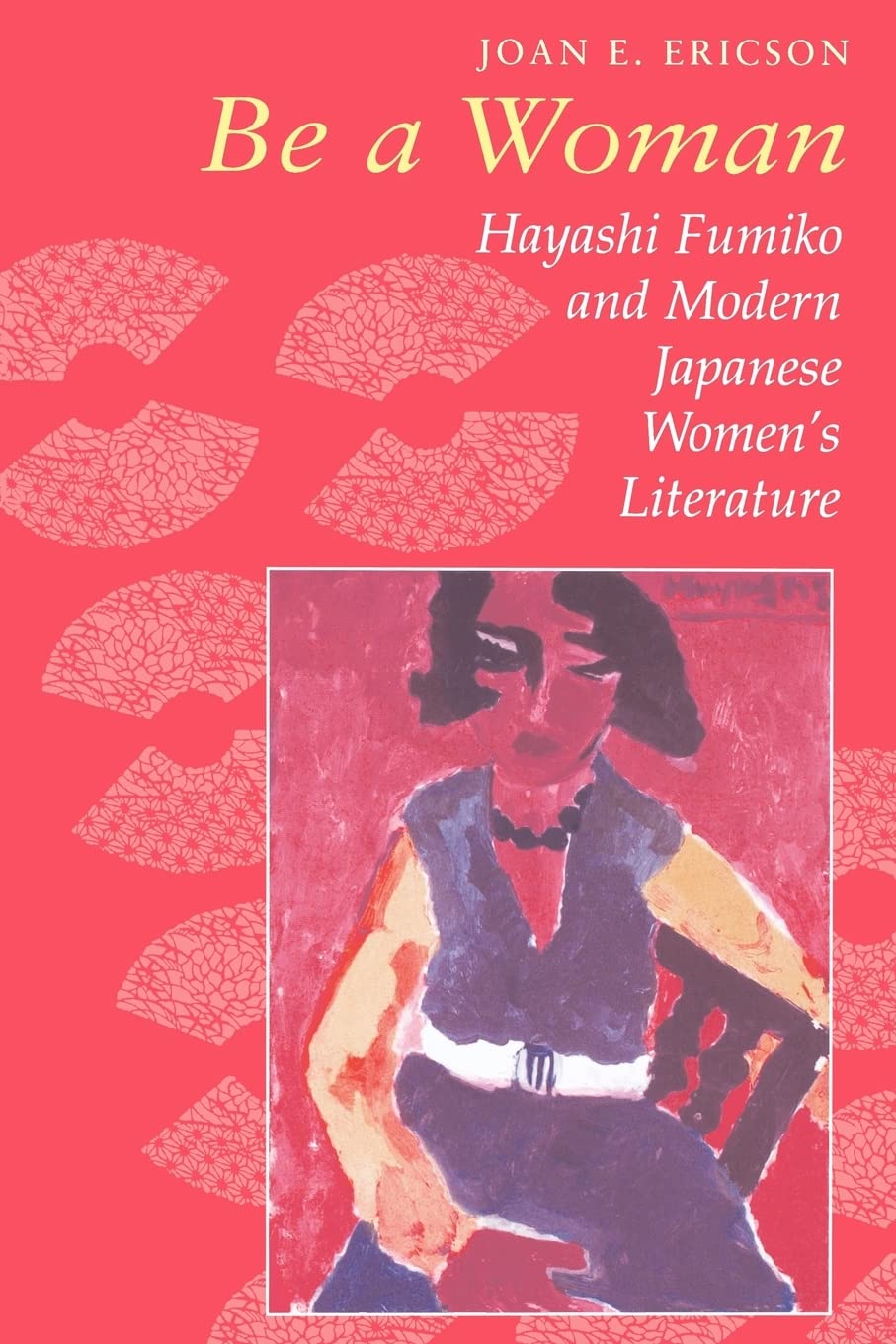
Joan E. Ericson. Be a Woman: Hayashi Fumiko and Modern Japanese Women’s Literature, University of Hawai’i Press, 1997. 273 pgs.

In Be a Woman, Joan Ericson foregrounds an intriguing question concerning an anomaly in Japanese literary history and literary criticism: Why has Hayashi Fumiko (1903 to 1951), an exceedingly prolific and popular writer, considered at one point “the representative woman writer” in Japan, been excluded from the modern canon of Japanese literature and received very little scholarly attention?
Underlying the anomaly that Ericson explores in her book is the broader institutional practice of categorising literature according to the author’s gender, particularly literature by women, which reflects deeply rooted attitudes towards women and obscures the complexity and range of modern Japanese women writers’ work and styles. By translating selected fiction by Hayashi into English and reconstructing the historical context in which Hayashi’s works were produced and received, Ericson’s book made a necessary and invaluable contribution to the study of Japanese women’s writing when it was published almost three decades ago and continues to raise important questions about the translation of Japanese women’s writing today.
)
Ericson’s book is divided into two parts. Part One, Literary History, is subdivided into six chapters that incisively situate Hayashi, her works, and the question of her omission from the modern canon within broader historical forces, social processes, and institutional practices that perpetuate gender-based literary categorisation in modern Japan. Part Two, Fiction, comprises Ericson’s English translations of two of Hayashi’s most popular works, Diary of a Vagabond (Hōrōki, 1928 to 1930) and “Narcissus” (“Suisen”, 1949).
In Chapter 1 of Part One, Ericson presents Western readers with problems arising from gender-based literary categorisation that are often overlooked when works are read in English translation. Ericson carefully untangles the interrelationship between entrenched attitudes towards women and conflicting valuations of a specific literary style couched in the terms joryū bungaku (women’s literature) and joryū sakka (woman writer). “Women’s literature” as a literary style, according to Ericson, is “principally characterized by sentimental lyricism and impressionistic, non-intellectual, detailed observations of daily life”, while a “woman writer” was expected to write in this “feminine” style (p. 3). By examining selected studies by prominent male literary scholars, Ericson emphasises how the terms “women’s literature” and “woman writer” are taken for granted, employed unproblematically, or left unsubstantiated and ungrounded in women’s historical experiences. Gaps in these studies inform Ericson’s approach to Hayashi’s marginal position in literary history: “A close scrutiny of [Hayashi’s] writing and its reception demands a historically grounded appraisal to capture the mechanism through which gender operates, and, even more important, the means that an individual woman writer employs to engage or exploit the boundaries of her gendered world” (p. 13).
To elaborate on the gendered world of women writers, Ericson, in Chapter 2, traces the trajectory of women’s writing in Japan from the Heian period through the Taishō period, with particular emphasis on women’s changing economic, social, and discursive contexts. In contrast to the prominently “female” and “feminine” tradition of writing in Heian Japan, women’s voices were subdued during the modern period because of the decline in their economic position, the privatisation of the circulation of their writings, and the gatekeeping of intellectual work by elitist male Meiji scholars. To further highlight the marginalisation of women writers, Ericson traces the development of the modern meaning of “women’s literature” during the Taishō period, which was shaped by educational and social reforms, particularly the growth of women’s literacy and the flourishing of journals aimed at a female readership. These developments consequently produced the image of the working woman, which called conventional gender roles of the time into question. What had initially emerged as an esteemed literary style came to be associated solely with assumptions about its readership and the author’s gender. The implications of what “women’s literature” came to mean in modern Japan were profound: “Women writers grouped by critics shared no unifying tradition, no school, and no journal. Consequently, the term did not do justice to the diversity of perspectives and approaches of those labels. To call someone a ‘woman writer’ said nothing about the author’s relation with other literary, intellectual, social, and political trends… The stereotyping encouraged neglect of any transformation or change in an author’s style and obscured artistic maturation and development” (p. 27).
In Chapter 3, Ericson turns her attention to structural changes in the publishing industry during the early twentieth century. Publishers increasingly catered to the sentiments and fantasies of a specific market of female readers, particularly middle-class housewives and daughters, reflecting the notion that “women had a distinct—and separate—place in society” (p. 39). Two kinds of women’s journals thus developed: first, “commercially oriented, mass-market magazines that often, but not always, advocated the ‘good wife, wise mother’ concept of the ‘traditional’ Japanese family”; and second, journals that served as “forums for social and political reforms or took as a mandate the education of women” (p. 39). Women’s journals such as Seitō (Bluestockings), Fujin kōron (Ladies’ Review), Shufu no tomo (Housewives’ Friend), and Nyonin geijutsu (Women’s Arts), the last of which initially serialised Hayashi’s Diary of a Vagabond, are examined to illustrate the varying political orientations and themes of women’s magazines and to highlight notable women writers who served as editors and contributors. Ericson points out, however, that critics condemned the boom in female-oriented and female-produced popular literature for commercialising literature, which, in turn, contributed to what they perceived as a decline in the standards of the bundan (literary guild).
Moving away from broader historical forces and institutional structures, Ericson, in Chapter 4, focuses on several notable features of Hayashi’s Diary of a Vagabond, particularly its blending of traditional and modern sensibilities and aesthetics as an uta nikki (poetic diary), and argues that the work should be read within the context of, and as a valuable contribution to, runpen bungaku (lumpen literature) (p. 63). After meticulously discussing the adoption of “lumpen” in the Japanese context, Ericson demonstrates how this concept manifests itself in the narrative, characters, and themes of Diary of a Vagabond. The success of Diary of a Vagabond as one of the first works to portray authentically and sympathetically the struggles and sentiments of those on the margins of society, according to Ericson, is often eclipsed by “its perceived failure to reflect calls for art to contribute to political struggle”, since Hayashi did not express an interest in any particular political ideology and may even have been “uneasy” with the categorisation of her works as lumpen literature (pp. 67 to 68). The political orientation of Hayashi’s works is explored further in Chapter 5.
In Chapter 5, Ericson charts developments in Hayashi’s style and discusses critics of her work who imposed gender as a framework for evaluation. This tendency to foreground gender obscures “the relation of [Hayashi’s] work to more salient literary, social, and political trends” (p. 76). To counter this tendency, Ericson explores Hayashi’s evolving style and creative practices, as well as her involvement with the Communist Party’s newspaper, Akahata (Red Flag), and the state’s wartime propaganda. Hayashi was one of the popular writers who formed part of the Pen Squadron deployed in Japan and its occupied territories and who wrote about the patriotism of Japanese soldiers on the front lines (p. 80). Her wartime experiences, Ericson notes, contributed to the development of her style and informed her engagement with “the harsh realities of the era”, as she portrayed characters, mostly women, “confronting bleak circumstances and unpleasant choices” (p. 85). What appears to distinguish Hayashi from contemporaries writing in a similar vein is that her characters “internalize the ambiguities and conflict so characteristic of the uncertainties of the era” (p. 85). Exploring these various facets of Hayashi’s writing and her subject position as a writer ultimately demonstrates how difficult it is to contain Hayashi within “a single stratum, class, or gender” (p. 88).
In the final chapter, Ericson extensively synthesises Japanese criticism of Hayashi’s work and its intersections with discourses on women’s literature generated by male and female critics in Japan. Reiterating several ideas addressed in previous chapters, Ericson discusses how Hayashi’s works have been evaluated according to conflicting and contradictory attitudes towards, and preconceived notions about, women. To conclude the chapter, Ericson suggests future directions for the study of gender in literature, including the reinterpretation of works by both men and women in light of changing valuations of gender, gender-based literary categories, and “institutional factors and the broad patterns and pace of social change” (p. 106).
)
Since its publication in 1997, insightful critical reviews of Be a Woman have been written by notable scholars such as Reiko Abe Auestad (1998), Sharalyn Orbaugh (1999), and Jan Bardsley (2000). One point raised by Orbaugh that merits further consideration concerns Ericson’s selection of Hayashi’s works for translation. Her decision to translate Diary of a Vagabond and “Narcissus” in particular remains largely unexplained, apart from the fact that they are two of Hayashi’s most famous works. Although Ericson refers to these texts to examine questions central to her project, such as the autobiographical nature of Hayashi’s writing, Hayashi’s ambiguous political orientation, and lumpen literature in the Japanese context, I wonder whether other untranslated works by Hayashi might also effectively raise and explore these questions. Ericson’s treatment of the two selected works also appears uneven, as her contextualisation and discussion of Diary of a Vagabond are considerably more comprehensive than those of “Narcissus”. Concerning Ericson’s approach, readers today are likely to regard the “historical” approach she adopts in examining these two works, as well as her emphasis on analysing them in the context of debates and discourses concerning the changing meaning of gender in Japan, as both obvious and indispensable to the reading and analysis of literature. Even at the time the book was published, some of Ericson’s arguments, according to Auestad, were not entirely novel to readers and critics (p. 272). While it may therefore seem easy to overlook the book’s relevance today, it is illuminating to reassess Ericson’s work in light of the institutional history of translating Japanese literature into English and the broader questions the book raises about contemporary practices of translating Japanese women’s writing.
To situate the relevance of Ericson’s work, I briefly recall the surge in the production of English translations of Japanese literature during the postwar period. According to Edward Fowler (1992), the selection of Japanese fiction translated into English was deliberate and intended to facilitate the Cold War alignment between the United States and Japan, aiding in the transformation of Japan’s image from a “mortal enemy during the Pacific War to an indispensable ally during the cold war era” (p. 6). Japanese authors Tanizaki Jun’ichirō (1886 to 1965), Kawabata Yasunari (1899 to 1972), and Mishima Yukio (1925 to 1970) came to stand metonymically for the totality of modern Japanese fiction and were effectively recontextualised in English translations to produce the image of “an exoticized, aestheticized, and quintessentially foreign land” palatable to the American public (p. 3). As a consequence, these translations were far removed from the realities of modern Japan and failed to represent the diversity of its literary production.
In response to Fowler, Angela Coutts (2002) calls attention to “the neglect of Japanese female authors by translations” compared with their male counterparts (p. 105). Hayashi’s Floating Cloud (1949, trans. Koitabashi 1957) was one of only two works by modern Japanese women writers translated into English between 1955 and 1959, during the supposed golden age of translating Japanese literature into English (p. 105). The neglect of works by Japanese women in translation and the consequent unavailability of women’s writing in English engendered misconceptions about Japanese literature. Coutts’ examination of an array of anthologies edited by Donald Keene (Anthology of Modern Japanese Literature: From 1868 to the Present Day, 1965), Ivan Morris (Modern Japanese Stories, 1962), Howard Hibbett (Contemporary Japanese Literature, 1977), Van C. Gessel and Tomone Matsumoto (The Showa Anthology, 1985), and Theodore C. Goossen (The Oxford Book of Japanese Short Stories, 1997) reveals that Japanese male authors considerably outnumber female authors in these collections, that women receive less historical coverage than men, and that, when included, works by women tend to appear only towards the end of the modern historical period. Women’s writing, in effect, appeared ahistorical and discontinuous, as though it had emerged only recently (p. 109). To address such gaps, anthologies deliberately focused on collecting and translating works by women writers were published. These groundbreaking anthologies include This Kind of Woman (1982), edited by Tanaka Yukiko and Elizabeth Hanson; Stories by Contemporary Japanese Women Writers (1982), edited by Noriko Lippit and Kyoko Iriye Selden; To Live and To Write: Selections by Japanese Women Writers 1913 to 1938 (1987); and Unmapped Territories: New Women’s Fiction from Japan (1991), the latter two edited by Tanaka.

Hayashi Fumiko at work on the cover of the anthology To Live and To Write (1987).
Alongside the publication of these anthologies centred on translated works by Japanese women writers, Nina Cornyetz and Rebecca Copeland (2024) note an increase in doctoral dissertations focusing on individual Japanese women writers through biographical or social-historical approaches, many of which were subsequently revised and published by major university presses (p. 2). Ericson’s Be a Woman, which emerged from her doctoral research at Columbia University, forms part of this broader trend of recovering and re-evaluating the contributions of Japanese women writers, a trend that helped legitimise the study of Japanese women’s writing in North America. In this sense, Ericson’s translations of Diary of a Vagabond and “Narcissus”, her detailed social-historical account and institutional investigation of literary production and reception in Part One, and her extensive bibliography of works by and about Hayashi constituted a necessary endeavour that emerged at a particular juncture in the field of Japanese literary studies and provided invaluable resources for scholars of Japanese literature in English translation.
Some of the issues underscored above in this brief institutional account of the translation of Japanese literature, the broader context informing Ericson’s project, urge us to consider the position of contemporary Japanese women writers and their representation and reception through translation. Scholars and popular media outlets alike have highlighted the success of contemporary Japanese women writers both within and beyond Japan. In recent years, many Japanese women writers have received prestigious literary awards internationally and domestically and have gained recognition through translation. Women writers shortlisted for the International Booker Prize, for example, include Ogawa Yoko in 2020 for The Memory Police (trans. Stephen Snyder), Kawakami Mieko in 2022 for Heaven (trans. Sam Bett and David Boyd), and Kawakami Hiromi for Under the Eye of the Big Bird (trans. Asa Yoneda). Alongside Kawakami, Ichikawa Saou was also longlisted for Hunchback (trans. Polly Barton). There also appears to be a trend whereby women writers who win the Akutagawa Prize in Japan subsequently have their prize-winning works translated into English. These include Sayaka Murata, who won in 2016 for Konbini Ningen (Convenience Store Woman, trans. Ginny Tapley Takemori); Imamura Natsuko in 2019 for Murasaki no Sukāto no Onna (The Woman in the Purple Skirt, trans. Lucy North); Usami Rin in 2020 for Oshi, Moyu (Idol, Burning, trans. Asa Yoneda); Ishizawa Mai in 2021 for Kai ni tsudzuku basho nite (The Place of Shells, trans. Polly Barton); Takase Junko in 2022 for Oishii Gohan ga Taberaremasuyōni (May You Have Delicious Meals, trans. Morgan Giles); Ichikawa in 2023 for Hanchibakku (Hunchback); and Kudan Rie for Tokyō to Dōjō tō (Sympathy Tower Tokyo, trans. Jesse Kirkwood). Translators have also taken the initiative to highlight and promote Japanese women’s writing through the establishment of the collective Strong Women, Soft Power, whose members are Lucy North, Allison Markin Powell, and Ginny Tapley Takemori. Takemori’s 2018 translation of Murata’s Convenience Store Woman is considered a turning point in the popularisation of translated writing by Japanese women (Takeda; Self).
)
The rising popularity and visibility of contemporary Japanese women writers in translation today is significant given both the historically marginalised position of women writers in modern Japanese literary history, as represented by Hayashi, and their position within the translation industry. In 2017, Takemori specifically reflected on the status of Japanese women writers in the context of translating Japanese literature into English:
… although Japanese women authors are thriving in publishing at home, this is not reflected in translated works of Japanese literature. Despite achieving parity in the prestigious Akutagawa and Naoki literary prizes and bestselling lists at home, and a whopping 550-page Waseda Bungaku edition dedicated to women writers that sold out within one week of publication last September, works by women authors have been regularly well under half of all Japanese titled in English translation. (“Strong Women, Soft Power”)
Potential problems, however, arise from the popularity of Japanese women’s writing, several of which have been explored by Fowler, Coutts, and Ericson. The sensationalisation of contemporary writing by women and the neglect of earlier women authors in translation may produce an ahistoricising effect, as Copeland (2022) also notes: “readers may assume Japanese women writers are finally finding their voice, as if they had no voice before the 21st century” (p. xix). The proliferation of translations specifically of works by women may also misleadingly suggest that such writing constitutes an entire category or genre of its own, accompanied by expectations concerning how women should write and what they should write about. Such categorisation risks effacing the diversity of literature written by individual women authors and of literature produced in Japan more generally, as Ericson effectively demonstrates through her problematisation of “women’s literature”. Finally, to conclude this brief reassessment of Ericson’s book, it is worth further exploring and questioning the broader forces behind the selection and translation of literature from Japan and the kinds of images of Japan that are produced, branded, circulated, and consumed. As Ericson highlights in her book, translations and the selection of works “have a decisive influence on how Japanese writing is perceived and evaluated in the context of world literature” (p. x) and on the broader construction and consumption of Japan as an image.
Bibliography
▚ Auestad, Reiko Abe. “Be a Woman: Hayashi Fumiko and Modern Japanese Women’s Literature by Joan E. Ericson.” Monumenta Nipponica, vol. 53, no. 2, 1998, pp. 271-273. JSTOR, https://www.jstor.org/stable/2385681.
▚ Bardsley, Jan. “Be a Woman: Hayashi Fumiko and Modern Japanese Women’s Literature by Joan E. Ericson.” The Journal of Asian Studies, vol. 59, no. 4, 2000, pp. 1016-1017. JSTOR, http://www.jstor.org/stable/2659243.
▚ Copeland, Rebecca. “Introduction: When Women Write.” Handbook of Modern and Contemporary Japanese Women Writers, edited by Rebecca Copeland. Amsterdam University Press, 2022.
▚ Cornyetz, Nina and Rebecca Copeland. “Introduction.” Reading Desire in a New Generation of Japanese Women Writers: A Special Collection of Essays. Routledge, 2024.
▚ Coutts, Angela. “The gendering of Japanese literature.” Japan Forum, vol. 14, no. 1, 2002, pp. 103-125. DOI: 10.1080/09555800120109050.
▚ Fowler, Edward. “Rendering Words, Traversing Cultures: On the Art and Politics of Translating Modern Japanese Fiction.” Journal of Japanese Studies, vol. 18, no. 1, 1992, pp. 1-44. JSTOR, https://www.jstor.org/stable/132706.
▚ Orbaugh, Sharalyn. “Be a Woman: Hayashi Fumiko and Modern Japanese Women’s Literature by Joan E. Ericson.” The Journal of Japanese Studies, vol. 25, no. 1, 1999, pp. 141-145. JSTOR, https://www.jstor.org/stable/133361.
▚ Self, John. “Surrealism, cafes, and lots (and lots) of cats: why Japanese fiction is booming.” The Guardian, 23 November 2024, .
▚ Takeda, Hiromasa. “Japanese women writers gaining recognition in English-speaking world.” Asia News Network, 27 June 2022.
▚ Takeda, Hiromasa. “Japanese women writers gaining recognition in English-speaking world.” The Japan News, 23 June 2022.
▚ Takemori, Ginny Tapley. “Strong Women, Soft Power.” Global Literature in Libraries Initiative, 26 May 2018.
How to cite: Borlaza, Catherine Regina. “(En)Gendering Japanese Literature and Translation: Joan E. Ericson’s Be a Woman.” Cha: An Asian Literary Journal, 7 Sept. 2026, chajournal.com/2026/09/07/be-a-woman.


Catherine Regina Borlaza teaches in the Department of English and Comparative Literature at the University of the Philippines Diliman, where she earned a bachelor’s degree in Comparative Literature, specialising in Asian literatures. She obtained her master’s degree in International Culture and Communication Studies from Waseda University. Her essays have appeared in Longhand: The Journal of English Studies and Comparative Literature, Transcommunication, and the Philippine Humanities Review. Her current research focuses on ecocriticism, while her other research interests include Japanese literature and culture, popular culture and media, and women’s writing. Email: chborlaza@up.edu.ph