
茶 FIRST IMPRESSIONS
茶 REVIEW OF BOOKS & FILMS
[ESSAY] “Reading Cinema Beyond Geopolitics: Rey Chow’s Sentimental Fabulations, Contemporary Chinese Films” by Jessica Morris
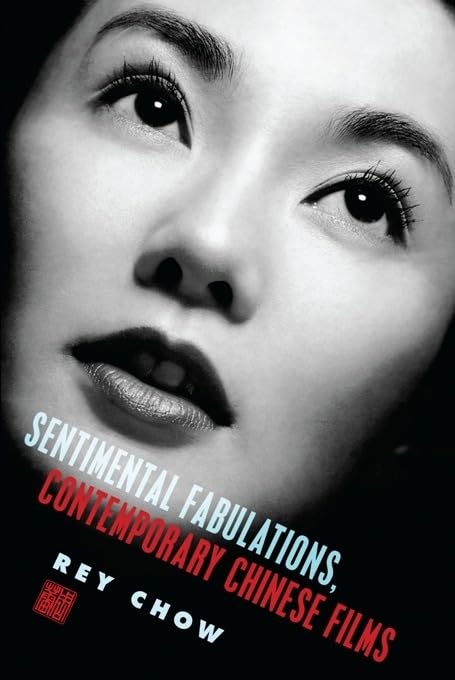
Rey Chow. Sentimental Fabulations, Contemporary Chinese Films: Attachment in the Age of Global Visibility, Columbia University Press, 2007. 288 pgs.

In Sentimental Fabulations, Contemporary Chinese Films, Rey Chow offers a rich introduction to contemporary Chinese film and draws upon a range of philosophical ideas as a foundation for much of her analysis. Chow’s book has rightly served as a catalyst for further research, such as Hui Miao’s The Sentimental in Chinese Cinema, in which Miao states that his book “forms a dialogue with Rey Chow’s.”1
Chow’s clear-eyed, direct style allows the relevance of her book to extend beyond the realm of film. She confronts challenging topics head-on, including how an excessive emphasis on geopolitical subcategorisation and “knee-jerk antiorientalist reactions” has deprived some Chinese films of their critical potential. According to one reviewer, “Sentimental Fabulation maps a landscape which… approaches the utopic—a place where individuals from all over the world trade freely in mutually intelligible visions of great beauty and power. The lucid authority of Chow’s critical voice makes such a transference possible”.2 In mapping this semi-utopic landscape, Chow offers those engaged with cinema in a globalised world, whether as casual audience members or critics, a worthwhile example of how to approach analysis with respect and equity.

While it is seldom advisable to begin a piece of non-fiction by summarising an entire field, Chow does so to good effect, opening her book with a review of film studies and criticism over time. This provides the reader with a stable foundation from which to explore Chow’s close analysis of twelve films, including Chen Kaige’s Temptress Moon (1996), Wong Kar-wai’s In the Mood for Love (2000), and Ang Lee’s The Wedding Banquet (1993), among others.
Her success derives from her ability to weave together pertinent norms and turning points that both inform and justify her approach, such as the reduction of foreign film to the primitive and Laura Mulvey’s introduction of the concept of the “gaze”. She avoids compartmentalising Chinese film “into distinct local archives and genealogies, which are typically arranged by way of chronological divisions and geopolitical boundaries such as the People’s Republic of China, Taiwan, Hong Kong, and Shanghai”. She argues that these films should instead be considered “as artifacts with logics and purposes of their own that are not reducible to socioeconomic factoids” (pp. x-xi). In this way, Chow privileges artistic and humanistic readings over political or historical ones, while still demonstrating how the latter can be employed responsibly.
Chow argues that sentimentalism is the dominant characteristic of contemporary Chinese film. However, she eschews the conventional derogatory associations of the term, including effeminacy and self-indulgence. Instead, she regards sentimentalism as a means of exploring and clarifying issues related to identity politics and as “a vindicated instrument in the reinterpretation of social entanglements, often providing new clues as to who is actually in control” (p. 17). From this premise, Chow moves into her film analysis, addressing themes such as the idealisation of the past, migration, filial loyalty, the subjugated and disenfranchised, and human interaction. She explores film both as a mirror of society that reinforces restrictive boundaries and as a means of revolution and a tool for achieving visibility.
)

Chow frequently employs theories developed by well-known thinkers as a means of broadening the discussion beyond film to encompass global society. The theme of homecoming in Temptress Moon is linked to Slavoj Žižek’s conception of nostalgia as the wishful reconstruction of a child’s gaze, with value placed on the naivety that allows a scene or image to be taken seriously. The two main characters in Wong Kar-wai’s Happy Together (1997) are compared through Jacques Lacan’s ideas about otherness as central to one’s identity, in much the same way that the meaning of the number 1 relies upon the existence of the number 2. The referential meaning infused into everyday objects in Zhang Yimou’s The Road Home (1999) and In the Mood for Love is brought into focus through Pier Paolo Pasolini’s concept of kinemes. This concept refers to the non-verbal elements of communication portrayed in film through the symbolism of objects and actions viewed through the camera lens, together with the audience’s historical experience of these objects. Chow concludes these analyses by insightfully questioning whether we, as viewers confined to the present, should accept or reject these methods of engagement. Should we adhere to the naïve, utopic construction of the past “as part of an aesthetic of redemption”, or adopt the “spirit of a seasoned and resigned ‘human understanding?’” (. 82). By posing questions of this kind, she invites the reader to engage with her ideas beyond the film and beyond the page.
While educating the reader about the use of philosophical ideas in film analysis, Chow also explores the use and impact of narrative structure, symbolism, and sociocultural context. Her assessment of Ann Hui’s Song of Exile (1990) hinges primarily on the director’s use of flashback, divided into three subtypes: flashback with voice-over, flashback without voice-over, and flashback within flashback. Chow uses this framework to examine the development of the female characters’ psychic interiority and, in turn, the cultural and familial bonds that bind them. In Peter Ho-Sun Chan’s Comrades, Almost a Love Story (1996), Chow focuses more closely on the embedded symbolism of everyday objects and people, such as an ATM and the pop icon Teresa Teng. Although she does not explicitly refer to kinemes in this section, the reader is well prepared to consider the concept’s relevance. Through extensive engagement with classical and philosophical approaches to film criticism, Chow prepares the reader to confront the more controversial subject matter in the latter part of the book.

In Chapter 7, Chow directly confronts the “seemingly unending melodrama of alternating vilification and approval” surrounding Chinese film, specifically in relation to orientalism, using Zhang Yimou’s career as a case study (p. 148). She argues that the vilification of Zhang’s work has obstructed productive criticism and seeks to reopen that avenue herself. Here, she again demonstrates the multiple strata through which film can be critiqued. Chow’s examination of Zhang’s Happy Times (2000) and Not One Less (1999) centres not on whether Zhang achieved his goals in making these films, but rather on how they can inform our understanding of the mediatised image and its historical relevance. She concludes that “the infinite transmigrations and transmutations of cultures, national, ethnic, rural, illiterate, into commodified electronic images are part and parcel of a dominant global regime of value making that is as utterly ruthless as it is utterly creative” (p. 165). Her arguments give the reader permission to disengage from the often inflammatory dominant viewpoints held by mainstream society and re-engage with critical thought. In doing so, she reinforces her plea that films be approached on their own merits rather than viewed predominantly through a cultural and political lens.
)

Chow’s provocative style continues in the postscript, where she discusses Ang Lee’s Brokeback Mountain (2005), stating that it “may be a bona fide reincarnation of the great Chinese theme of not being able to speak openly or directly about romantic feelings” (p. 198). She refers to the significant contribution that Chinese directors such as Lee have made to global cinema as an explanation for including the film in her book (p. 198). These contributions have indeed been substantial, and Chow could have expounded upon them in more specific terms as a summation of the many films she discusses. Beyond lending cohesion to the book’s multifarious themes, this would also assist the reader in better recognising and attributing those contributions after reading the book. Furthermore, it would have allowed Chow to explore more fully the method and outcome of Lee’s application of sentimentalism within the context of a modern American western, thereby further reinforcing her argument that film criticism should not be limited by geopolitics (p. 197).
Brokeback Mountain exemplifies elements of sentimentality as developed in contemporary Chinese cinema while simultaneously offering an authentic reconstruction of culture and the limitations that culture imposes upon individuals, as they existed in the American West. Pulitzer Prize-winning Texan author Larry McMurtry was one of two writers who adapted the screenplay. Many elements of the film can be directly connected to themes he explored in his essay collection In a Narrow Grave, in which he elucidated the culture and society of Texas through his personal experiences and observations. He discussed the culture of sexual obfuscation, gender-based separatism on the frontier, the nuanced relationships between cowboys, and contemporary attitudes towards homosexuality. Jack Twist and Ennis Del Mar are both examples of the diminishing existence of the cowboy and his “gradual metamorphosis into a suburbanite.”3 Lee was able to recognise the complexities at the emotional centre of the film’s narrative and skilfully express them through techniques he had honed over many years of working across multiple cultures and film-making traditions. He employs sentimentality to convey a particular expression of the universally occurring conditions of “reserve, indirection, submission, entrapment, and enslavement”, which Chow identifies as “the scenarios most effectively dramatized in the sentimental mode” (pp. 199-200).
Chow’s instructive book compels the reader to consider the implications of evaluating films with multifarious cultural origins, the specific ways in which Chinese film has contributed to global cinema, and the importance of viewing films according to their own logic and purpose. She teaches by example, demonstrating how a wide range of approaches and literacies can be employed to develop a richer understanding of film and its relevance to society.
Footnotes
- Hui Miao, The Sentimental in Chinese Cinema (Cham, Switzerland: Palgrave Macmillan, 2022), 16. ↩︎
- Matthew David Johnson, “Sentimental Fabulations, Contemporary Chinese Films: Attachment in the Age of Global Visibility by Rey Chow,” The China Quarterly 192 (Dec., 2007): 1043-1044. ↩︎
- Larry McMurtry, In A Narrow Grave: Essays on Texas by Larry McMurtry (New York: Simon & Schuster Inc., 1968), 27. ↩︎
How to cite, Morris, Jessica. “Reading Cinema Beyond Geopolitics: Rey Chow’s Sentimental Fabulations, Contemporary Chinese Films.” Cha: An Asian Literary Journal, 5 Sept. 2026. chajournal.com/2026/09/05/sentimental.


Jessica Morris is a writer, translator and former athlete. Currently based in Hong Kong, she has also spent considerable time in mainland China, Japan, the United States and Australia. Her work has appeared in Renditions and Voice & Verse Poetry Magazine, among others, and she is a contributing poet at Mad Swirl. She holds a BA in History and an MA in Chinese Culture and currently works in manufacturing.