
茶 FIRST IMPRESSIONS
茶 REVIEW OF BOOKS & FILMS
[FIRST IMPRESSIONS] “The Many-Headed Dragon: Myth, History, and The Chronicles of Japan” by Marsha McDonald
All entries in Cha
on The Chronicles of Japan
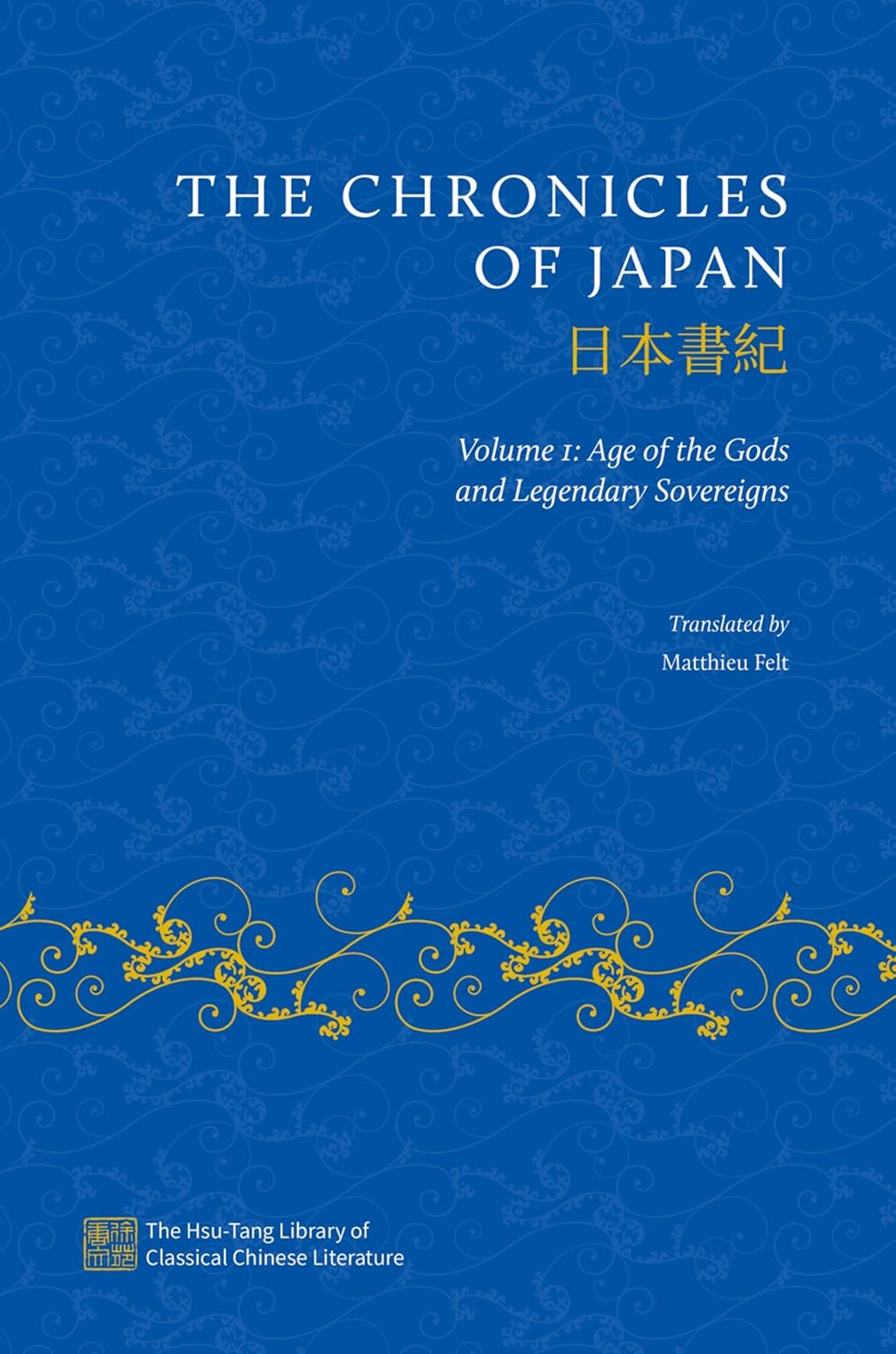
Matthieu Felt (translator). The Chronicles of Japan—Volume I: Age of the Gods and Legendary Sovereigns, Oxford University Press, 2026. 752 pgs.


There is much in Matthieu Felt’s English translation of the Nihon Shoki 日本書紀, or The Chronicles of Japan, to inform, engage, and inspire curious contemporary readers of Japanese cultural history and mythology.
Felt’s scholarship, his gift for accessible English, and his generous compendium of supporting materials offer the attentive reader a sound, critically comparative approach to an ancient story and a people’s first written account of their imperial history.
The Chronicles’ notes are organised sensibly. Tables of names and places and units of measurement are interspersed throughout the text. Simply but skilfully drawn line maps are extremely helpful, even essential, in picturing a Japan far different from that of today. Hokkaido, the Ainu homeland, is not part of this imperial story, for instance. As a kami’s (god’s) relationships are often complicated, and a single Japanese ruler may be known by more than one name, the inclusion of genealogical tables is invaluable.
Facsimile pages of The Chronicles, in classical Chinese and often accompanied by kana explication or commentary, appear within each of the sixteen books in Felt’s Volume I translation. Necessarily longer notes follow the body of the text, together with two appendices, extensive critical endnotes organised by chapter, and an index of key names and places.
)
The Chronicles of Japan is a rich and colourful tapestry, a fascinating national origin story.
The second-oldest book in Japan dating from 720 CE, The Chronicles of Japan is a rich and colourful tapestry, a fascinating national origin story. From threads of rural traditions, folklore, religious beliefs, and practices emerges a mythic past that is then deftly woven and rewoven over the ages with historical cultural practices, military campaigns, and Imperial court events.
First written at the request of the seventh-century Emperor Tenmu, under the direction of his son, Prince Toneri, the book was intentionally composed in literary Sinitic, the canonical language of Imperial China, a literary language that scholars can still read and study today. This script was revered by Japanese scholars and nobles and employed for its high literary status. In addition, cited and uncited sources within the text refer to numerous works from the Chinese Imperial and literary canons.
The Chronicles also contain colourful idiomatic commentary written in vernacular Japanese, annotations, “unusual grammatical constructions, washū 和習”, and passages written in man’yōgana 万葉仮名, an early phonographic system using Chinese characters to represent Japanese sounds. More than 120 poems employing man’yōgana are found in the text.1
)
This book was created to be seen and presented to important visitors, Imperial courts, and foreign dignitaries. Japanese rulers wished to circulate their version of their empire, tracing the historical foundations of their Imperial dynasties back through time to establish a connection to their gods and thus a sanctioned and sacred mandate to rule. This ideology invites comparison with other nation-founding myths. Felt himself has mentioned the Ancient Greeks.2
Scholars, emperors, Shinto adherents, Buddhists, and the military have all left their mark on the book.
Scholars, emperors, Shinto adherents, Buddhists, and the military have all left their mark on the book and offered their interpretations. The Chronicles have flexed through nation-building diplomacy, pride and guile, betrayal, earnest and excellent scholarship, religious rifts, ethnocentrism, and Japanese expansionist nationalism.
Felt is well aware of this. His translation includes copious variations and versions of both myths and historical accounts, as well as citations and influences culled from other cultural traditions known to the Japanese. A single narrative thread? His translation instead celebrates how The Chronicles’ written trail of ever-evolving revisions, additions, citations, borrowings, and blendings has continued to forge a multifaceted, intercultural literary treasure over the centuries.
The Chronicles remain a dragon with many heads.
The myths and histories of the Nihon Shoki remain a source of inspiration and fertile material for contemporary artists. If you can, please visit online two interesting exhibitions inspired by The Chronicles, featuring the artists Ryunosuke Okazaki3 and Kazuyuki Futagawa.4
Footnotes
- “Nihon Shoki 日本書紀 History”, Japan Reference, 2 June 2026. https://jref.com/articles/nihon-shoki-%E6%97%A5%E6%9C%AC%E6%9B%B8%E7%B4%80.1037/ ↩︎
- Poe, Marshall, host. Li Jingyi, episode interviewer. “Matthieu Felt, ‘Meanings of Antiquity: Myth Interpretation in Premodern Japan’ (Harvard UP, 2023).” Episode 142, New Books in Folklore, 25 May 2026. https://podcasts.apple.com/ie/podcast/matthieu-felt-meanings-of-antiquity-myth/id1329243507?i=1000769451506 ↩︎
- “Ryunosuke Okazaki: Oracle”, Hong Kong Wong Chuk Hang Space, 11 January to 19 February 2025, Tang Contemporary Art. https://www.tangcontemporary.com/2025-ryunosukeokazaki-oracle ↩︎
- “The Beautiful Universe of Kazuyuki Futagawa Portraying the Invisible: A New Appreciation Contemporary Japanese and Asian Art”, 23 October, Whitestone Gallery, Japan. https://www.whitestone-gallery.com/blogs/articles-post/contemporary-japanese-and-asian-art-kazuyuki-futagawa ↩︎
How to cite: McDonald, Marsha. “The Many-Headed Dragon: Myth, History, and The Chronicles of Japan.” Cha: An Asian Literary Journal, 25 Aug. 2026, chajournal.com/2026/08/25/age-of-gods.


Marsha McDonald lives in Vilar de Andorinho, Portugal. An artist and writer, she works and exhibits between North America, Europe, and Asia. She has received grants from the Pollock-Krasner, Puffin, Mary Nohl (travel), Lynden Sculpture Garden, Gallery 224 Artservancy (artist working within conserved land in Wisconsin USA), and a New York Fellowship. Her writing has appeared in Otoliths (Australia), The Drum and The Cantabrigian (Cambridge MA), Voice & Verse Poetry Magazine, Cha (Hong Kong), and La Piccioleta Barca (Milan). She has collaborated with artists and writers in the UK, France, Spain, Germany, Portugal, North America, and Japan. In 2024, she will be an arts resident at the Tyrone Guthrie Centre in Ireland and Studio Kura in Kyushu, Japan. Visit her website for more information. [All contributions by Marsha McDonald.]