
茶 FIRST IMPRESSIONS
茶 REVIEW OF BOOKS & FILMS
[REVIEW] “Revisiting Farewell My Concubine: Is Devotion Enough to Keep Art Alive?” by Stella Kwok
Chen Kaige (director). Farewell My Concubine, 1993. 172 min.

Like everyone in the audience, I was just trying to hold on to something beautiful that night.
I’ve watched Chen Kaige’s Farewell My Concubine three times.
The first time, I was a teenager in Hong Kong, mesmerised by the magic of Leslie Cheung in the 1990s. He was gorgeous, multifaceted, at the top of his game. The second time, I was a queer young woman newly arrived in Los Angeles, mourning my own loss of a homeland and Leslie, who jumped from the Mandarin Oriental on 1 April 2003. This July, I went to a screening at Toronto International Film Festival (TIFF) to celebrate the film’s thirty-third anniversary.
Our world is unrecognisable from the one in which the film was released in 1993. Like everyone in the audience, I was just trying to hold on to something beautiful that night.
)

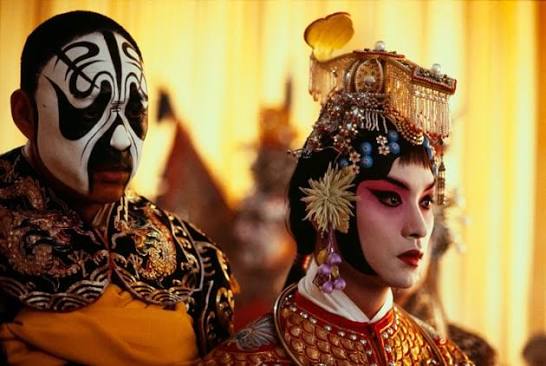
Duan Xiaolou (Feng Xiaogang) and Cheng Dieyi (Leslie Cheung)
The film follows the lives of the Beijing opera duo Duan Xiaolou (Feng Xiaogang) and Cheng Dieyi (Leslie Cheung) over fifty years of Chinese history, from the Republican era to the Cultural Revolution.
The film’s namesake, Farewell My Concubine, is a classic tale about the warrior king Xiang Yu and his devoted consort Yu Ji, who takes her own life as his enemies advance. Central to this story is the concept of “to remain faithful to one until the end” (從一而終). Dieyi, who plays Yu Ji, wants to spend every minute of his life with Xiaolou, who plays Xiang Yu. But Duan Xiaolou is no king, and this film is not just about unrequited queer love.
“Without becoming possessed, one cannot truly live” (不瘋魔不成活) is a Beijing opera saying that suggests an artist must be possessed by their art in order to bring it to life. Dieyi’s devotion to his craft is existential. His constancy makes him both vulnerable and invincible in the eyes of the ruling elites of the time. He takes his rightful place in the spotlight even as audiences grow increasingly disinterested in a traditional art form burdened with old-world values. For the Nationalist army, the opera is treacherous because it pleased the Japanese. For the Revolutionary Youth, Dieyi’s critiques of modern opera and insistence on traditional craft are exclusionary and despicable.
While witnessing the decline of the stage, Dieyi loses Xiaolou to his real-life wife, Juxian, and his leading-lady role to their apprentice, who harbours a revolutionary vengeance. With almost nothing left to lose, he copes by becoming addicted to opium, confessing to treason, and taking a lit match to all his precious costumes. Yet his devotion dictates that one must hold the line, and the sword, until the very last act. When the Red Guards round up the opera troupe for public humiliation during the Cultural Revolution, Dieyi descends upon a trembling Xiaolou to finish his make-up, just as in the old days. Even though we know what an unmasking ceremony entails, we are still stunned by Xiaolou’s spectacular betrayal of the two people who loved him most.
With his make-up smudged and torn sleeves swaying with his stumbling steps, Dieyi lashes out in retaliation, a beautiful ruin in his last act. When all is said and done, Juxian finds him kneeling in a pile of ashes, as though contemplating the aftermath of his own cremation. She might have been the one who hanged herself that evening, but nobody survived that fire. Eleven years later, the duo reunite in an empty stadium. The film concludes with a hand reaching for a blade. Cheng Dieyi fulfils the destiny of Yu Ji: “to remain faithful to one until the end” (從一而終).
)

Farewell My Concubine was the first Asian film to win the Palme d’Or. It is also Leslie Cheung’s most remembered and haunting work because of its devastating parallel with his own life.
“I denounce the riot of brilliant blossoms, I denounce the ruined wells and crumbling walls”
Watching it again in 2026, I found myself asking: how can art endure the new threats of our lifetime? The current ruling elites seem to define craft itself as an obsolete antiquity. When we see rare books being chopped up to feed LLMs and writers being told they can no longer use the em dash (—), do we experience the same rage that made Dieyi scream, “I denounce the riot of brilliant blossoms, I denounce the ruined wells and crumbling walls” (我揭發奼紫嫣紅,我揭發斷井頹垣)?1 As writers, how do we stay loyal to our art when we, too, find ourselves knee-deep in the ashes of humanity?
I have no answer to these questions. All I can hope is that, a few decades from now, someone might still write another review of Farewell My Concubine, an old film based on an old book, inspired by an old opera, about an old war.
Footnote
- “I denounce the riot of brilliant blossoms, I denounce the ruined wells and crumbling walls” (我揭發奼紫嫣紅,揭發斷井頹垣) is a reference to “So the brilliant blossoms have bloomed everywhere, only to be abandoned to ruined wells and crumbling walls” (原來奼紫嫣紅開遍,都付與斷井頹垣) from the Kunqu opera The Peony Pavilion (牡丹亭·驚夢). In this line, the female protagonist laments her own youth and beauty wasted in captivity, comparing her predicament to flowers blooming splendidly among forsaken ruins. I thought the reference was brilliant in capturing Dieyi’s devastation, both in imagery and context. ↩︎
How to cite: Kwok, Stella. “Revisiting Farewell My Concubine: Is Devotion Enough to Keep Art Alive?.” Cha: An Asian Literary Journal, 24 Aug. 2026. chajournal.com/2026/08/24/my-concubine.


Stella Kwok is a third-culture kid raised in Hong Kong, Singapore and Los Angeles. Her writing explores bilingualism, multiple cultural identities and a lifelong pursuit of belonging. She is a writer by night, a product designer by day and a mother at all times. [All contributions by Stella Kwok.]