
茶 FIRST IMPRESSIONS
茶 REVIEW OF BOOKS & FILMS
[REVIEW] “Many Hong Kongs: Xu Xi’s Horizon Hong Kong” by Rebekah Chan

Click HERE to read all entries in Cha
on Horizon Hong Kong.
Xu Xi. Horizon Hong Kong: Selected Stories, Gaudy Boy, 2026. 288 pgs.
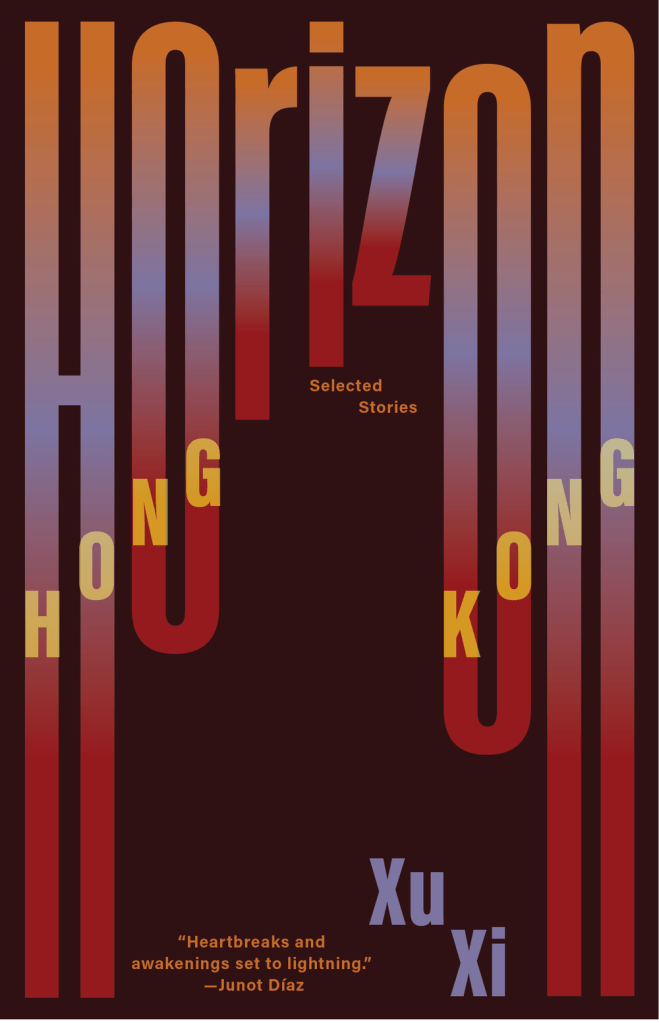
Xu Xi’s latest collection of short stories transported me across time, class, and borders into Hong Kong worlds that I could never inhabit within a single lifetime.
Upon reading the opening pages of this book, I realised how little I knew about Hong Kong, where my children were born, my parents grew up, and my grandparents fled to during the 1940s. Yet these experiences and stories are limited to one family’s heritage and perspective. Xu Xi’s latest collection of short stories transported me across time, class, and borders into Hong Kong worlds that I could never inhabit within a single lifetime.
I first came to know Xu Xi through my Master’s programme in Creative Writing. She was the programme director, and it was under her vision and guidance of Asian writing that I became a writer. During my time as her student, I came to understand her distinctive positionality as a Chinese-Indonesian Anglophone writer who was born and raised in Hong Kong. Xu Xi describes this as an outsider-insider perspective,1 or what is now more commonly known as being a Third Culture Kid.2
Her vantage point of being both from Hong Kong and at a distance from it enables her to capture a remarkable range of identities across twenty-two stories drawn from five collections and forty years of publishing. Her characters coexist and collide within a condensed space, much like the short-story form itself. For example, her shortest story, “The Transubstantiation of the Ants”, spans a mere three pages and features ants, butterflies, and boars in a playful reimagining of the 1997 Handover.
)
On the opening page, “Democracy”, Xu Xi references the Star Ferry Riots of 1966 and a man who “staged a hunger strike to protest the proposed Star Ferry fare increase”. While this event marked a flashpoint in civic activism that led to wider grievances against British colonial rule, the story centres on two classmates and an election for the nineteenth Kowloon Girl Guides Company’s first Company Leader.
The story is political in the way it explores how decisions are made and how power is distributed between Maria, who lives in a one-hundred-square-foot flat with her factory-working parents, and Patricia, whose father is educated and works as a civil servant. As the plot unfolds, Xu Xi invites us to question the difference between perceived and genuine self-determination, power, and privilege.
Although the book refers to events such as the Star Ferry Riots, the Handover, the appointment of a new Chief Executive, Occupy Central, and the Umbrella Revolution, historical significance is never imposed upon the reader. In “Insignificant Moments in the History of Hong Kong”, the story unfolds as a diptych of eateries. A waiter, Yam Kuen, visits his uncle’s local restaurant on 30 June 1997, the day before the Handover, juxtaposed with the exclusive private club where he works on the evening of 1 July 1997. Meanwhile, the Handover itself is simply referred to as the “homecoming” by Yam Kuen.
}
There are no easy resolutions tied up with pink bows in these stories. Instead, the collection lays bare desire, prolonged discomfort, and the consequences of complex relationships. In “Famine”, weeks after her parents die, a Chinese daughter attempts to escape a lifetime of filial piety by boarding a business-class flight to New York for a multi-day feast at the Plaza Hotel. The indulgence becomes a necessary comfort, or perhaps a physical distraction from the thoughts that continually draw her back. In stories such as “Anon.”, “Iron Light”, and “Off the Record”, lust and emotional connection drive characters who may find momentary relief, but never satisfaction, by the time the story ends. It is as though something always remains just beyond their reach.
Xu Xi’s Hong Kong is the opposite of romanticised and tends towards noir.
Xu Xi’s Hong Kong is the opposite of romanticised and tends towards noir. Her stories frequently look back upon a real or imagined Hong Kong through a lens of resignation and fatalism. Her protagonists are likewise outsiders: a young girl navigating adult problems in “Chungking Mansions”; a foreign student in New York State attempting to appeal a cancelled visa in “Citizenship”; or, in “Rubato”, a Hong Kong woman visiting San Francisco for the first time while reflecting upon the differing cultural freedoms of Asian Americans and local Chinese in Hong Kong. There is an underlying sense of alienation and estrangement from their surroundings.
Even when her characters are from Hong Kong and remain in Hong Kong, Xu Xi’s particular gift lies in revealing how people can become estranged from the families, classmates, culture, homelands, and even identities to which they are supposedly connected. This is especially evident in “All About Skin”, in which a Chinese woman recounts, at great length, the history of the different “skins”, or identities, that she acquires in a hilariously absurd tale.
)
While Xu Xi’s prose remains unflinchingly stoic as it guides us through the grittier corners of the human psyche, I found myself laughing at the same deadpan delivery in her speculative stories, particularly “Monkey in Residence” and “All About Skin”.
Not every book leaves its reader with a sense of resolution or optimism. The achievement of Horizon Hong Kong lies instead in its power to provoke. It quietly unsettles familiar ways of seeing Hong Kong, and reveals how the city’s fast-moving history filters into the lives of its people, whether they themselves change or not.
Rather than offering the sweet nostalgia for Hong Kong that so many now long for, Horizon Hong Kong presents raw, unfiltered snapshots of how things were, or how they might have been. It looks back without sentimentality and without regret.
- Blumberg-Kason, Susan. “The Condition of Colonialism: A Conversation with Xu Xi Undomesticated.” The Condition of Colonialism: A Conversation with Xu Xi, UNDOMESTICATED, www.undomesticatedmag.com/blog/xu-xi-responsible-travel-writing. Accessed 17 July 2026. ↩︎
- Mayberry, Kate. “Third Culture Kids: Citizens of Everywhere and Nowhere.” Third Culture Kids: Citizens of Everywhere and Nowhere, BBC, 18 Nov. 2016, www.bbc.com/worklife/article/20161117-third-culture-kids-citizens-of-everywhere-and-nowhere. ↩︎
How to cite: Chan, Rebekah. “Many Hong Kongs: Xu Xi’s Horizon Hong Kong.” Cha: An Asian Literary Journal, 4 Aug. 2026, chajournal.com/2026/08/04/many-hong-kongs.


Rebekah Chan is from Toronto and has also lived in Singapore, Tokyo, and Hong Kong, where she completed her MFA at City University in Hong Kong. While in Hong Kong she served as Editor-in-Chief for her MFA legacy anthology, Afterness: Literature from the News Transnational Asia, and held the position of Community Manager for the Hong Kong Writers Circle. In Japan she wrote for the lifestyle magazine Tokyo Weekender. Her literary work appears, or is forthcoming, in Tupelo Quarterly, Blood Orange Review, Wild Roof Journal, Reed Magazine, and more. Rebekah is currently based in Toronto and writes about loss and belonging. Her writing is also supported by the Canada Council for the Arts. You can find her at @bx_writenow on Instagram. [All contributions by Rebekah Chan.]
 Cha
Cha 