
[FICTION] “The Room After the Typhoon” by Christian Wilken

Christian Wilken on “The Room After the Typhoon”: “The Room After the Typhoon” began with a memory from my year as an exchange student in Okinawa, from 2013 to 2014: the peculiar stillness after a typhoon, when the storm has passed but the ordinary world seems subtly rearranged. During typhoon season, loose objects are brought indoors, windows secured, food stocked, and people wait. Afterwards, familiar streets and rooms can feel both intact and newly strange. I became interested in the idea that a room might preserve that sensation: holding objects displaced not only by wind, but by time.
Although the story is not autobiographical, its emotional world draws on my later life in a German-Japanese family and on becoming the father of a bilingual daughter. Parenthood has made me unusually conscious of ordinary objects as accidental archives: socks, toys, picture books, hair clips, and the small things one tries to save because childhood changes faster than expected. The narrator’s urge to record and preserve his daughter’s life comes partly from that experience, as does the story’s question of whether preservation can itself become another form of loss.
Okinawa is significant to the story not simply as a setting, but as a place where weather, architecture, mobility, and memory meet. Its concrete apartment buildings, humid climate, powerful storms, and the experience of living there temporarily as a foreign student all helped shape the story’s atmosphere. The protagonist returns years later with a family that did not exist during his first stay. That return allowed me to imagine the past as a room unknowingly inhabited by the future.
At heart, the story asks whether love can move backwards as well as forwards in time. The objects that appear in the room are less clues to a puzzle than evidence that the narrator’s younger, lonelier self was never entirely alone. I wanted the final moment to remain deliberately small: not a revelation that conquers time, but a father choosing to watch his daughter rather than immediately turning the moment into another image to be preserved.


The Room
After the Typhoon
by Christian Wilken
Secure all loose objects before the storm.
After the third typhoon, there was a child’s yellow sock beneath my desk.
It was dry, although rainwater had crossed the balcony and gathered beneath the window in a shallow grey line. Leaves were pasted to the outside of the glass. The room smelled of wet concrete, rust and the food in my refrigerator beginning to warm.
I lived alone on the fifth floor. The balcony door had been locked since the warning sirens began, and no child had ever entered the apartment.
The sock was small enough to fit into my palm. Its yellow had faded unevenly, and near the ankle was a pale orange stain. I held it by the elastic and checked the space beneath the desk as though another child-sized object might explain it.
Nothing else was there.
The electricity returned shortly after noon. First the refrigerator coughed itself awake. Then the air conditioner clicked without starting. Down in the car park, the vending machine began to hum. The sound was so ordinary that it made the wreckage along the road seem temporary: palm fronds, sections of guttering, a blue plastic crate lodged beneath the wheels of a parked car.
I took the sock downstairs to Mrs Higa.
She managed the building from a small room beside the entrance, though it was difficult to tell where the office ended and her home began. Slippers stood beside the filing cabinet. A rice cooker occupied the shelf beneath the mailboxes. She was placing towels around a leak in the ceiling when I showed her what I had found.
“A child’s?” she said.
“I think so.”
She looked at the sock, then at me.
“Not yours?”
I had enough Japanese to understand that she was making a joke, but not enough to answer quickly. By the time I laughed, she had already turned the sock over in her hand.
“There are no children on your floor,” she said. “Maybe it was there before.”
“I cleaned under the desk yesterday.”
“You cleaned before a typhoon?”
“I had nothing else to do.”
This seemed to confirm something she had suspected about me.
She handed the sock back. “Then the storm cleaned after you.”
She did not mean anything by it. Mrs Higa blamed the weather for everything in the building: the swollen doors, the insects in the stairwell, the smell inside the cupboards, the television losing colour whenever it rained. A storm did not need to be supernatural to rearrange your life. It only needed to find what had been badly secured.
I returned upstairs and placed the sock in the lowest drawer of my desk.
For the rest of that year, whenever the wind began pressing against the glass, I checked that the drawer was closed.

The second object was a plastic whale.
It appeared after a storm that passed during the night. By morning the sky was a hard, polished blue, and the road outside steamed as if the island had been placed beneath glass.
The whale stood upright on the windowsill.
It was no longer than my thumb. One painted eye was larger than the other, and a scratch ran across its blue back. It looked like something from a capsule machine, the kind of object children wanted intensely for three minutes and adults later found beneath furniture.
I checked the window latch. I checked the balcony. I looked behind the curtains and beneath the bed.
The blue pen I had left beside my notebook was gone.
There was nothing remarkable about the pen. I had bought a pack of three at the university shop. I searched for it because losing things in the room had begun to feel like an accusation. The apartment was barely large enough to misplace anything. There was a bed, a desk, two narrow cupboards and a kitchenette I could cross without taking a full step.
I emptied my bag. I moved the desk. I looked inside the refrigerator, though I knew I had not put it there.
The pen did not return.
I placed the whale beside the sock.
After the next storm, I found a torn page from a picture book inside the bathroom.
On one side, a whale surfaced beneath Japanese text. On the other, the same picture appeared beneath three lines of German. Water had blurred the ink along the torn edge, but the page itself was dry.
My old bus ticket disappeared that day.
I had kept it from my first week in Okinawa, when I still misunderstood the routes and once travelled nearly to the end of the island before realising I had boarded in the wrong direction. The ticket had remained tucked inside the clear pocket of my wallet for months. I liked the faded numbers and the strip of pink along one edge. It proved there had been a morning when I knew so little that every stop sounded plausible.
After the storm, the pocket was empty.
By then I had begun making a list.
I wrote down the date, the time at which the storm warning had been lifted, the approximate location of each object and whatever had gone missing. I recorded the humidity because it seemed scientific. I copied the names of the typhoons from the television reports. When I could not remember whether the whale had faced into the room or towards the window, I added both possibilities.
The list embarrassed me, so I hid it behind a stack of language textbooks whenever anyone visited.
Only once did I tell another student.
We were waiting outside a classroom while rain moved across the campus in a white sheet. He was leaving Okinawa the following week and had already entered the state in which every inconvenience became precious. He photographed vending machines. He spoke fondly of humidity.
I told him about the sock, the whale and the picture-book page.
“So your apartment is trying to give you a family,” he said.
“It has also taken my pen.”
“Families do that.”
He laughed. I did too.
The remark stayed with me longer than the conversation.
The final object appeared in November, after a storm that did little more than shake the balcony railings and knock over the bicycles outside the convenience store.
It was a silver hair clip, slightly bent at the centre.
My room key disappeared at the same time.
I noticed the key was gone when I tried to leave for class. I had locked the door the previous evening and placed the key in the ceramic dish beside the sink. The dish was empty.
I searched until the lecture had already begun. Then, angry with myself and the room, I pulled open every drawer.
The key lay beneath the yellow sock.
That was the first time I considered throwing the objects away.
Instead, I put the hair clip beside the whale, closed the drawer and placed a strip of tape across it.
Before leaving Okinawa the following spring, I packed the sock, the whale, the page and the hair clip into a small cardboard box. I put my list on top and sealed the box with two layers of tape. It went into my suitcase between a folded jacket and several books I had bought because I could not imagine finding them in Germany.
When I unpacked, the box was gone.
I told myself I had left it in the desk.
For years, that was the only explanation I permitted.
Mrs Higa emailed me twelve years later.
The message arrived while I was labelling photographs of my daughter.
I had taken forty-three that morning, most of them before breakfast. Mio had been sitting on the kitchen floor in her pyjamas, arranging wooden animals into groups whose principles she refused to explain. I saved the pictures by year, month and date. Audio recordings went into separate folders. Beneath those were documents in which I listed words she had begun using, words she had stopped using, and expressions that belonged neither entirely to German nor Japanese.
My wife said I was building an archive of things still happening.
The email subject line contained the name of the apartment building.
For several seconds I did not open it. The building had existed more reliably in memory than most places I still visited. I knew the colour of the stairwell after rain. I knew which balcony rail rattled in strong wind. I knew the black mark on the wall beside the mailboxes where someone had once parked a motorbike indoors.
Mrs Higa wrote that the building had been sold and would be demolished before the end of the summer. During the clearance, workers had removed the built-in wardrobe from my former room. Behind it, they had found a small box bearing my name.
She attached a photograph.
The cardboard had darkened with damp. My surname was written in Japanese on one side. Across the lid, in my handwriting, was the name of a tea shop in Naha where I had once intended to apply for a part-time job.
I showed the photograph to Yuka.
“You wrote your name on a tea-shop box?”
“I reused things.”
“You kept bus tickets.”
“That was different.”
She enlarged the photograph with two fingers. “Did you know it was there?”
“No.”
“Do you want her to send it?”
I looked again at the box. One corner had collapsed. Something blue showed through the gap.
“We’ll be in Japan next month,” I said.
Yuka glanced at me. “We’ll be in Kobe.”
“We could add Okinawa.”
“We have a four-year-old.”
“She likes planes.”
“She likes the idea of planes.”
From the other room Mio called something in German, then repeated it in Japanese when neither of us answered.
Yuka locked the phone and handed it back.
“You’ve wanted to go for years,” she said. “We can go.”
I thanked her too seriously, which made her suspicious.
“You know it won’t be the place you remember.”
“I know.”
“You say that now.”
Mio loved the monorail.
She stood at the window and announced every road, roof and car park as though she had discovered them. She liked that the tracks rose above the city and curved between buildings. She did not care about the sea, the university or the places I had planned to show her.
At the station shop she persuaded Yuka to buy her a capsule toy. The machine offered six possible sea animals. She wanted the pink turtle and received a blue whale.
“It has a strange eye,” Yuka said.
The painted eyes were different sizes.
Mio pressed the whale against the window for the rest of the journey, making it swim above traffic.
I took twelve photographs.
On our first morning, she spilled orange juice on one sock.
Yuka rinsed it in the hotel sink and draped it over the edge of the bath. By the time we left, the stain had faded but not disappeared.
The weather report showed a typhoon moving north-east of the island. It was not expected to make landfall. There would be wind and heavy rain, but nothing unusual for the season.
I had learned as a student that “nothing unusual” could include schools closing, supermarkets selling out of bottled water and every bicycle in the neighbourhood being laid carefully on its side.
We took a bus to the district where I had lived.
The route had changed. Or I had remembered it incorrectly. I pointed out a shop where I used to buy dinner, then realised it now stood on the opposite side of the road from where I had placed it in every story.
“That can’t be it,” I said.
“It has the name you told me,” Yuka said.
“The building was lower.”
“Maybe it grew.”
Mio, sitting between us, held the whale to her ear as though listening to it.
When we got off the bus, I could not immediately find the street.
A pharmacy occupied the corner where I remembered an empty lot. New apartment blocks had risen between the older buildings. The road seemed narrower than it had in my mind, the slopes less steep, the distances almost insulting.
Yuka watched me turn twice beneath the same traffic mirror.
“Every time you told me about this place,” she said, “the room got smaller and you got younger.”
“The room was small.”
“You made it smaller.”
“Why would I do that?”
“So the person inside would seem larger.”
I looked at her.
She smiled, but not enough to withdraw it.
Mio had crouched beside a drain to watch rainwater carry a leaf beneath the pavement. I took out my phone.
“You already have that picture,” Yuka said.
“The light is different.”
“Mio isn’t.”
At the sound of her name, our daughter looked up.
“Papa,” she said, “fertig?”
I put the phone away.
The building stood at the end of the next street.
Its paint had once been cream. Now whole sections had darkened to the colour of soaked cardboard. Green mesh covered the lower balconies, and orange demolition notices had been taped across the entrance.
It was smaller than I remembered.
Mrs Higa waited beneath the awning with three umbrellas.
Her hair had become white, but she wore the same kind of loose house slippers. For a moment I expected her to look through me, to recognise only the young foreign student who had left twelve years earlier and not the heavier man standing with a wife and child.
Instead, she said my name immediately.
Then she looked at Mio.
“So,” she said, “the storm was right.”
I was unsure whether she remembered the sock.
Before I could ask, she crouched and showed Mio how to make the plastic whale jump between the paving stones.
The room was on the fifth floor, though by the second landing I had begun to doubt even that.
The stairwell smelled of concrete dust and old detergent. Several apartment doors had already been removed. Exposed wires hung from the ceiling where the lights had been taken down.
Mrs Higa unlocked my former door and pushed it with her shoulder.
The room resisted, then opened with a scrape.
The first thing I noticed was the missing wardrobe.
The second was how little space remained without it.
A pale rectangle showed where my desk had stood. Rust spread beneath the air-conditioning unit in the shape of a river delta. The kitchen cupboards were open and empty. Beyond the balcony, a newer building blocked most of the view.
Mio walked to the centre of the room and turned around once.
“You lived here?”
“Yes.”
“Alone?”
“Yes.”
She considered this.
“Why?”
Yuka laughed.
Mrs Higa set the box on the floor.
“We found it here,” she said, pointing to the space behind the missing wardrobe. “No one could have reached it without taking everything apart.”
The tape had come loose. I lifted the lid.
These were not the things I had packed.
Inside lay my blue pen.
The plastic casing had yellowed, and the ink had dried near the tip. Beneath it was the photograph from my student card, creased across the forehead. My old bus ticket had curled into itself. At the bottom of the box lay the room key and the notebook in which I had recorded what the storms left behind.
I picked up the photograph.
My younger face looked impatient with the camera. I remembered believing that expression made me appear independent.
Yuka looked over my shoulder.
“You had more hair,” she said.
“I was standing in stronger light.”
“That must be it.”
Mrs Higa went downstairs to speak to one of the demolition workers. She told us not to remain long. The rain was beginning, and the roads would be worse near the coast.
It struck the balcony door before she reached the second landing.
Mio ran to the window.
The sky had disappeared behind rain. The new building opposite became a grey surface, then vanished entirely. Wind pressed water through the warped frame, and droplets gathered on the floor.
“The weather report said evening,” Yuka said.
“The weather report was wrong.”
“You’re enjoying this.”
“I’m not.”
“You are a little.”
The outer bands passed in violent intervals. Rain hammered the building for several minutes, weakened, then returned from a different direction. The balcony railing began to rattle.
Mio sat on the floor to remove her shoes.
Her left sock was wet. She pulled it off and placed it beside the pale rectangle where my desk had stood.
The sock was yellow.
Near the ankle was a pale orange stain.
I knew the stain before I knew the sock.
Yuka was closing the balcony door more firmly. Mio spoke to her, but I could not hear the words above the rain.
I stared at the sock.
The colour was slightly brighter than I remembered. Or perhaps memory had faded it. The elastic was folded in the same way. A loose thread extended from the heel.
I crouched.
“Papa?”
I touched the fabric.
It was wet.
Mio had already lost interest. She was making the whale travel along the edge of the empty kitchen counter.
I opened the notebook from the box. The paper had buckled in the damp. My list began with the date of the third typhoon.
Yellow sock. Dry. Beneath desk.
The whale struck the wall and fell.
It rolled across the floor, turning blue and white, and stopped against the skirting board.
One eye was larger than the other. A scratch crossed its back.
I did not move.
Yuka took the bilingual picture book from her bag. She had brought it for the bus journey, though Mio had refused to look at it until now. The cover showed a small whale beneath a moon.
Mio reached for the book without releasing her toy. The page caught between her fingers.
It tore.
She looked at Yuka, waiting to learn how serious this was.
“It’s all right,” Yuka said. “Give it to me.”
A current of air passed through the room.
The torn page lifted from Mio’s hand, crossed the floor and slid beneath the open bathroom door.
I followed it.
The page lay beside the drain. On one side, a whale surfaced beneath Japanese text. On the other, the same picture appeared above three lines of German.
Behind me, Yuka was tying back her hair.
She removed the silver clip she had been wearing and placed it on the windowsill.
It was bent slightly at the centre.
For twelve years I had believed the room contained the belongings of someone who had lived there before me. A previous tenant, a child who had visited, a family whose presence had remained lodged behind the furniture.
Standing there with Yuka and Mio, I understood that the family I had imagined behind the objects had been us. My family had entered the room before I knew they existed.
The sock beneath my student desk had belonged to my daughter. The hair clip had come from the woman I had not yet met. I had kept their objects in a drawer while imagining myself alone.
The building shuddered.
The bathroom door slammed.
Mio began to cry.
Her whale was gone.
We searched the floor, though there was nowhere for it to be. Yuka looked beneath the kitchen cabinet. I moved the box, the torn sections of skirting board, the books we had placed beside the wall.
The sock had disappeared too.
The page was no longer in the bathroom.
Yuka went to retrieve her hair clip from the windowsill and found only water.
“That’s strange,” she said.
I had no answer that would not sound like an explanation I had invented years too late.
“Papa,” Mio said. “My whale.”
“We’ll find it.”
“It was here.”
“I know.”
She stood with one bare foot on the concrete, furious at the room.
Yuka knelt and pulled her close. Mio resisted for several seconds before allowing herself to be held.
I returned to the space where the wardrobe had stood.
A section of skirting board had detached from the wall. Behind it was a narrow recess filled with dust, plaster and the bodies of small insects.
Something pale green caught the light.
I reached inside and removed a pair of reading glasses.
They were inexpensive, the kind sold beside medicine and batteries. One arm had been repaired with purple thread. The lenses were scratched.
Inside the right arm, someone had carved a name.
MIO.
The letters were small and uneven, cut with the point of a pin or knife. Not a child’s label written by a parent. A mark made by someone old enough to expect her belongings to go missing. I imagined her old, standing at a crossing with the rain silvering her hair, waiting for the light to change. There would be years of her life, perhaps many, in which I would not be there to take her hand.
The glasses were almost weightless in my palm.
I held the glasses towards the window.
The prescription was stronger than mine.
They might have belonged to another Mio. They might have been placed there by a worker, a tenant, a visitor. Other lives had passed through the room before and after mine.
But I knew.
I could take them with me.
At the hotel, I could photograph them properly. I could search the manufacturer, compare the frame to current models, examine the thread, the scratches, the oils left on the arms. I could ask an optician to estimate the prescription.
I could begin another list.
Yuka appeared beside me.
“What did you find?”
“Nothing that belongs to us yet,” I said.
She looked at me, then at the gap behind the wall.
I returned the glasses to the recess and replaced the skirting board.
Yuka did not ask again.
The rain weakened as suddenly as it had begun.
Mrs Higa called from downstairs that the road was still open but would not remain so for long. We gathered the book, the box and Mio’s shoes.
Mio had only one sock.
Yuka checked her bag, then the bathroom.
“Leave it,” she said. “It’s only a sock.”
I saw it beneath the pale rectangle where the desk had stood.
The fabric was dry now.
I could have picked it up.
Instead, I pushed it further beneath the edge of the wall with the toe of my shoe.
Somewhere behind me, my younger self was waiting for the electricity to return.
Outside, the rain had softened to a warm mist.
Mrs Higa locked the building behind us. She gave Mio a small packet of tissues printed with cartoon flowers. Mio accepted them solemnly, though she was still grieving the whale.
At the bus stop, Yuka asked whether the box contained what I had expected.
“I didn’t know what I expected.”
“Did you find your list?”
“Yes.”
“Will you keep it?”
I looked down at the box. The damp cardboard had begun to collapse against my fingers.
“For now.”
Yuka nodded. That was more agreement than the answer deserved.
The bus was delayed, so we walked towards the next stop.
Water rushed along the gutters. Palm leaves trembled above the walls. Somewhere a machine was pumping rain from a flooded car park, and the air smelled of petrol, salt and broken vegetation.
Mio walked between us with one bare foot inside her sandal.
At the corner she pulled her hand from mine and jumped into water deep enough to cover both shoes. She landed awkwardly, steadied herself, and stood there without reaching back for my hand.
I reached for my phone, then stopped.
She turned to see whether I had watched.
I had.
How to cite: Wilken, Christian. “The Room After the Typhoon.” Cha: An Asian Literary Journal, 13 Jul. 2026. chajournal.com/2026/07/13/the-room.

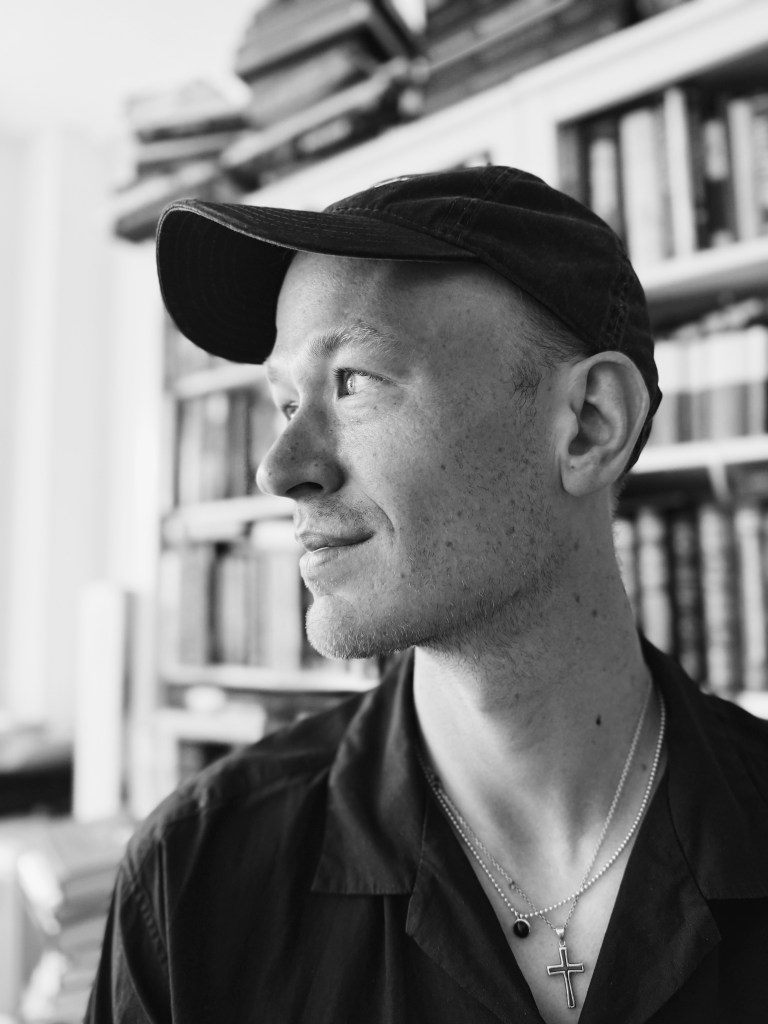
Christian Wilken is a German writer and scholar of modern English literature and media at Heinrich Heine University Düsseldorf. He studied Japanese Studies, spending 2013 to 2014 at the University of the Ryukyus in Okinawa, an experience that continues to shape his writing on place, memory, and transnational family life. His academic publications include Reading Lovecraft in the Anthropocene: A New Dark Age (Routledge, 2025) and essays on Gothic literature, religion, film, animation, and video games. He lives in Germany with his Japanese wife and their daughter. “The Room After the Typhoon” is his first published work of fiction.
 Cha
Cha 