
茶 FIRST IMPRESSIONS
茶 REVIEW OF BOOKS & FILMS
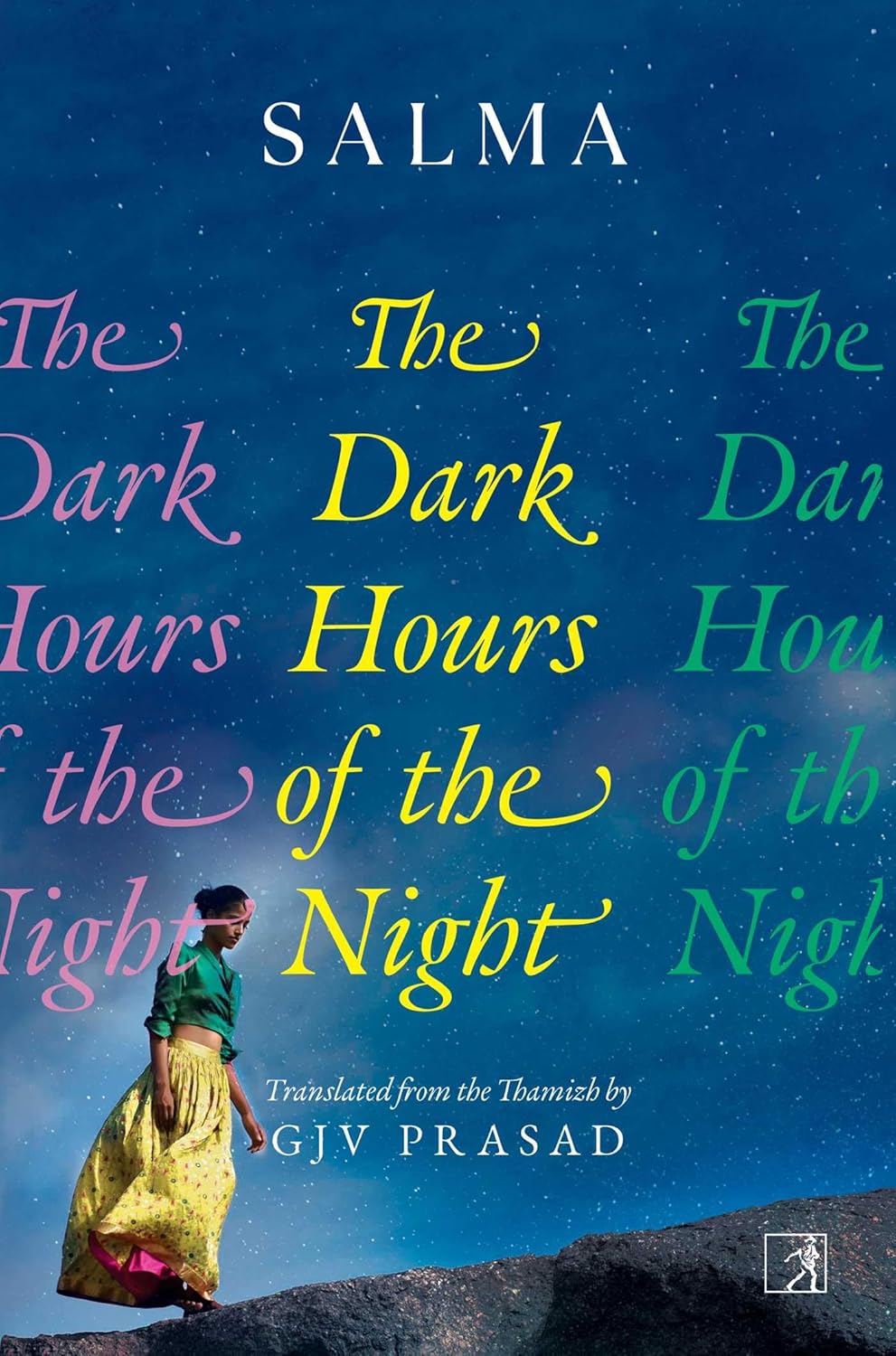
[REVIEW] “The Forbidden Desires of Women: Salma’s The Dark Hours of the Night” by Fathima M
Salma (author), GJV Prasad (translator). The Dark Hours of the Night, Simon & Schuster, 2025. 392 pgs.

I was able to read this novel because it was translated into English. Since translation and translators are so often overlooked, I have chosen to begin this review by considering the quality of the translation itself. The Dark Hours of the Night was originally written in Thamizh, and this new translation by GJV Prasad enables us to delve into this significant work through its sheer brilliance. It is interesting that this is not the first translation of the novel: Lakshmi Holmstrom was its first translator, under the title The Hour Past Midnight. This is significant, for it shows that translation is never a linear process, but is as creative an endeavour as any other.
There is nothing more threatening to patriarchy than women who express their desires.
When the desires of women are voiced, they become stories of longing, frustration, silence and oppression, among other things. There is nothing more threatening to patriarchy than women who express their desires and are unafraid to live and tell their stories. Hence, one of patriarchy’s tools is the silencing of women through physical, emotional and sexual suppression. Salma’s novel, The Dark Hours of the Night, unleashes the joys, pains and longings of women in highly patriarchal Muslim families in a small South Indian town.
The novel reveals that patriarchy does not function in a single, linear way.
The novel follows the life of Rabia, a young girl in a small town in Tamil Nadu. The household and the surrounding families are conservative. The men are sometimes religious but always conservative. The novel reveals that patriarchy does not function in a single, linear way. The image of the sit-at-home woman who runs the house and the man who earns money to support it is but a surface-level picture of patriarchy. Behind this facade lies a woman who has forgotten her own humanity, having devoted her life entirely to the running of the household and the raising of her family. It is equally intriguing how women themselves become carriers of patriarchy, even after being victimised by the very same system of oppression.
There are stories within stories, the central and saddest of which concern arranged marriages. That women are forced to marry men not of their choosing is grotesque, yet it remains a living reality. Despite all the development in the world, women’s continued fight for personal autonomy remains a sad but lived reality in many parts of the world.
Zohra is a strict mother and, just like any other mother in a patriarchal system, keeps a sharp eye on her daughter. She wants to ensure that Rabia is trained (read brainwashed) to become a submissive and obedient Muslim woman, well-versed in household chores and Quran lessons. Zohra represents everything that patriarchy expects from women, and that is everything that is wrong with such expectations. There are parallel stories of women trapped between social norms and personal happiness. What is equally disturbing is how women themselves become agents of patriarchy, at times without realising it. Young girls are not allowed to go to the cinema or talk to boys, yet men enjoy complete freedom, including sexual freedom. Marriage holds different meanings for men and women; given the context of the novel, it resembles glorified slavery for women.
A woman not empowered enough to look after herself is forced to remain in a loveless or abusive marriage.
The novel allows readers to look at the mundane aspects of women going about their everyday lives. It is within this mundane routine that one finds how deeply patriarchy is embedded within their lives. Zohra, despite being a strict mother, is a mute spectator when it comes to her own personal life. Her husband maintains an open relationship with a woman from another community and a lower caste, of which she is aware. And yet, she has neither the voice nor the means to leave her marriage. This demonstrates that leaving a marriage also requires agency. A woman not empowered enough to look after herself is forced to remain in a loveless or abusive marriage. Patriarchy strips women of that dignity and leaves them with little or no choice. Things do not change much with time: this legacy of marrying for the sake of family honour is passed down to the next generation, and the vicious cycle continues.
“The Dark Hours of the Night” has a special relevance in Islam. The darkest hour is said to be the most intense of the night, when prayers are most likely to be heard and the world is quiet. Some sources suggest that it is the last third of the night, a time that allows a deep bond with the Creator. In the context of the novel, this signifies the self coming to terms with itself during the most intense and quiet hour of the night. It is the women in the novel who realise that their desires remain unfulfilled in the name of family honour. These women come to terms with their desires through self-realisation. At times, they even pay a heavy price for this. It is a powerful novel that depicts not only the vulnerability of women across social classes but also their strength and resistance.
How to cite: M. Fathima. “The Forbidden Desires of Women: Salma’s The Dark Hours of the Night.” Cha: An Asian Literary Journal, 11 Jul. 2026, chajournal.com/2026/07/11/karbala.


Fathima M teaches English literature in a women’s college in Bangalore, India. She likes hoarding books and visiting empty parks. [Read all contributions by Fathima M.]