
茶 FIRST IMPRESSIONS
茶 REVIEW OF BOOKS & FILMS
[FIRST IMPRESSIONS] “Living and Dying in Fung Hon Shing’s Life (cycle) of the Hong Kong Newt” by Vanessa Winghei Yeung
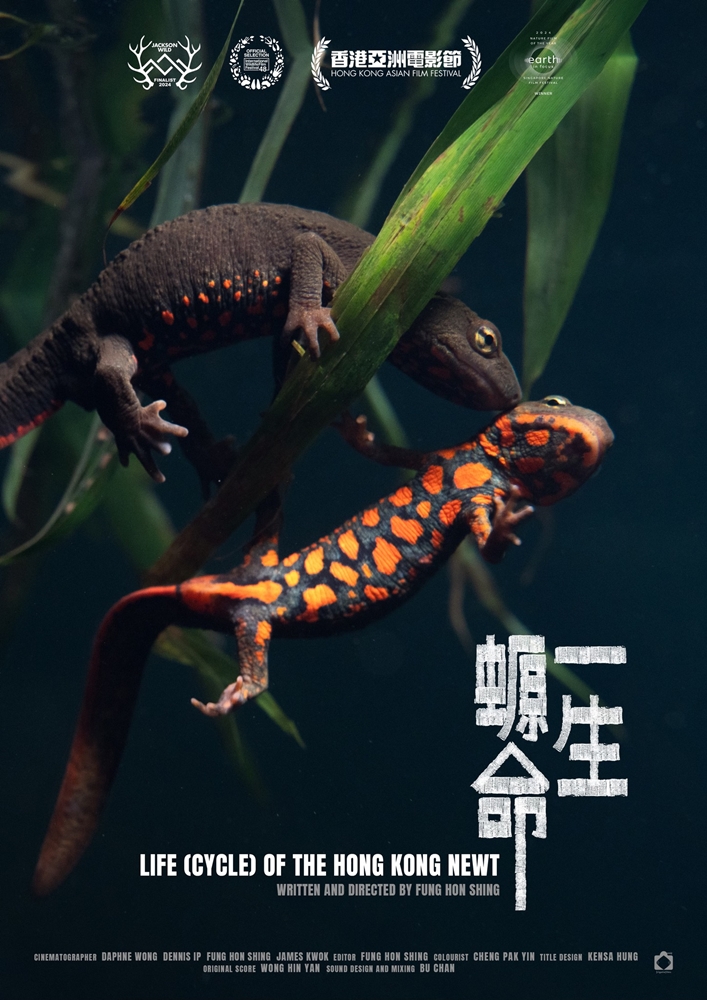
Fung Hon Shing (director). Life (cycle) of the Hong Kong Newt 一生螈命, 2024. 9 min 51 s

A natural history documentary without narration, Fung Hon Shing captures the essence of life: adaptability, brevity, and an element of randomness. In just under ten minutes, viewers are given the privilege of following Hong Kong newts’ trajectories both underwater and on land.
The film begins with a medium shot of a dark irrigation channel with cascading water, the temporary residence of a Hong Kong newt. Slowly crawling across concrete surfaces, it moves towards the flowing stream. The water’s restlessness drags the Hong Kong newt into an unexpected journey.
In the underwater shots, which consist mostly of close-ups, the director offers a condensed version of the beginning of the life cycle, namely mating and egg laying. Golden Horse Award-winning musician Wong Hin Yan’s score is intense, employing various percussion instruments to evoke the sounds of religious ritual. Time-lapse is used in shots demonstrating the newts’ growth.
One intriguing, magnified shot captures a procession of tiny blood cells traversing the fragile, transparent, still-maturing bodies of the newts. Eventually, baby newts break through the eggs, revealing to viewers how markedly different they appear from their adult form.
The following scenes are accompanied by light piano notes and string instrumentation, perhaps evoking a sense of curiosity and playfulness. As soon as the baby newt begins navigating this unfamiliar world, it also becomes a predator, immediately learning to catch tiny animals for food. An out-of-focus shot blurs a baby newt’s face, with the light source coming from above, signifying the beginning of a new life. It also leaves viewers with a chilling, alien impression, while underscoring the anonymity of the Hong Kong newts.
)
As much as life is about living, it is equally about dying. In the climax, a highly effective scene consists of a high-angle shot showing the road marking “SLOW”. This is followed by a close-up of a lifeless body, its organs exposed, lying upon the upper tip of the “W”. Absent from the sockets are the gem-like eyes so often featured in the earlier minutes of the film. Instead, an unidentifiable greyish-white, oval-shaped internal organ is exposed. Its stillness tricks the audience into believing life has ended, yet a twist follows.
An underwater shot shows a newt swimming through ripples, set against a backdrop of clear sky and abundant leaves stretching from the branches beneath warm sunlight. Towards the end, a similar scene appears. This time, however, fog envelops the leaves and the sky lies overcast. No newts are swimming. The similarities in visual composition symbolise not only the Hong Kong newts’ life cycle, but also that of human beings. The setting remains the same, simple: time passes, events happen, things in the same place change, and we live another day. Eventually, one day, it is simply done. One day, it just ends, without our even knowing. Living and dying are not separate processes.
How to cite: Yeung, Vanessa Winghei. “Living and Dying in Fung Hon Shing’s Life (cycle) of the Hong Kong Newt.” Cha: An Asian Literary Journal, 7 Jul. 2026, chajournal.com/2026/07/07/newt.


Vanessa Winghei Yeung is a steward at Glasgow Cathedral and a waitress at one of the city’s historic Italian restaurants. She is a co-author of Hong Kong Art Deco Architecture: Unveiling the Hidden Heritage (CUHK Press, 2026). She has lived in Bristol, Freiburg im Breisgau, and Rome. Her writing has been featured in the Journal of the Royal Asiatic Society Hong Kong Branch, as well as on the websites of Zolima CityMag and the International Council of Museums. Follow her documentation and research journey: @artdecohongkong She speaks German, and some French and Italian. [Read all contributions by Vanessa Winghei Yeung.]