
茶 FIRST IMPRESSIONS
茶 REVIEW OF BOOKS & FILMS
[REVIEW] “A Riddle Wrapped in a Mystery: On Angie Kim’s Happiness Falls” by Raymond K. Nakamura
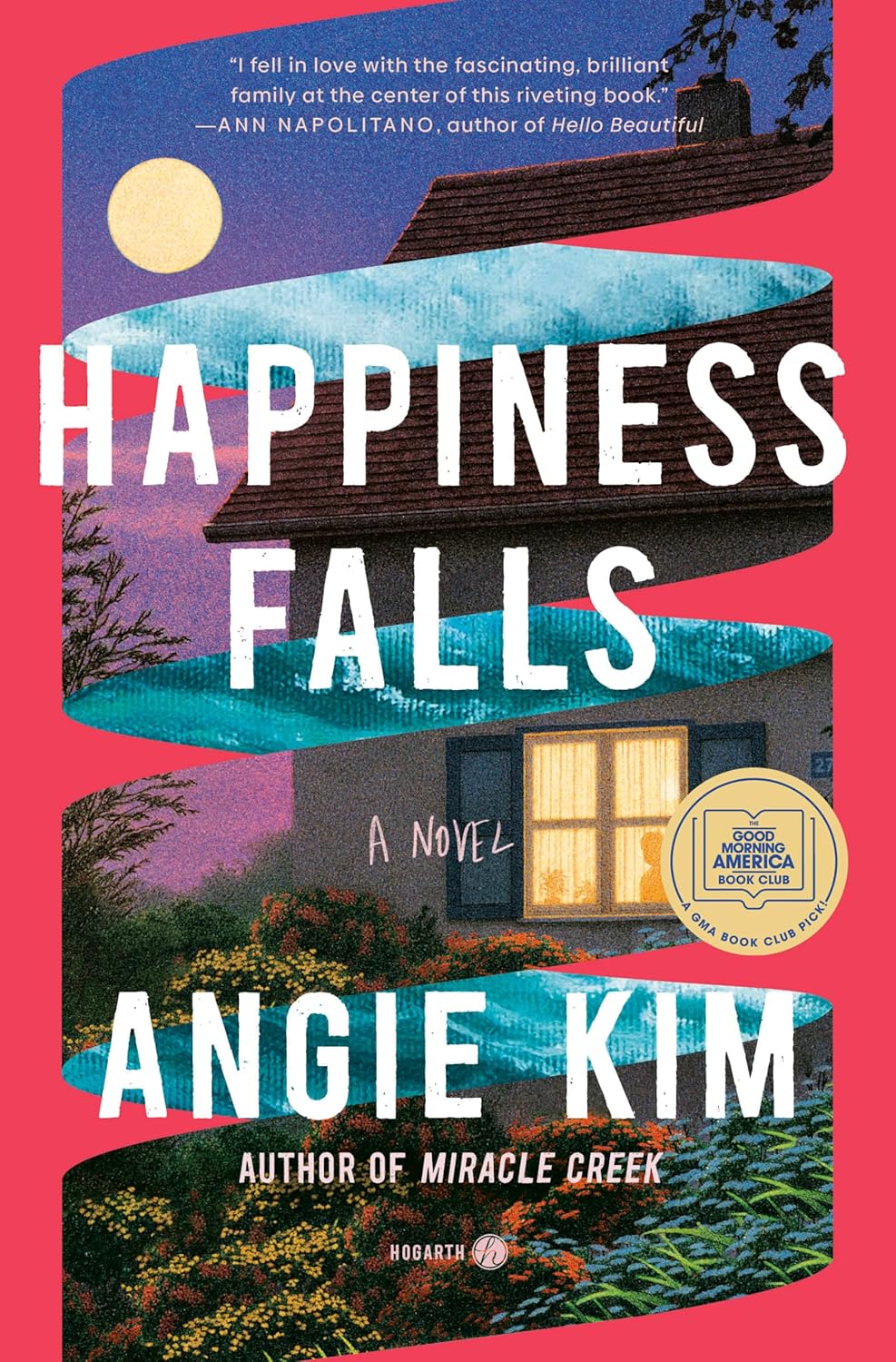
Angie Kim, Happiness Falls, Hogarth Press, 2023. 336 pgs.
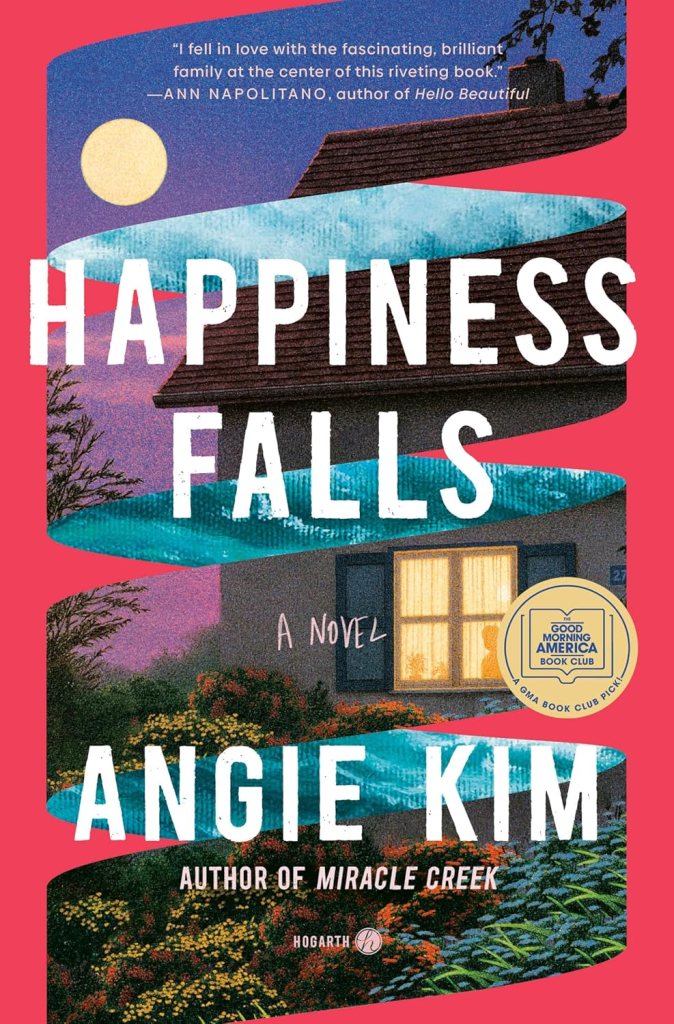
The novel Happiness Falls by Korean-American writer Angie Kim reminded me of Winston Churchill’s famous quote about Russia: “a riddle, wrapped in a mystery, inside an enigma.”
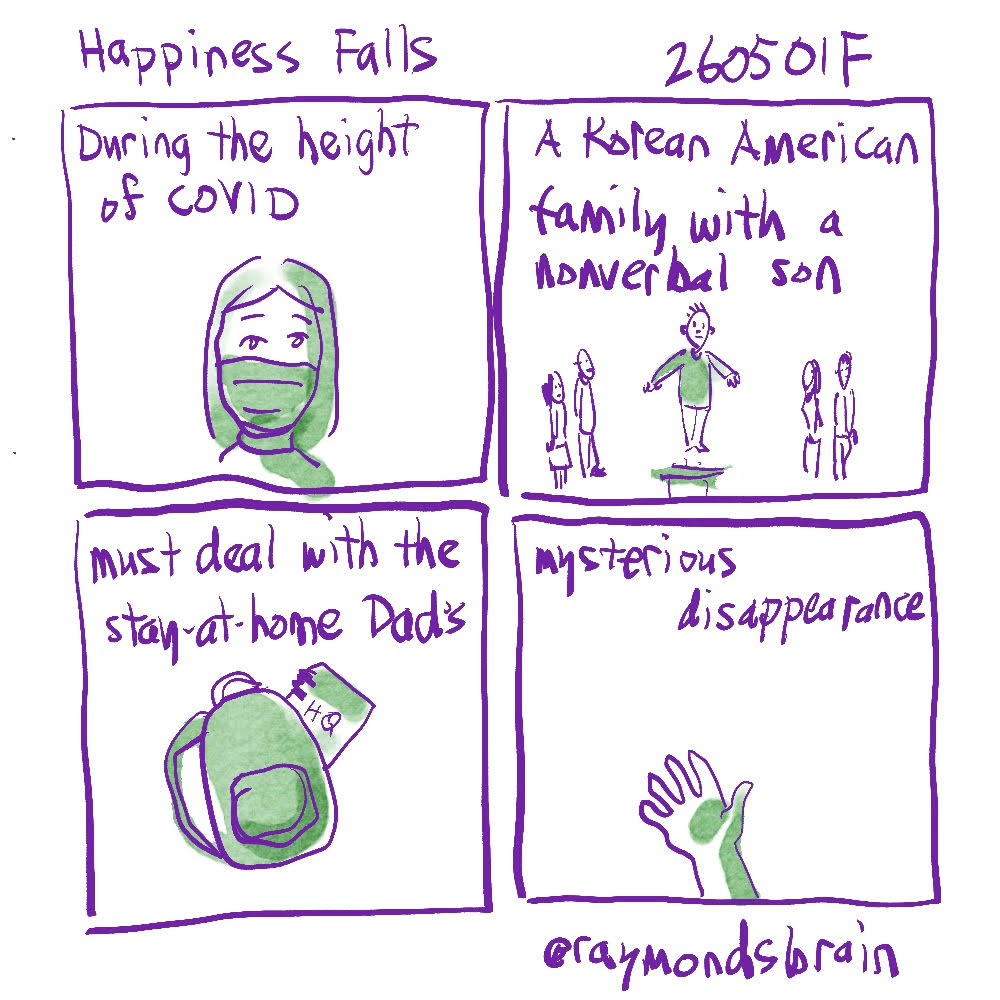
The riddle of how to be happy, as suggested by the title, emerges from the thoughts and experiments recorded in the recently uncovered pages of a cryptic notebook found in the father’s backpack, retrieved from the river near where he was last seen.
The narrator, his university-aged biracial daughter Mia, shares her interpretation, shocked to realise that her father had been covertly conducting social experiments on her and the members of her family: her Korean-born mother, her twin brother John, and her younger brother Eugene. The father had set up experiences, manipulated expectations, and observed their responses to test his theories about a “happiness quotient,” which relates responses to an individual’s baseline of expectation. Such machinations raise the possibility that his current absence might be part of some other ill-advised experiment.
The mystery of what has happened to this usually conscientious, stay-at-home dad initially drives the actions and priorities of the family. After some initial confusion about his whereabouts, the family finally realises they are dealing with a missing persons case and call in the police. This all takes place in 2020, during COVID restrictions, which leads to adjustments in standard procedures, with both positive and negative consequences. The police officer assigned to the case, and later the family’s lawyer, are both, in their own ways, hard-nosed and no-nonsense.
)
The enigma of Eugene, the youngest son, centres on his internal life living with a rare genetic disorder called Angelman syndrome, which renders him incapable of communicating orally. He is presumed to be the last person to have seen the father, but is also initially assumed to be unable to explain what happened. To the police, he is a key witness and possibly a suspect. His own family treats him with kindness, but do not really understand him either.
The general assumption seems to be that the limits to Eugene’s speaking abilities reflect his mental capacity. The family had previously been duped by a fraudulent therapist using a physical letter-based system. The father revealed her deception with a sting operation that, while effective, also undermined trust within his family. Until that point, the Korean-born mother, who was also an expert in linguistics, had been the primary caregiver for Eugene. After the incident seemed to break her spirit, her husband gave up his corporate job to take over domestic duties, including looking after their disabled son. He secretly discovered another therapist with a system for treating patients who, like Eugene, lacked fine motor control. But given the previous deception, and perhaps as part of his happiness studies, he decided to conceal Eugene’s newfound abilities from the family until he was certain he could replicate them in natural situations.
At the time of the father’s disappearance, the name of an unknown woman was found in his phone, suspected of being an “other woman.” Only later, when the secret training is revealed and the woman makes contact, do we find out what Eugene can think and share. The police had been unable to contact her because she had been confined to a hospital with COVID. The therapist is able to help Eugene using the method online for the first time, in front of the family and their lawyer, the session recorded for the police so as not to add unnecessary stress. This takes hours of Eugene struggling to pick one letter at a time from stencil boards as the therapist transcribes his choices into words and sentences. The painstaking process reminded me of a scene in The Diving Bell and the Butterfly (2007), a French film about a man who becomes paralysed and can only communicate by blinking his left eye, based on Jean-Dominique Bauby’s 1997 memoir.
Ultimately, everyone is astonished by the coherence of Eugene’s testimony, which explains the circumstances surrounding the father’s tragic accident, apparently clearing Eugene of responsibility, though I felt a hint of doubt about statements that exonerate the witness.
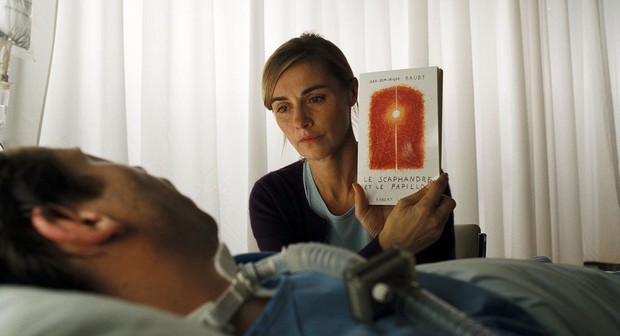
A still from The Diving Bell and the Butterfly
)
In the aftermath of Eugene’s statements, Mia realises how frustrating his life must have been, not being able to communicate all that was going on in his head.
She relates this to her own experience in Korea of being treated as lesser for her limited language skills. In the author’s note, Kim shares her challenges as an immigrant child from Korea in the United States, being perceived as less intelligent for her limited language abilities. This must be a common immigrant experience that is perhaps not so appreciated by monolingual locals.
I caught a glimpse of this feeling when I moved from Canada to study marine ecology and Japanese in Japan. As a third generation Japanese Canadian, I was genetically Japanese, psychologically Canadian, and linguistically in middle school. Particularly in the village where I lived, foreigners were relatively rare, and I felt compelled to explain to uneasy locals that I was not a stupid Japanese person, just a foolish Japanese Canadian. Fortunately, English holds international privilege, and even the Japanese students had to write their theses in it, so my limitations in the local language, though sometimes frustrating, were not so traumatic.
The themes of language ability, agency, and self-respect in Angie Kim‘s Happiness Falls also made me wonder whether the disappearance of the white man in the story was intended as a symbolic overthrowing of racist, patriarchal systems of control. The book explores many intriguing issues of contemporary society, perhaps even more than words can say.
How to cite: Nakamura, Raymond K. “A Riddle Wrapped in a Mystery: On Angie Kim’s Happiness Falls.” Cha: An Asian Literary Journal, 22 May 2026. chajournal.com/2026/05/22/happiness-falls.

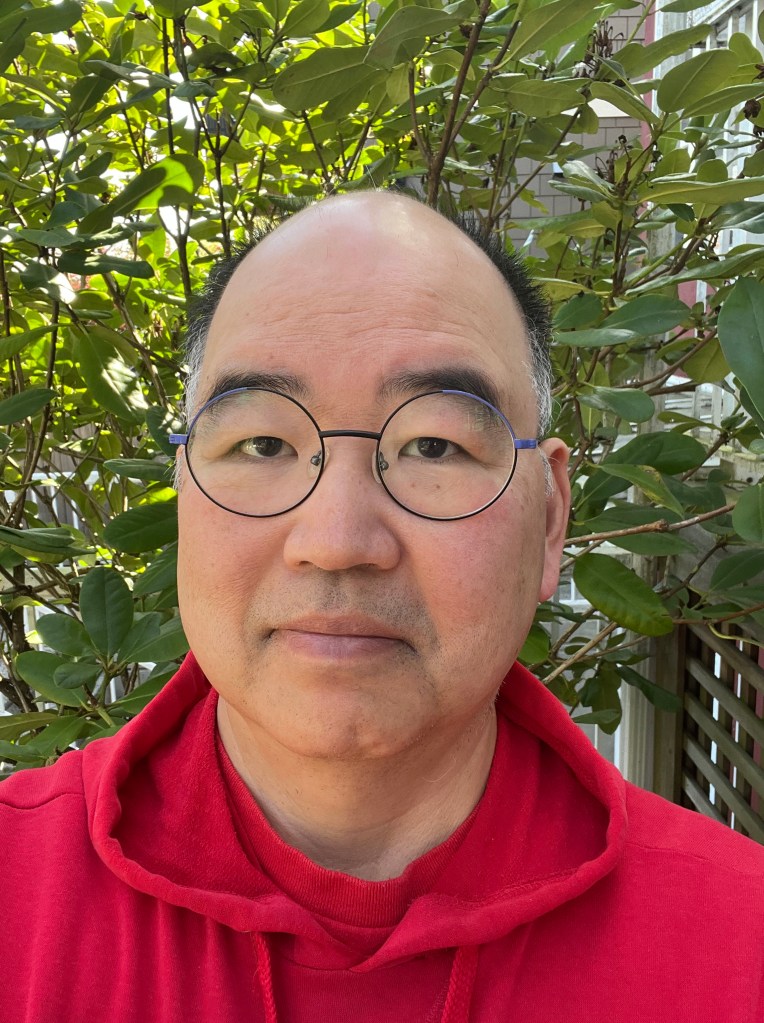
Raymond K. Nakamura is a writer, cartoonist, and educational consultant, when he is not walking the dog or washing the dishes. While reading, he enjoys drinking cha, tea, or chai. This third-generation Japanese Canadian lives in Vancouver, Canada, on the unceded traditional territories of the Musqueam, Squamish, and Tsleil-Waututh Nations, with his patient spouse, ambitious daughter, and feisty dog. He is the author of the picture book Peach Girl, published by Pajama Press, and posts daily comics on social media under @raymondsbrain. [All contributions by Raymond K. Nakamura.]
 Cha
Cha 