
茶 FIRST IMPRESSIONS
茶 REVIEW OF BOOKS & FILMS
[ESSAY] “Through the Time Tunnel and Written on Water: Eileen Chang Across Exile and Memory” by Jeff Tompkins
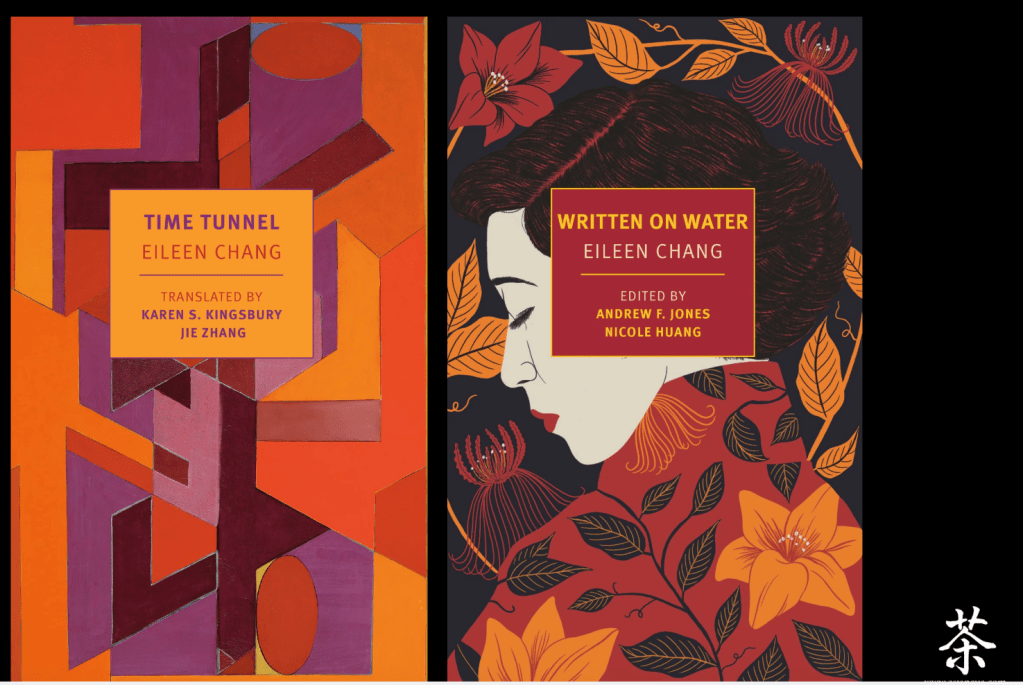
❀ Eileen Chang (author), Karen S. Kingsbury and Jie Zhang (translators). Time Tunnel, New York Review Books, 2025. 216 pgs.
❀ Eileen Chang (author), Andrew F. Jones (translator), Andrew F. Jones and Nicole Huang (editors). Written on Water, New York Review Books, 2023. 272 pgs.

i.
In Los Angeles, decades later, she rode the bus. All around the San Fernando Valley, one suburb to the next, this ageing Chinese expatriate of uncertain means and uncertain health took in the sights, such as they were, and we can only imagine the procession of strip malls and subdevelopments, freeways and fast food joints that would have met her gaze in the mid- and late 1980s. And yet, it is tempting to surmise that in the unfolding vistas on the other side of the bus window she was looking for something that was as vital to her as breathing. A dim, distant descendant, possibly, of the panorama of human activity that she first encountered in the streets of her native Shanghai, nearly half a century earlier.
(There may have been another motive too. These were the years of her life that friends called her motel period, and it is conceivable the bus rides were also a way of escaping the lice that evidently plagued her in more than one short-term rental.)
Eileen Chang (1920-1995) left us at least one memento of this melancholy twilight stage of her career. It is “1988-?,” the final essay in Time Tunnel, a collection of fiction and non-fiction from early and late in the career that New York Review Books published last fall. In it, she considers the SoCal landscape both spatially, top to bottom, and temporally, acknowledging which features the Spanish would have encountered centuries earlier. Ultimately she sees
a single silent travelogue on a cracked silver screen, in color but no audio added, off in one corner of an exhibit that was operating at a loss, playing soundlessly, and no one was watching.
As a metaphor for being alienated from your surroundings, that’s hard to top.
ii.
The blurbs that accompany a new Eileen Chang title in the New York Review Books Classics series suggest a literary equivalent to the fable of the blind men and the elephant. One reviewer compares her to both Joan Didion and Evelyn Waugh; another hails her as “China’s Virginia Woolf.”
Who is this shapeshifter, this woman of a thousand faces, who can inspire such incongruous comparisons?
Who is this shapeshifter, this woman of a thousand faces, who can inspire such incongruous comparisons? It is now 30 years since a special 1996 all-Chang issue of Renditions (the late, great journal of Chinese literature in English that ran for a hundred issues between 1973 and 2024) paid tribute to her in the immediate wake of her death the previous year. And it is nearly 20 years since New York Review Books published Love in a Fallen City, the 2006 collection of Chang’s short fiction from the ’40s translated by Karen S. Kingsbury that, more than any other book, launched the posthumous English-language revival of her work and reputation. With more than half a dozen titles by her now in print, the answer to the above question should be simple: Eileen Chang is incomparably and inimitably herself.
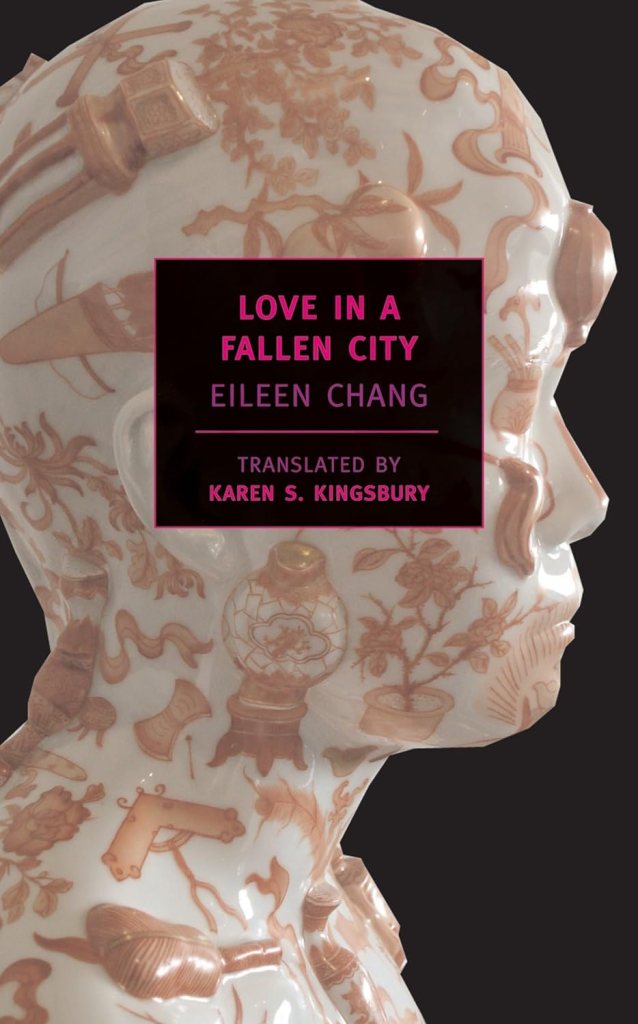
Probably no one who has read this far needs to be told about Love in a Fallen City, but its half-dozen stories and novellas, all taken from the meteoric early phase of her career and all set in Shanghai and Hong Kong, remain the best introduction to Chang’s world. They are a discovery that galvanises on a first encounter and still inspires frissons on second and third readings. For me, the epiphany came towards the end of the first story in the collection, “Aloeswood Incense: The First Brazier.”1 A young woman reaches an abyss of spiritual abjection—she has just realised that her marriage is effectively a form of genteel prostitution—and yet just a few sentences later, this is what we experience through her eyes:
The car passed through Wanchai. The sharp pop-pop of the firecrackers faded behind them, and the red traffic lights chased each other across the windshield, then slipped into darkness.
It is an emblematic moment that demonstrates Chang’s ability to hold everything in balance: how she remains attuned to the most minute shadings of her characters’ torments, yearnings and hurts alike, while being equally sensitive to the glamour of the sensory world, the dazzling surfaces whose claims on our attention will not be denied.
Those qualities are all evident in the first story in Time Tunnel. “Young at the Time” (1944) introduces Pan Ruliang, a bashful young Shanghai medical student who falls for Cynthia Rubashov, a good-hearted Russian émigré who far exceeds him in worldliness. Their awkward courtship, which unfolds in several imperfectly understood languages, is depicted with a respectful attentiveness to both the fragility and freshness of first love. But in typical Chang fashion, moments of stark objectivity intrude on this relative idyll, as when Ruliang acknowledges to himself, “He knew that what he was in love with was not Cynthia. He was in love with being in love.” Near the story’s end, the truth-telling shades into a kind of mischievous wit, also one of the author’s defining traits: Cynthia nearly succumbs to typhoid fever, but when Ruliang goes to visit her sickbed, his first impression is that “The room smelled like Russian people.”
It is only when you finish reading Time Tunnel that you realise “Young at the Time” is an outlier. That is because it is the one story in this shrewdly conceived selection in which the main characters live entirely in the present. For subsequent protagonists, like the tyrannical matriarch in “Genesis” and the two women who have fled Communist China in “Blossoms Afloat, Flowers Adrift” and “These Old Schoolmates They’re All Quite Classy Now,” the past is an irresistible well of reverie: the source of rueful self-reckonings, catalogues of hurts inflicted and received, and the occasional fleeting memory that they understand only in retrospect as happiness.
The layered chronologies in “Genesis” (1945) are a formal marvel even by Chang standards. The novella begins with a woman barely out of her teens exulting in her new freedom as she goes to work at an old Jewish refugee couple’s pharmacy and is wooed by a roguish shop owner; it ascends into a new dimension once the narrative voice, fluid as a Marcel Ophuls camera (and cinematic references are usually apposite with Chang’s fiction), follows her home and glides among various other members of the household. The domestic horrors mount and mount, as often in Chang, the family’s older women regard the cruelties inflicted on the younger ones with chilling complacency, but two-thirds of the way through, a graceful pivot places us into the perspective of Ziwei, the fearsome “Grandma.” Ziwei, we learn, was born in 1884, the daughter of a Qing dynasty official. Initially her recollections seem to be evoking nostalgia for a semi-mythical past, but when she remembers a humiliation inflicted on her father by the Empress Dowager Cixi herself, we begin to understand how the family unit, even in its fallen, latter-day phase, has internalised the worst features of a society obsessed with hierarchy and subservience.
A startling moment in “Genesis” occurs midway through, when a supporting character offhandedly refers to “the fighting,” abruptly reminding us that this Shanghai clan is going about its business in the midst of the Japanese assault on their city. We can read their seeming obliviousness as a mark of their solipsism, but their determination to carry on with their lives, and, being Chang characters, their private lives in particular, can also be understood as a humanist gesture: an insistence on the dignity and worth of individual experience even during a world-historical catastrophe. It is a mark of the pessimism of Chang’s later fiction that the main characters in “Blossoms Afloat, Flowers Adrift” (1978) and “Those Old Schoolmates” (also dating from the late ’70s, exact year unknown) are not allowed even that much space. While it is unmistakable that exile has taken a psychic toll on Luozhen in “Blossoms” and Zhao Jue in “Schoolmates,” both women, solitary, awkward, equally prone to serious faux pas and sudden resentments, are revealed to be so uncomfortable in social life that they seem to suffer from an even more fundamental estrangement that marked them well before the Communist Party takeover in 1949.2 (We might wonder if either of them is destined to end up as a motel-room recluse.)
In “Blossoms,” Chang sweetens the pill by situating Luozhen in a series of sensationally vivid locales. One of these is the bridge at Lo Wu, the pedestrian crossing that functioned for years as the border between the PRC and British-ruled Hong Kong, the definition of a liminal space and the closest real-world analogue to the “time tunnel” Luozhen imagines herself as having entered. Another is the dilapidated old freighter that will later take Luozhen from Hong Kong to a new life in Japan, a setting so redolent of fictional artifice that the character will even wryly wonder if she has not stepped into a short story by W. Somerset Maugham.
The four works of fiction in Time Tunnel are followed by three essays, making this book as much of a pendant to another NYRB Classics Chang title, the essay collection Written on Water, as it is to Love in a Fallen City. For any devotee, Written on Water is also essential Chang: reproducing in full a collection she published in late 1944, it demonstrates that the hot hand of her initial phase extended to non-fiction. It includes at least two masterpieces, both autobiographical, that document an artistic sensibility being shaped under conditions of extreme duress. “From the Ashes” recounts her time at the University of Hong Kong during the early years of the Second World War; among much else, it contains a remarkable first-person description of passengers fleeing a tram during one of the city’s first air raids. “Whispers” covers her life from birth through the time she leaves for university and includes ordeals, most notably the murderous rages of her opium-addicted father, who beat her and kept her imprisoned within the family home for months, that are all the more shocking for being related with such measured poise. Chang would revisit these experiences at greater length in novels she published much later in life, but she never bettered her handling of them in these two essays.
The more modest pieces in Time Tunnel, all products of her years in exile, proceed both chronologically and in order of level of interest. The first two were written in English and herald the more stripped-down style of later Chang. “New England Is China” (1958) is a would-be magazine casual she was never able to place; an explanatory end note, longer than the essay itself, reveals how Chang’s then husband, the American writer Ferdinand Reyher, made a number of feeble editorial changes to it in an effort to make it more palatable to the mass market, to no avail. Far more rewarding is “Return to the Frontier” (1963), an account of her visit to Taiwan and Hong Kong after years in the United States. The initial encounter with Taiwan, which she still calls “Formosa”, yields a snapshot of expatriate vertigo:
I looked around the crowded airport and it really was China, not the strange one I left ten years ago under the Communists but the one I knew best and thought had vanished forever. The buzz of Mandarin voices also made it different from Hong Kong. A feeling of chronological confusion came over me.
“It feels like dreaming.”
Later, further inland, she registers the lingering presence of spoken Japanese and takes note of the island’s Indigenous population. “In the countryside Formosa peels back, showing older strata.” The essay’s Hong Kong section is a litany of recounted horror stories from across the frontier, yet we also get a reminiscence of Chang’s own crossing over the same bridge Luozhen experiences as a time tunnel in “Blossoms Afloat, Flowers Adrift.” In a distinctively Chang touch, the guard on the Hong Kong side of the border is a martinet, while his counterpart on the PRC side is an obvious country boy who shows some sympathy for the civilians wilting in the heat while their documents are being examined. “For a moment I felt the warmth of race wash over me for the last time,” she writes.
(Special mention is due to the translators Karen S. Kingsbury and Jie Zhang, who maintain the exceptionally high standard of prose that Kingsbury set back in Love in a Fallen City. Kingsbury’s involvement with Chang dates to that 1996 issue of Renditions, which means she has done as much as anyone alive to make Chang’s work available in English.)3
The last piece in Time Tunnel, “1988-?”, was found among Chang’s papers after her death and published posthumously in 1996. The one essay of the three originally written in Chinese, it is the most open-ended work in the collection and, as much a prose poem as a formal essay, teases the possibility of a whole new experimental direction in her writing. Somewhere in the San Fernando Valley, the narrator is waiting for a bus that may never arrive; any reader who has endured the existential anxiety of relying on public transport in Southern California will instantly relate. Chang’s stand-in mercilessly surveys the surrounding landscape, cataloguing the details that add up to a “feeling of desolate ruin,” like a shopping district so devoid of foot traffic “sparrows could hop around undisturbed.”
That is, until her eye alights on a bit of graffiti, etched in chalk on the bus stop bench. Two names, “Wee and Dee,” under which is added “1988-?” Through a kind of imaginative sleight of hand, Chang deduces the graffiti to have been made by a Chinese immigrant, and the discovery transforms her mood. “Here, in the midst of utter ennui, this sudden sighting of written marks made by a Chinese strikes a spark of delight.” Note the double affinity: the narrator is responding not only to the felt presence of a member of her own culture and ethnicity but to the written marks he left behind. From there, the rest of this short piece is taken up by a quite touching attempt to extrapolate entire lives, even a community, from the one chalk inscription.
Bored to desperation, he pulls from his pocket a chalk picked up in his English class after it fell off the blackboard and spills out the thing most on his mind.
It is as if even here, near the end of her tether and the end of her life, this preternaturally gifted writer of fiction cannot stop conjuring other people into existence.
iii.
The absence of a full-scale English-language biography, meanwhile, is a mystery that only grows more perplexing all the time.
For English-language readers, Time Tunnel opens a revealing window onto the latter half of Chang’s career. Even now, the contours of that career are still taking shape for us, in ways that are both frustrating and tantalising. It is vexing to know, for instance, that in Chuanqi (Romances or, alternatively, Legends), the definitive Chinese-language collection of her short fiction from the ’40s, “Aloeswood Incense: The First Brazier” was followed by an as yet untranslated parallel story, “Aloeswood Incense: The Second Burning,” especially when you learn that the latter tale takes as its protagonist an Englishman living in Hong Kong, which would seem to make it, like “Young at the Time,” a rare instance of Chang’s applying her imaginative sympathies to the cultural other. I hope that one day we will get a complete, one for one equivalent version of the expanded 1947 Chuanqi, just as we might also get a complete edition of its bookend companion, her 1983 collection Wangranji (a title Kingsbury renders as Dazed Recollections). The absence of a full-scale English-language biography, meanwhile, is a mystery that only grows more perplexing all the time.
And yet, with all the above respectfully noted, I will confess that the untranslated Chang I most want to read is her only book-length work of non-fiction, from 1976: an evidently contrarian, not to say polemical study of Cao Xueqin’s eighteenth-century novel Dream of the Red Chamber that she mischievously titled Nightmare of the Red Chamber, as if pre-emptively acknowledging how likely it was to irk establishment gatekeepers of a canonical work. As described in an enlightening 2012 essay by Xiaojue Wang, the work’s form would seem to be as unorthodox as its opinions:
It is a fragmentary work composed of quotations, gleanings, extensive textual and edition comparisons, literary criticism, as well as recollections of her own reading and writing experiences. . . . Huang Xincun suggested that one reads Nightmare as a work of literature rather than a scholarly monograph.4
“As a work of literature,” or, in other words, as the kind of productively wayward, genre-defying creative non-fiction, the book report that bursts out of the lab, exemplified by irreverent homages like Geoff Dyer’s book on D. H. Lawrence or Andrei Sinyavsky’s on Pushkin. I could see New Directions or Fitzcarraldo Editions publishing it next week.
Wang’s study appears in a 2012 collection of critical essays, Eileen Chang: Romancing Languages, Cultures and Genres, that offers stimulating prompts for rethinking the latter half of Chang’s career. Especially relevant in the wake of Time Tunnel is the discovery that her decades-long grapple with Dream of the Red Chamber parallels her similar engagement with The Sing-song Girls of Shanghai, Han Bangqing’s sprawling 1892 novel, which she translated from Wu into Mandarin and from Mandarin into English. (The English translation, edited and revised by the Renditions editor Eva Hung, is an undersung literary accomplishment.) Immersing herself for years in the work of these two unmistakable forebears, ancestors—in current parlance—she hit upon a version of time travel far happier and more fruitful than the kind she visited on her heroines.
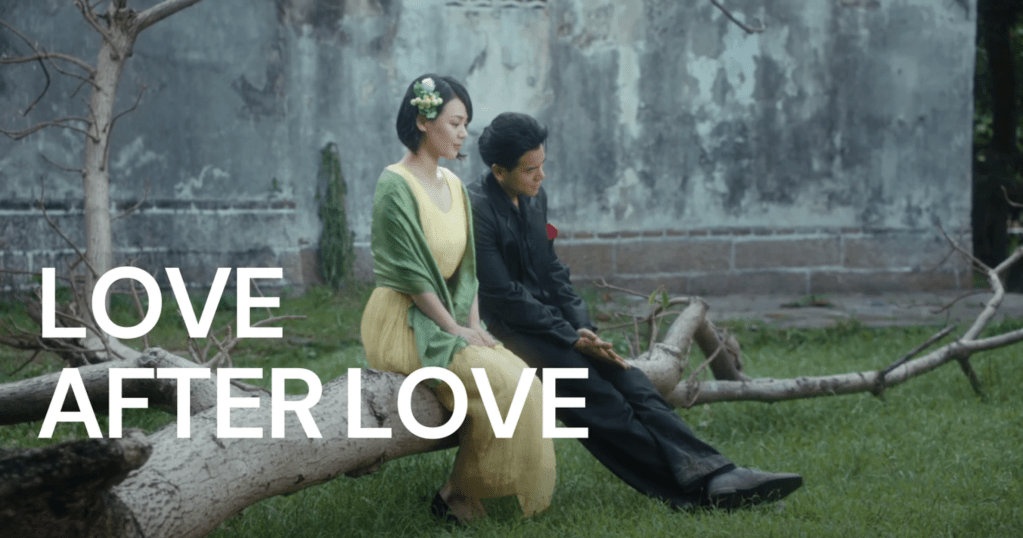
- “Aloeswood Incense: The First Brazier” 沉香屑·第一爐香 was Eileen Chang’s debut publication, appearing in the Shanghai literary journal Zijin in 1943. It was adapted into the film Love After Love by Ann Hui in 2021, with a screenplay by Chang Wen. ↩︎
- The famous story “Lust, Caution,” which hinges on a stunningly perverse split-second decision by its heroine in a moment of crisis, also dates from the late phase of Chang’s career. We might speculate that by then she was committed to making her women protagonists as un-ingratiating as possible. ↩︎
- Kingsbury also translated Chang’s late ’40s novel Half a Lifelong Romance, the culmination of her Shanghai phase, in 2014. The lame U.S. paperback edition of the book does not include Kingsbury’s name on the front cover, the back cover, or the title page. ↩︎
- Xiaojue Wang, “Eileen Chang, Dream of the Red Chamber, and the Cold War,” in Eileen Chang: Romancing Languages, Cultures and Genres, ed. Kam Louie (Hong Kong: University of Hong Kong Press, 2012). ↩︎
How to cite: Tompkins, Jeff. “Through the Time Tunnel and Written on Water: Eileen Chang Across Exile and Memory.” Cha: An Asian Literary Journal, 29 Apr. 2026, chajournal.com/2026/04/29/eileen-chang.


Jeff Tompkins is a writer and zine artist in New York City. His essays and reviews have appeared in the Brooklyn Rail, IMPULSE, and Words Without Borders, among other outlets. In previous incarnations he was a Senior Producer for Asia Society New York and the Online Content and Community Manager for Library of America, the non-profit publisher. [All contributions by Jeff Tompkins.]
 Cha
Cha 