
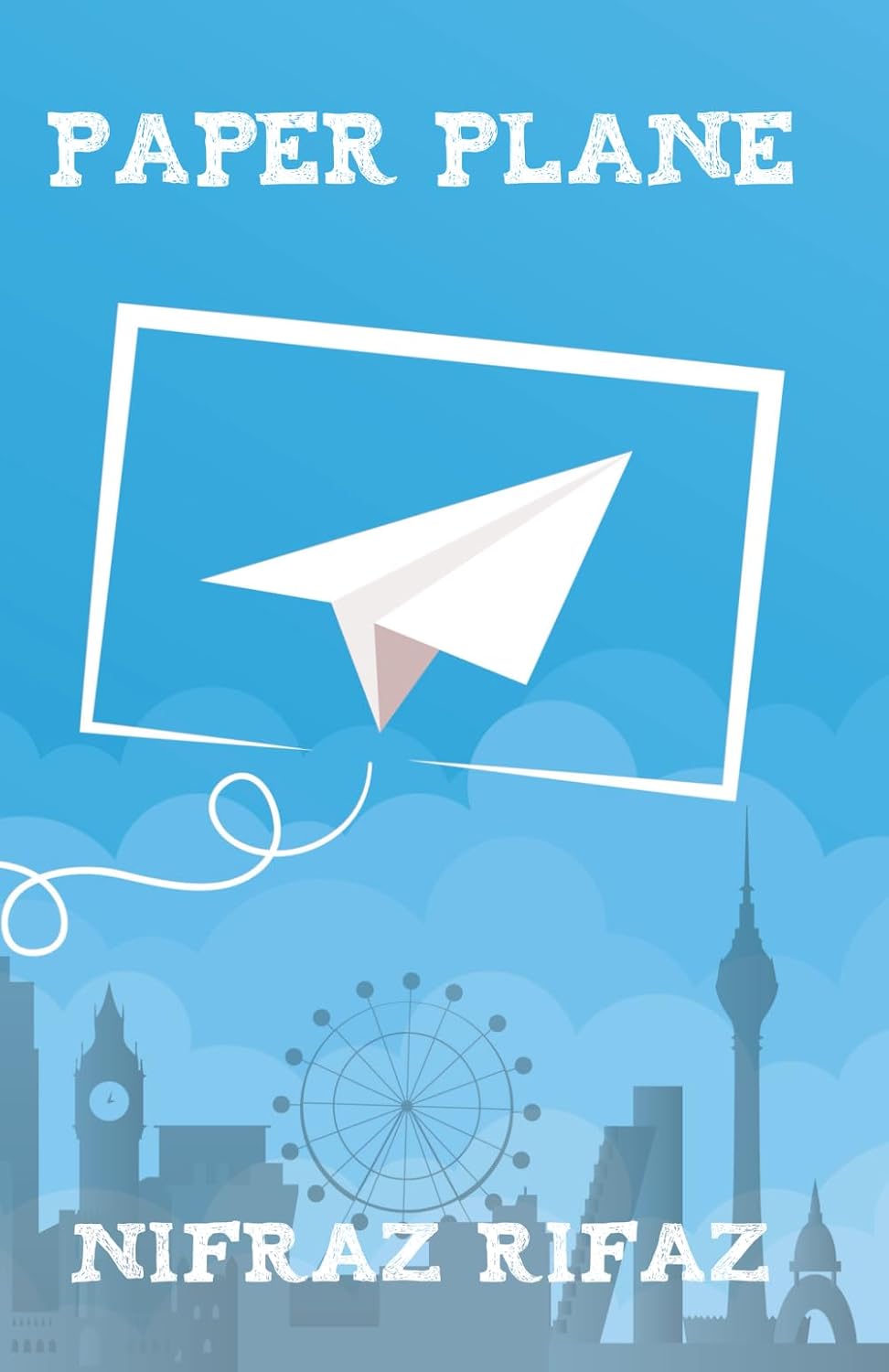
[CONVERSATION] “Flights of Memory and Meaning: On Paper Plane” by Sadie Kaye and Nifraz Rifaz
Nifraz Rifaz, Paper Plane, The Jam Fruit Tree Publications, 2026. 368 pgs.
In my review of Paper Plane, first published in The Hooghly Review, on 23 December 2025, I described Nifraz Rifaz’s debut as a striking and emotionally resonant journey into the psyche of Zed, a complex protagonist grappling with unresolved trauma and an uncertain sense of belonging. The novel unfolds with a quiet intensity, drawing the reader into a world shaped by memory, conflict, and the fragile act of self-reckoning. What stayed with me was the way Rifaz transforms deeply personal and collective pain into something both intimate and expansive, without diminishing its weight.
I was particularly captivated by the central image of the paper plane, which evolves from a simple, almost childlike gesture into a powerful symbol of fragility, endurance, and renewal. The narrative moves fluidly through layers of love and loss, nostalgia and upheaval, capturing the delicate interplay between vulnerability and resilience. Rifaz’s prose carries a lyrical precision, allowing even the heaviest emotions to feel unexpectedly buoyant, while remaining grounded in emotional truth.
I was equally struck by the subtle weaving of the personal and the political, as Sri Lanka’s charged landscape lends urgency and texture to Zed’s journey.
In the following conversation, I speak with Rifaz about the inspirations, themes, and creative choices that shaped this remarkable debut.

Sadie Kaye (Sadie): In Paper Plane, you explore the intricacies of human relationships. Can you share a personal experience that shaped your understanding of these dynamics?
Nifraz Rifaz (Nifraz): I grew up inside an unusually large family. My mother has fourteen siblings and my father seven, which meant a childhood surrounded by cousins, noise, alliances and disagreements. Within my own household, I was the middle child, positioned naturally as the negotiator between an older brother and a younger sister. That role quietly trained me to listen, to mediate and to read emotional undercurrents. Watching how love, rivalry, loyalty and forgiveness played out daily gave me an early education in human relationships. I think that constant exposure shaped how instinctively I navigate people and how I write them, with empathy, contradiction and care.
Sadie: The title Paper Plane evokes a strong sense of hope and nostalgia. How does this reflect the deeper themes of the narrative?ese dynamics?
Sri Lanka has endured a long civil war, deep political fractures and, more recently, rising Islamophobia following the Easter Sunday attacks.
Nifraz: At the heart of the novel is Zed, a Sri Lankan Muslim living as a minority in a country shaped by decades of ethnic conflict. Sri Lanka has endured a long civil war, deep political fractures and, more recently, rising Islamophobia following the Easter Sunday attacks. Against this backdrop, the image of a paper plane feels fragile, almost naïve, yet it continues to fly. That tension mirrors Zed’s inner world. Despite everything happening around him, he chooses hope. The title reflects the idea that optimism can exist even when circumstances are violent, uncertain or unfair, and that hope itself can be an act of quiet resistance.
Sadie: If Paper Plane were a cocktail, what would it taste like?
Nifraz: Hmm. Well, I don’t consume alcohol…
Sadie: Me neither. Hick!
Nifraz: …so I’ll approach this one metaphorically. It would be something deceptively light, citrussy, with an unexpected depth beneath the surface. Something that goes down easily at first, then lingers, leaving a more complex aftertaste. Much like the book itself, it would balance sweetness with bitterness, fragility with resilience. The experience wouldn’t be about intoxication, but about reflection.
Sadie: For a non-drinker, you did that very well. The book’s nonlinear timeline mirrors the flight of a paper plane, veering unexpectedly. Why did you choose to fracture time?
My instincts as a storyteller are shaped more by cinema than by literature.
Nifraz: My instincts as a storyteller are shaped more by cinema than by literature. I’ve watched far more films than I’ve read books, and I’m particularly drawn to the emotional power of flashbacks. In films, memory often interrupts the present, just as it does in real life. That influenced me deeply. Writing the story nonlinearly felt natural, almost instinctive. Trauma, longing and nostalgia don’t arrive in neat sequences, they surface unpredictably. Fracturing time allowed the narrative to mirror how the mind works, letting the reader experience the story emotionally rather than simply following it from beginning to end.
Sadie: If Paper Plane were adapted into a film, who would you cast in the leading roles?
Nifraz: For Zed, I’d cast Ishaan Khatter, a Bollywood actor. He brings a quiet intensity and emotional vulnerability that suits the character well. His performance opposite Nicole Kidman in The Perfect Couple (2024) showed off his ability to hold space with subtlety. For Maya, I’d choose Maitreyi Ramakrishnan, best known for her lead role in Never Have I Ever (2020) by Mindy Kaling. Maitreyi has Sri Lankan Tamil heritage and a natural warmth that would translate beautifully on screen. Her range and authenticity make her an ideal fit for the role.

Ishaan Khatter. Photo: Instagram/ishaankhatter

Maitreyi Ramakrishnan. Via
Sadie: Your writing style has a lyrical quality. Did you draw inspiration from any particular poets or authors?
Nifraz: I read selectively rather than widely, but I return often to writers whose language lingers. Authors like Jhumpa Lahiri, Arundhati Roy, Kiran Desai, Orhan Pamuk and Chimamanda Ngozi Adichie have all influenced me in different ways. What draws me to their work is not just story, but rhythm, restraint and emotional precision. I enjoy rereading passages that feel musical, where meaning is carried as much by cadence as by plot. That sensitivity to language has shaped my own approach. I’m less interested in spectacle and more in sentences that breathe, resonate, and stay with the reader long after the page is turned.
Sadie: Was there a pivotal moment or turning point that prompted you to write this story, and how did it unfold?
Nifraz: There was a moment during the Easter attacks that stayed with me deeply. I was living in Hong Kong and had just returned from a short holiday in Sri Lanka, unaware of the scale of what was unfolding. As news filtered through, my cousins began sharing stories of fear and survival. One account, about forty men invading a family home, struck me with cinematic clarity. I could see the scene unfold in my head. That night, I promised my cousin I’d write it. That promise became the emotional genesis of the novel, and later emerged as Chapter 19, titled Safe.
Sadie: The characters’ journey is transformative. How did you ensure authenticity, and do you see aspects of yourself within them?
The characters are drawn from people I’ve encountered across cities and continents, in Colombo, Hong Kong and London.
Nifraz: The characters are drawn from people I’ve encountered across cities and continents, in Colombo, Hong Kong and London. Friends, colleagues, family members and strangers all contributed fragments to their personalities. Rather than inventing traits in isolation, I stitched together lived experiences and observed behaviours. I think that’s where the authenticity comes from. While none of the characters are me, pieces of my perspective, questions and contradictions inevitably seep in. I think every writer leaves fingerprints on their work. In this case, the honesty comes from recognising people as layered and imperfect, shaped by context as much as by choice.
Sadie: Were there any supporting characters who came to play a more significant role as your writing journey developed?
Nifraz: Two characters grew far beyond their original outlines: Vimukthi and Kadeeja. Vimukthi, Zed’s childhood best friend, is Buddhist and represents a bridge across faiths and histories. Kadeeja, Zed’s fiancée, surprised me the most. Initially, I imagined her as a composed, devout and idealised Muslim woman. As the story evolved, she became far more complex. She uses faith strategically, sometimes manipulatively, to assert control and achieve her aims. That unpredictability made her compelling to write. Kadeeja challenged my assumptions and ultimately became one of my favourite characters because she resists easy moral categorisation.
Sadie: How do the themes of aspiration and resilience connect with your own aspirations as a writer?
Nifraz: I come from a family where writing as a career was never encouraged and reading for pleasure was rare. I knew I wanted to be a writer, but practicality pushed me towards a career in finance and later communications. Still, I refused to abandon that part of myself. Instead, I placed myself deliberately in literary spaces. I volunteered at the Hong Kong International Literary Festival, working under three different festival directors, performed storytelling on stage at Hong Kong Stories, and joined the Hong Kong Writers Circle. Those environments sustained my ambition. Resilience, for me, meant staying close to storytelling, even when it was not my profession.
Sadie: Your novel touches on the complexity of trauma, the pursuit of dreams, and the fragile strength of the human spirit. How does this relate to your own journey?
My mother spoke several languages, we spoke English at home, studied in Sinhala medium and communicated with family in Tamil.
Nifraz: My relationship with identity and language has always been fluid. Growing up, I was exposed to multiple languages simultaneously. My mother spoke several languages, we spoke English at home, studied in Sinhala medium and communicated with family in Tamil. As a result, I never had a clear sense of a single mother tongue. We shifted language depending on audience. Writing in English itself felt like an act of aspiration. I don’t have a formal degree in English literature, yet my career in communications involves shaping language for native speakers. That tension between belonging and uncertainty mirrors the novel’s exploration of voice, ambition and self-definition.
Sadie: Have you ever received feedback that surprised you?
Nifraz: One of the most unexpected responses came from an early reader who apologised to me after finishing the book. She assumed the story was autobiographical and felt sorrow for what she believed I had personally endured. I explained to her that it was not my story, that I was merely a vessel carrying experiences entrusted to me by others. She remained unconvinced. That reaction surprised me deeply. It reminded me how powerfully readers can inhabit a narrative and blur the line between author and character. It also reaffirmed my responsibility to handle borrowed stories with care and integrity.
Sadie: You use paper planes as physical objects, metaphors, and plot devices. Which of these layers emerged first?
Nifraz: The paper plane entered the story almost by accident. It began with M.I.A.’s song Paper Planes playing in the background of a bar scene. At the time, it was just an atmospheric detail. I didn’t overthink it. Later, the image reappeared as a physical object within the story and started to take on metaphorical meaning. As the manuscript evolved, I became more deliberate, using the paper plane as a plot device. What’s interesting is that it grew organically, from sound, to object, to symbol, rather than being imposed from the outset.
Sadie: I can really relate to that. Everything I write begins with a playlist to set the mood. Whenever I experience writer’s block, I go for a walk and listen to it.
Nifraz: Does it work?
Sadie: Not really, it simply means I spend more time walking than writing. Moving on. Paper planes are often used to symbolise fragility and hope. Is hope something you earn in Paper Plane?
Nifraz: I don’t see hope as something you earn, but as the ultimate strength of the human spirit. In the novel, suffering doesn’t automatically lead to hope, and hope doesn’t cancel out pain. Instead, hope exists alongside hardship, often quietly and stubbornly. It’s what keeps people moving when everything suggests they should stop. For me, hope isn’t optimism or denial, it’s survival. It’s the refusal to give up, even when circumstances are brutal. That persistence is what keeps the characters alive and, I think, speaks to something universal in readers.
Sadie: The book has an effervescent energy that contrasts with its heavier themes. Was this tension deliberate?
Nifraz: Not at the start, but it became a conscious responsibility as the book developed. I was very aware of not wanting to hurt anyone, especially given the sensitivities around Sri Lanka’s political and social landscape. I chose my early readers carefully, people who read widely, felt deeply, and weren’t afraid to challenge me. Many of them held strong, informed views on Sri Lankan politics. Their feedback helped me find a balance. The lighter, more lyrical prose created space for difficult themes to breathe, allowing readers to engage without feeling overwhelmed or emotionally bludgeoned.
Sadie: As a debut novelist, were there times when you felt pressured to soften your characters’ flaws?
Nifraz: Yeah, there was pressure, but it came with advice I chose to respect. Early on, I was given two clear guidelines: make sure your main character remains likeable, and as a male writer, always write women with respect and grace. Both came from my development editor, Jay Oatway. Rather than resisting those constraints, I embraced them. They forced me to be more thoughtful and disciplined in how I shaped my characters. Instead of flattening their flaws, the guidance pushed me to explore those flaws with greater care and nuance. In the end, that pressure strengthened the emotional credibility of the story rather than weakening it.
Sadie: Considering the rich world you have created, do you see yourself returning to this universe in future works, or are you inclined towards new stories and themes?
I enjoy stepping into spaces where I have more to discover than to repeat.
Nifraz: At the moment, I feel drawn towards a new story. I have the seed of an idea, though not a fully formed plot yet. It will likely move between Sri Lanka and Hong Kong and be set during the COVID-19 period. This time, the focus will be on a married couple and the complexities of long-term relationships under pressure. It feels like unfamiliar territory for me as a writer, which is why it excites me. I enjoy stepping into spaces where I have more to discover than to repeat.
Sadie: Are there any lessons you intend to carry forward into your next project?
Nifraz: What I will carry forward is a commitment to complexity. Characters shouldn’t exist to make a point; they should exist to be understood. I’m also keen to maintain restraint in language, allowing silence and subtext to do some of the narrative work. Those lessons feel essential as I move into more intimate emotional terrain.
Sadie: What conversations do you hope Paper Plane will spark among readers?
Nifraz: I hope the book encourages readers to think about resilience beyond slogans. I want it to spark conversations about choosing agency even in oppressive circumstances. Not being defined solely as a victim, but as someone who responds, resists and endures. The novel asks readers to consider what it means to stand upright in the face of injustice, to fight with dignity rather than despair. Across cultures and contexts, adversity looks different, but the human response to it is universal. If the book inspires even one reader to face their own battles with courage, then it has done its work.
How to cite: Kaye, Sadie and Nifraz Rifaz. “Flights of Memory and Meaning: On Paper Plane.” Cha: An Asian Literary Journal, 23 Apr. 2026, chajournal.com/2026/04/23/paper-plane.



Sadie Kaye is a storyteller from Hong Kong who creates quirky podcasts, offbeat documentaries, and independent films. Her humour columns for RTHK Radio 3 and essays on mental health have been published by the South China Morning Post and featured in numerous anthologies by the Hong Kong Women in Publishing Society and the Hong Kong Writers Circle. She has produced two feature films for Contro Vento Films: the first, Transference (2020), went viral on YouTube with over 29 million views, while the second, To Love a Narcissist, is set for release in North America on 19 May 2026. [All contributions by Sadie Kaye.]

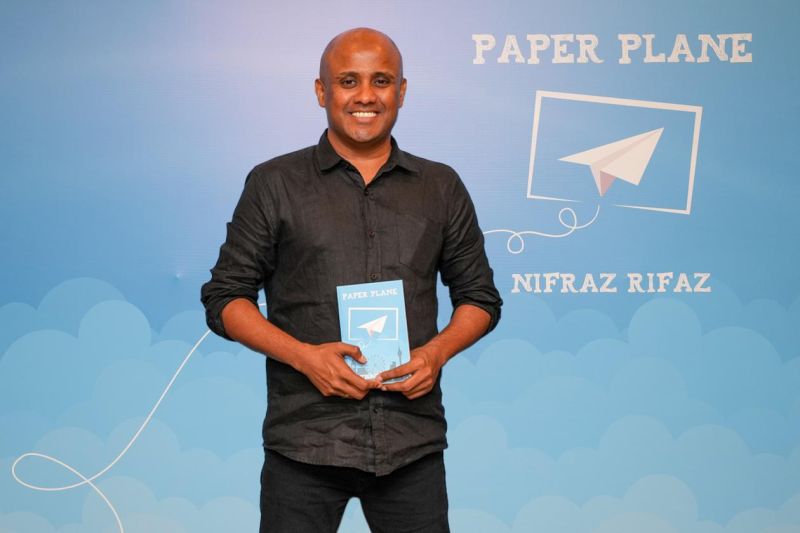
Nifraz Rifaz is a Sri Lankan author whose work explores the delicate intersections of war, reconciliation, migration, and the search for belonging. His stories, much like his own life, traverse borders, probing the meaning of home and the legacies we carry with us. He lives and writes between Colombo and Hong Kong, with his work published in both cities, and is an active member of the Hong Kong Writers Circle, contributing to numerous anthologies. Nifraz feels most at home wandering the streets of Galle Fort, yet the skyline of Hong Kong continues to call to him. He is fond of red rice and vegetable curries with halal chicken, and cannot resist a slice of carrot cake with his Yuenyeung coffee. He is close to his cousins, all fifty of them, whom he regards as siblings.
 Cha
Cha 