
茶 FIRST IMPRESSIONS
茶 REVIEW OF BOOKS & FILMS
[FIRST IMPRESSIONS] “Bearing Witness in Gigi L. Leung’s Everyday Movement” by Rebekah Chan
Click HERE to read all entries in Cha
on Everyday Movement.
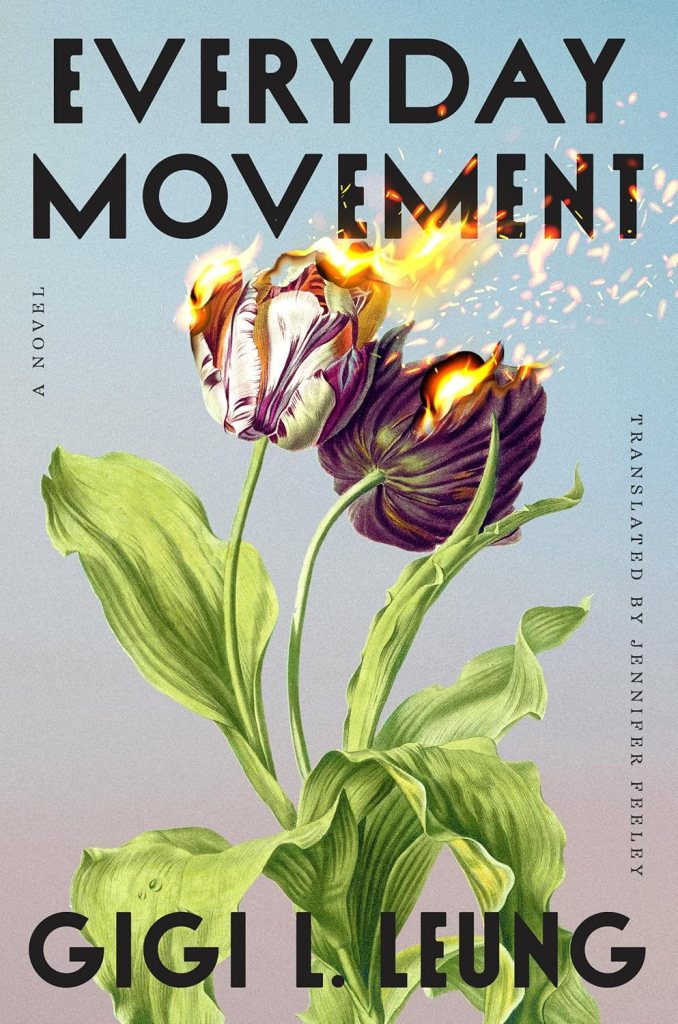
Gigi L. Leung (author), Jennifer Feeley (translator), Everyday Movement, Riverhead Books. 2026.
For some, the 2019 Hong Kong protests were an event that came and passed. Things changed. Life moved on. People dispersed, and many vowed never to look back, like the Hong Kong family I met in Canada who expressed precisely that sentiment.
Even though I lived in Hong Kong through the Umbrella Revolution and during the passage of the National Security Law, I remained an outsider, existing largely within the anglophone world and following developments only peripherally. I read Karen Cheung’s The Impossible City (2022) in the year I moved away from Hong Kong and winced as she disparaged privileged expatriates who were apathetic to the political changes unfolding around them. While I became a new mother at the height of the movement, I also recognised that she was correct about many who possessed the privilege of observing from the sidelines and then departing, regardless of passport nationality.
As someone who had been merely a spectator during the protests, I was eager to read Gigi L. Leung’s Everyday Movement, a fictionalised account of women in the protests written by another female author, who deliberately chose to look back and document this period of Hong Kong’s history.
)
The book opens with an allusion to violence. The opening paragraph describes drinking warm water each day without realising that it is gradually becoming hotter, eventually scalding. “Before you could react, the pain had scorched every inch of its tender surface. It was too late to spit it out. Your entire respiratory tract was ablaze.” The imagery of white steam and an inflamed respiratory tract evokes the experience of being tear gassed, while the transition from warm to scalding water functions as a metaphor for the escalating intensity of the 2019 protests.
This reimagined, behind-the-scenes portrayal of a high-profile event lends Leung’s narrative both legitimacy and authenticity.
We are then introduced to the protagonists, Ah Lei and Panda, in their dormitory room, alongside the ordinary objects of university life, such as makeup, a sun dress, and handbags, seamlessly interwoven with remnants of the protests from a few nights earlier, including a possibly contaminated water bottle and nightmares of a severed, bloodied finger. For context, in July 2019, clashes occurred between protesters and police in the New Town Plaza mall, during which an officer lost his finger. This reimagined, behind-the-scenes portrayal of a high-profile event lends Leung’s narrative both legitimacy and authenticity for readers curious about experiences beyond the news headlines.
In each chapter, we are introduced to Ah Lei and Panda’s wider circle of friends and family through shifting focalisation, the frame through which events are perceived, across different characters and their backstories. The cumulative effect of this layering is a novel that feels vividly alive, with each narrative strand adding colour and depth to a portrait of Hong Kongers during this period. Leung deliberately incorporates a discordance of perspectives to demonstrate how the movement both united and divided individuals.
One night, after preparing Molotov cocktails at their university, Panda and Ah Lei encounter a middle-aged man who remarks, “To be honest, I think the movement is becoming too extreme… That really puts me off.”
In the following chapter, Panda attempts to persuade her boyfriend to vote in the upcoming election, but he resists, “I’ve told you already. I’m not voting… Why do you keep looking for an opportunity to push me to change my mind?”
)
The title, Everyday Movement, suggests that the political movement permeates daily life. Leung’s novel embodies the notion that “the personal is political” through the deeply personal interactions of women at the centre of the protest, particularly the ongoing tensions between Panda and her mother.
Panda’s face suddenly darkened. She tossed the bag she had been carrying to the ground. Its contents, face masks, skincare products, and health supplements her mother had bought for her, spilled out. She was gasping with rage… Sai Mui had never seen her elder sister like this… Just then, Panda opened her mouth, each word stretched tight and forced through her teeth: “I swear I’m never going home.”
This focus on, and exploration of, the female experience gives Leung’s novel a distinctly feminist perspective.
This focus on, and exploration of, the female experience gives Leung’s novel a distinctly feminist perspective, with a structure that highlights the power of community, an important feminist value. Leung makes a point of including differing portrayals of mothers. For example, Panda’s mother texts her, “You’ve been exposed to so much tear gas lately, your pores must be clogged with toxins… Come and get a proper facial.” This contrasts with Ah Mak’s mother, who one day packs up and leaves him to live on his own.
This feminist reading gains additional resonance when considered alongside the political context in which the novel is set. The 2019 protests unfolded under Hong Kong’s first and only female Chief Executive, Carrie Lam, whose public rhetoric cast protesters as wayward children in need of maternal correction.1 After major clashes in June 2019, Lam told viewers in a televised interview that “if I indulge his wayward behaviour, he might regret it after he grows up.” While the state-appointed maternal figure reprimanded rioters and demanded obedience, Leung’s mothers are contradictory, absent, smothering, tender, and overwhelmed, human in ways that resist instrumentalisation. As such, the novel can be viewed as a reclamation of motherhood as lived complexity rather than political posture.
For me, Everyday Movement amplifies the stories of Hong Kong women, the spats between sisters, lovers lost and found amidst violence, and the complexity of female relationships at the height of political tension. Through these tenderly drawn characters, Leung acknowledges what was at stake on the streets, but also reveals what was risked, what broke, and what endured when they returned home.
- For more context, scholar Guo Ting argues in her recent book Religion, Secularism, and Love as a Political Discourse in Modern China (2025) that Lam’s motherly love discourse appropriated the paternalistic and authoritarian governing style of Beijing, working to register political relations as Confucian family relations and to justify government violence as a form of parenting. ↩︎
How to cite: Chan, Rebekah. “Bearing Witness in Gigi L. Leung’s Everyday Movement.” Cha: An Asian Literary Journal, 7 Apr. 2026, chajournal.com/2026/04/07/leung-everyday-movement.


Rebekah Chan is from Toronto and has also lived in Singapore, Tokyo, and Hong Kong, where she completed her MFA at City University in Hong Kong. While in Hong Kong she served as Editor-in-Chief for her MFA legacy anthology, Afterness: Literature from the News Transnational Asia, and held the position of Community Manager for the Hong Kong Writers Circle. In Japan she wrote for the lifestyle magazine Tokyo Weekender. Her literary work appears, or is forthcoming, in Tupelo Quarterly, Blood Orange Review, Wild Roof Journal, Reed Magazine, and more. Rebekah is currently based in Toronto and writes about loss and belonging. Her writing is also supported by the Canada Council for the Arts. You can find her at @bx_writenow on Instagram. [All contributions by Rebekah Chan.]
 Cha
Cha 