
Editor’s note: Leslie Shimotakahara reflects on how a childhood encounter with an institutionalised great-uncle, silenced by internment-era injustice, became her latest novel The Breakwater. She recounts research, family reticence, editorial reshaping, and the imaginative recovery of erased places, presenting writing as an ethical act of remembrance across generations. An excerpt from The Breakwater is available HERE.

Read an excerpt from Leslie Shimotakahara’s
The Breakwater HERE.
[ESSAY] “From Scrapbooking to Novel Writing: Giving Voice to an Unsettling Family Secret in The Breakwater” by Leslie Shimotakahara
Leslie Shimotakahara, The Breakwater, Cormorant Books, 2026. 350 pgs.
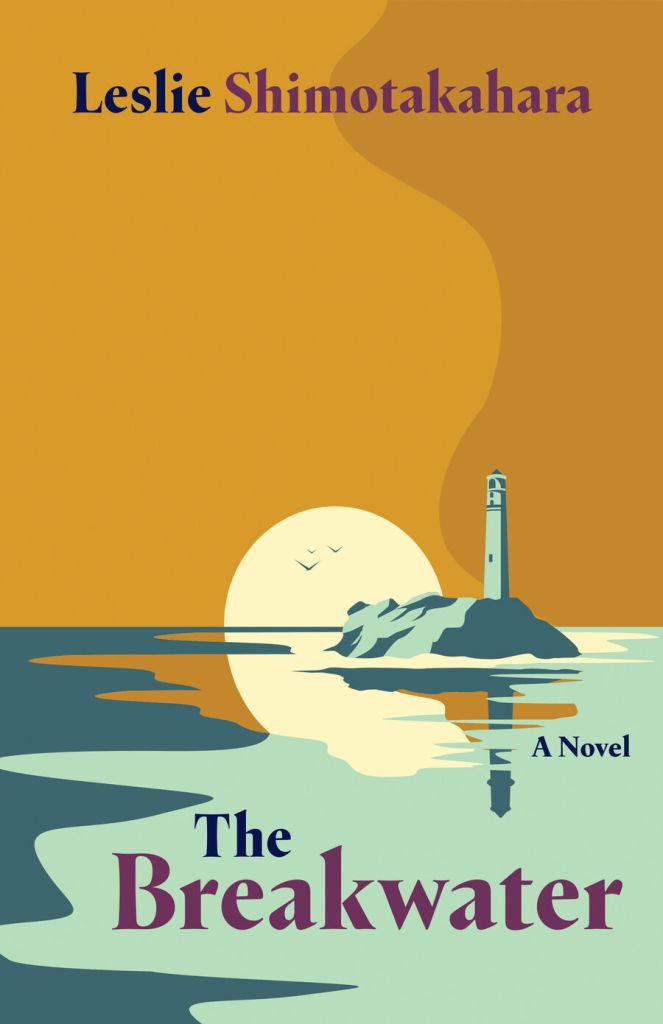
Writing for me begins with a memory, an image. In the case of my latest novel, The Breakwater, it was the recollection of meeting my great-uncle Akira for the first and only time at the psychiatric care facility where he lived on the outskirts of Victoria, British Columbia, circa 1990. I was twelve years old, skinny and awkward, with my teeth in braces. I also wore a fibreglass back brace beneath my oversized clothing, as I was being treated for scoliosis. That summer, my parents and I set out from our home in Toronto on a week-long holiday with my maternal grandparents to Vancouver Island.
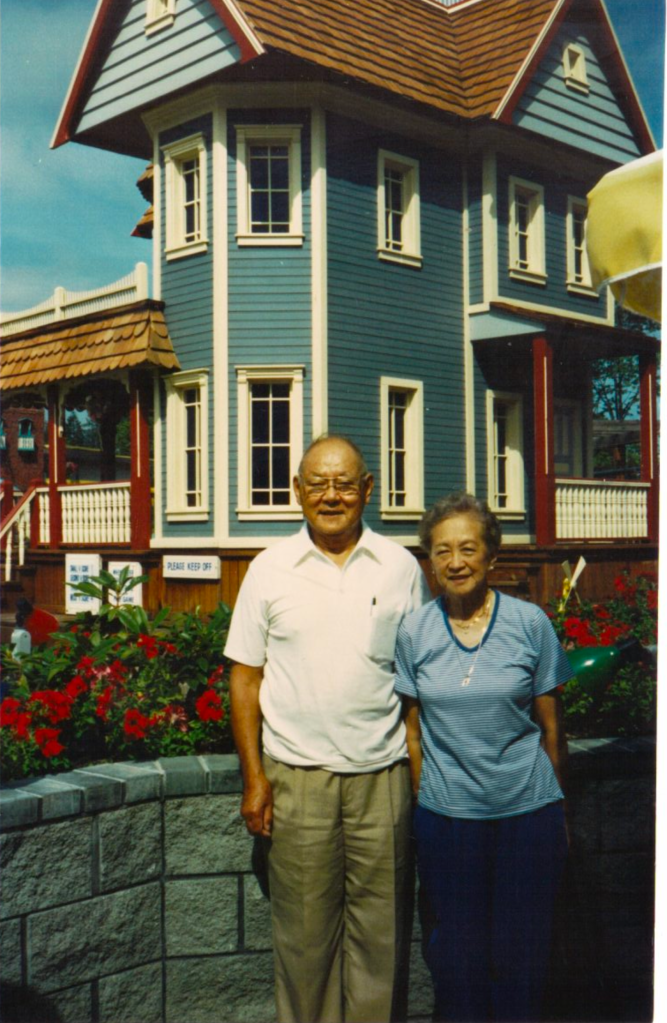
My maternal grandparents
At the outset, I was under the impression that the trip was intended as a final look back at the childhood hometowns my grandparents had inhabited before the Second World War and the Japanese Canadian Internment destroyed their lives and uprooted them forever. I believed the purpose of the journey was educational. I was being given the opportunity to learn about my heritage and the unjust government actions that had led to my forebears being thrown into squalid internment camps, hastily set up in ghost towns, for the duration of the war.
When we were in Victoria, however, my grandfather pulled my mother aside one evening and revealed that the real reason he had wanted to make this journey was that he had a brother in a nearby psychiatric facility. This brother, Akira, whom my mother and her siblings had not known existed, had been institutionalised as a young man at Essondale, the provincial asylum, before the war. Although the family had not intended for Akira to spend the rest of his life there, the Japanese Canadian Internment prevented anyone from ever securing his release. After the war ended, when my grandfather and his family were forced by law to leave the province and resettle in Ontario, Akira was left to languish in British Columbia’s mental health system for more than fifty years. In response to the asylum’s downsizing in the 1960s and 1970s, he was moved between smaller institutions.
My visit with my grandfather to see Akira remains my most vivid and unsettling memory from my youth.
The Breakwater is inspired by these harrowing events. My visit with my grandfather to see Akira remains my most vivid and unsettling memory from my youth. More specifically, it is my recollection of this elderly man’s face that has stayed with me through the decades and haunted my imagination. As I describe Akira in the pages of The Breakwater, he appeared to be a better-looking version of my grandfather, with “snow white [hair], parted on the side, neatly combed down.” Yet as he entered the common area where my family and I were waiting, his strangely elegant appearance quickly dissolved. Upon catching sight of my grandfather, Akira was rendered speechless: “Panic takes hold of him, his shoulders clenching up. He backs up on his heels, a spooked horse about to break free during a thunderstorm. His eyes clamp shut, his big nostrils flare and quiver.” A moment later, a nurse escorted him out of the room. Thus ended our visit in real life, although my novel takes a different, more circuitous course.
That image of my great-uncle in a catatonic state was indelibly imprinted on my memory with the clarity of a photograph. In 2018, when I first began writing about the experience, this mental snapshot offered a vivid source of inspiration from which a larger narrative gradually unfolded. Initially, it became a short story titled “The Breakwater,” published in the anthology Changing the Face of Canadian Literature (edited by Dane Swan and released in 2020). Over time, I reworked and expanded the piece into a novel.
In doing so, I drew upon a range of resources. In the years before my grandfather’s death, I had cautiously attempted, with a detective-like restraint, to ask him questions about his relationship with his brother, never wishing to press him too far. Ever since our failed visit with Akira, I had known the subject to be sensitive and painful. I also spoke with other members of the family in an attempt to gather information. I am particularly grateful to my father for sharing stories my grandfather had told him about the less seemly aspects of Akira’s life. I came to understand that what had prompted the family to have him committed may have been less a matter of mental illness per se and more a matter of wild, rebellious behaviour. Substance abuse. Consorting with prostitutes. Drunken threats directed at his stepmother, who no longer felt safe living under the same roof. Who knows what else? Akira was deemed the black sheep of the family. Competition between the good son, my grandfather, and his ne’er-do-well brother may also have played a role. Following these threads, the novel I have written is as much a story of sibling rivalry and collective guilt as it is an exploration of the history of British Columbia’s brothels, gambling dens, Asian ghettos, mental health institutions, and internment camps. My writing seeks to illuminate a long-overlooked dimension of the internment’s aftermath and a turbulent era in Canadian immigrant history.
In the summer of 2017, my father and I took a road trip around Vancouver Island to reconstruct the journey we had made nearly thirty years earlier, revisiting many of the neighbourhoods and sites we had encountered on the original trip. Victoria, the small city where my grandfather had lived during his youth, was a focal point. The city had changed dramatically between 1990 and 2017. An abandoned building along the waterfront that my grandfather had told us had once been a brothel had, by the time of my second visit, become a high-end condominium development.
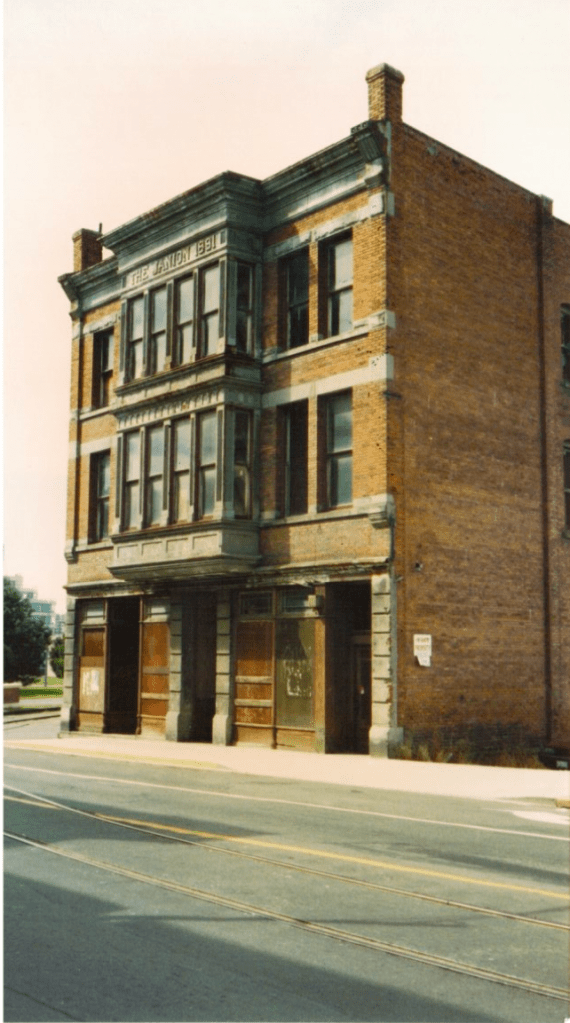
This building, according to my grandfather,
had once been a brothel
On the first trip, my grandfather took us to Ogden Point Breakwater, where he and his brother had fished during their childhood and claimed to have sighted a famous sea monster with a horse-like head. He told us this strange tale as we walked far out into the sea along the dramatic breakwater, its walkway perilously narrow, waves crashing high on both sides. When my father and I returned there on our own, however, the scene no longer struck me as quite so treacherous, because high guardrails had been added along the walkway, reducing one’s sense of proximity to the waves.
Despite exhaustive internet research and extensive driving around Shawnigan Lake, my father and I were unable to locate the facility where Akira had once lived. It had probably been decommissioned and torn down. Its absence somehow seemed appropriate and, in itself, offered a powerful stimulus to my writerly imagination.
In early drafts of The Breakwater, I thought it was primarily a narrative about the tortured relationship between two men, my grandfather and his brother. The novel was narrated from their dual perspectives, weaving back and forth between past and present timeframes. Several years into the writing, however, my editor at Cormorant Books, Marc Côté, challenged me to rethink this structure and to significantly amplify the voice of a secondary character, loosely inspired by my mother. The aim was to foreground how traumatic events of the past, both historical and personal, had shaped subsequent generations.
In the course of carrying out these revisions, I also ended up including a young granddaughter, a character based on me and my recollections of the original trip. Eleven-year-old Tessa is an only child, bookish and introverted, as I was then, and still am to some extent. When Tessa is not reading Agatha Christie mystery novels, she has her nose buried in a scrapbook she is keeping to document the family holiday, including the distressing encounter with her great-uncle.
This is no fiction. On all our summer holidays at that time, I devoted an hour at the end of each day to recording what had happened, pasting postcards, museum brochures, and other souvenirs onto the pages of a notebook. I surrounded these ephemera with explanatory captions, doodles, and personal reflections written in brightly coloured pen. If no postcard could be found to capture a particular moment, I might produce a drawing instead. Writing for me begins with a memory, an image, and keeping a scrapbook diary is not so different from writing a novel, in the end. As time passes, each image gains increasing vividness in the mind’s eye, and a story begins to come into focus around it.
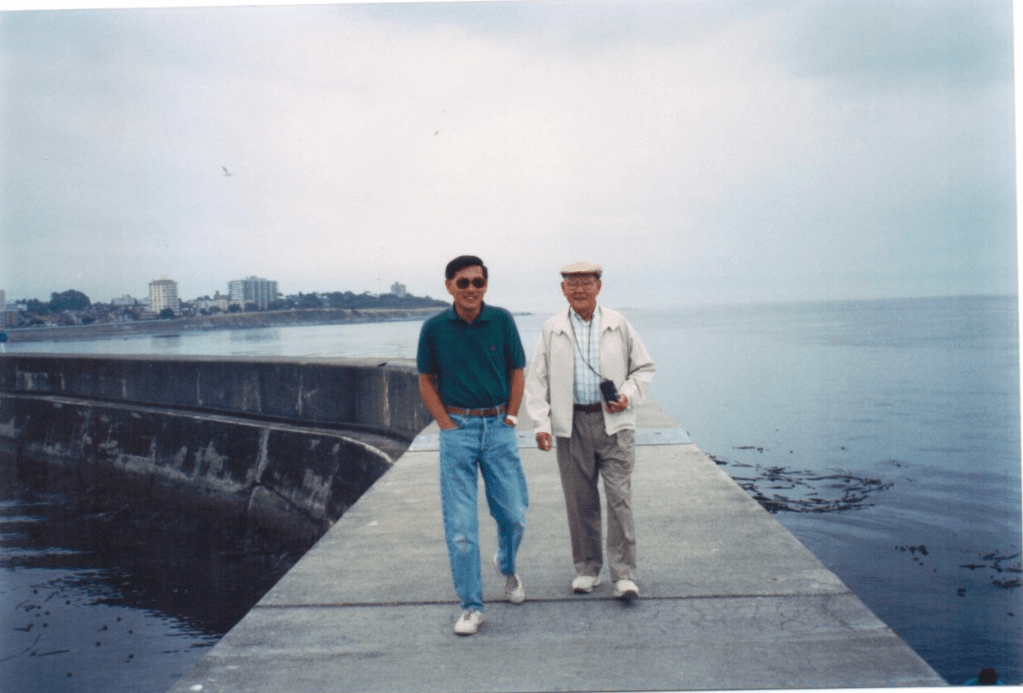
My father and grandfather on that trip to Vancouver Island
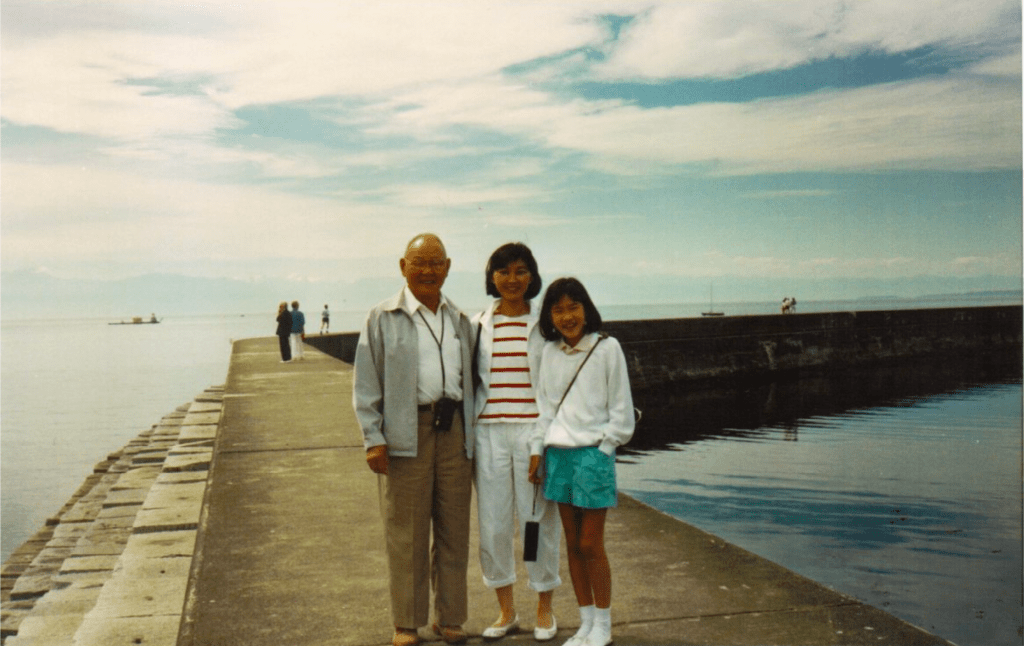
My grandfather, my mother, and me
How to cite: Shimotakahara, Leslie. “From Scrapbooking to Novel Writing: Giving Voice to an Unsettling Family Secret in The Breakwater.” Cha: An Asian Literary Journal, 7 Apr. 2026, chajournal.com/2026/04/07/leslie-shimotakahara.

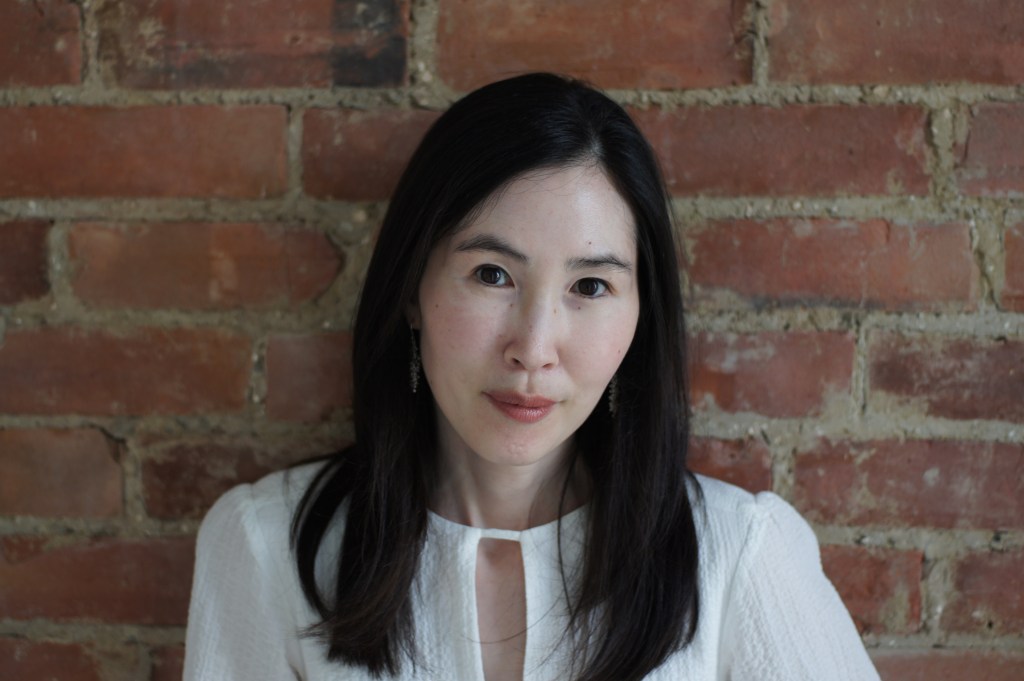

Leslie Shimotakahara is an award-winning author of three novels and a memoir, as well as numerous short fiction and essays. She won the Canada-Japan Literary Prize (2012) and has been shortlisted for the K.M. Hunter Artist Award. Her writing can be found in the National Post, World Literature Today, and anthologies and periodicals. She holds a PhD in English from Brown University, and lives in Toronto with her husband. Visit her website for more information. [All contributions by Leslie Shimotakahara.]
 Cha
Cha 