
茶 FIRST IMPRESSIONS
茶 REVIEW OF BOOKS & FILMS
[ESSAY] “We Are What We Read: Reading Zheng Liu’s Cultural Mavericks” by X. H. Collins
Click HERE to read all entries in Cha
on Cultural Mavericks.
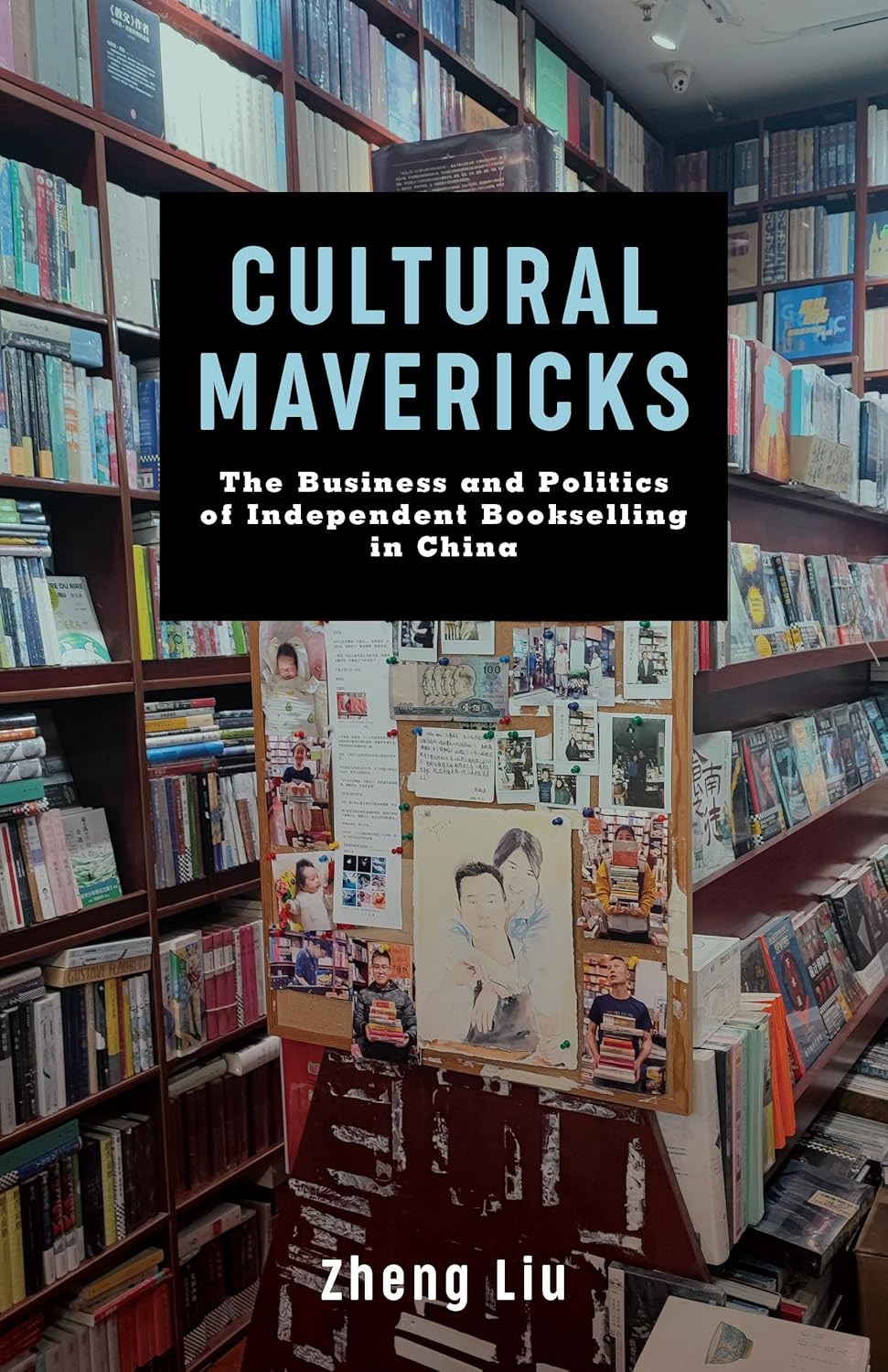
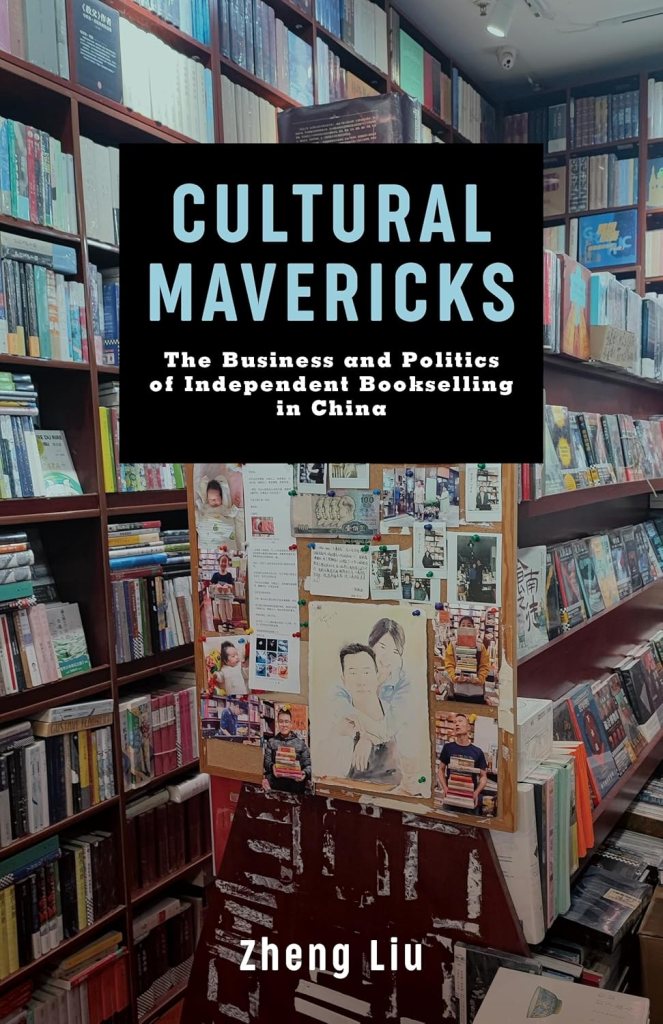
Zheng Liu, Cultural Mavericks: The Business and Politics of Independent Bookselling in China, Cambridge University Press, 2026. 280 pgs.
Some of my earliest memories were formed in my father’s workplace, specifically on the wooden floor beneath the counters of a Xinhua Bookstore.
Some of my earliest memories were formed in my father’s workplace, specifically on the wooden floor beneath the counters of a Xinhua Bookstore, where he worked for ten years, from before I was born until I was about four. There, I developed my first appreciation of books, curling up with one as soon as I could read and taking full advantage of accompanying my father to work, as my mother, being a schoolteacher, could not bring me along. After my father changed jobs, I continued to receive books as gifts from his former colleagues at the bookshop. For me, bookshops are synonymous with “the best place to be”: safe, cosy, and never dull.
It was with this affection for bookshops, as well as the nostalgia of my Xinhua Bookstore days, that I came to read Zheng Liu’s Cultural Mavericks, drawn in particular by its subtitle, “The Business and Politics of Independent Bookselling in China.” Having lived in the American Midwest for almost thirty years, I have, to some extent, become a stranger to my homeland. I return as often as I can, yet China has transformed beyond recognition. During each visit, I make a point of going to one or two bookshops, though I have long known that they are no longer my Xinhua. What, then, are these bookshops? Who runs them? How do they operate? In what ways do they differ from, or resemble, the bookshops I frequent here?
)
Liu’s book is an academic study, and I was initially uncertain whether I would be able to follow it. What might a lay reader such as myself gain from it? Quite a great deal, as it turns out. While I lack the expertise to assess its scholarly merits, I found it extensively researched, well organised, clearly written, accessible, and engaging. Between 2014 and 2023, Liu visited fifty-nine independent bookshops across six cities to gather material. She also joined a WeChat group for independent bookshop owners in order to monitor ongoing developments within the industry, a detail that underscores the importance of such networks in contemporary China. The extended period of research strengthens the work, allowing it to reflect broader transformations within Chinese society.
When I think of “an independent bookshop,” I picture the one run by Meg Ryan in the film You’ve Got Mail, which survives an attempted hostile takeover by a conglomerate chain.
When I think of “an independent bookshop,” I picture the one run by Meg Ryan in the film You’ve Got Mail (1998), which survives an attempted hostile takeover by a conglomerate chain only because its owner, played by Tom Hanks, retains both his humanity and, of course, his affection for her. I suspect I am not alone in this association. In China, however, owing to the state’s presence within the cultural sphere, matters are neither so dichotomous nor so straightforward as a simple opposition between large-scale capital and small-scale local enterprise. Liu devotes considerable attention to defining what constitutes an “independent bookshop,” or duli shudian (独立书店), within the Chinese context. According to Liu,
The Chinese term for “independent,” duli (独立), conveys a nuanced sense of standing out and being noticeable, a connotation absent in the English word independent. In English, independent generally signifies two main ideas: autonomy from external control and self-sufficiency. In contrast, duli carries richer meanings, which may be the source of Chinese independent bookstores’ emphasis on distinguishability and recognizability.
Liu proposes three criteria for this definition. First, and most importantly, an independent bookshop must not be state-owned, a distinction that separates it from a Xinhua Bookstore. Second, it must not be corporately owned and must retain the autonomy to select its books and make operational decisions, in other words, not Tom Hanks’s but Meg Ryan’s shop. According to Liu, privately owned bookshops first emerged in China during the late 1970s and 1980s, yet self-identified “independent” bookshops did not appear until the mid to late 2000s. The distinction between corporate and independent, however, is not entirely clear-cut. Non-book corporations, including venture-capital investors, may invest in independent bookshops, as such ventures can enhance their brand image, value, and reputation. Third, the shop must possess its own “personality,” or gexing 個性, defined as “an ability to offer alternative perspectives and maintain intellectual autonomy.” This criterion is the most difficult to delineate, yet for some booksellers it constitutes the very essence of what duli signifies.
Of these, only the second criterion can be readily applied to define an independent bookshop in the United States, which is the focus here, given my unfamiliarity with those in the United Kingdom. Liu contends that Chinese independent bookshop owners tend to overemphasise their cultural commitments, valuing cultural prestige above economic gain, with the result that their shops function, in effect, as not-for-profit enterprises. Many owners have alternative sources of income and do not depend on their bookshops for their livelihood.
My experience with local independent bookshops in the United States offers some anecdotal support for Liu’s observations, while also contradicting others. Chinese independent bookshops collectively reject best-selling “popular” titles, regarding their inclusion as contrary to their cultural and intellectual mission. They favour scholarly works, serious non-fiction, and literary writing. By contrast, a visitor to an American independent bookshop is likely to encounter best-selling titles from sources such as the New York Times, USA Today, and selections from Oprah, Weese, and Jena’s book clubs, alongside a modest shelf, often tucked into a corner, devoted to works by local authors, whether published by small independent presses or self-published, and unlikely to appear in a Barnes & Noble.
At the same time, contrary to Liu’s observations, American booksellers do recommend titles to readers, if not always overtly or verbally as their Chinese counterparts do, then through curated “staff picks.” Independent bookshops in both China and the United States adopt similar strategies to sustain their businesses, including the addition of cafés, the sale of non-book merchandise, and the hosting of cultural events. One of my favourite, though regrettably short-lived, local independent bookshops, which closed after only three years due to insufficient profit, hosted readings, book signings, art exhibitions, and even knitting classes. Booksellers in China and in the West confront many of the same challenges today, chief among them large online retailers capable of offering steep discounts and free shipping, as well as a declining readership increasingly drawn to digital screens. Despite these pressures, those who cherish books continue to share a kindred spirit, striving to preserve and promote what they love. As I unwrap a newly arrived book from Bookshop.com, I find myself wondering whether a similar organisation might one day emerge in China, enabling independent bookshops to collaborate and support one another. Yet this raises a further question: would they still be considered “independent”?
)
In addition to defining the “independent bookshop,” Liu offers comparisons and contrasts between the Chinese book industry and its Western counterparts, thereby providing readers with a useful framework for understanding unfamiliar material. Through this approach, I acquired a range of intriguing, even surprising insights, not only about China but also about the United States. For instance, while privately owned publishing companies do exist in China, only state-owned publishing houses possess the legal authority to publish books. How, then, does this system function? The most common practice is for a private company to purchase book numbers from a state publisher. Alternatively, a private company may obtain an eligible supervising organisation, a state-affiliated body such as a government department or a major state-funded university. This arrangement offers a revealing example of how capitalism operates in China with Chinese characteristics. I am also curious about how the immensely popular and highly prolific Chinese web novels, wangluo xiao shuo 網絡文學, are regulated, a subject that I hope the author may one day explore further.
Conversely, I also learned about the practice of paid book placement in the United States. Liu cites data from John B. Thompson’s Merchants of Culture, explaining that, in order for a book to secure “a prominent position on a front-of-store table across all branches of a major US chain bookstore,” a publisher must pay approximately “$10,000 for a two-week period,” and around “$3,500” for “less central locations.” Highly sought-after positions, such as a stepladder display, can cost as much as “$25,000 for just one week.” Here, one encounters capitalism in its most direct form.
)
When a Western reader, even a progressive one, encounters information about China, she often seeks a narrative that confirms her pre-determined view, even if only subconsciously. When such confirmation is not forthcoming, she may question the credibility of alternative accounts. As a member of the Chinese diaspora who immigrated to the United States in my late twenties, having spent half my life in China and the other half in the United States, I believed myself better equipped to resist the pull of this pre-framed Western lens. I was mistaken.
Several years ago, for instance, a friend gave me her Kindle, which had become “useless” after Amazon withdrew from China. Without examining the reasons behind Amazon’s departure, I assumed that it must have been related to government intervention. Liu, however, presents a different account. Amazon entered the Chinese market in 2004 through its acquisition of the Chinese firm Joyo.com. By 2014, it held a 25 per cent share of China’s online book market, second only to Dangdang. Yet by 2016, its share had declined to 16 per cent, while Dangdang maintained 45 per cent and another Chinese company, JD.com, rose to 21 per cent. This, rather than political pressure, explains Amazon’s exit in 2019.
The Amazon case exemplifies what Liu identifies as a “significant contribution” of her work, namely a more nuanced approach that challenges “the dominant resistance narrative in English language literature on Chinese cultural production.” Liu explains,
… much of the existing English-language literature on this topic is shaped by a narrow resistance discourse, which portrays nonstate media and cultural creators as politically motivated and ideologically driven to challenge the state and state-sanctioned practice and order in the Chinese media and cultural fields. In contrast to this simplified view, my analysis shows that much of the so called political contestation exhibited by nonstate media and cultural participants, such as independent bookstores, should be more precisely understood as an act of political framing–a strategic tool used to advance their cultural and economic objectives rather than to fulfill confrontational political agendas.
“Political framing” is one of the three “culturally adapted” strategies employed by Chinese independent bookshops that Liu identifies in the book. The other two are “moral positioning” and “cultural distinguishing.” Liu argues that this concept of “culturally adapted strategy” should serve as “a central analytical framework for understanding the practices of independent bookstores in China.” The strategy of political framing does not constitute activism in the sense of “evoking grievance and instigating rebellion.” These bookshops are not politically motivated; rather, the strategy “stems from the bookstores’ concern about the influence of political power in cultural production.” The strategies of moral positioning and cultural distinguishing represent booksellers’ resistance to “the rising power and growing dominance of commercialism in book retailing.” Together, these three strategies enable independent bookshops in China not only to maintain their autonomy from state influence but also to survive within a highly competitive bookselling industry.
Liu presents compelling evidence to support her argument that independent bookshops in China employ “political framing” to serve particular functions. She describes a Beijing bookshop divided into three thematic sections, each marked by large, highly visible signs reading 宪政, 自由, and 民主 (constitutionalism, freedom, and democracy), thereby creating a distinctive political atmosphere. An old birdcage containing a piece of paper bearing the Chinese and English words for power served as a visual representation of the well-known political slogan “Put power in a cage.” Here, power refers not only to bureaucratic abuse, as in the slogan’s original usage, but to political power more broadly.
Other independent bookshops may be less explicit in expressing political views, yet they often cultivate a “Western cultural ambience” as a form of political framing. Liu describes distinctive interior designs, including “large black-and-white posters of renowned Western writers—Albert Camus, Ernest Hemingway, and Franz Kafka—hung on the walls, a striking black cross at the end of a hallway, and a large picture of a music band (The Rolling Stones?) on the ceiling.”
The fact that such politically charged displays can exist without direct government interference is revealing, as are other anecdotes Liu records. In one case, a venture-capital-backed bookshop cancelled an event featuring a politically controversial author due to pressure from its investor. The publisher subsequently relocated the event to an independent bookshop, where it proceeded without issue and without any apparent government intervention. In another instance, after being asked to cancel an event featuring “a law-breaking speaker,” an independent bookshop chose to discontinue its entire lecture series, which had frequently featured “politically sensitive figures.” This decision was made voluntarily, rather than as a result of an official ban. In yet another example, an independent bookshop received a 100,000-yuan subsidy from its local government in 2022. The owner used the grant to refurbish the premises, including removing an in-store café that had struggled during the COVID-19 pandemic and reallocating the space for additional books. While it remains difficult to determine the precise role of the government in the day-to-day operation of independent bookshops, one conclusion seems clear: it is unwarranted to assume that any given difficulty must necessarily be attributed to state intervention, or that Chinese people uniformly resist their government.
In every Chinese bookshop I have visited, translated works from around the world occupy prominent display alongside Chinese titles.
One particularly striking observation Liu makes concerns the “innovative use of scholarly books to harness their symbolic power to convey political meanings.” Equally intriguing is the classification of works such as George Orwell’s Nineteen Eighty-Four and Animal Farm as scholarly texts. Liu quotes a bookseller from Suzhou: “…I always put George Orwell’s 1984 and Animal Farm on our recommended books table because we share their ideas on authority and authoritarianism and want our customers to read them.” According to PEN America, these two novels rank among the most frequently banned classic books in schools in my home state of Iowa. This juxtaposition is both ironic and revealing. It underscores the extent to which reading practices, as well as the cultural and political contexts that shape them, differ across societies. In every Chinese bookshop I have visited, translated works from around the world occupy prominent display alongside Chinese titles. This is not a pattern I have observed in the bookshops I have visited in the United States. To be candid, I recognise in myself a similar limitation: I seldom read translated works, even those written in my mother tongue, and the only time I keep a stack of Chinese books by my bedside is when I am in China.
)
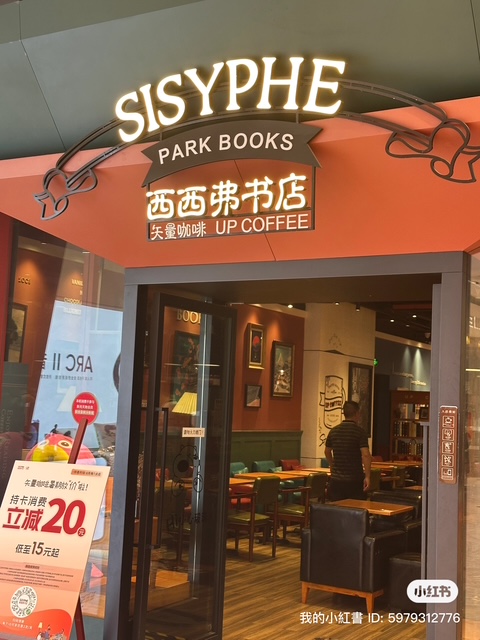
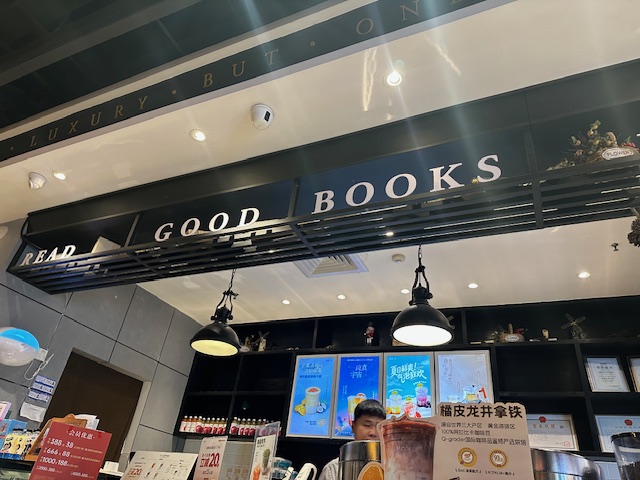
Picture by the author
One of the final discussions Liu undertakes is a case study of the popular bookshop Sisyphe. I was somewhat surprised to find Sisyphe categorised as an independent bookshop, as I had assumed it to be a chain. Liu provides a brief history of Sisyphe, acknowledging that although it was once regarded as “an exemplary independent bookstore,” its status has been questioned following its rapid expansion and its sale of “too many bestsellers.” Sisyphe happened to be the one bookshop I visited in August 2025. I asked a friend for recommendations of bookshops to visit in Wenjiang, a suburb of Chengdu, and she provided an AI-generated list. The AI apologised for the absence of large chain bookshops in Wenjiang before offering a curated selection of five, along with descriptions of the kinds of readers they might suit: Wenxuan, a branch of Sichuan Xinhua, described as the largest, with the widest selection and the most comfortable environment; Sisyphe, noted for its café and popular titles; and three others unfamiliar to me, one a Chengdu favourite with local character, suited to quiet contemplation but with fewer books, another specialising in study guides and supported by in-store teachers, and a third known for its artistic atmosphere, coffee, and snacks, though with a smaller and more expensive selection.
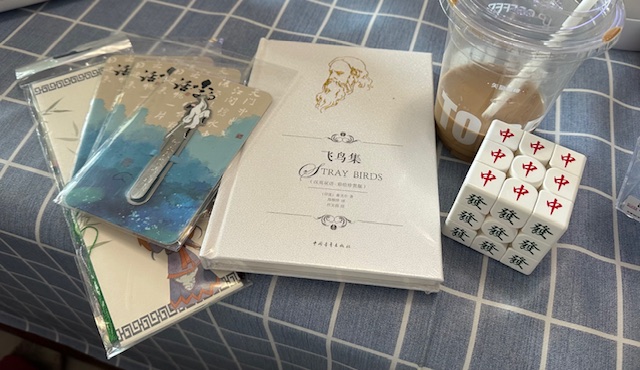
Opting for a convenient five-yuan electric-tricycle ride, I made my way to Sisyphe, located in a large shopping centre beside a Tim Hortons, on a sweltering day during one of the hottest summers on record. As I closed Liu’s book, I revisited the photographs I had taken that day to refresh my memory. I sat in Up Coffee, attached to the bookshop, and enjoyed an iced oatmeal latte. Among the translated works that caught my attention were A Room of One’s Own by Virginia Woolf, Silent Spring by Rachel Carson, Educated by Tara Westover, and The Visual Art of Super Mario, which featured a Sisyphe special-edition cover. My purchases were modest: a couple of bookmarks as gifts for friends, a mahjong-themed Rubik’s cube for my son, and an edition of Stray Birds by Rabindranath Tagore. Several translations of this work were on display, all bilingual English-Chinese editions, beautifully illustrated. These days, when I travel, I rely on my fully loaded Kindle for convenience. Yet my affection remains with physical books, and on that day I could not leave without taking one with me. I found myself longing to hear the “stray birds of summer,” sung for more than a century.
After reading Liu’s book, I felt compelled to visit more independent bookshops in China. Which ones in Chengdu should I explore this summer?
After reading Liu’s book, I felt compelled to visit more independent bookshops in China. Which ones in Chengdu should I explore this summer? I follow an account called “Chengdu Independent Bookstores” on Rednote. At the time of writing this reflection, the account listed events taking place across various independent bookshops in Chengdu during the week of 30 March to 5 April 2026. These included a screening of Mel Gibson’s Apocalypto, a book-club discussion of The Stranger by Albert Camus, a screening of the French film India Song, a “thinking marathon” led by the translator of The Road to Serfdom, and a range of discussions on topics such as “what is your social style?”, “what will an omnivore eat?”, and “should we advise young people to do whatever they want?” I have a strong sense that there will be no shortage of bookshops to visit, nor of things to read and do.
How to cite: Collins, X. H. “TWe Are What We Read: Reading Zheng Liu’s Cultural Mavericks.” Cha: An Asian Literary Journal, 6 Apr. 2026, chajournal.com/2026/04/06/liu-cultural-mavericks.


X. H. Collins was born in Hechuan, Sichuan Province, China, and grew up in Kangding on the East Tibet Plateau. She has a PhD in nutrition and is a retired biology professor. She is the author of the novel Flowing Water, Falling Flowers (MWC Press, 2020), and has published short stories and essays. She now lives in Iowa with her family. For more information, visit her website and follow her on Twitter, Facebook, and Instagram. [All contributions by X. H. Collins.]
 Cha
Cha 