

[ESSAY] “Lost and Found in Languages” by Qinxian Bonnie Ran

Photo by Peicen Yan
The Failure
of Poetry
Ma, I read a poem today:
—the walls have been mortared with grief, dark enough
To make blindness as a gift—we don’t have to look each other in the eyes
…
When I do hear, the only thing my mom says is,
How much longer? I prefer that to what she wrote
In florescent paint on the ceiling last weekend:
What does he do with all the lightbulbs?
—“As a Consequence of My Brother Stealing All the Lightbulbs”, ll. 46-53.
In this poem, Natalie Diaz explores the impact that her addicted brother has on her family. Her brother steals the lightbulbs in the household and repurposes them as pipes to smoke drugs. “Lightbulbs”, an object that brings light, function as a metaphor for hope. The absence of lightbulbs therefore produces darkness in the house, both literally and metaphorically. Because of her brother’s addiction, Diaz and her family lose not only light but also hope.
Her mother, for example, asks, “How much longer?” rather than “What does he do with all the lightbulbs?” This suggests that her mother is already familiar with her brother’s addictive behaviour and the darkness he brings. However, she does not know when it will end, or whether it will end at all. Diaz, too, feels ashamed and hopeless for her brother, yet cannot avoid confronting him and his addiction because of their familial bond. She is thus left helpless, witnessing such a family tragedy without the ability to intervene. The pain is so intense that she comes to appreciate the darkness her brother brings, as it offers the only momentary escape from confronting reality. She writes, “Dark enough / To make blindness as a gift—we don’t have to look each other in the eyes.”
Again, I knew you’d say
you didn’t understand poetry,
either those written by me or others.
Again, I knew we’d hide our fear, our hope, and
our secret in this tiny, dark room that
only we knew & avoid talking to each other,
writing in a language that no one understood &
in the corner that no one could ever find. But
Amber, there’re
so many things you didn’t know &
so many things I didn’t know.
)
This afternoon, I was thinking about how you gave birth to me. During the winter of 2002, Shanghai was blanketed in snow, a sight I have rarely encountered since. A year earlier, you had married your dream lover, that intelligent boy you had known since high school, my father. You could scarcely believe that both of you had secured well-paid positions in this vibrant city with a name you had previously encountered only in the news. With unease and uncertainty, yet above all a sense of anticipation for your future, you moved there and eventually made it your home. “A new life,” you murmured. Meanwhile, you had not abandoned another lifelong aspiration, applying to graduate school, until those snow-filled days arrived before spring.1
As you once said, I was the daughter of snow.
Ma, I have just realised that I never asked whether you had seen snow in your hometown before. What did snow mean to you? A source of playful delight or a cause for concern? I never knew. I remember the first time I saw snow after 2002. It was 2010. The heavy snowfall kept me from going to school, and I spent the entire day playing snowballs with you, Dad, and our neighbours. I was so happy that day, so happy that I could not imagine that one day I would complain about the snow while stranded in the upstate. As you once said, I was the daughter of snow.
That snowy winter, I gently spoke to you in your belly. A new accident. “Was I a dawn, or a war between your legs?” (“The Red Blues”, ll. 1 and 28). Yet at least I would never be your “period of exile” (“The Red Blues”, l. last), since my coming interrupted your cycle. You had planned to have a child in your thirties, so why did I arrive in the winter of 2002? You wished to complete your doctoral degree and become a qualified doctor before pregnancy, so why did I arrive then? You wanted to purchase a larger apartment near a reputable school district, so why did I arrive then? You thought of me and your boy, as well as your education, career, income, and future. You wiped your tears away and told me:
“Because of you, I live with light.”
)
Ma, you were a well-prepared mother. Always, always.
I became your abecedarian poem.
You told me that I must learn English well from the age of three. You said, “By learning this lingua franca, you can go farther and farther.” Then you gave me an English name beginning with B, because yours begins with A. I never knew why you named yourself Amber, or whether you understood the origins of Bonnie. From Latin to French to English, bonus/a/um became bon/bonne, and then bonnie, yet its meaning, good, beautiful, kind, and every other positive word one might imagine, remained unchanged. But that did not matter. What mattered was that you said, “By naming my girl a name beginning with B, I feel a sense of continuation.” I became your abecedarian poem.
Then I wrote my name, Bonnie, which never appeared in my legal documents, on all my schoolwork. Before others asked for my real name, before English became my mask, before “accent became my anchor”,2 let me tell you this: in English, we use tenses everywhere. Let us try:
07. The Past Simple is used to talk about completed actions that happened at a fixed time in the past (English for Everyone, p. 24).
So, if you were to say “我曾經是醫生”, rather than “I am a doctor in the past”, you would say, “I was a doctor”, as straightforward as its name, the past simple. I was certain that you would learn it quickly, because English seemed simple. But your life was not. You were indeed a doctor. Yet, many times, you told me that you still wanted to be a doctor and were always striving to become a better one. I thought you might prefer the perfect tenses, as explained in the following:
11. The Present Perfect Simple is used to talk about events in the recent past that still have an effect on the present moment (English for Everyone, p. 34).
So, our model sentence would become, “I have been a doctor.”
Now that you understand the present perfect simple, would you like to read the poems I mentioned earlier a second time? If you wish, you may repeat after me. “The walls have been mortared with grief…” (“As a Consequence of My Brother Stealing All the Lightbulbs”, l. 46). As I explained, the present perfect simple indicates that an action continues to affect the present. This suggests that, for Natalie Diaz, her brother’s addiction continues to shape her, her entire family, and even the walls of their home.
But my poem was different, or at least I hoped it would be. I therefore used the simple past deliberately when I wrote “you didn’t understand poetry”, “so many things you didn’t know &”, and “so many things I didn’t know”. In doing so, our fears, hopes, memories, and forms of avoidance would remain confined to the past.
But do we truly need grammar lessons when telling stories?
Ma, I hoped this would not annoy you. I knew you would say, “I will have to work hard to catch up with you, so that I can understand your poems and translations someday”, as you always did. I knew you worked tirelessly to achieve everything you desired. Learning something new is valuable. But do we truly need grammar lessons when telling stories?
)
Natalie Diaz did not write exclusively in Mojave. Poetry, particularly Anglophone poetry in America, failed her, as she finds it painful to represent her identities and sense of belonging in English, a language imposed by colonisers. She therefore interweaves English, Spanish, and Mojave in her work to locate her voice within Anglophone America. She observes, “We need to grieve, and the English language and lexicons we have been given for grief teach us that it’s not natural to grieve” (Jamail and Diaz).
From 1860 to 1978, “approximately 357 [Native American] boarding schools across 30 states both on and off reservations … housed over 60,000 Native children.” Operated by Christian missionaries and the federal government, these institutions forbade Native Americans from speaking their own languages (Mejia). The consequences of enforcing English continue to shape Native American communities today. “Today, approximately 167 Indigenous languages are spoken in the US, and it’s estimated that only 20 of these languages will remain by 2050” (Andrews).
Ma, we should be grateful that we still retain our own language. It is the greatest gift we have given each other.
The Death
of Language
Our language, Chinese, has no explicit markers for tense or number. We cannot express an event’s continuing impact in the way that the perfect tenses do in English. Instead, we have images, which allow us to perceive and experience meaning directly. In English, I wrote about metaphors frequently when composing essays on poetry. Yet metaphors can never achieve what imagery does in Chinese.
When you see the word “spring” (春), you immediately envision blooming grass3 and the shining sun (日). When you see the word “winter” (冬), you perceive a knot that symbolises an ending (夂)4. When you see the word “poem” (詩), you recognise a temple of words (言 and 寺). When you see the word “love” (愛), you perceive the heart (心) within it. In Chinese, writing has never been governed by logic alone. Rather, it is an act of visualisation, of rendering what one imagines into form. Whether it is heritage, love, hope, or trauma, one draws it and confronts it directly.
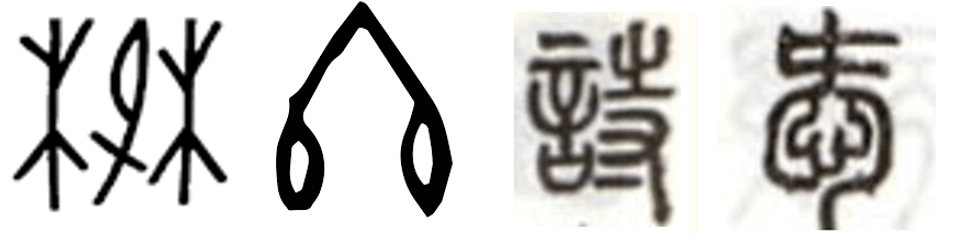
From left to right are the oracle bone script (jiaguwen, used in 1250 –1050 BC) for “春” (spring) and “冬” (winter), and small seal script (xiaozhuan, used in 500 BC – 200 AD) for “詩” (poem) and “愛” (love).
)
Language dies twice in Obit. One of these moments occurs when Victoria Chang recounts witnessing her mother struggle to read the night person’s notes:
…Couldn’t breathe, 2:33 AM. Screaming, 3:30 AM. Calm, 4:24 AM … I wanted the night person to write in a language I could understand. Breathing unfolding, 2:33 AM. Breathing in blades, 3:30 AM. Breathing like an evening gown, 4:24 AM … (Chang 12)
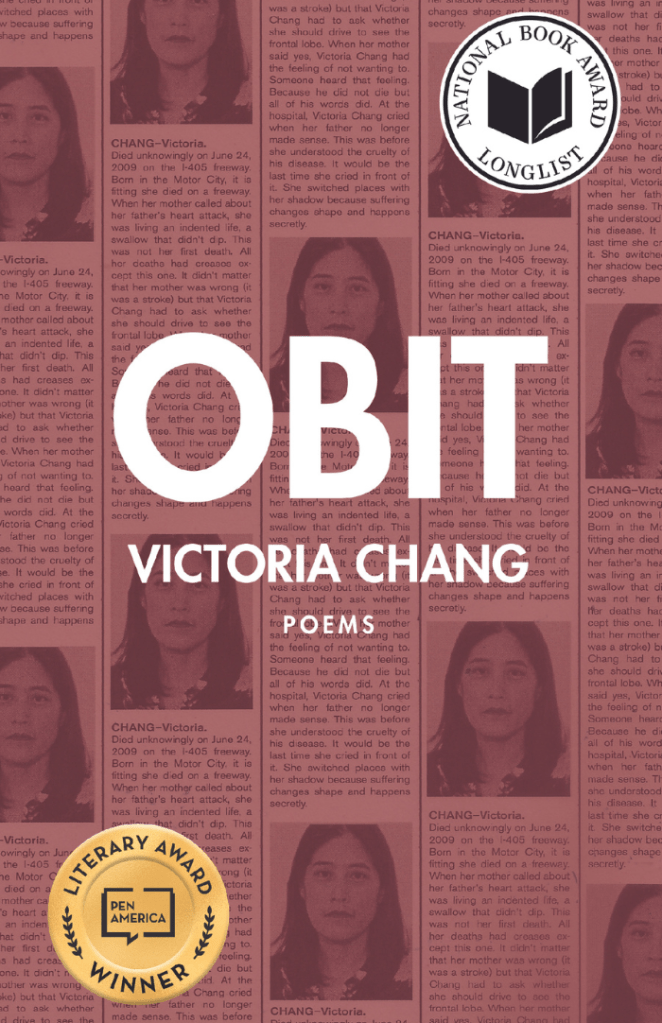
In 2015, Victoria Chang’s mother died of pulmonary fibrosis, a chronic lung disease. Before her passing, Chang hired a night person to record her mother’s breathing patterns, which were connected to her condition. The night person’s notes were precise and detailed within a medical and scientific framework. She carefully documented each change in breathing, “2:33 AM…3:30 AM…2:33 AM…3:30 AM…4:24 AM…” She also employed various modifiers to describe these changes, “unfolding,” “calm,” “in blades,” “like an evening gown.” Both approaches demonstrate the night person’s meticulous monitoring of Chang’s mother’s health.
However, for Chang, the night person’s language had died. The words were cold and dehumanising, reducing her mother to a problem rather than recognising her as a person. They never conveyed the moment when Chang’s father had a stroke and her mother was left at a loss, when there were “so many things that [they] weren’t ready or equipped to deal with”; they never conveyed that “[she hasn’t] had a cohesive conversation with [her father] in about twelve years”; they never conveyed how, “when there’s grandparent’s day at school, she [felt] sad that [her] kids never really got to know [her] dad or [her] mom too much” (Rodriguez and Chang).
Would our language, the language that can visualise our heritage, love, hope, and trauma, also die?
Ma, we were both familiar with the grief Chang experienced. Would our language, the language that can visualise our heritage, love, hope, and trauma, also die?
)
Three years ago, my father’s hypertension and diabetes progressed to uremia. Before his kidney transplant surgery, he had to undergo haemodialysis three times a week. That same year, I left for university. I moved to the other side of the world, where it snows for half the year. That left you as the only person to accompany Dad during this difficult time.
Ma, all the medical knowledge you acquired was meant to prepare you to become a doctor. At that time, you went to the hospital with Dad three times a week. You had spent years learning the definitions, causes, symptoms, and treatments of “hypertension”, “diabetes”, and “uremia”. You used all the biological and medical terminology you had mastered over the years to discuss his illness and treatment with his doctor. Yet you were not his doctor. You were his wife.
You told me about Dad’s condition in Chinese. A native language is meant to preserve cultural heritage; Chinese is meant to render our thoughts vivid and visible. Yet your language failed you. It only made you feel more vulnerable. Like those notes written by the night person in Chang’s poem, the word “illness” in Chinese (病) is also a simple, scientific term. It could not convey the many layers beneath it.
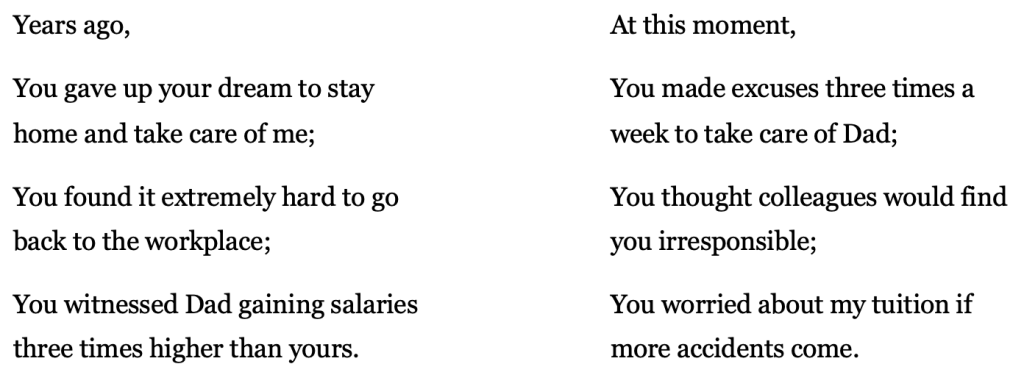
You wondered what might have been if none of those events had occurred, if you had truly become a doctor. Yet in the hospital, all you saw was the Chinese character for “illness” (病).5 At the sight of it, you immediately visualised severe disease (疒) and felt its coldness. Why did Spring not bring spring?6 Your language failed you again. You chose to fall silent, telling me only, “I felt so cold.”
All I could see was “冬”. Winter. The knot. The end.
My language failed me as well. You and Dad sent me here to study Literature, even though you often said that you did not understand the poetry and fiction I read. I thought about everything I had learned about language, meter, metaphor, and form; character, setting, and plot; New Criticism, Structuralism, and Deconstruction. Yet how could my language contend with the snowfall, the sixteen-hour flight, and the thirteen-hour time difference? I felt ashamed of my inability to help you and Dad. All I could see was “冬”. Winter. The knot. The end.
Lost and Found
in Translation
Language also dies in Don Mee Choi’s DMZ Colony. She was born in South Korea, which she describes as a former Japanese colony and “a neocolony of the US, politically, militarily, and economically.” She therefore identifies “Japanese [as her] father’s colonial language” and “English [as her] neocolonial language” (“WiT Month: Q&A with Don Mee Choi”). Neo-colonial and colonial languages, Japanese and English, are, after all, the languages of occupiers. How can one tell their stories using languages that signify oppression, trauma, and death?
In Choi’s account of Mr. Ahn Hak-sŏp, a former political prisoner living near the DMZ, Ahn describes his traumatic encounters with Japanese and American military forces, as well as with the languages Japanese and English. He recounts, “…if you don’t speak Japanese then you couldn’t get a permit to travel…many young women were taken as comfort women and young men were conscripted into the Japanese military or into forced labour…I really thought America liberated us…in Incheon when people came out to welcome the Americans they were shot indiscriminately” (p. 28-29). For Ahn, Japanese was imposed by Imperial Japan, while English became the language through which Korean people attempted to “welcome” American soldiers, only to be “shot indiscriminately.” Both colonised and not fully sovereign, the Korean Peninsula remained “a country that [was] not a country, a divided country” (p. 20).
The loss of identity and belonging caused Ahn profound pain, even when recounting these experiences in Korean. He repeatedly paused within his fragmented sentences, a pattern emphasised by Choi’s deliberate use of ellipses. Remembering such inhumane treatment is itself unbearable, so painful that “[he would] leave up to [our] imagination…” (p. 30).
)
Ma, we were both familiar with what Mr. Ahn, Choi, and his father were going through. Grandfather recounted these wartime memories to us repeatedly. During World War II, Imperial Japan conquered and colonised territories across East Asia, Southeast Asia, and the Pacific, from the Korean Peninsula to Northeastern China, Burma (Myanmar), Thailand, and beyond, killing millions of local people. We were equally familiar with what followed. Our ancestors fought for their freedom and gained independence from Imperial Japan. Such a decolonising struggle indeed merits recognition. We reclaimed our language, our most powerful weapon. Grandfather would often tell us, “We were truly fortunate. For I love our country so much.”
Patriotism. “Patriot” plus “ism”. I murmured, reflecting on two Greek words, “πατρίς,” meaning “of one’s fathers, one’s fatherland, country,” and “πατριώτης,” meaning “fellow-countryman” (LSJ). Neither English nor Chinese has grammatical gender, yet the root of patriotism is bound to masculinity. I thought of the same wartime narrative, but from your perspective. When Grandfather proclaimed his loyalty to our country, he attempted to abandon you at birth. When he celebrated the National Day, he declared that you were useless because you were a woman. As women, we remained colonised subjects under patriarchy.
)
Languages failed us repeatedly; languages died repeatedly. In Chinese, we were both wounded by visualised trauma; in English, Don Mee Choi, Victoria Chang, Natalie Diaz, you, and I all lost ourselves; in Greek, we were silenced by gender-biased roots. Moving among these languages, I reflected on the word “translation.” From the Latin root “translatus”, the passive form of “transferre”, “to translate” denotes a passive act, meaning “to be carried across.” Languages were carried by confessional writers: Mojave was carried across Anglophone America by Diaz, Korean was carried across the Pacific Ocean by Choi, our family histories were carried by you to me, and these languages were carried among one another by me. Yet languages died as often as they were carried across boundaries. Trauma, grief, and hopelessness were all that language and translation seemed to offer us. What we needed was change.
An interpreter between English and Korean, Choi showed me that translation could bring about change.
An interpreter between English and Korean, Choi showed me that translation could bring about change. For her, translation was not merely a passive act of transliteration or conversion from one language into another. Instead, she defined her practice of translation as “an anti-neocolonial mode [that could] create other words” and “mirror words [that were] meant to compel disobedience, resistance.” She offered several strategies: (p. 1) “avoid translating poets who perpetuate conventionalised ‘female’ language or patriarchal language;” (p. 2) “use translation, translingual punning, collages, and reversed words in order to generate mirror words”; (p. 3) “use translator’s note as a way of establishing literary and political contexts” (“WiT Month: Q&A with Don Mee Choi”).
Let’s start with words:
1. Instead of saying “πατριώτης/fatherland,” Let’s say “homeland/家鄉,” or perhaps “motherland/母國.” Similarly, instead of saying “history,” let’s say “story” or “memory.”
2. Instead of saying the word “illness/病,” you may try to keep all the medical records, and write a journal about the moments you spent in the hospital.
3. All my footnotes are examples of the third strategy.
Let’s try some of these strategies in sentences:
1. Let translation be an active act of changing. Instead of saying “our family histories were carried by you to me,” let’s say “you carried our family histories to me.”
2. Let us be the subject of translation. Instead of saying “you carried our family history to me,” let’s say “you carried our family story to me.”
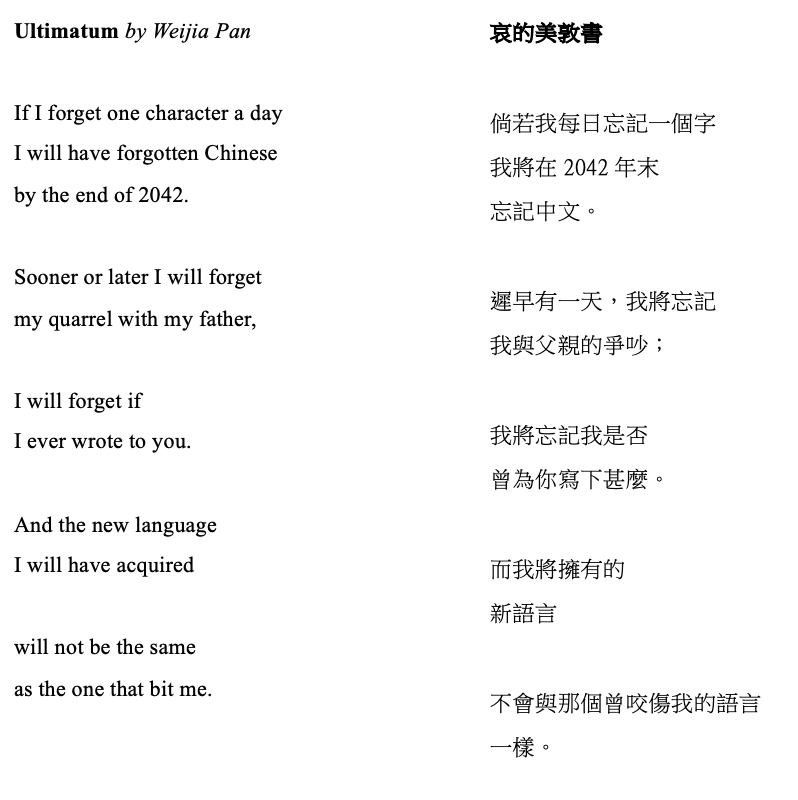
Lastly, let us generate mirror words for a poem. I recently translated Wijia Pan’s “Ultimatum” from Motherlands, a poetry collection written in English, his second language, about Chinese:7
- My father’s name, in both Chinese and English, means “Spring.” Accordingly, beyond denoting the season, I intend to foreshadow both his presence and my mother’s marriage to him. ↩︎
- From the title of Ashley Jiang’s zine, Accent is My Anchor. Jiang and I know each other through poetry and translation. ↩︎
- According to the Multi-function Chinese Character Database’s explanation of “春”, “甲骨文多從「木」從「日」” (“In oracle-bone script, ‘春’ originates from ‘木’, meaning ‘wood’, and ‘日’, meaning ‘sun’”, my trans.). ↩︎
- According to the Multi-function Chinese Character Database’s explanation of “冬”, “甲金文「冬」是「終」的本字,象絲繩兩端打結之形,本義是末端、終結之處” (“In oracle-bone script and bronze inscriptions, ‘冬’ is the original form of ‘終’. It resembles a knot tied at both ends of a silk thread, with the primary meaning of an endpoint or conclusion”, my trans.). ↩︎
- From the Multi-function Chinese Character Database’s explanation on “病,” “從「疒」,「丙」聲。本義是重病。” (It is composed by the base “疒”—illness—and the phonetic “丙,” meaning “serious illness,” my trans.) ↩︎
- The first “Spring” in the sentence refers to my Dad’s name. The second one refers to the season. ↩︎
- The Chinese translation, by me, was published on Poemeal. ↩︎
Works Cited
▚ Andrews, Toni. “A Brief History of Native American Languages in the US.” Interpreters & Translators, Inc., 31 October 2024, https://ititranslates.com/a-brief-history-of-native-american-languages-in-the-us/.
▚ Chang, Victoria. Obit. Copper Canyon Press, 2020.
▚ Choi, Don Mee. DMZ Colony. Wave Books, 2020.
▚ Diaz, Natalie. “When Your Family Reads Your Writing About Your Family.” YouTube, Arts and Digital Media, 9 May 2014, https://www.youtube.com/watch?v=QROG4ZNhFS8.
▚ —. When My Brother Was an Aztec. Copper Canyon Press, 2012.
▚ English for Everyone: English Grammar Guide. DK Publishing, 2016.
▚ Jamail, Dahr, and Natalie Diaz. “Natalie Diaz on the Mojave Language and Where English Fails Us.” Literary Hub, 19 May 2022, https://lithub.com/natalie-diaz-on-the-mojave-language-and-where-english-fails-us/.
▚ Jiang, Ashley. Accent Is My Anchor. Brake Corner, 2024.
▚ Mejia, Melissa. “The U.S. History of Native American Boarding Schools.” The Indigenous Foundation, 26 July 2022, https://www.theindigenousfoundation.org/articles/us-residential-schools.
▚ Multi-function Chinese Character Database. https://humanum.arts.cuhk.edu.hk/Lexis/lexi-mf/.
▚ Pan, Weijia. Motherlands. Milkweed Editions, 2024.
▚ Rodriguez, Janet, and Victoria Chang. “Interrogating Grief: A Conversation with Victoria Chang.” The Rumpus, 27 April 2020, https://therumpus.net/2020/04/27/the-rumpus-interview-with-victoria-chang-2/.
▚ The Liddell, Scott, Jones Ancient Greek Lexicon (LSJ). https://logeion.uchicago.edu/.
▚ “WiT Month: Q&A with Don Mee Choi.” Books Are Magic, 14 April 2021, https://booksaremagic.squarespace.com/home-1/2020/7/31/wit-month-qa-with-don-mee-choi?rq=DMZ+Colony.
How to cite, Ran, Qinxian Bonnie. “Lost and Found in Languages.” Cha: An Asian Literary Journal, 3 Apr. 2026. chajournal.com/2026/04/03/lost-and-found.



Qinxian Bonnie Ran was born and raised in Shanghai. In Chinese, she has published poems in The Epoch Poetry Quarterly, Voice & Verse Poetry Magazine, and Poetry Lab Shanghai. In English, she studies Classics and Literature at Hamilton College, where she is developing her research interests in comparative and world literature, diaspora studies, and postcolonial studies.
 Cha
Cha 