
茶 FIRST IMPRESSIONS
茶 REVIEW OF BOOKS & FILMS
Editor’s note: Jason S Polley opens his review essay by recounting his fond and fervent championing of Kit Fan’s first novel, Diamond Hill (2021), whose Cantonese-inflected language enabled rare intergenerational and cross-cultural connection. He then focuses on Fan’s second novel, Goodbye Chinatown (World Editions, 2026), and offers an admiring account of its stylistic elegance, diasporic reach, and evocative portrayal of Hong Kong’s enduring cultural memory, while tracing a family’s evolving sense of home across continents.

[ESSAY] “Zoi Gin Canton: Reading Kit Fan’s Goodbye Chinatown” by Jason S Polley
Click HERE to read all entries in Cha
on Goodbye Chinatown.
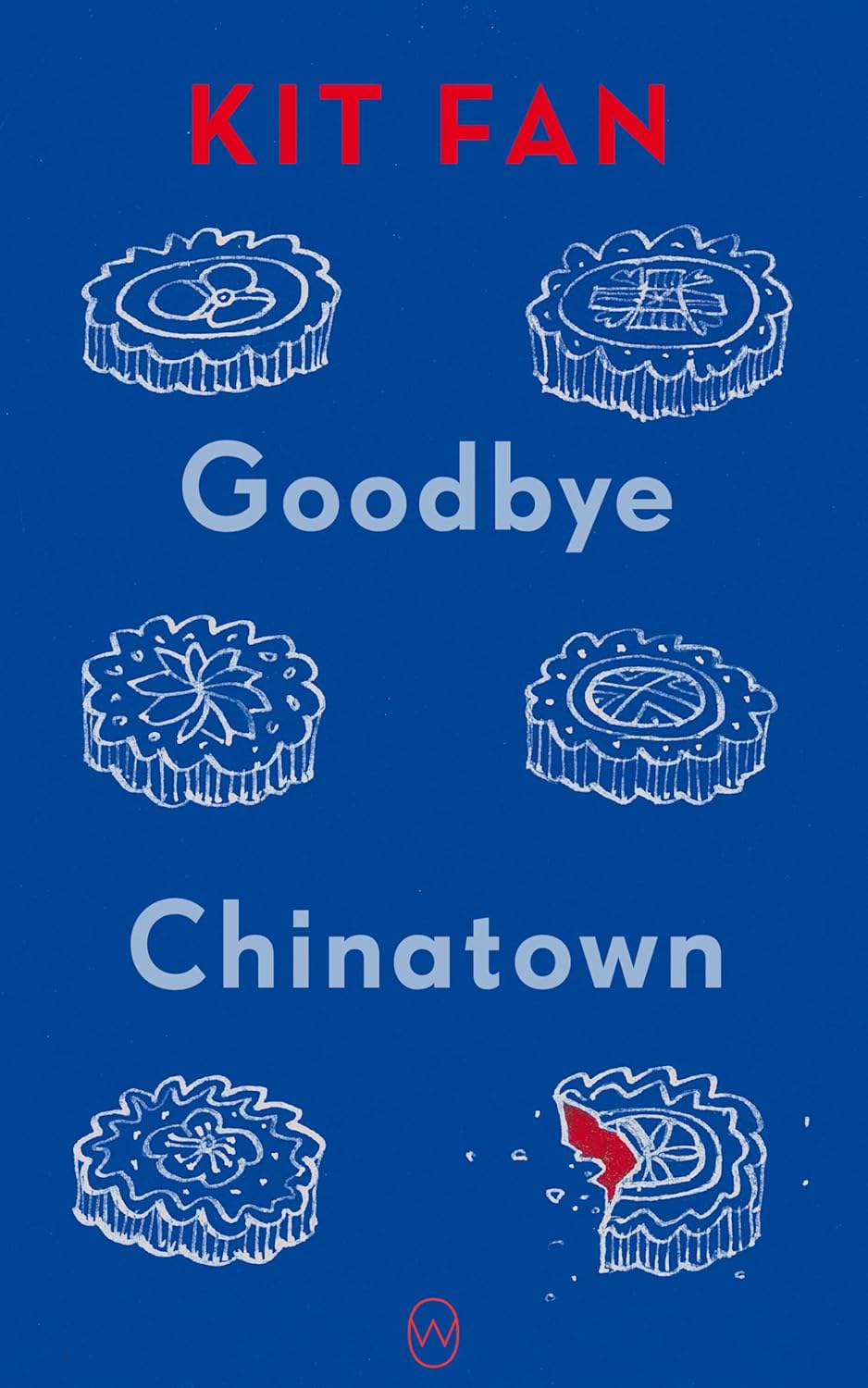
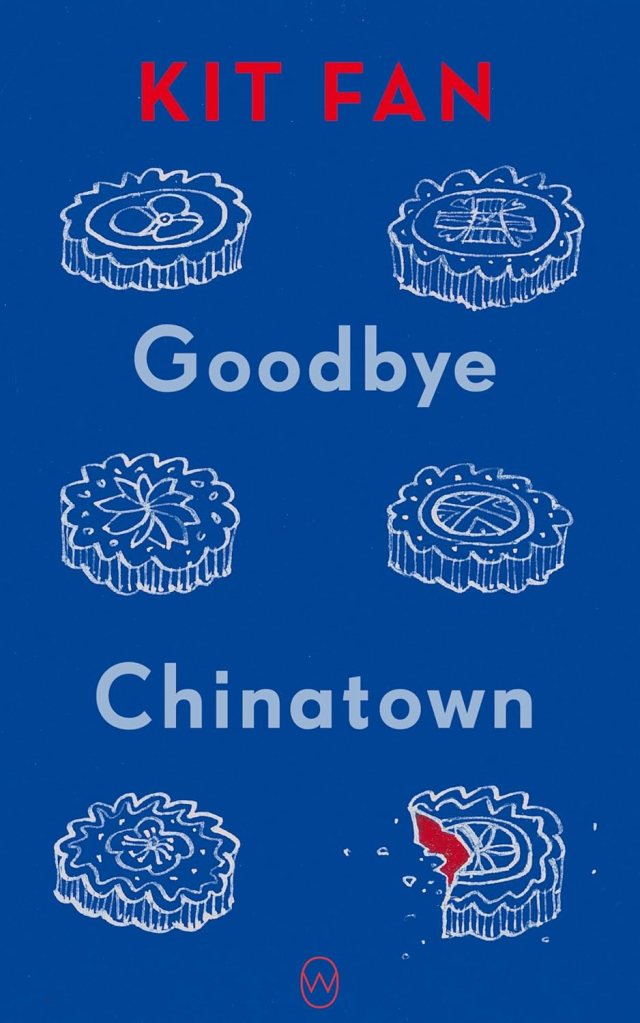
Kit Fan, Goodbye Chinatown, World Editions, 2026. 268 pgs.
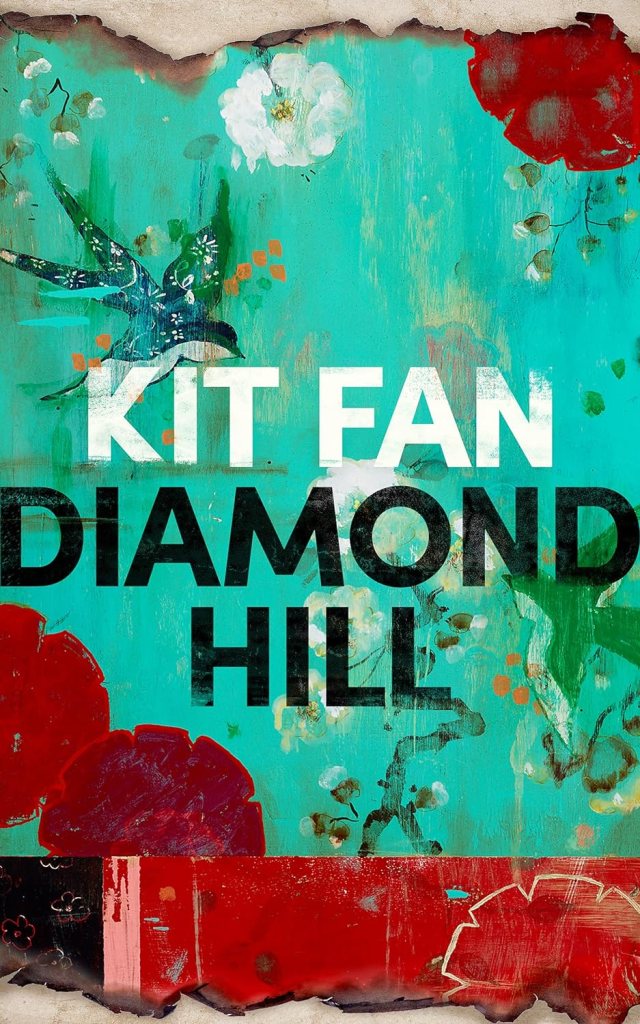
I purchased every copy of Kit Fan’s first novel Diamond Hill that I could locate at the best branches of BookXcess in Kuala Lumpur.
I was of two minds when asked to review Goodbye Chinatown, Kit Fan’s second novel; of two minds because I purchased every copy of Fan’s first novel, Diamond Hill (2021) that I could locate at the best branches of BookXcess in Kuala Lumpur, my go-to bookshop since it principally carries remainders, so the cost is not prohibitive (what I might pay 170 HKD for in Hong Kong, I pay 20 MYR (38 HKD) in KL).
I purchased every remainder of Diamond Hill I could locate in KL over seven separate trips to Malaysia in 2024 and 2025, when the novel was featured prominently atop BookXcess’s shelves, because I wanted everyone I knew and liked (and who still read linear novels) also to read it. This I did partly selfishly. I wanted my far-flung family and friends to experience Hong Kong as I prefer to, not from the glistening glass heights of Hong Kong Island, but rather from the bustling mean streets of Mong Kok. Fan’s Diamond Hill is just that good. Just ask my father, who’s based outside Calgary, and, approaching 80, can no longer stomach the passage to Hong Kong. The book transports readers into the heart of Kowloon, the symbolic dark side of Hong Kong.
I most especially loved sharing these Cantonese obscenities and idioms with my Cantonese in-laws in Hong Kong.
The language of Diamond Hill, as Fan spells out in the novel’s afterword, titled “Note on Cantonese slang and profanities,” makes a virtue of “Cantonese swear words” because these are “particularly agile, allowing the speaker to conjugate inventive insults through puns and metaphors.” “Although forbidden in mainstream media,” Fan explains, “Cantonese swear words loom large in local speakers’ imaginations and sense of humour, transcending social boundaries and taboo.” Fan commemorates the “subversive power of Cantonese profanities” as they “give and perpetuate a culturally distinctive inflection to a language that is under threat.” I most especially loved sharing these Cantonese obscenities and idioms with my Cantonese in-laws in Hong Kong. For the first time in my near decade-long membership of the Lam and Ng families, who communicate across four generations in Hok Lo and Cantonese, I could finally share what I was reading with whoever happened to be present while I was reading Diamond Hill.
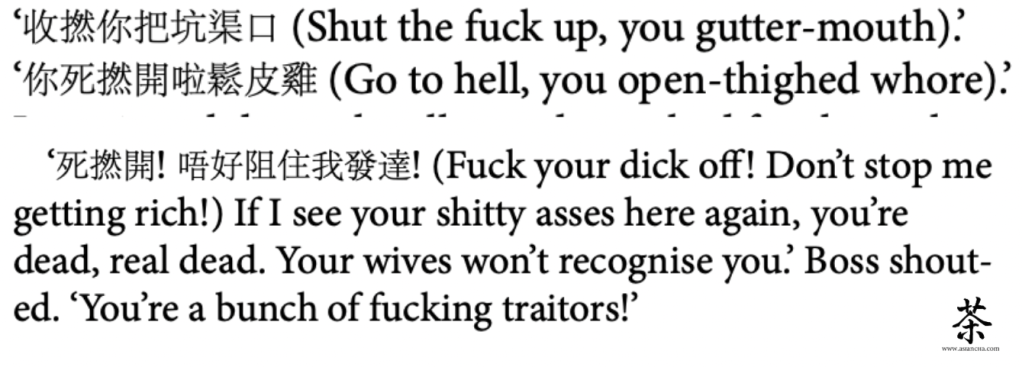
Examples of Cantonese profanities from the first chapter of Kit Fan’s Diamond HIll
Fan’s Cantonese profanities, always rendered first in classical Chinese characters and then in English translation, allowed me to connect, in ways I had never considered, with my wife’s father, her mother, and her gonggong. Seeing Gonggong adjust his glasses, squint, track his finger, and then look at me laughing and nodding before even finishing the clause, they always recognised the explicit idioms immediately, proved to be a new Cantonese, literary, intergenerational, and life privilege for me. There I was, engaging in an integral part of a predominantly English-language novel set in 1980s Hong Kong with someone who swam to Hong Kong to remain during the Cultural Revolution.
Thus, my hesitation when, again privileged to be offered a pre-print of Fan’s next novel. Fan’s own benchmark, I felt, was too high. The novelist was unlikely to produce yet another riveting streetwise text, one that exhilaratingly oscillated between crumbling squatter settlement and serene Buddhist nunnery, all set in 1987 Diamond Hill, that erstwhile Hollywood of the East that Bruce Lee helped to mythologise, that hyper-symbolic cinematic zone destined for obsolescence due to property development and the impending Handover, that ever darker-side dystopic space that Wong Kar-wai fetishises as ironic utopia, as an underworld preserve of Cantonese culture in resistance to capitalist, communist, and linguistic subsumption. Fan’s Diamond Hill echoes Mong Kok, that uniquely Hong Kong precinct, that sector, touristic, criminal, prostitutional, occult, that I cannot help but read in a similar way today as I did yesterday, and the day before.
)
Goodbye Chinatown, so its title suggests, likewise entails looking back, or looking back for as long as one can. Pivoting from the underclass, and from the harrowing beginning of the end of the 20th century, Kit Fan’s second novel opens on Gerrard Street in London’s Chinatown in 2001. The novel centres on a displaced Hong Kong family. This family, the Fans, fled Hong Kong on the heels of 1989’s Tiananmen Square protests and massacre (or what I have learned, after 20 years in Hong Kong, to encode as either May 35 or June 4 or 04 06, depending on the perceived sensibilities of my interlocutor as well as the medium through which I am communicating).
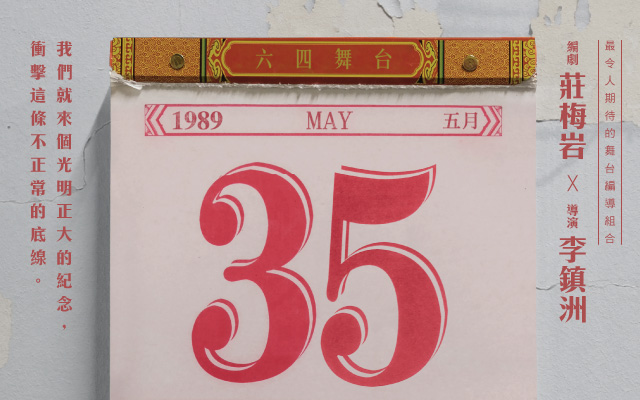
Prima facie, the diasporic narrative of the Fans appears promising. They have, after all, survived, if not prospered, owning and operating a Cantonese restaurant in the United Kingdom for 12 years. Their family story thus initially emerges, for readers already familiar with Kit Fan’s work, as an above-board version of the motley ersatz family (comprised of Buddha, Audrey Hepburn, and Boss) who flee late-1980s Hong Kong to London’s Chinatown to open a restaurant, this on the spoils of Boss’s drug dealing, at the close of Diamond Hill.
Kit Fan is not one to luxuriate in unproblematic progress and enlightenment.
Kit Fan, however, is not one to luxuriate in unproblematic progress and enlightenment. Readers of Goodbye Chinatown soon learn that the Fan family is fracturing. Having sold their restaurant to mainland Chinese investors who have bought out Cantonese establishments in London’s Chinatown, Mr and Mrs Fan return to Hong Kong; Mr Fan retires to gardening; Mrs Fan resumes her career as a secondary-school Head of English; and little Bobo begins kindergarten. All this unfolds while daughter Amber, whose Cantonese is only worse than her Mandarin because she speaks no Mandarin, remains in London’s Chinatown to open her own Rupert Street fine-dining fusion establishment, Luna, not “China Moon or Full Moon or Moon Dynasty or even A Taste of Moon,” as her father had reprimanded her.
(This Latinisation is a rare instance of code-mixing in Goodbye Chinatown. Besides the French gastronomie on Amber’s accomplished menus, and a single instance of pinyin (that is, the Romanisation of Mandarin), Cantonese is only mentioned and never shown in Fan’s second novel. Absent too is Diamond Hill’s litany of profanities, in any language. Rather than rendering Amber’s words, readers are simply informed that she “tell[s] off” her father for his complacency in the face of the “endless stream of cocky men, plasterers, kitchen-fitters, electricians, plumbers and decorators, who had sold her the world, but so far delivered peanuts.”)
Complicating this naturalised splitting of the Fan family, Amber, by the skin of her teeth, did graduate from Oxford’s Mansfield College; she is, after all, a young adult ready for self-reliance, is the fact that Amber’s pre-linguistic toddler “brother” Bobo (later Bobby) is in fact her fatherless toddler son, conceived on the night of Amber’s first sexual experience with a stranger, one who beguiled her with his broken Cantonese, on a beach in Kardamyli, Greece, at the age of 18.
Amber partly finances Luna with the help of a mainland Chinese investor named Celeste, an industrialist funded by her CCP-member father, the same party responsible for pushing Old Wong, Mr Chan, Mr Lam, and Mr Fan himself out of Chinatown. Celeste is a late-twenty-something beauty who collects master’s degrees and enterprises much as I collect novels. With Celeste’s persuasive support, Amber thrives, even earning a Michelin star, until the financial crisis of 2008, after which she eventually relocates to Shanghai as a Shangri-La executive chef, where she amasses further Michelin stars, again under the aegis of the well-connected Celeste.
It was not uncommon to see “anti-Mainlandisation” stickers plastered in public buses in Hong Kong over the latter half of the 2010s.
Along the way, and into 2019, a turbulent “year of protests” in Hong Kong, protests that formally concluded only with the simultaneity of COVID-19 and the implementation of the National Security Law in 2020, Amber’s father passes away, her mother becomes increasingly radicalised (it was not uncommon to see “anti-Mainlandisation” stickers plastered in public buses in Hong Kong over the latter half of the 2010s), and Amber’s young-adult son, who prefers the fiction of Amber as his sister, emerges as a gifted young man who is gay and likewise radicalised, as were many Hongkongers in that period.
(An ironically naïve era, we can now recognise, one in which a healthy, general distrust of Chinese media propaganda, a Cantonese cynicism practised even by children, as Matthew Wong Foreman underscores early in Sunset at Lion Rock, had yet to translate into a comparable general scepticism towards analogous Western media machination.)
)
It is a nostalgic Hong Kong witnessed and recollected from afar, a gourmet Hong Kong whose flavours transcend continents, while offering a real refuge from Machiavellian politricks.
Certainly, the selected details above form the skeleton of Fan’s plot in Goodbye Chinatown, but the heart of this novel, which for the first half of my pre-publication PDF is, at the sentence level, as accomplished as the English prose of D. H. Lawrence, Mulk Raj Anand, Elizabeth Bowen, and Kazuo Ishiguro, is Hong Kong. More specifically, it is a nostalgic Hong Kong witnessed and recollected from afar, a gourmet Hong Kong whose flavours transcend continents, while offering a real refuge from Machiavellian politricks, a Cantonese Hong Kong to which novelist Kit Fan lamentably bids farewell. Hence the conspicuous absence of Cantonese in the second novel of a Hong Kong-born English novelist thus far renowned for code-mixing Cantonese and Chinese characters, both traditional and simplified, into his English fiction.
The Fan family, as an allegory of Cantonese Hong Kong, becomes increasingly deracinated by all-pervading mainland Chinese influence. They flee. They fracture. Some return. Another, fathered by one who had himself been fathered by someone who had presumably fled, returns, or is it flees? An idea of home, the practice of language, a sense of belonging, even the division of generations, each, Kit Fan shows, risks collapse in the face of incremental institutional cultural erasure.
How to cite, Polley, Jason S. “Zoi Gin Canton: Reading Kit Fan’s Goodbye Chinatown.” Cha: An Asian Literary Journal, 1 Apr. 2026. chajournal.com/2026/04/01/kit-fan-goodbye.


Jason S Polley is an Associate Professor of English at Hong Kong Baptist University, where he teaches modern fiction. His passions extend beyond the seminar room—to Indian English fiction, long-distance running, motorcycling, skateboarding, turtle husbandry, and the works (to be brief) of Joan Didion, Anthony Powell, Naguib Mahfouz, Proust, Flaubert, Stendhal, and Defoe. Yet his truest love is his blue-eyed daughter, Jacynthe Milagros Lloy—Jacyn the Miracle Joy (alias Jacyn Jr!; alias Lam Ling; alias Lin Ling)—who was already at 30 months (2.5 yrs) at home in English, French, Cantonese, and Hok Lo, a northeastern Guangdong dialect that, as Popo tells him, drifts somewhere between Cantonese, Hakka, and Min Nan Hua. Jason (Sr.) has published articles on John Banville, District 9, Jane Smiley, Watchmen, Wong Kar-wai, House of Leaves, Bombay Fever, Joel Thomas Hynes, R. Crumb, critical pedagogy, David Foster Wallace, and sex work in Hong Kong, alongside encyclopaedia entries, most recently, on a range of Indian authors. He is also co-editor of the essay collections Everyday Evil in Stephen King’s America (2024), Poetry in Pedagogy (2021), and Cultural Conflict in Hong Kong (2018). [All contributions by Jason S Polley.]
 Cha
Cha 