
茶 FIRST IMPRESSIONS
茶 REVIEW OF BOOKS & FILMS
[FIRST IMPRESSIONS] “What One ‘Nobody’ Did: On Mr Nobody Against Putin” by Jennifer Eagleton
David Borenstein and Pavel Talankin (directors), Mr Nobody Against Putin, 2025. 90 min.
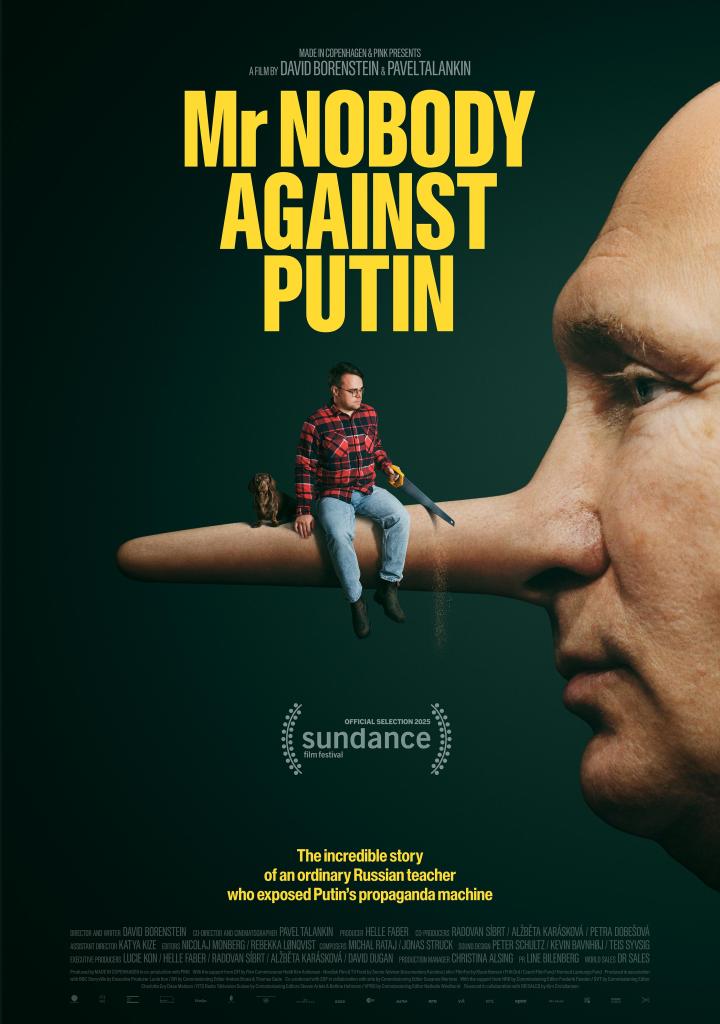
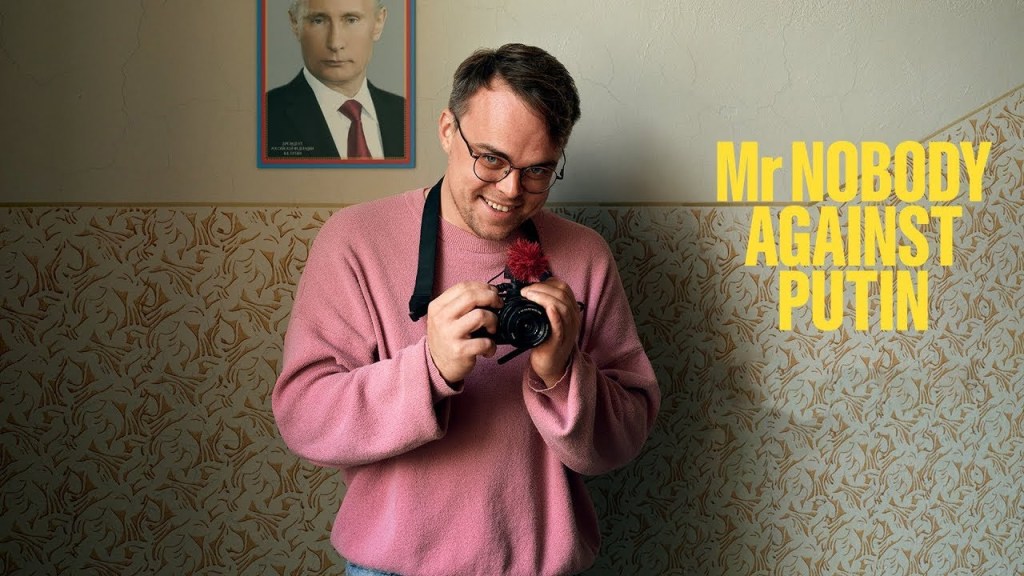
Mr Nobody Against Putin is a 2025 Oscar-winning documentary film by and about Pavel “Pasha” Talankin, the videographer and events coordinator at a local primary school in Karabash, a poor mining town near the Ural Mountains.
While recording his students, Talankin also documents how the authorities attempt to control public perception following the 2022 Russian invasion of Ukraine. The government began requiring schools to hold regular “patriotic displays” with goose-stepping students and to use the state curriculum, such as Conversations about Important Things, which addresses “national unity, patriotism and traditional values”, to justify the invasion to students. The government required him to upload footage of these displays to a state-run portal to prove compliance, thereby allowing Talankin cover to film meetings, lessons, and visitors to the school without attracting suspicion. He gradually became increasingly disturbed by what was occurring, occasionally expressing his views in a low-key manner to his colleagues.
Talankin initially planned to resign in order to avoid supporting the Russian government; however, after making contact with the American director David Borenstein, he withdrew his resignation to continue gathering footage. It was a unique opportunity to reveal what was actually happening at the grassroots level. He considered it important to disseminate this information, despite the considerable personal cost involved.
Education in Hong Kong following the 2020 National Security Law resonates with what Russia was implementing in schools. The outward manner in which loyalty to the state is displayed is also significant in Hong Kong. For example, there are detailed regulations governing school flag-raising ceremonies. One school was found to be “singing the national anthem softly” during one such ceremony, as noted in a recent Education Bureau Annual Report on schools’ implementation of the National Security Law. Teachers were advised to “give reminders and help students develop a habit of singing the national anthem loudly”. Furthermore, teachers are provided with specific examples of incidents “involving political propaganda in schools”, such as wearing items that convey a political message on campus, “chanting slogans, forming human chains, posting slogans, publicity materials or singing songs” that carry political messages on school grounds, all of which occurred during the 2019 protests. Teachers are expected to enforce these regulations. The Liberal Studies curriculum was designated a failure. It was cited as one of the causes of contemporary youth problems, as it “instilled in students the desire to criticise a lot of things”. Liberal Studies was ultimately replaced by Citizenship and Social Development in the curriculum, with an emphasis on Chinese culture, national security, and patriotism.
Certain individuals left Hong Kong after 2020, following the introduction of the National Security Law, fearing that they might inadvertently cross indistinct boundaries regarding what was acceptable to say or do. They could not tolerate the altered circumstances and were unwilling to compromise their beliefs or silence their voices. I cannot condemn them for leaving. They wished to remember Hong Kong as it once was. Some remained and resisted “softly”, and thus far within the bounds of the law, although such behaviour now appears to be an increasing target of criticism.
Why some people accept change without resistance, while others resist despite the potential penalties, is a question that can never be fully answered.
Why some people accept change without resistance, while others resist despite the potential penalties, is a question that can never be fully answered. Talankin was an ordinary teacher rather than a committed political activist. He could not live with his conscience otherwise. Consequently, he exiled himself from the place he loved and from the school where he had taught. This sentiment may be encapsulated by what Timothy Snyder, a well-known historian of authoritarianism in Eastern Europe, wrote in his introduction to Václav Havel‘s The Power of the Powerless: “Freedom is not doing the things you are inclined to do. It is reflecting upon what you ought to do, as your unrepeatable self, and just occasionally taking a risk and doing that thing.”
How to cite, Eagleton, Jennifer. “What One ‘Nobody’ Did: On Mr Nobody Against Putin.” Cha: An Asian Literary Journal, 31 Mar. 2026. chajournal.com/2026/03/31/mr-nobody.


Jennifer Eagleton, a Hong Kong resident since October 1997, is a close observer of Hong Kong society and politics. Jennifer has written for Hong Kong Free Press, Mekong Review, and Education about Asia. She has published two books on Hong Kong political discourse: Discursive Change in Hong Kong(Rowman & Littlefield, 2022) and Hong Kong’s Second Return to China, A Critical Discourse Study of the National Security Law and its Aftermath(Palgrave Macmillan, 2025). Her poetry has appeared in Voice & Verse Poetry Magazine, People, Pandemic & ####### (Verve Poetry Press, 2020), and Making Space: A Collection of Writing and Art (Cart Noodles Press, 2023). [All contributions by Jennifer Eagleton.]
 Cha
Cha 