
茶 FIRST IMPRESSIONS
茶 REVIEW OF BOOKS & FILMS
[FIRST IMPRESSIONS] “Between Moonlight and Market Prices: Reading Yam Gong” by Jonathan Han
Click HERE to read all entries in Cha
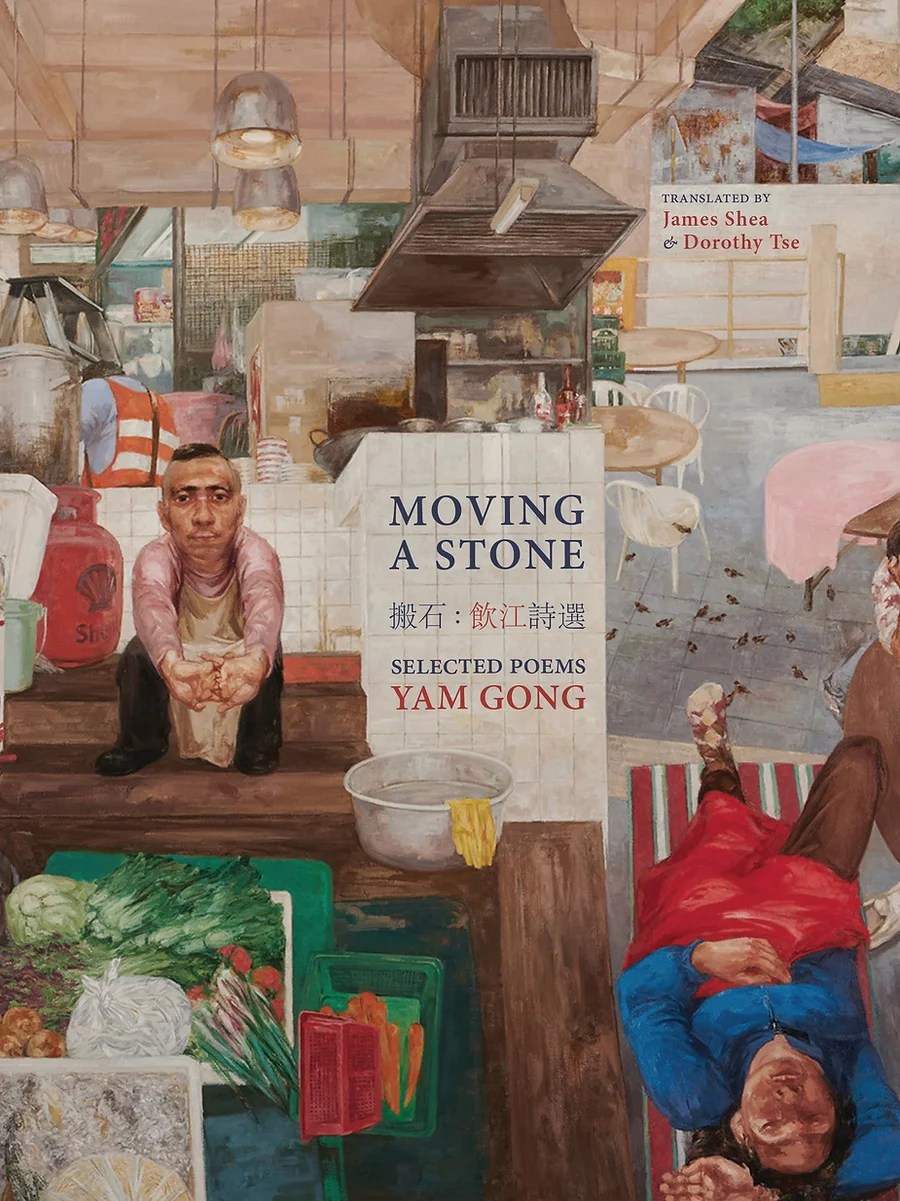
on Moving a Stone.
Yam Gong (author), James Shea and Dorothy Tse (translators), Moving a Stone, Zephyr Press and 水煮魚文化 Spicy Fish Cultural Production, 2022. 208 pgs.

Yam Gong’s poetry is not confined to the historical or the nostalgic. Humour and wit are equally prevalent.
What one immediately notices about Yam Gong’s Moving a Stone is inflation. I do not remember the last time something could be purchased for a few dollars in Hong Kong, not to mention “a seventy-cent bus [ride]” or “ten cents for a piece of gum.” Nothing marks a changing city more clearly than the universal realities of economics. Although such references to market prices signal a considerable passage of time, Yam Gong’s poetry is not confined to the historical or the nostalgic. Humour and wit are equally prevalent. The result is a balanced collection, in which the seriousness of a changing city is both alleviated and elevated by Yam Gong’s playfulness.
While much of his playful poetry is written in free form, Yam Gong’s skill with poetic structure is best highlighted when set against specific expectations. His poem, “Quiet Night Thoughts,” is considerably longer than Li Bai’s succinct quatrain. The free form is layered with images of dealers, desserts, “bleats from a funeral horn,” and “the sound of a wandering lute,” all of which come to a halt before a striking conclusion:
When did I become like my long-wandering father
looking up at the streaming moonlight
and gazing in bewilderment
at children underfoot
Before my hometown bed
there’s a well . . .
In these conclusive lines, Yam Gong both reinforces and subverts the original poem. With the father as the primary subject, the poem effectively compounds the homesickness and disconnection prevalent in Li Bai’s poem, first through the son’s bewilderment at becoming like his father, and second through the father’s own bewilderment at the “children underfoot”. The final two lines of the poem are set apart as a quotation, one that diverges from Li Bai’s most familiar variation. Whereas in Li Bai’s poem the moonlight appears as frost, Yam Gong depicts it as a well of water reflecting the light, thereby situating the modern poem within the subtropical climate of Hong Kong.
Yam Gong also draws on Western poetic tradition. His sonnet, “The Salted Fish Shop (A Sonnet),” serves as the primary example:
It hung there for a long time, that salted fish
On the first day of work I used a pole
to hang it up and I started thinking
this salted fish is so handsome
surely someone is going to pick it
but day after day it hung there upright
and not a single grain of salt fell
Today someone should pick it
Looking at it every morning I thought every day
this same thing every day I looked at it
and slowly it became my hope each day
until my boss came to me today and said
You look as dumb as a salted fish
Don’t bother coming back tomorrow
In both the original Chinese and the translated English, there is no discernible rhyme scheme. The rhythm, at best, approximates ten syllables per line. Beyond the fourteen lines and the indicative title, there are few structural markers that identify the poem as a sonnet. Thematically, however, as a subversion of the form, the poem works remarkably well. The object of affection, the salted fish, is treated with a distinctly Petrarchan fixation. The volta in the final two lines delivers a strong comedic effect.
That humour, however, does not detract from the cerebral nature of Yam Gong’s poetry. His prose poem, “A Tolerant Person,” depicts a cockroach crawling before an open palm poised to end its life, only for the speaker to realise that he has no slipper or newspaper to hand. That hesitation culminates in contemplation:
It crawls slowly. Crawling from one side of the table to the other. From one group of words to another. Time stretches. Time long enough for me to raise my palm and hold it in the air and think about “tolerance” over the length of a lifetime—and the embarrassment and dismay of a tolerant person who opens his naked palm and finds it relies on nothing.
The dash is an inspired decision by the translators. Combined with the opening of a naked palm, the punctuation suggests the possibility of a deadly action, the life of a cockroach brought to an abrupt end. It also simulates, through the pause, how long or how brief a lifetime may be. The Chinese original on the opposite page does not employ a dash, but a period. In appearance, the Chinese period is considerably larger than its English counterpart, and is the only punctuation mark to appear in the poem’s Chinese original, evoking the image of a cockroach scurrying across the page. Such an observation would not have been possible without the Chinese and the English appearing in the same volume, and stands as a clear example of translation bringing out the strengths of the original.
As the first book-length collection of Yam Gong’s poetry to be translated into English, the breadth offers a generous representation of his work. The careful efforts of the translators, James Shea and Dorothy Tse, have resulted in an accessible and admirable text for both English and Chinese readers. The clarity and musicality of Yam Gong’s voice, carried across the verso and the recto, invite a deeper appreciation of each succeeding poem.
How to cite, Han, Jonathan. “Between Moonlight and Market Prices: Reading Yam Gong.” Cha: An Asian Literary Journal, 29 Mar. 2026. chajournal.com/2026/03/29/moving-a-stone.


Jonathan Han is a Hong Kong-based writer. His work has appeared in Essays in Criticism, Hong Kong Review of Books, and Asian Review of Books. His chapbook Quinquennial was published by Pen and Anvil Press. Follow his Substack @jhantheman. [All contributions by Jonathan Han.]
 Cha
Cha 