
茶 FIRST IMPRESSIONS
茶 REVIEW OF BOOKS & FILMS
[ESSAY] “Reading—Making Notes on (There is Always Music)—Geoffrey William Brodaksilva’s The Philosophy of Aggressiveness” by Jeremy Fernando
Geoffrey William. Brodaksilva. The Philosophy of Aggressiveness: The Necessity and Indeterminacy of Escape, Atropos Press, 2025. 430 pgs.
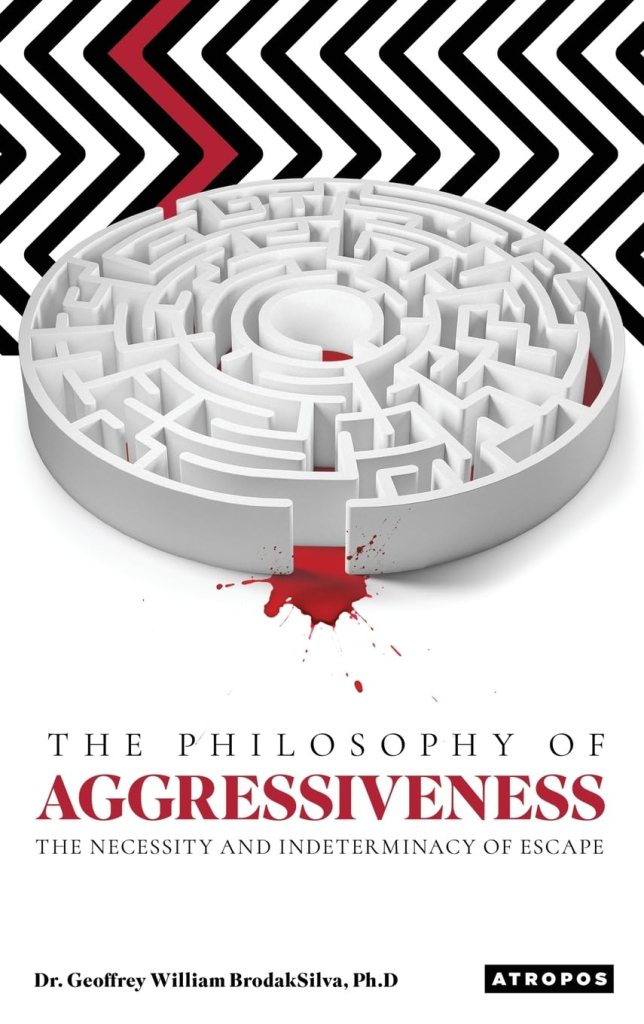
In the midst of reading The Philosophy of Aggressiveness, a line, a phrase, might we call it a thought?, comes, speaks, appears, let us go with comes, to me: still waters run deep. For beneath, perhaps in the midst of might be more apt, the calm, serious, methodical approach taken by Geoffrey William Brodaksilva lies a powerful challenge, question, even wager. Read it with care, for once you open yourself to this work, what you might always embody, carry with you, hear in you, egging you on, inspiring you, infecting you, may be, in the voice of Adel Abdessemed no less, à la attaque!
As Brodaksilva continually reminds us, there is no possibility of thinking without aggression.
But this is no call for violence. Instead, aggressive thought. All at the risk of being tautological: for, as Brodaksilva continually reminds us, there is no possibility of thinking without aggression. And even as “thought may start out as an aggression, that does not suggest that the point of thinking is to refine aggressions. However, it does suggest that the rejection of aggression as such, is a rejection of thinking” (p. 382). Perhaps it is quite apt that it is often difficult to cleanly, logically, clinically distinguish the two, for his is a call for a thinking-as-doing, as making, as bringing forth. This is no sanitised work: this is a call for you to get your hands dirty.
Dive in with Geoffrey Brodaksilva: courage courage.
And courage is needed for thought, particularly if to think is to confront not just the world, but, as importantly, one’s own thoughts themselves, maybe even thinking itself. For this is an ambitious project, one which attempts not only to differentiate aggression from violence, but to tease out its possibilities, often at the limits of both, at the point where they touch. In many ways, the hidden title of this work is Zur Kritik der Aggressivität. And if, as Walter Benjamin continues to teach us, critiquing violence entails bearing in mind (with all its incumbent burdens) that all critique is violent, Geoffrey Brodaksilva reminds us that “aggression is the becoming-affirmative of the negative, it is the joyful act of critique” (p. 71). So perhaps even Pour une critique mineure de l’agressivité.
Yes, Nietzsche is always walking with us. Test, test, jab, jab, play a bluff, raise the stakes, poke, provoke (are there votives involved, certainly votes), challenge the others to show their hand.
Also why to experiment is such a crucial notion, certainly approach, even as one can never approach with any certainty, even as he cautions us against being too certain, for Brodaksilva. For to think is to attempt to respond to the world beyond oneself. To people, moments, things, places, times, in their radical singularities, thus absolute multiplicities. And like our gay scientist, Geoffrey Brodaksilva does so joyfully: moving from text to text, moment to moment, possibility to possibility, teasing out their links, guarding their differences, playing with their perhapsnesses … peut-être les textes, ah, ils peuvent être. Continually, even questioning the question itself: which is why Brodaksilva never preaches (this is not ideology), does not give cheap answers (nor advertising), but continues to sit-with questions, seeing, listening to, trying to attune his antennae with, where they lead us. And at points, junctions, where Brodaksilva encounters limits, for instance, “in what is undiscussable in Deleuze’s treatment of Jackson while simultaneously not reducing Jackson to a case” (p. 18), he does not stop: potential contradictions are not interdictions, far from it; there are no no-fly zones, possibilities that are beyond the pale. In fact, thresholds are invitations to play, for limits are precisely where (the skin on and in which) creation lies.
Respond, and not just react.
Read.
Reading, ah reading, as Geoffrey Brodaksilva does closely, in particular with and alongside the works, so worlds, of George Jackson, Gilles Deleuze, and Félix Guattari; but far from them only, for many, many voices appear, make showings, stagings (theoria), ah reading, thus encountering, responding to, writing alongside, creating. For encounters bring forth emergent properties, if only we pay attention.1 Like how, thanks to Brodaksilva’s reminder, we should all be going back to reread, to really read, to open ourselves to the words, so worlds, of George Jackson. Who continually teaches us that to escape, to truly escape (which is not the same as being an escapist), is to be looking for a gun / stick even as you are running (and really, even turning your run into a gun; make language vibrate! Intensity, intensity).2
In other words, radical escape is nothing other than opening ourselves to the possibility of an event.
Or, in Brodaksilva’s eloquent formulation: “radical escape requires escaping the defensive maneuver of escapism that has the capacity to sever personal from systemic necessity as well as separate necessity from the indeterminism of chance itself” (p. 31). In other words, radical escape is nothing other than opening ourselves to the possibility of an event. But not some transcendental one, there is nothing mythic nor mystical in what Brodaksilva is positing, rather one which is immanent: an opening of a new world in an old world, as Alain Badiou might have said;3 so, one which is contemporary, in the precise sense of with-time, as Giorgio Agamben continues to teach us, thus always also outside of what has been dictated as time.4
Ah yes, time and timing is always involved.
Ah yes, to play your hand at the right moment. Not just in the sense of you got to know when to hold ’em, know when to fold ’em, as Kenny Rogers might say, but, more radically, that one has to disappear into the game itself: where one’s opponent no longer even realizes they are in a duel, for the duality has seemingly vanished.5 Be like water, my friend.6 Where the gap between holding ’em and folding ’em might become the moment of revolution: it is not just a question of knowing when to but of creating that in-between, the bluff, in response to which the others at the table might well just make meaning where there is none.7 Giving them just the right amount of space (if you are also hearing proper distance, you are not just hearing voices in your head) to waltz into their own abyss. As poker legend Annie Duke sagely says, “sometimes it’s not the big things you do that get you the win, it’s the big things you don’t do” (p. 341).
A not-doing that is not a doing-nothing but a not that does.
Positing, for one is always taking a position, a not, perhaps even posing (simulation baby!), in order to give (gift)8 your opponent the latitude to expose themselves. A not-doing which still requires you to take that chance: not that Tykhe can ever be tamed, nor does a throw of the dice ever abolish chance, but that you have to choose to leap.
Courage courage.
Dive into Geoffrey Brodaksilva’s The Philosophy of Aggressiveness to catch a glimpse of the possibility of a contemporary work: not that it is timely or, even worse, speaks to its time (nothing that banal), but that it is with-time, thinking alongside the moment it is in, and then staking its own wager.
And calls for you—challenges you—to stake yours too.
Courage courage.
March 2026
Singapore
- There are many convergences between my approach to reading—in which I posit blindness as being both a condition of and limit to—and Geoffrey Brodaksilva’s, particularly those explored in The Philosophy of Aggressiveness. ↩︎
- The fact of this line—“I may be running, but I’m looking for a gun as I go”—appearing multiple times (at least four from what I can tell; on pages 101, 146, 165, and 350) in this text shows how central George Jackson’s thinking is to Geoffrey Brodaksilva. Not just because it is repeated but even more so as Brodaksilva’s text is continually thinking alongside the line even as it appears in the text: “I may be running, but I’m looking for a gun as I go may not be the best contemporary translation of Soledad Brother’s I may run, but all the time that I am, I’ll be looking for a stick!” (350). Uncertainly, staying-with, continually exploring, being nothing other than the marks of questioning, prodding, exploring, of thinking. ↩︎
- Amongst many other places, Alain Badiou explores this—one of his definitions of an event—in Being and Event. ↩︎
- I first encountered this particular meditation on the question of the contemporary in Agamben’s seminar, Homo Sacer, in June 2006 at The European Graduate School. ↩︎
- This idea is developed more fully in my “Waxing on wagers”, which can be found in Contemporary Arts as Political Practice in Singapore (2016, edited by Wernmei Yong Ade and Lim Lee Ching), with a longer version in A Political Writing. ↩︎
- I refrain from naming Bruce Lee directly in the text, not out of any disrespect, far from it, but in homage to his flippancy towards names, towards naming (which he always found too restrictive, a limiting by a prior conception): if you don’t like the name Jeet Kune Do, call it something else. Personally, I’ve always preferred remembering him as 李振藩. ↩︎
- The game of poker, and poker as a game—particularly the question of the bluff, and a bluff as a question—is extensively, and intensely, explored throughout The Philosophy of Aggressiveness. ↩︎
- And even though this is never quite explicitly explored in this text, giving, gifts, and hospitality, are never far from Geoffrey Brodaksilva’s approach to thinking. ↩︎
Echoes
▚ Badiou, Alain. Being and Event. Translated by Oliver Feltham. London: Bloomsbury Academic, 2013.
▚ Brodaksilva, Geoffrey. The Philosophy of Aggressiveness. New York & Dresden: Atropos Press, 2025.
▚ Cixous, Hélène, and Adel Abdessemed. Insurrection de la poussière: Adel Abdessemed. Paris: Éditions Galilée, 2014.
▚ Fernando, Jeremy. A Political Writing. Guadalajara: Hidden Hand Press, 2025.
▚ Fernando, Jeremy. “Waxing on Wagers” in Contemporary Arts as Political Practices in Singapore. Edited by Wernmei Yong Ade & Lim Lee Ching. New York: Palgrave Macmillan, 2016, 13-27.
▚ Fernando, Jeremy. Reading Blindly: Literature, Otherness, and the possibility of an Ethical Reading. New York: Cambria Press, 2009.
▚ Lee, Bruce. Tao of Jeet Kune Do. Burbank: Ohara Publications, 1975.
▚ Schlitz, Don. “The Gambler”. Single by Kenny Rogers. New York: United Artists, 1978.
How to cite: Fernando, Jeremy. “Reading—Making Notes on (There is Always Music)—Geoffrey William Brodaksilva’s The Philosophy of Aggressiveness.” Cha: An Asian Literary Journal, 17 Mar. 2026, chajournal.com/2026/03/17/aggressiveness.

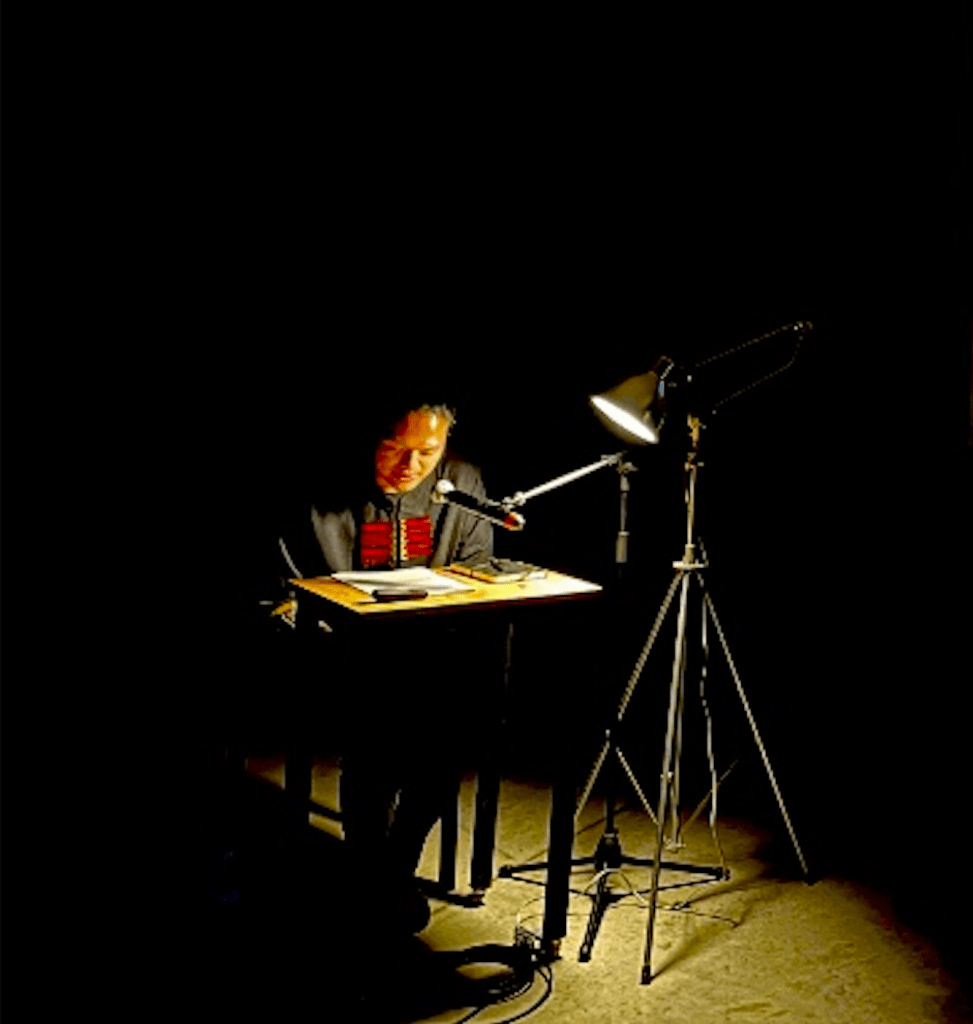
Jeremy Fernando in Buenos Aires

Jeremy Fernando reads, writes, and makes things. He works at the intersections of literature, philosophy, and art, has written more than thirty books, and has been translated into ten languages. His explorations of other media have led him to film, music, performance-readings, and the visual arts, and his work has been exhibited in Seoul, Buenos Aires, Berlin, Vienna, Hong Kong, Lisbon, and Singapore. He is the general editor of Delere Press, curates the thematic magazine One Imperative, is the Jean Baudrillard Fellow at The European Graduate School, is the co-creator of the private-dining experience People Table Tales, and serves as the writer-in-residence at Appetite, a sensorial laboratory that explores the crossroads of food, music, and art. Visit his website for more information.
 Cha
Cha 