
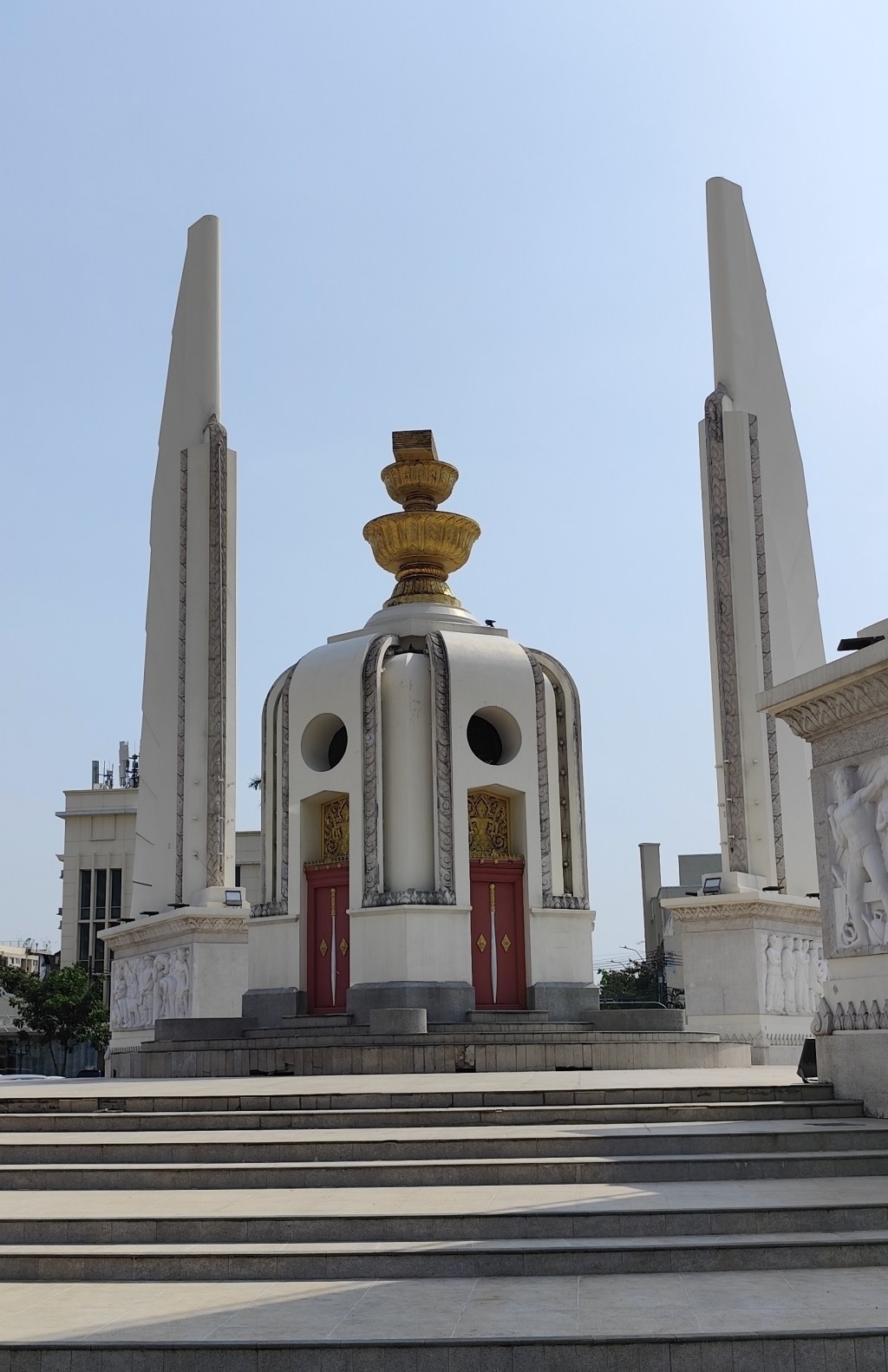
Editor’s note: In this essay, Daniel Gauss reflects on Bangkok’s Democracy Monument as a symbol of Thailand’s unfulfilled democratic promise. Erected in 1939 to commemorate the 1932 coup that ended absolute monarchy, it honours a revolution carried out by elites rather than a popular movement. Because civilian institutions remained fragile and the military retained political authority, Thailand developed a recurring pattern of coups, constrained elections, and elite dominance. Although constitutional forms persist and democratic openings occasionally emerge, unelected institutions repeatedly limit popular rule, leaving the monument a reminder of democracy’s unrealised future.

[ESSAY] “A Democracy Monument in Bangkok, Still Waiting for Democracy” by Daniel Gauss
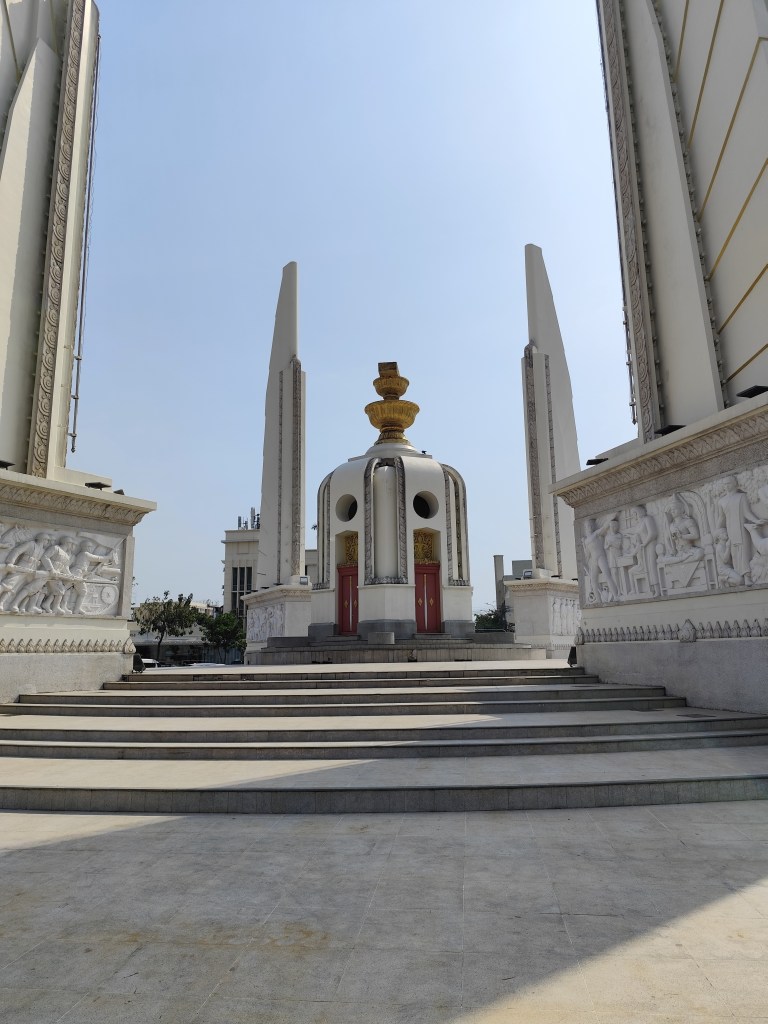
The expansive, grandiose monument stands at the centre of one of Bangkok’s most-used traffic circles, impossible to avoid even if it is rarely considered. Commuters stream around it daily along Ratchadamnoen Klang Avenue; tourists may pause to photograph it, often without knowing precisely what the behemoth represents.
Four monumental wings frame a central pedestal that holds a gilded constitution, with bas-reliefs depicting soldiers and civilians ushering in a new political order. Completed in 1939, the Democracy Monument commemorates the 1932 “revolution” that ended absolute monarchy and proclaimed constitutional rule in Siam.
In June 1932, a small group of civilian and military elites calling themselves Khana Ratsadon coordinated a nearly bloodless coup while the king was away. They seized key infrastructure in Bangkok, including military installations and communication hubs. They then issued a proclamation declaring that absolute monarchy had ended and that sovereignty now belonged to the people.
Faced with unified military pressure and no loyalist forces ready to assist him, King Prajadhipok accepted their demands. Within days, he signed the country’s first constitution, transforming Siam into a constitutional monarchy (the name Siam was changed to Thailand in the late 1930s).
In 1933, Prince Boworadet and his allies launched an armed rebellion to reverse that revolution and restore the old order. Government forces loyal to the new constitutional regime fought them in a brief civil conflict. The rebels lost. There is also a lesser monument that commemorates that victory, the Constitution Defence Monument.
Yet, standing in front of the Democracy Monument, one must ask what this signifies in a country where the military has repeatedly overthrown elected governments, where constitutions are written and torn up with regularity, and where various unelected institutions wield decisive power.
Thailand today operates under the pretext of constitutionalism, with elections, parliament, and courts, but democratic operations are constrained by military, bureaucratic, and royalist power.
The monument appears less a living symbol of a victorious revolution and more an idol of an unfulfilled future.
In that light, the monument appears less a living symbol of a victorious revolution and more an idol of an unfulfilled future, a structural remnant of a political project that was never allowed to develop into a healthy democracy. Instead, it marks the first of many coups carried out by groups of elites to change power undemocratically in Thailand, regardless of how well intentioned the act may have been for the people.
How do we move from what is celebrated as a resounding victory for constitutional government to what is happening now in Thailand? One way is to follow the historical sequence from the 1930s to the present. The People’s Party won the battles in 1932 and 1933. The order they opposed has, however, won the long war. This is the story of how ends should shape means, and of what can happen to a nation when the wrong means are used to bring about progressive, democratic change.
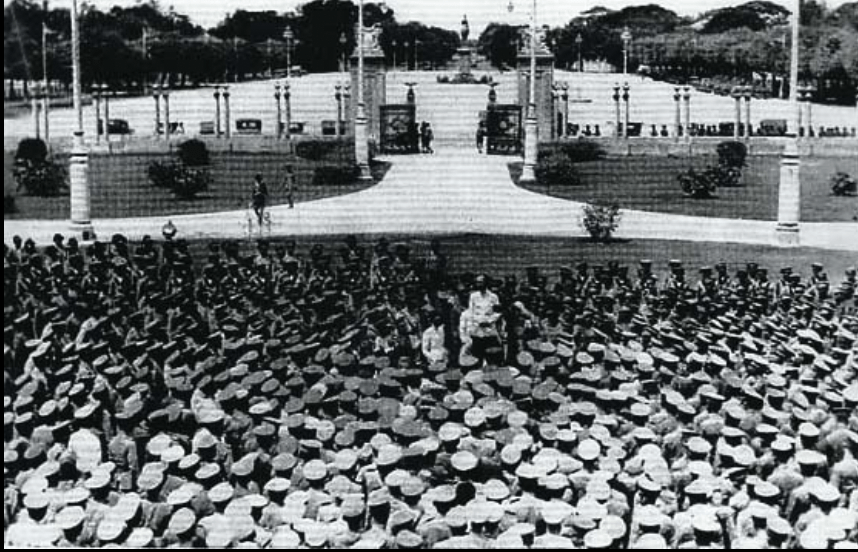
The People’s Party address the crowd at the Royal Palace, Bangkok

1930s:
Revolution, Counter‑revolt & Consolidation
The 1932 revolution ended absolute monarchy and created a constitutional framework. Yet the People’s Party was not a mass movement but rather a coalition of military officers, civil servants, and intellectuals who chose to act in the people’s name without employing democratic means of change.
Their goals ranged from cautious constitutionalism to more ambitious programmes of social and economic reform. Pridi Banomyong’s economic plan, with its redistributive and social democratic elements, alarmed conservative elites and the king, who denounced it as “communistic.” Had all of this followed a popular uprising, the situation would have been different. Instead, it unfolded as a contest among factions, an inter elite conflict in which neither group of elites genuinely spoke with the voice of the masses.
The Boworadet Rebellion in 1933 was the first organised attempt to reverse this revolutionary coup. Its defeat allowed the People’s Party to consolidate control. Yet even the People’s Party relied heavily on the military. Civilian institutions remained weak, and the monarchy, though stripped of absolute power, retained symbolic authority and networks of loyalty. The revolution had not truly dismantled the social and institutional foundations of the old order.
Late 1930s–1940s:
Militarization and Wartime Politics
By the late 1930s, power within the revolutionary camp shifted towards more authoritarian and militarist figures, especially Plaek Phibunsongkhram (Phibun). Under Phibun, the regime embraced aggressive nationalism, cultural campaigns, and a more centralised, top down style of rule. The promise of broad based civilian constitutionalism narrowed into a military dominated modernising project.
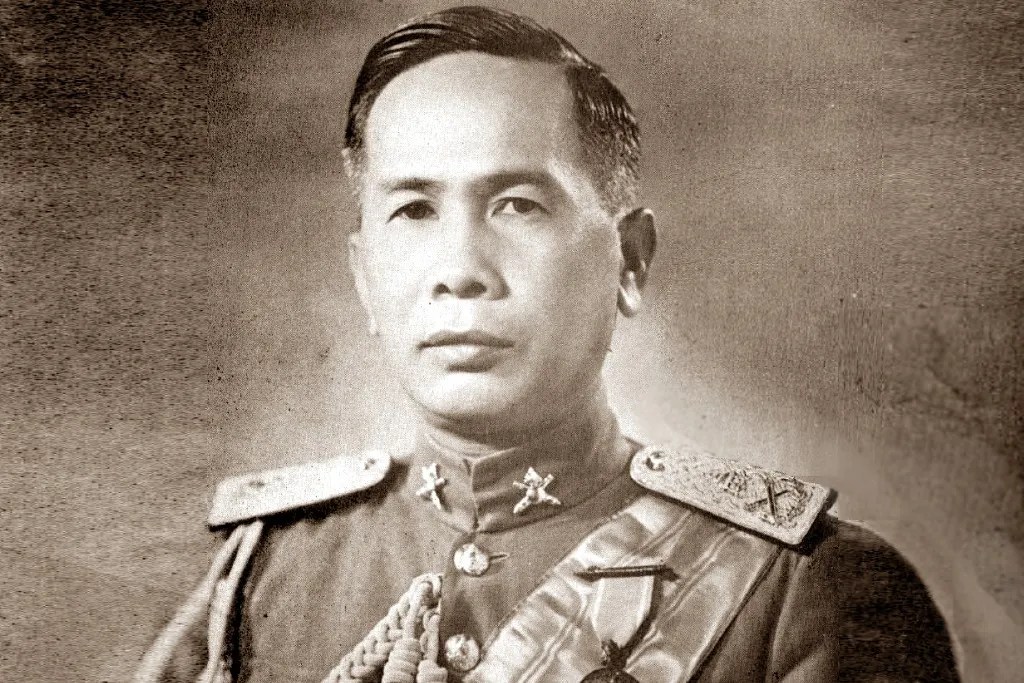
Plaek Phibunsongkhram, 1940
Phibun’s “cultural campaigns” were efforts to remake everyday life so that citizens would look, act, and think in ways the regime defined as modern and properly “Thai.” They promoted Western style clothing, standardised the language, established new nationalist rituals, and initiated state approved forms of public behaviour, while discouraging traditional dress, local customs, and anything labelled “superstitious” or “backward.”
These campaigns were enforced through laws, propaganda, radio broadcasts, and public messaging that instructed people how to greet, eat, queue, speak, and present themselves. The campaigns amounted to social engineering, an attempt to manufacture a modern nation through discipline, uniformity, and nationalism.
They reflected the broader shift of the late 1930s, away from the pluralistic civilian hopes of 1932 and towards an authoritarian, militarised modernisation project centred on obedience, order, and a tightly controlled national identity.
During the Second World War, Thailand, under Prime Minister Phibun, aligned with Japan after a brief Japanese invasion in December 1941. The government allowed Japanese troops to move through the country and formally declared war on the United States and Britain, even as many Thai elites and civilians opposed the decision.
Behind the scenes, the Free Thai (Seri Thai) resistance movement cooperated with the Allies, gathered intelligence, and prepared for a post war break with Japan. By 1944, the Japanese alliance had become deeply unpopular, Phibun fell from power, and Thailand began distancing itself from Japan. Pridi, associated with both the revolution and the Free Thai resistance, briefly held high office after the war, but the political environment remained unstable and conservative forces regrouped.
The 1940s did not restore absolute monarchy, but they normalised the idea that the military was the central arbiter of politics. The People’s Party’s own reliance on military officers had opened that door. The revolution’s form, constitutionalism, remained, but its substance was increasingly mediated by generals.
1950s:
Cold War, Royal Revival and Anti‑communism
The 1950s were decisive in shifting the centre of gravity towards a conservative, royalist, and military bureaucratic order.
First, the Cold War made Thailand strategically important to the United States. Military regimes that presented themselves as anti communist bulwarks received support and legitimacy. This strengthened the hand of generals who argued that strong, centralised, and often extra constitutional rule was necessary to prevent communist expansion.
Second, there was a deliberate revival and elevation of the monarchy’s public role. Through state rituals, media, development projects, and international diplomacy, the institution of the king was repositioned as the moral and cultural centre of the nation. This did not mean a return to pre-1932 absolutism, but it did mean that the symbolic influence of the monarchy grew.
Third, the memory of the People’s Party and its leaders became contested. Pridi went into exile, and the revolutionary period was reframed less as the foundational moment of the modern state and more as a turbulent, ideologically suspect interlude.
In the 1950s, a constitution existed and elections were sometimes held, but ultimate authority rested with military and royalist networks, justified by anti communism and national security.
1960s–1970s:
Development, Protest and Violent Resets
The 1960s saw rapid economic development under military regimes, further supported by Cold War alliances. The state expanded its bureaucratic capacity, and the military’s role in governance remained central.
In the early 1970s, urban middle-class and student movements challenged military rule, culminating in October 1973, when Thailand experienced a massive popular uprising led primarily by university students and joined by workers and the Bangkok middle class. This movement overthrew the Thanom-Praphas military dictatorship. It was the first time in modern Thai history that mass mobilisation forced a military regime from power.
Hundreds of thousands of students and citizens filled Ratchadamnoen Avenue in Bangkok, near the Democracy Monument, to demand an end to military rule. When security forces opened fire, killing at least seventy-seven people and injuring hundreds, the violence backfired. An army commander refused to escalate matters further, the king intervened, and the ruling triumvirate of Thanom, Praphas, and Narong fled the country.
The king appointed Sanya Dharmasakti, a respected jurist and former rector of Thammasat University, as interim prime minister. A new constitution was drafted in 1974, and Thailand entered a brief period of parliamentary democracy from 1973 to 1976.
This experiment did not last. On 6 October 1976, security forces and right-wing militias attacked students occupying Thammasat University. Students were beaten and shot. That same evening, the military staged a coup, installed Thanin Kraivichien as prime minister, and began a harsh period of repression. The genuine democratic opportunities of 1973 to 1976 were effectively extinguished.
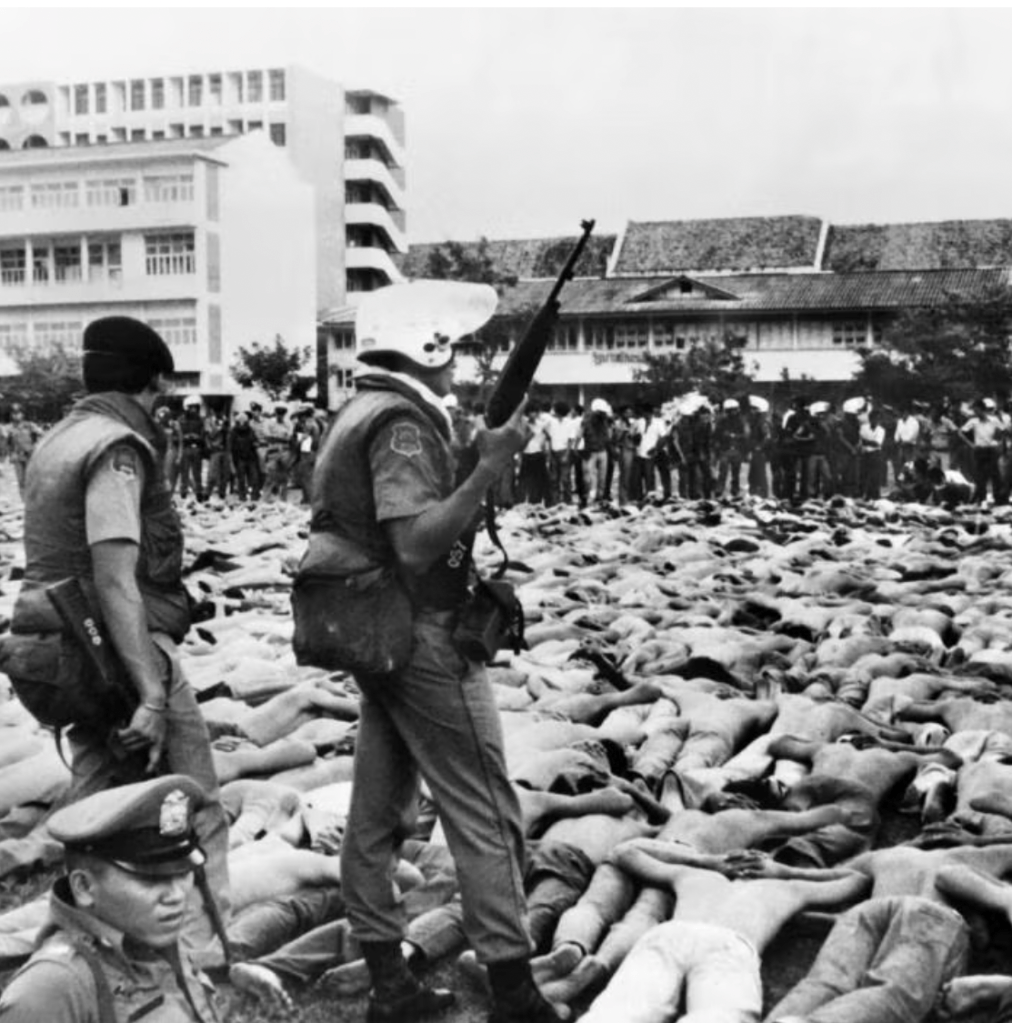
Shirtless students lie with hands behind their necks
during the Thammasat University massacre on 6 October 1976 in Bangkok (image)
1980s–1990s:
Semi‑democracy, Technocracy & a New Constitution
From the 1980s onward, Thailand experienced what is sometimes called “semi-democracy,” alternating periods of elected governments and military influence, with technocratic and business elites playing larger roles. Semi democracy emerged because the military never fully withdrew from politics, even as Thailand’s economy and society changed too much for outright dictatorship to remain viable.
From the 1980s onward, rapid growth, urbanisation, and the rise of business and middle-class groups created pressure for elections, policy stability, and civilian rule. Yet the armed forces still held institutional veto power, producing a hybrid system in which elected governments operated under constant military and bureaucratic oversight.
Then came Black May in 1992, when mass protests erupted after a coup leader, General Suchinda Kraprayoon, made himself prime minister without ever standing for election. The military’s violent crackdown, shootings, arrests, and “disappearances,” shocked the country and destroyed the legitimacy of military-backed rule. Suchinda was forced to resign, and the trauma of Black May convinced many Thais that the old pattern of interventionist military politics had become untenable.
Out of this moment grew the push for the 1997 constitution, the most participatory charter in Thai history. Civil society groups, academics, business leaders, and reform-minded politicians sought a framework that would strengthen political parties, create independent oversight bodies, expand rights, and reduce the military’s ability to override elected governments. The result was a serious attempt to build the stable, accountable democratic order that the People’s Party had envisioned but never achieved.
Yet the underlying structural tensions remained. Unelected institutions retained significant power. The military was not removed from politics; it merely became less visible when conditions were stable. The monarchy’s symbolic centrality remained intact. The system was more open than in earlier decades, but it was not insulated from the ever-present possibility of military reversal.
2000s–2010s:
Polarisation, Populism and Coups
The rise of Thaksin Shinawatra and his political movement in the early 2000s exposed the fragility of the system. Thaksin Shinawatra was a telecommunications billionaire who entered politics in the late 1990s and founded the Thai Rak Thai Party. He gained power by winning the 2001 election in a landslide, using a mixture of populist policies, rural outreach, and promises of strong, centralised civilian leadership. His dominance triggered fierce resistance from military and royalist networks, which saw his rise as a threat to the existing order.
A 2006 military coup removed Thaksin. Subsequent years saw cycles of protest, court interventions, and political deadlock. The 2014 coup against Yingluck Shinawatra, Thaksin’s younger sister, was another decisive moment, reasserting direct military control and leading to a new constitution designed to constrain elected governments and preserve the influence of the military in leadership selection. Yingluck’s ouster marked the end of Thailand’s brief democratic opening and the return of direct military rule.
By this point, the pattern that began in the mid-20th century was fully visible. Constitutional forms were repeatedly re engineered to accommodate the continued dominance of military and conservative elites, especially when electoral outcomes threatened their interests. The People’s Party’s original project of civilian supremacy, social reform, and a stable constitutional order was far from realisation.
The Present:
A Democratic Movement in a Constitutional Cage
Thailand’s current political landscape exists in the long afterlife of the Thaksin era and the two coups that followed it. The 2014 coup established a system in which elections exist but are tightly managed, with rules designed to limit the power of elected governments and preserve the influence of the military, judiciary, and conservative networks. Even after the return to electoral politics, various unelected institutions, led by the military and the courts, continue to shape outcomes through party dissolutions, legal interventions, and mechanisms that allow appointed bodies to outweigh elected ones.
In the 2023 general election, the reformist Move Forward Party won the largest share of seats and a majority in the lower house, but the military-appointed Senate, created under the 2017 constitution after the 2014 coup, held decisive power in selecting the prime minister. As a result, the party with the greatest popular support was unable to form a government, and in August 2024 the Constitutional Court dissolved Move Forward for proposing changes to Thailand’s lèse majesté law, a statute that prohibits criticism of the king.
This reflects a persistent mechanism of the post-coup era: unelected institutions, including the military, courts, and regulatory bodies, can override electoral outcomes, ensuring that reformist victories do not translate directly into executive power.
In stark contrast to what occurred with Move Forward, the February 2026 election produced a different outcome. The conservative Bhumjaithai Party, already part of the government and aligned with military and establishment interests, won only a modest number of seats but successfully formed a coalition with Pheu Thai and several smaller parties under the military’s aegis. This demonstrated how Thailand’s political system, shaped by earlier interventions, ensured that executive power remained under establishment-aligned control while more popular reformist parties remained sidelined.
Reformist and populist parties, though competitive, face structural barriers that limit their ability to secure executive power. Thailand’s post-coup political landscape therefore continues to operate as a “managed democracy.” Elections occur, parties compete, and voters participate, but the broader architecture of unelected institutions ensures that ultimate authority remains aligned with military and conservative networks.
The result is a political order that appears democratic on the surface but remains structurally tilted towards non-elected centres of power.
The result is a political order that appears democratic on the surface but remains structurally tilted towards non-elected centres of power. Reformist parties have gained significant popular support, especially among younger voters, yet they repeatedly encounter constitutional and judicial barriers that prevent them from governing.
Against this backdrop, the Democracy Monument in Bangkok still marks a genuine historical event. That struggle was not meaningless, for it ended the possibility of an absolute monarchy and established constitutionalism as the formal framework of the Thai state. Yet it was a constitutionalism honoured more in the breach than in the observance, and it was not one that favoured democracy. Over time, it evolved into a constitutional order designed in many respects to restrain democratic power.
In retrospect, one might argue that preserving a stronger role for the monarchy in 1932 while allowing a slower but steadier movement towards democracy might have produced a more stable outcome. If a country were compelled to rely either on a monarch or on the military to guide it towards full democracy, modern Thai history raises a difficult question about which institution would have been the less damaging guardian.
Thus the monument is a remnant of a moment when a different historical path seemed possible: a Thailand in which constitutionalism meant not merely a written charter but a durable, civilian-led, socially reformist political order. The choice of undemocratic means to advance a democratic agenda left the Thai people without a fully effective voice in shaping their political destiny, and with constitutions that repeatedly constrained rather than empowered that voice.
No one has abolished constitutionalism in Thailand, yet the constitutions themselves have rarely functioned as one would expect a constitution to function. In practice, the monument commemorates a victory that inaugurated a constitutional future in which democratic authority has repeatedly been curtailed.
The origin of the system mattered. Because the new order rested on elite initiative rather than broad civic participation, civilian institutions never developed deep roots independent of the military. The Democracy Monument therefore marks both a breakthrough and a constraint. It ended absolute monarchy and established constitutional government as the formal framework of the Thai state. Yet it also embodies the unresolved tension at the heart of Thai politics, a system that proclaims popular sovereignty while repeatedly limiting its exercise.
The Democracy Monument does not merely commemorate a victory in 1932. It stands as a reminder that the manner in which power is first established can shape the character of political authority for generations. When democracy is introduced without democratic means, the result may preserve constitutional forms while leaving democratic practice largely illusory.
How to cite: Gauss, Daniel. “A Democracy Monument in Bangkok, Still Waiting for Democracy.” Cha: An Asian Literary Journal, 15 Mar. 2026, chajournal.com/2026/03/15/democracy-monument.



Daniel Gauss was born in Chicago and studied at UW–Madison and Columbia University. He has worked in the field of education for over twenty years and has published non-fiction in 3 Quarks Daily, The Good Men Project, Daily Philosophy and E: The Environmental Magazine, among other platforms. He has also published fiction and poetry. Daniel currently lives and teaches in China. See his writing portfolio for more information. [All contributions by Daniel Gauss.]
 Cha
Cha 