
茶 FIRST IMPRESSIONS
茶 REVIEW OF BOOKS & FILMS
[FIRST IMPRESSIONS] “Metamorphosis and Memory in Dorothy Tse’s City Like Water” by Jonathan Han
Dorothy Tse (author), Natascha Bruce (translator). City Like Water, Graywolf Press, 2026. 112 pgs.
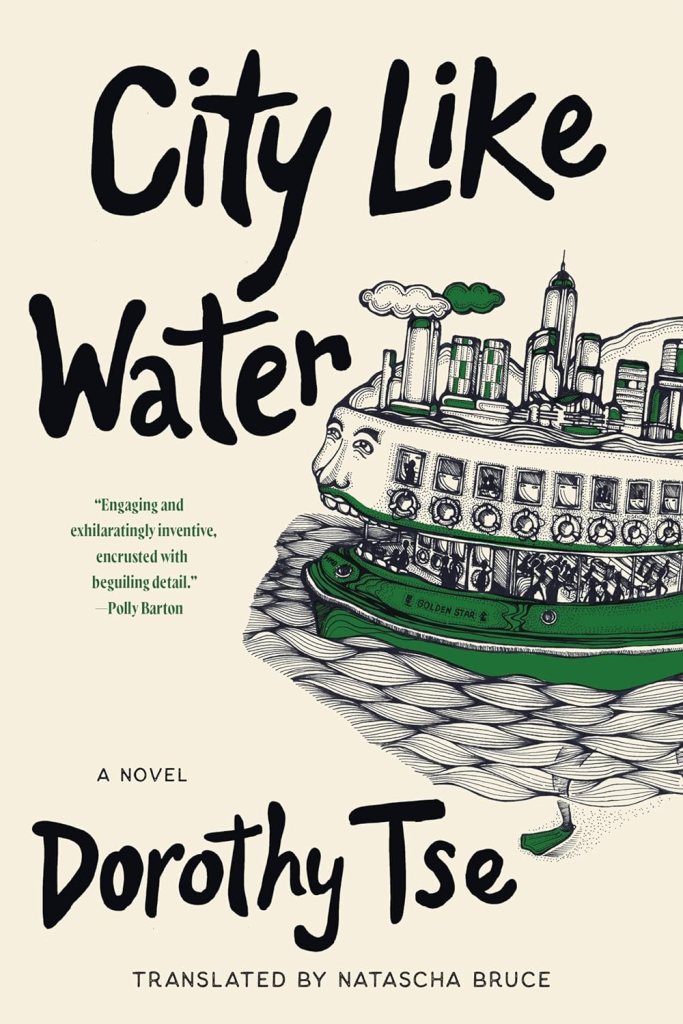
Dorothy Tse’s City Like Water is a story that diverges. An unnamed narrator observes their family, their neighbourhood, and the city around them gradually break down through a series of grotesque and oppressive episodes. One incident, in which housewives are duped into buying counterfeit lotus roots, triggers a protest whose fragmented consequences generate the momentum of the story.
Those consequences, however, are not easily traced through the text. One chapter, titled “Dolls Gone Unruly,” reveals a sister whom only the narrator can remember, as they think of her while driving. “Flocks of Birds Upstairs” depicts birds transforming into books in a shop that later disappears. Crucial details of the plot are interspersed throughout these haunting scenes, culminating in a kaleidoscopic text, perhaps best represented by a striking image from the narrative:
Every rainy day, the city breaks up into so many puddles, and every puddle contains a reflection, and every reflection is the reflection of another reflection.
Within and beyond these reflective episodes, the city fractures along moments of surrealism; it divides between dreams and the waking world, between memories of the past and the dystopian present, and between the two sides of the television screen. Tse’s design is articulated in the narrator’s early confession:
My own memory is a mess. A ravenous, never-tidied storeroom, constantly in motion. A chaotic sea. But the tides of my sea must follow some kind of rule, some subliminal rhythm, because some things sink forever beneath the waves while others keep bobbing to the surface.
That chaotic memory is primarily held together by three “subliminal rhythms.” The first is a narrator whose lucidity counters the fragmented nature of the narrative. The second consists of striking and unmistakable depictions of life in Hong Kong. The third, an extension of the second, comprises the story’s motifs, which accumulate meaning with each episode. All three converge in Tse’s depiction of the wet market, a setting central to several episodes and first described as a metaphor for the history omitted from textbooks.
It was like entering one of those new-build indoor wet markets, the floor slick with foul-smelling waste that glistened like fish scales. Somewhere, a chicken’s throat was slit, its lingering final squawk absorbed by the blare of our home television.
Disgusting and iconic in every sensory register, the description’s viscerality is matched by a succinct transition from metaphor to narrative, facilitated by the narrator’s matter-of-fact tone. However, once the wet market becomes the setting for the protest in the chapter “Lotus Roots at War,” the metaphor is effectively transposed onto the narrative itself, and the distinction between the two dissolves.
The lotus root, and food more broadly, serves as a crucial motif in City Like Water (perhaps an allusion to the lotus-eaters of Homer and Tennyson). Incensed by the bleeding lotus roots she has purchased, the narrator’s mum and a band of neighbourhood housewives storm out to the wet market in search of the counterfeiting culprits:
The hose water carried a fish-smelling scum out onto the street. With these white crests of everyday debris foaming around their shoes, the women gripped their fake lotus roots and wondered if it was a sign they should go home. But this couldn’t wait another day. Tomorrow’s wandering traders wouldn’t be the same as today’s. Today’s lotus root cheat would probably never come back.
“666!”
The inversion of the police hotline from 999 to 666, the anonymity of the city, and the dark treatment of emblematic Hong Kong settings can easily frame the novella as an allegory. The difficulty, however, is that allegories function only when aspects of the fictional correspond with aspects of the real. Once the foundations of the allegory are overwhelmed by the layers of Tse’s metaphors and surrealism, the connection becomes harder to trace. The centre of gravity of the text therefore lies not so much in the allegorical city as in the narrator and their memories.
Although City Like Water does not readily conform to established genres, it is not reluctant to acknowledge its influences. When inhabitants of the city are described as turning into cockroaches, the book invokes Kafka’s The Metamorphosis. Yet as protestors turn into statues, soldiers step out of the state-issued television, and birds become books, the theme of metamorphosis extends beyond a singular outcome of repression. In this city, change is pervasive, interactive, and frequently oppressive. The force of these transformations is matched by the brevity of the text, which prevents their effects from spilling into excess. Given its ambition, City Like Water is an unexpectedly balanced book, an experiment well worth the experience.
How to cite, Han, Jonathan. “Metamorphosis and Memory in Dorothy Tse’s City Like Water.” Cha: An Asian Literary Journal, 13 Mar. 2026. chajournal.com/2026/03/13/city-like-water.


Jonathan Han is a Hong Kong-based writer. His work has appeared in Essays in Criticism, Hong Kong Review of Books, and Asian Review of Books. His chapbook Quinquennial was published by Pen and Anvil Press. Follow his Substack @jhantheman. [All contributions by Jonathan Han.]
 Cha
Cha 