
茶 FIRST IMPRESSIONS
茶 REVIEW OF BOOKS & FILMS
[REVIEW] “When Goodbyes Are Not Permanent: Kit Fan Goodbye Chinatown” by Susan Blumberg-Kason
Click HERE to read all entries in Cha
on Goodbye Chinatown.
Kit Fan, Goodbye Chinatown, World Editions, 2026. 268 pgs.
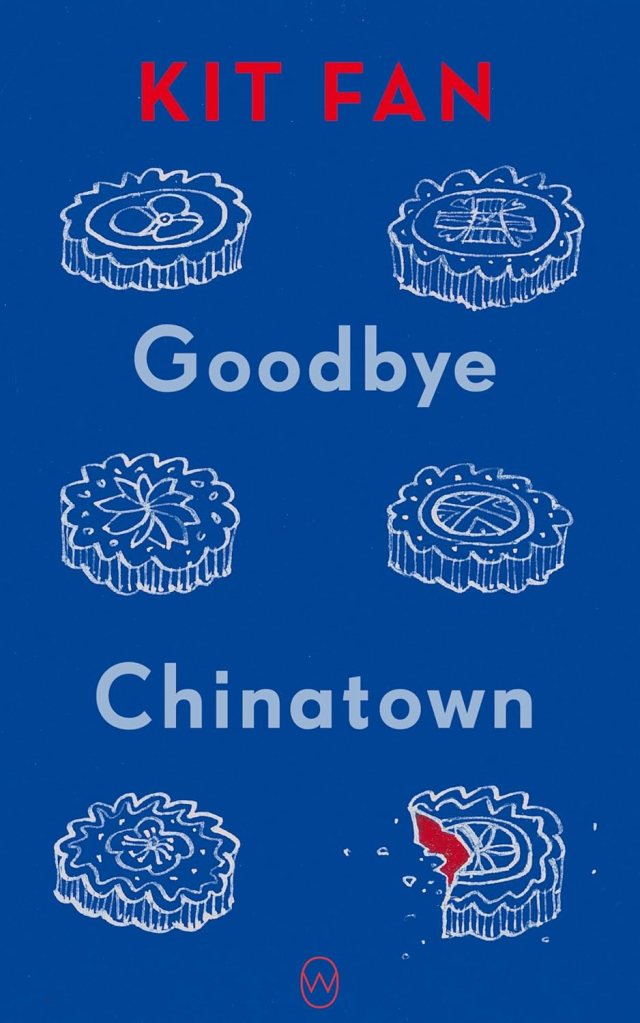
What is a nice Oxford-educated woman doing running a London Chinatown restaurant? Amber Fan, the protagonist in Kit Fan’s new novel, Goodbye Chinatown, knows exactly what she is doing. She has chosen to open Chinatown’s first fusion restaurant at precisely the moment her parents, former restaurant owners themselves, are about to move back to Hong Kong. What follows is a meditative story of reinvention and redemption, one innovative dish at a time. Kit Fan’s background as a poet shines through in his concise prose, which carries this book just as much as the compelling plot.
The Fan family, like the author himself, immigrated to England from Hong Kong. Amber’s parents’ restaurant was called The Golden Palace before they bowed out because of a bird-flu alarm. Amber’s fusion restaurant is called Luna, named for the moon.
Funnily enough, when she was young, when they had recently arrived in London, her mother used to say, “Freedom means letting go of Hong Kong, the place we love.” But after The Golden Palace had taken off, her family had got no time to think about freedom. In any case, for Amber, from the moment she had found love in her father’s kitchen, all she’d wanted was for her food to be tasty, joyous, memorable.
Luna is scheduled to open in the early 2000s, and the auspicious date chosen falls after her parents’ planned flight back to Hong Kong. This is a moment just after 9/11, when flights were frequently cancelled and rescheduled. Moreover, Amber’s parents intend to take her young son, Bobby, back with them to Hong Kong. Amber was a teenage mother, and her parents have been raising Bobby as their own. It is painful for Amber to think of her son so far away, even though Bobby believes she is his older sister and remains unaware of the truth behind this separation. Still, it is difficult for a mother to part with her young child.
She spotted the grey hair on her father’s sideburns and the exaggerated curvature of his spine after years of bending over the wok. Now was too late—or was it too early—for her to be Bobby’s mum, but at some point in the distant future, there would be a right time. She gently touched her father’s back and said, “I’ve never said this to you or to Mum or even to myself…One day, perhaps when Luna is well-established, I want to spend more time with Bobby.”
It is also a time when London’s Chinatown, like many others around the world, is changing. For decades the dominant language had been Cantonese, but as more mainland Chinese began to emigrate in the late 1990s and early 2000s, Mandarin started to become the primary language spoken in Chinatown. Amber comes into contact with a mainland investor named Celeste Gao, who enters Luna and asks for an omakase, a menu of the chef’s choice. Celeste is impressed not only that Amber is the daughter of the former owners of The Golden Palace, which was purchased by Celeste’s father, but also that she is striking out on her own with a fusion restaurant. Celeste offers to invest in Luna, promising to help bring the restaurant to a level at which it could win a Michelin star.
Celeste’s predictions come true, and Amber is catapulted into the ranks of London’s most renowned restaurateurs. Half a decade passes before her parents return for a visit with Bobby. Amber dislikes keeping her true relationship with him a secret and must grapple with how and when to tell him the truth. Not long after this visit, Amber receives an opportunity she cannot pass up: to run her own restaurant at the Shangri-La in Shanghai. She will be closer to Bobby and her parents, among other reasons. In later sections, Bobby’s point of view comes into play, and one section is cleverly titled:
Hong Kong
University of
The Chinese
3 June to 2 July 2019
For those knowledgeable about Hong Kong and its history, the title and the dates are laden with significance. Bobby is a university student at this point, and Amber is still in Shanghai. When Amber visits in late 2019, however, mother and son share a moment of connection as they stand before the harbour in Tsim Sha Tsui, gazing across the water at the famous skyline.
They didn’t speak. They just walked together side by side like two long lost friends. Across the Victoria Harbour, the neon lights of Tsim Sha Tsui dyed the sea a psychedelic watercolour blur. Amber realized that no place on planet Earth had a more beautiful skyline than Hong Kong and yet, reflected in the changing currents, the city looked fragile and transient.
Amber and Bobby continue on to the Star Ferry, where they have a heart-to-heart conversation as protests in Tsim Sha Tsui intensify. Yet the most compelling moments of the book occur toward the end, when Amber and Bobby finally find peace in their mother-son relationship and Bobby begins to fend for himself in the ways he desires.
There are several ways to read this book. One could interpret the dynamics of the Fan family as reflecting the ways in which Hong Kong has changed over the past four decades. The older Fans are pre-1997 Hong Kongers, while Amber belongs to the generation that came of age during the Handover and whose formative years straddle the two eras. Celeste represents the rising economic powerhouse of mainland China, whereas Bobby belongs to the post-Handover generation that is still trying to determine its own identity. Kit Fan writes these characters with great empathy, and the reader can clearly perceive and appreciate the good in each of them.
Kit Fan also uses the most tumultuous episodes of the past forty years to frame this touching family saga, contained within a little more than 250 pages. From the late 1980s to the turbulence after 9/11 and the bird-flu outbreak, from the international financial crisis around 2008 to the months leading up to the COVID-19 pandemic, Fan suggests that it is sometimes necessary to leave in order to begin again. Amber’s parents left Hong Kong for London, but a decade later they left England to return to Hong Kong. Amber makes several major moves, as does Bobby. Yet the story remains hopeful. If, in one year, someone feels the need to leave, it does not follow that a decade or two later it will not be the right time to return.
How to cite: Blumberg-Kason, Susan “When Goodbyes Are Not Permanent: Kit Fan Goodbye Chinatown.” Cha: An Asian Literary Journal, 11 Mar. 2026. chajournal.com/2026/03/11/chinatown-goodbye.


Susan Blumberg-Kason is the author of Bernardine’s Shanghai Salon: The Story of the Doyenne of Old China, a 2023 Zibby Awards finalist for Best Book for the History Lover. She is also the author of Good Chinese Wife: A Love Affair With China Gone Wrong and the 2024 Zibby Awards winner When Friends Come From Afar: The Remarkable Story of Bernie Wong and Chicago’s Chinese American Service League (University of Illinois Press, 2024). She is the co-editor of Hong Kong Noir and a regular contributor to the Asian Review of Books, Cha and World Literature Today. Her work has also appeared in the Los Angeles Review of Books and PopMatters. Visit her website for more information. (Photo credit: Annette Patko) [Susan Blumberg-Kason and ChaJournal.]
 Cha
Cha 