
茶 FIRST IMPRESSIONS
茶 REVIEW OF BOOKS & FILMS
[ESSAY] “Bittersweet Fusion: Taste, Pain, and Fate in Kit Fan’s Goodbye Chinatown” by Angus Stewart
Click HERE to read all entries in Cha
on Goodbye Chinatown.
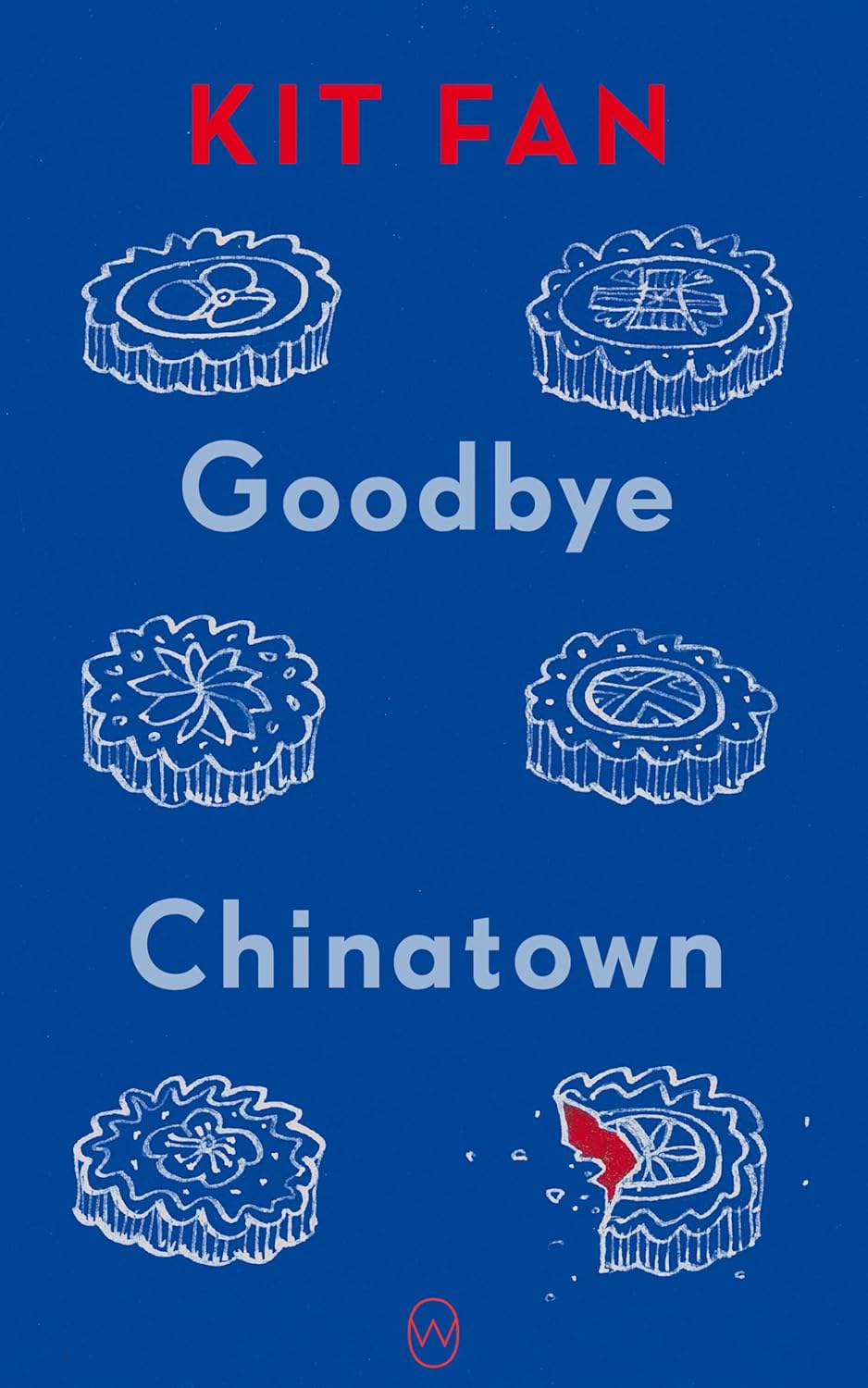
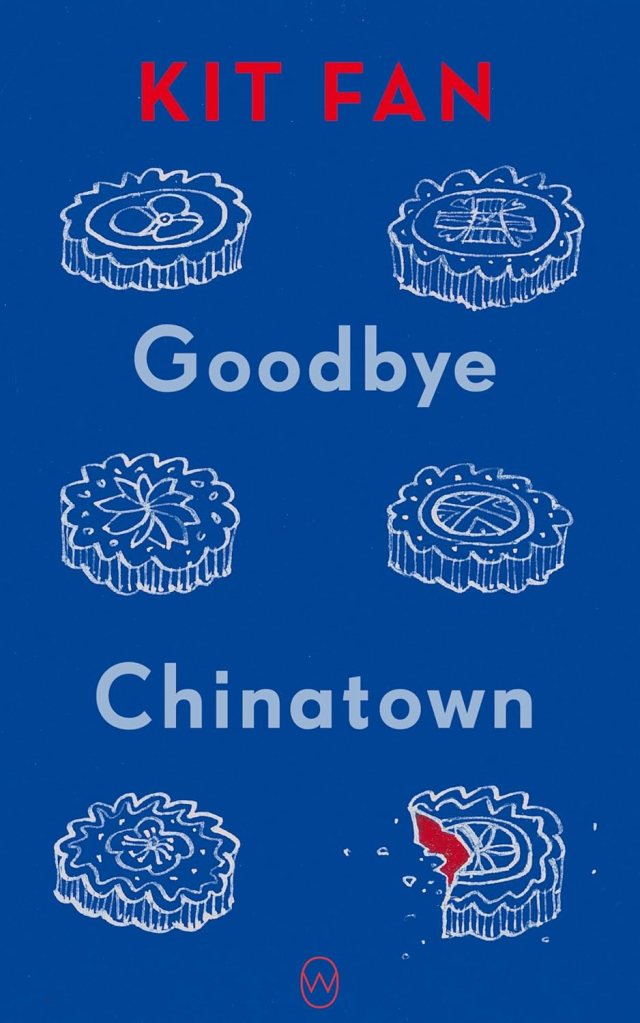
Kit Fan, Goodbye Chinatown, World Editions, 2026. 268 pgs.
)))
Table Setting:
A Preface from Manchester, 2026
In Stockport, my home since March 2023 and six miles south of Manchester’s Chinatown, almost every Chinese restaurant and takeaway serves British Chinese food. Their menus are Anglicised, and they often double as chippies. These venues are beloved, and their mass appeal marks their place in mainstream British culture. Besides chips and curry sauce, their dishes lean Cantonese because their deepest roots lie in migration from colonial Hong Kong.
The democracy movement art on the walls chimes with the café’s yellow brand colour.
But nothing stands still. New venues run by “new” Hong Kongers are appearing. Brew Crew in Edgeley can serve a full English or American pancakes, but can also rustle up a pork chop bap or Hong Kong French toast. The heavy presence of Spam on the menu feels like a largely retired Anglo item slingshotting back from one of the homes it found in Asia. The democracy movement art on the walls chimes with the café’s yellow brand colour. Does this resonance pass straight through most of the regular customers, the ordinary working people of Stockport? I have no idea.
More popular with sections of the East Asian community was Garden of Peach Taiwan Ramen in Chorlton. It is now closed, but it offered another interesting case of linguistic and culinary criss-cross: Taiwanese noodle soup marketed with a Japanese word, and run by Hong Kongers, as indicated by a noticeboard hosting a plethora of event and community flyers. A small art space occupied one wall, and on Friday 19 December 2025 the venue held a farewell night featuring Canton pop (sic), Taiwan pop music, and an open mic.
I have not quizzed any owners, but Occam’s razor suggests that the new wave of Sino suburban businesses exemplified by Brew Crew and Garden of Peach traces back to a scheme set up in 2020 by Boris Johnson’s government, in which three million Hong Kong residents were offered a quick path to UK residence and citizenship. Whatever other motives Johnson may have had, he framed the move as a moral and political response to the Hong Kong national security law passed in the same year.
All this was frequently on my mind while reading Kit Fan’s new novel, Goodbye Chinatown. Its main character is Amber Fan, a Chinese fusion chef. Over the course of the novel, she runs kitchens in London, Shanghai, and finally Liverpool, the site of Europe’s first Chinese community. Its Chinatown lies thirty four miles west of Stockport town centre.
)))
First Course:
Luna/London
Amber is the child of Hong Kongers who emigrated to London in 1989 after being spooked by the events of Tiananmen Square. When Amber’s father retires and closes The Golden Palace, his deliberately conventional restaurant in London’s Chinatown, Amber carries the torch in a new direction. She opens “Luna”, a restaurant serving her creative fusions of Chinese cooking with cuisines from Europe and elsewhere in Asia. To her father’s amused displeasure, Luna’s interior design is “faux Scandinavian”. Even the name is a calculated cultural exchange, imbuing the resonant Chinese moon with the prime language of the European classics. Financing comes in part from her friend Jasmin (also known as Jas), whom Amber considers extremely wealthy. She is, but it is all relative. Every named character in Goodbye Chinatown is very privileged, whether they know it or not.
Thematically, this makes sense. The novel opens in 2001, when London is financially flush. The initial focus on Luna suggests that Goodbye Chinatown will be a novel about running a restaurant, and that its drama will derive from the turbulences that arise as “Cool Britannia” ends and the noughties turn sour. To this the answer is both yes and no. Bin Laden receives a fleeting mention, and the word “Iraq” never appears. Goodbye Chinatown is not Goodbye Blair. Its initial tensions are specific to Chinatown.
Mainland “Mandarin” money and influence are moving in, long before Britain’s societal acknowledgment of a rising China during the 2008 Beijing Olympics. Kit Fan gives “mainland money” a face in the whimsical, ultra rich, party linked Shanghainese heiress Celeste Gao, who eventually replaces Jasmin as Luna’s financial backer. She is morally and emotionally ambivalent, and yet irresistible, both figuratively and literally. Her untouchability, set against Amber’s unbanishable emotional and existential vulnerability, serves as a broad metaphor for the fate of legacy Cantonese culture in London and Hong Kong at the hands of new mainland Mandarin culture. The economic impact of scares around SARS and bird flu adds further tension, but these threats pale when the 2008 financial crisis strikes. Ever the pragmatist and keenly attuned to capital flows, Celeste retreats to Germany and hints to Amber through messages at what is coming. In a poignant and quiet stretch of the book, Amber tries to soldier on, but ultimately she folds and flees, accepting an offer from Celeste to man the tower top kitchen at the Shangri-La hotel in the burgeoning Pudong New Area of 2010s Shanghai.
From our perch in the curdled reality of the mid 20s, Kit Fan guides us to look back on all this, but not in anger. In Amber he shows a flawed but good hearted human muddling through as she tries to balance “win” and “lose”, and “right” and “wrong”. She has talent, but talent alone cannot fix one’s life, nor the world. Celeste is her foil, a character whose insulation from any meaningful precarity is so complete that it renders her a moral alien, and whose talent for spotting talent wants to be human, but remains locked into the logic of capital and cultural consumption.
)))
Palate Cleanser:
Class/Crass
The novel excels when serving the reader the delights of Amber’s fusion cooking.
Accordingly, for a novel concerned with taste and with London, judgements of taste abound in Goodbye Chinatown. The novel excels when serving the reader the delights of Amber’s fusion cooking. The fact that these dishes exist within a novel, and are therefore arranged in a purely verbal form rather than set on a plate, only emphasises the cultural dimension of Amber’s creations. Kit Fan treats us to the layout of an entire “omakase” menu on (p. 54), which Amber has devised on commission for Celeste. (“Omakase” being a Japanese word meaning a meal consisting of dishes selected by the chef.) As a concoction of words, Amber’s VIP menu fuses southern England, the western European mainland, China, and Japan. Here is a generous sample:
View of Delft: oyster, tiger’s milk, cardamom
White Cliffs of Dover: sole, chips, ketchup, vinegar
Suzie Wong’s Wontons: aged grouse, trompettes de la mort, chives
Dartmoor vs Kobe: pedigree dexter, A5 wagyu, beef tomato coulis
Waxing Gibbous: gooseberry, burned sugar, mooncake
Amber’s fusion stylings eventually earn her a Michelin star. In Goodbye Chinatown she is the paragon of bourgeois good taste, as far as cookery is concerned. Even her deployment of fish and chips, a working class classic, feels knowing and postmodern. Hence the use of pricy sole rather than plebeian haddock.
Amber’s achievements, enabled by her membership of an educated, property owning upper middle class, and secured through drive, talent in the mechanics of cookery, and a refined yet bold cultural taste, provide her with leverage in her dealings with Celeste, the crass nouveau riche whose family, before buying in external highbrow talent, deal in “pop food”. Not long after her omakase meal, Celeste shows Amber “BAOISM”, the pop up venue that her family money has built to replace The Golden Palace. Here it is difficult not to imagine the author wrinkling his nose slightly as he describes:
…a white-washed, laboratory-style eatery selling bao buns with twelve customisable fillings. You could choose veal with lady’s fingers or lemon curd with red bean paste. About ten customers were queuing outside, mainly teenagers or adults who dressed like teenagers.
Or perhaps the snobbery is a literary point of view device, spilling over from Amber into the narrative. In any case, this moment illustrates the class war running through Goodbye Chinatown, one of manoeuvre and compromise between the relatively moneyed and the infinitely moneyed, with near zero input from those below.
This particular moment appears to come at the cost of anachronism. It occurs in 2001, more than a decade before the mainstream take off of the bao, gua bao to be precise, among young hip consumers in urban Britain. Trends do often take hold first in London, but here it feels as though taking a pop at the populist pop up took priority over historicising the arrival and popularisation of, for lack of a better catch all category, “mainland” Chinese food in the centres of Britain’s wealthier cities.
And even these zones, it should be said, remain the front line. In today’s Manchester, for example, if you know where to look, you can find shaokao, huoguo, and roujiamo. Yet these words, and the foods they signify, remain unknown to the vast majority of Britain’s teenagers and those “dressed like teenagers”. A metropolitan hipster might well enjoy stopping by Amber’s Luna, for fun or to accrue some cultural capital, but they would need to belong to the variety who does not worry much, or ever, about paying rent.
}}}
Second Course:
Dis/Connection
Across Goodbye Chinatown, cooking recedes into the background. This is partly because, in the final act, Amber loses her position as the sole point of view character, and partly because the setting shifts from London’s Chinatown to the “real thing”, before a hopeful close in north west England. Above all, however, it is family that overtakes food.
Early on, we learn that Amber is a mother. And yet she is not. After an accidental pregnancy at eighteen, she agrees with her parents not to inform the father and to let them raise the child. They agree to maintain a lie, that Amber is the child’s sister. The boy is named Bobby, or Bobo. At the onset of his teenage years, Amber tells him the truth. This triggers the major emotional rupture of the novel. Bobby shuts down, then shuts Amber out, shortly before returning to Hong Kong with his grandparents. While Luna is running into post financial crash problems, Amber struggles to avoid a more personal collapse. She wrestles with guilt and longing, and with the fear that her chance for a human connection with her son is now permanently lost. Readers who have been part of unconventional or fractured families will recognise the peace Amber eventually finds in accepting that while “normality” is not always retrievable, it is certainly not essential to a meaningful and acceptably happy life.
Other painful imperfections characterise the Fan family, and all are mediated by patience and understanding. Mr Fan never fully appreciates Amber’s fusion cooking, but he supports her emotionally and commends her success. When Mr and Mrs Fan have more or less fallen out of love and landed grouchily on either side of Hong Kong’s political divide, they do not abandon one another. They deceive Bobby to support Amber, but support each “child” when the truth emerges, continuing as tactful go betweens where others might have taken a side or resigned themselves to victimhood or indignation. Bobby wrestles with his conflicting feelings for Amber: resentment, sympathy, and indifference. Yet as he matures he learns to see her as simply human and fragile, and accepts that there was sense in her decision not to move straight from childhood to motherhood. When Bobby’s involvement in pro democracy activism lands him in trouble, the family comes to his rescue without lecturing or extended lamentation.
Goodbye Chinatown is deeply concerned with its Chinese diaspora story.
Goodbye Chinatown is deeply concerned with its Chinese diaspora story, and with the fading of an idealised and short lived liberal Hong Kong. For many readers, the primary interest will lie in these linked strands.
And yet the book is arguably at its best when engaging in its portrait of a small but complex family. This portrait is in some ways culturally specific, but it will surely chime with what the ideal of “family” means to many readers across cultures, patience that survives disconnection and dislocation and that, given time, can outlast any wound.
}}}
Third course:
Who am I?/Where am I?
Of course, it would be facetious to suppose that diaspora identity does not also connect with “family”. And perhaps it is a cliché, but it is worth mentioning for readers who may not know that in Chinese “home” and “family” are expressed by the same character: 家.
Each of the Fans faces the problem of belonging. 家 in the sense of a physical household is not the issue. This family does not live pay cheque to pay cheque, and always has enough cash or property to manage each continental relocation. Yet four sound walls cannot banish the persistent emotional pain of being caught in the netherworld between two, or more, worlds: the old home and the new, the receding order and its replacement. These forms of homelessness cannot be bought off or outrun. Indeed, continent hopping only deepens one’s dislocation.
As the novel progresses, the independent status of Hong Kong gradually erodes. The city itself is not vanishing, but the notion of it that the Fans regard as “home” is either dying or evolving, depending on one’s perspective. This ticking timer forms the tension, or at least one major tension, that underlies each character’s dilemmas of collective and individual identity.
For Bobby, there are all the vexing questions that we see him inherit as he grows from an oblivious, babbling four year old into a precocious and taciturn youth. It is perhaps no surprise that towards the novel’s end we see the young Bobby enter into a sexual relationship with a man twenty years his senior, though readers might reasonably question why the author chose the name “Kit” for the latter. Bobby participates at the edges of the political struggle for Hong Kong’s future, but directs his most personal focus towards environmentalism. A less doomed cause, perhaps, since nature operates on longer timescales than families, nations, or education systems.
China emerges as a juggernaut destined to edge out the transient micro identity of Hong Kong and the faltering Anglo world order.
Mr and Mrs Fan’s age grants them a longer historical perspective on the trajectory not only of Hong Kong but also of London’s Chinatown, each interlocking with a story too vast to grasp: that of China. In Goodbye Chinatown, China emerges as a juggernaut destined to edge out the transient micro identity of Hong Kong and the faltering Anglo world order. The novel grants China only one face: Celeste, and even she is less a simple Shanghainese patriot than a rootless transnational capitalist.
When push comes to shove, Mr Fan sees little point in resisting Hong Kong’s slow incorporation into the broader authoritarian system. Before he finally passes away in his home city, he has retreated into gardening and, perhaps tellingly, has been hiding his ailments from his loved ones. As a teacher displeased with the imminent roll out of a censorious and Mandarin centric curriculum, Mrs Fan is less ready to discard her ideals. Yet when the time comes to give up and fly to Liverpool to live with her daughter and grandson, she hesitates, turns one hundred and eighty degrees, and embarks on a taxi journey around the highways of Hong Kong that, as far as the reader can tell, will never end. Thus we leave her in an untenable state that, once she finally pays and exits the taxi, will simply unfold into limbo on a larger scale.
For Amber, there is not only the individual problem of being neither completely sister nor mother. There is also the bind of performing one’s identity through food, which the novel raises early and then sets aside. And there is the problem of mother tongue, which proves unsolvable for Amber. She is “from” Hong Kong, yet her Cantonese is shaky. She relocates to Shanghai without Mandarin in hand, which ironically affords her the privilege that the right kind of foreign “other” often enjoys in China. When Amber finally returns to the United Kingdom, she moves somewhere far from London, both geographically and culturally: Liverpool. Her happy ending does not tie a neat bow around the idea of “home” as a fixed place on earth. It is happy because she is alongside Bobby at last. If one spells it out, Goodbye Chinatown ends on an old and slightly cheesy truism: home is where the heart is. And there is nothing wrong with cheese.
}}}
Dessert:
Bitter Sweets
This novel goes down easy.
It is not too long, its prose is breezy, and its family drama has a big heart and a strong pulse. Kit Fan treats his characters with kindness, even at their weakest and worst. Its journey through the ’00s and ’10s into our troubling ’20s makes for a rewarding retrospective, especially perhaps for millennials, while the Sino British settings and reflections on foodie fusion lend the dimensions that give Goodbye Chinatown its own distinctive shape.
There are plenty of quibbles one might have, and I have raised mine above. I will expand a little on one. Mainland Chinese readers might feel hard done by in having a woman like Celeste as their only representative. Or they might simply recognise her as an archetype of the ruling class, or a Shanghainese nepo baby. In any case, she belongs to a stratum of wealth that most humans alive today do not, and cannot, encounter, and therein lies the licence for aggressive flavouring, together with an extra hint of quiet disquiet. The fact that there exists a class of people so stratospherically wealthy, so untouchable, and so untroubled by conscience, Epstein files and Party crackdowns notwithstanding, is the tangy cherry floating in the middle class cocktail of life’s petty frustrations. Amber can chase success and flee pain across oceans and nation states, but there is no private island waiting.
If the reader can accept Goodbye Chinatown for what it is, they will be able to accept its bittersweet flavour. Beauty and discovery abound in cultural fusion and in the forging and flourishing of friendships and families, yet all such things remain tied to materiality, to the constraints and contingencies that all but the ultra rich must face.
Despite every innovation in diplomacy and technology, the crow flight distance between nations remains non negotiable.
You can be the chef, or the mother. You can fight and die, or fold and live. You can bake a cake, but given time it will rot. Despite every innovation in diplomacy and technology, the crow flight distance between nations remains non negotiable. And despite thousands of years of politicking, these nations have proved by turns as immovable and as fickle as their covetous rulers. Nothing is promised. Time is always ticking. As I mentioned above, nothing stands still. Furthermore, nothing is reversible.
Everyone you meet and everyone you see, whether their family has lived next door for one hundred years or moved in yesterday, and whether they have inherited the family business and are using it to explore and materialise their artistic passions or are being paid minimum wage to serve those passions on an exhausting Friday evening shift, carries their pain and has their story.
Goodbye Chinatown is neither nonfiction nor journalism, but besides being a good read it ought to be a great conversation starter. It is, for me at least, a reminder that when you leave somewhere you do not truly leave it behind. For me it is also a prompt to ponder the individual and familial sagas of Britain’s Cantonese speakers. All bridge two far corners of the world, yet none are quite the same. Some are multigenerational, others a one off. Some are old history, others newborn. Behind those stories lie tides and entities and abstract dramas, unliving forces much older and stranger than our brief human lives. Colonialism, cold war, democracy, multiculturalism, communism, curricula, diaspora, people power, state power, protest, crisis, collapse, evolution, reinvention, and the arrival of China in a multipolar world. It will be a great deal to chew on over my next serving of Hong Kong French toast. Or perhaps I will go for the Spam croissant.
How to cite: Stewart, Angus. “Bittersweet Fusion: Taste, Pain, and Fate in Kit Fan’s Goodbye Chinatown.” 8 Mar. 2026, chajournal.com/2026/03/08/goodbye-chinatown.


Angus Stewart writes strange stories and essays that have found home in publications including Necksnap, Big Other, and Typebar. He hails from Dundee, lives in Stockport, and ran the Translated Chinese Fiction Podcast for five years. [All contributions by Angus Stewart.]
 Cha
Cha 