

茶 FIRST IMPRESSIONS
茶 REVIEW OF BOOKS & FILMS
[REVIEW] “Claire Lee’s On The Verge: Silence, Urban & City Life, and Quiet Chaos” by Tin Yuet Tam
Click HERE to read all entries in Cha
on On the Verge.
Claire Lee, On the Verge, Independently published, 2025. 120 pgs.
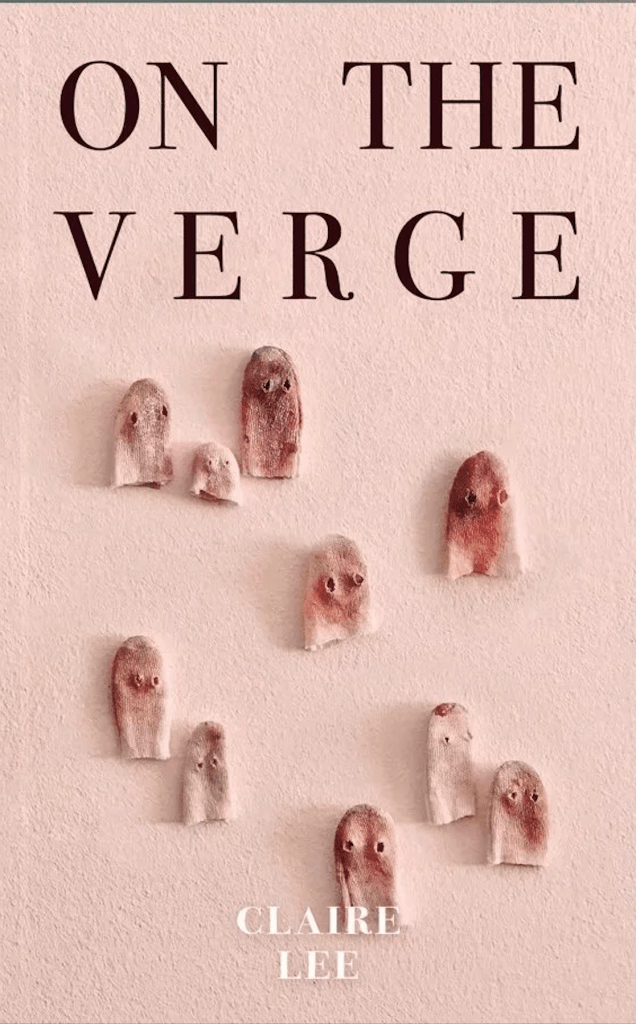
Claire Lee‘s On the Verge moves readers to the edge of their seats from the moment they encounter the cover. The cover artwork, Out of Touch (2022), an installation by the author herself, presents a striking arrangement of fingertip gloves like those worn by cashiers. Yet these gloves resemble severed fingers marked with bloodstains. The phantom like openings appear as the eyes of wounded souls looking out upon the world.

What is the life we are living? What lies beyond or beneath it?
As a visual artist, Lee approaches writing with a similar sensibility. Her latest book, a collection of prose and poetry written between 2019 and 2025, reflects years marked by social movements and a lingering pandemic. Throughout the volume, Lee interweaves prose pieces named after places and objects. Between these prose fragments, which offer an almost X-ray observation of everyday life, short poems emerge from the observer’s perspective, giving voice to murmurs and cries from deep within the emotional landscape. The book produces a mixture of comforting and disquieting feelings that place the reader on the verge of contemplation: what is the life we are living? What lies beyond or beneath it? From perspectives of silence, urban life, and quiet chaos, this review traces the subtle perceptions that arise from Lee’s inquisitive eye and pen.
}
Silence:
Choice of everyday objects
Among the titles of the prose pieces, Lee frequently selects everyday objects as her subjects. Rather than placing human beings at the centre of narration, objects assume that role. Objects and animals witness human horror and observe our world with doubt. A lone wolf, snowflakes in underground bunkers, and a rose become symbols of contemporary loneliness, wartime perseverance, and hard won freedom.
Lee selects and gives voice to objects that often pass unnoticed in ordinary life. At times these objects provide warmth amid life’s cruelty, yet they also remain silent spectators gathering the loose ends of human experience. Observing two people sitting silently beside her in a restaurant, Lee writes the short story “The Old Table” (p. 10-11), imagining what might have transpired between them before their long silence. The table between them becomes a powerful witness to their conflict and distance. Through gestures such as fidgeting with folded napkins and the ring of a glass upon the surface, the restaurant table stands as a quiet presence. It reflects the sentiment that “The distance between us and within ourselves fails to recognise how much closer we truly are than what we see in each other” (p. 11), a line interwoven into the prose in the form of a poem.
The book creates a sombre atmosphere surrounding lives that are misunderstood or forgotten. Some pieces may leave the reader with a tightening in the stomach because they foreshadow unhappy endings, yet Lee often stops at that moment, leaving the narrative unresolved. “Exodus” (p. 50-51), for example, presents a two page prose passage depicting scenes of disappearance: people long gone, words that fail, cultures in ruin. When the passage ends with animals scattering amid unending atrocities, the scene resembles the closing moments of many dystopian films, when nothing remains to be remembered.
At times, however, the everyday objects and the analogies attached to them become somewhat ambiguous, requiring readers to revisit passages several times to grasp their implications. Some pieces are not long enough to fully articulate their underlying meaning, as though they were films not entirely developed. The piece “Americano” (p. 89-90) is one such example. Its intriguing premise, in which the protagonist “she” becomes transfixed by an image of mountains, suggests the possibility of deeper exploration. Yet without clearer indications of what the mountains symbolise, the narrative concludes somewhat indistinctly. One wonders whether “she” might have been engaged in an existential enquiry that culminates in the moment when the coffee spills and the situation reverses.
}
Urban & City Life
Following the structure of the prose pieces, Lee intersperses poems throughout the book. It would be interesting to know more about her creative process. Did she write the prose and poems simultaneously to ensure that they complemented one another, or were the poems selected later to accompany prose pieces that seemed to match them?
In any case, Lee’s prose possesses a flexibility that allows it to be situated in a variety of geographical locations. From Berlin to unnamed cities, from a city in Britain to uncharted places, Lee depicts human lives shaped by the surrounding world. Ukrainians sheltering in bunkers during air raids fight on like dancing snowflakes (p. 64-65). Wars and conflicts tear families and communities apart (p. 23-24). Lives are lost to tragedy, as in “Eunice” (p. 62-63). The choice of subjects and locations makes On the Verge particularly compelling to read because it does not confine itself to a single setting. Instead, it turns its attention to common life, everyday mundanity, and the atrocities that can suddenly disrupt everything that has been built.
Drawing inspiration from Alain Resnais‘s Last Year at Marienbad (1961), Lee reflects on relationships between people and the city in her piece “Blanket” (p. 98). The sense of distance that accompanies being away from a city dissolves once Lee observes the quiet togetherness shared by solitary individuals inhabiting the same urban space. This realisation brings her a sense of safety she has not felt for some time, and with it comes the idea of home as something like a blanket surrounding her.
Contemplation of what we hold in our hands can express something greater than words.
Lee’s depictions of city life are not limited to bustling crowds and crowded streets. They also dwell on fleeting moments of observation and reflection. In the piece “Tea” (p. 103), spoken words are absent from the interaction between “us”. Instead, through close attention to the tea itself, Lee introduces a poetic dimension into the prose. Connection emerges through exchanged glances and the warmth of the teacup. At times, contemplation of what we hold in our hands can express something greater than words.
}
Quiet Chaos
At the edge of ordinary life, Lee’s writing reveals a sense of quiet horror within everyday mundanity. What appears ordinary can awaken our deepest fears, regrets, and sadness rooted in the past. Across many pages, Lee writes about loss and the abrupt endings that life can bring. In the prose piece “Lombardy Poplar” (p. 91-92), the narrative begins with an unsettling scene in which a “woman child”, a phrase that invites reflection on its meaning, dances at night. Hospital sheets might seem ordinary to many of us, yet when associated with a solitary “woman child” dancing in a forest on a pitch dark night, they take on a disturbing quality. Without revealing what this figure has endured or what grief she carries, the prose leaves behind an uneasy and chaotic atmosphere that lingers.
Other pieces evoke loneliness through everyday objects. Despite the festive setting of decorating a Christmas tree (p. 82), the conclusion is melancholic, with scattered pine needles lying on the ground like fallen constellations. In another story, an old radiator (p. 83-86) standing in the same home for decades becomes a quiet witness to the passing of time and the transformation of space. Yet the radiator remains fixed in place, observing generations of people who long for connection but “were present in the same room yet remain strangers” (p. 86).
}
The Spinning Top
at the end
Amid streams of moving objects, cities, and thoughts, On the Verge is composed of prose and poetry that resist any standardised structure. Instead, the book unfolds through contrasts of noise and quietness, chaos and calmness, clarity and confusion, reality and dreams. Lee does not explain why a spinning top appears on p. 108, yet one may imagine it as an invitation, as well as an extension to the reader, to dream beyond the boundaries of the book.
Like the spinning top at the end of Christopher Nolan’s Inception (2010), this object brings us to the cusp between reality and dream, prompting us to notice the subtle intricacies within everyday objects. On the fringe of ordinary life, this collection of prose and poetry captures moments that are both unsettling and soothing. Between and beyond the prose, one still longs to glimpse small signs of hope emerging from the lines, the objects, and the faces that remain preserved in written words.
How to cite: Tam, Tin Yuet. “Claire Lee’s On The Verge: Silence, Urban & City Life, and Quiet Chaos.” 6 Mar. 2026, chajournal.com/2026/03/06/verge.


Tin Yuet Tam is a Hongkonger who writes about arts and culture. She has written critiques on performing arts in Chinese, for example, her theatre critiques can be found in Hong Kong Repertory Theatre’s Repazine. She has also been writing poetry, reviews, interviews, and essays in English. Tin Yuet’s poetry has been featured in Canto Cutie and Voice & Verse Poetry Magazine. When she is not writing, you might find her strolling along the streets for hours just to immerse herself in cities. She currently resides in Toronto, Canada. Find her work on Instagram: @walk_talk_chalk [All contributions by Tin Yuet Tam.]
 Cha
Cha 