
茶 FIRST IMPRESSIONS
茶 REVIEW OF BOOKS & FILMS
[FIRST IMPRESSIONS] “Of Mirth-merchants and Humour Literature: Ankit Raj Ojha’s The Bare Bones Book of Humour” by Pradip Mondal
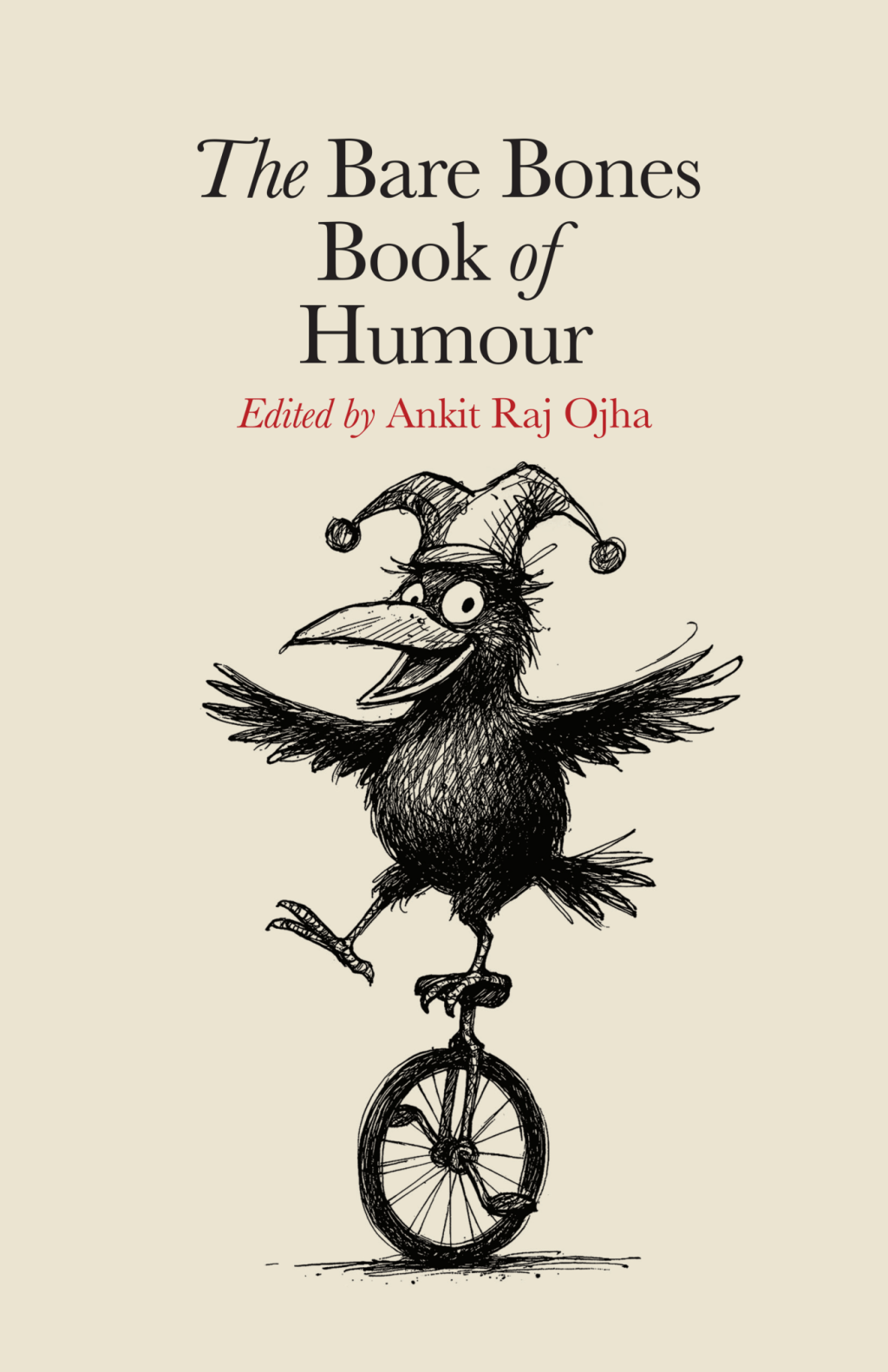
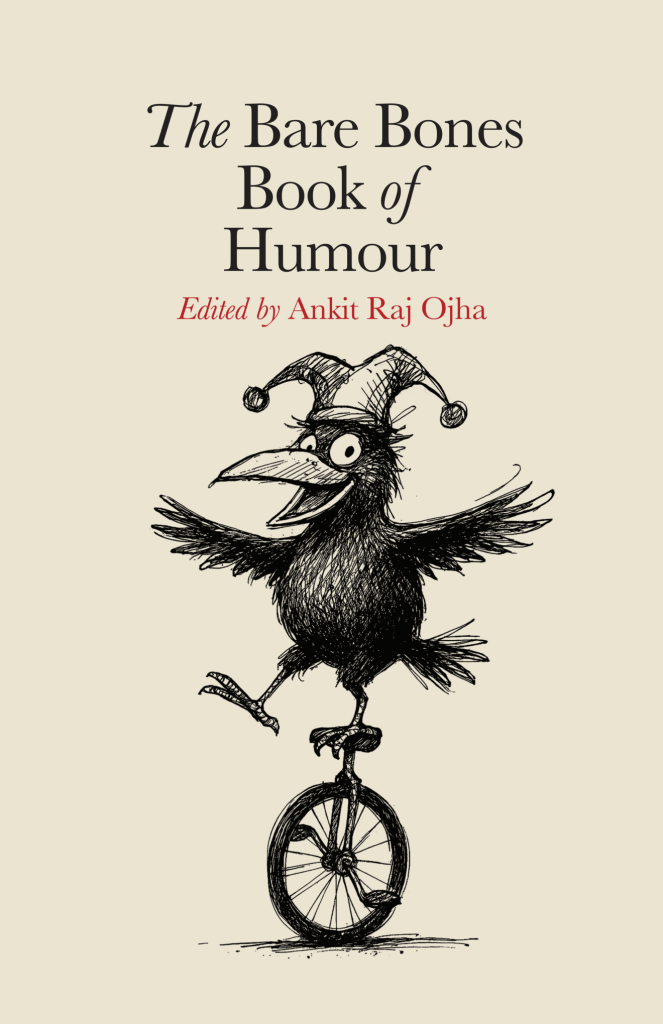
Ankit Raj Ojha (editor), The Bare Bones Book of Humour, Bare Bones Publishing, 2026. 148 pgs.
François Rabelais, in his pentalogy Gargantua and Pantagruel, writes, “Seeing how sorrow eats you, defeats you, I’d rather write about laughing than crying, for laughter makes men human, and courageous.” Ankit Raj Ojha, in the avatar of a mirth-merchant, strides in the footsteps of Rabelais through his The Bare Bones Book of Humour. The editor himself avers in the introduction that humour became his métier “after weeks of serious research.” All twenty four raconteurs in the anthology, based in eight countries, display exceptional finesse in concocting these stories, yet never at the expense of their mérite littéraire.
Mike Nagel’s engaging foreword perfectly sets the tone of the book. He recounts his experience of feeling demurred in a bookshop when he struggles to locate a book of humour. He asserts that such a book should not be undervalued but rather taken seriously. The editor, too, in his introduction suggests that we should throw away the pall of gravity and drape ourselves in habits of hilarity.
The book unfurls with the fascinating story “The Invitation” by Jahnavi Gogoi and ends with the equally merry “Two Good People,” written in and translated from Mandarin by Grace Q. Hu. Gogoi’s story sets before the reader a hilarious scene of Bhaskar’s desperate attempt to eat a “cannonball of a laddoo” at his principal’s home, where he is invited on the occasion of Bihu. “Robes and Roles” by Merlin Flower is a rib-tickling speculative tale in which God is having periods: “After all, he had a ping-pong match with Lucifer and a massage session after that, but his attention kept circling back to the nether regions of his body.” This is one of the funniest stories in the book, along with “The Developments” by Allan Miller, “Regeneration” by Amit Majmudar, “A Man of Culture” by the editor himself, “The Haunting of Chill House” by Abhilipsa Sahoo, “Enlightenment Begins at Home” by Swapnit Pradhan, and “Protection” by Aparna Kalra. In Miller’s story, the narrator’s dream of becoming a palaeontologist by attempting to discover a Jurassic Park in Scotland ends in stupefaction. The character of Suraj Yadav in “A Man of Culture” is presented with vivacity, vividness, and veracity, for this roguish boy could be found in every high school across India. During the screening of a C-grade film in a theatre, he has a tryst with his mathematics teacher, who perhaps went there “to find the value of pi!”
Technically, some stories are novel in their treatment. Aneeta Sundararaj employs the epistolary technique in “Yantra, Tantra, Mantra.” Even when certain stories contain sexual innuendo, they do not verge on the risqué. Humour throughout these stories is deftly laced with wit, euphemism, double entendre, and other ornate linguistic devices. Although some of the stories contain scatological references, they do not indulge in gross humour but instead offer a subtle, succinct, and refined variety. The reader may therefore savour this smorgasbord of humorous literature with the utmost glee. Apart from occasional displays of grotesquery and bawdiness, the book offers much more to admire and thus goes beyond being merely Rabelaisian.
The stories are eclectic in nature, with themes ranging from marriage to menstruation, palaeontological obsession to pubertal precocity, phallic fury to frustration over funerals, Bluetooth blunder to bowel movement, mobile menace to a missing condom, defence mechanism to dodging the police, fake fortune-tellers to a fiasco on a plane, soporific habit to the simulation of snow and tsunami, cleaning weeds to counterfeiting, and gastronomy to God.
Artist Prakash Thombre’s sketch of the crow in its trickster-jester avatar on the book’s cover is evocative, as this archetype has long been associated with laughter. The blurbs by Tabish Khair, Kamlesh Singh, Ashok Pande, Keerthik Sasidharan, and others are beautifully crafted.
Dear good-humoured readers, and also the grim ones to whom laughter is proscribed, if you wish to make your entire set of teeth, if you proudly possess one, glint with delight, you are prescribed to grab a copy. I am certain that these twenty four stories will brighten your day, for the book is indeed a healer of sullenness. In the words of the Bard, “With mirth and laughter let old wrinkles come, / And let my liver rather heat with wine than my heart cool with mortifying groans.”
How to cite: Mondal, Pradip. “Of Mirth-merchants and Humour Literature: Ankit Raj Ojha’s The Bare Bones Book of Humour.” Cha: An Asian Literary Journal, 5 Mar. 2026, chajournal.com/2026/03/05/bare-bones.

Pradip Mondal was awarded a JRF in English by the UGC. He obtained his PhD from Visva-Bharati (India) in 2021. He teaches at L.B.S. Government P.G. College, Halduchaur, Nainital (India). His poems and book reviews have appeared in journals such as Suburban Witchcraft (Serbia), Muse India (India), Borderless Journal (Singapore), Indialogs (Spain), and Setu (USA). He has edited the book Dystopian Deliberations: Essays on Dystopian Fictions and Films (Atlantic).
 Cha
Cha 