
茶 FIRST IMPRESSIONS
茶 REVIEW OF BOOKS & FILMS
[REVIEW] “Cultivating the Infinite: The Art and Spiritual Vision of Zhao Hai Tien” by Jennifer Eagleton
Zhao Hai Tien, Cultivation: The Art of Zhao Hai Tien, University of Hong Kong Press, 2026. 292 pgs.
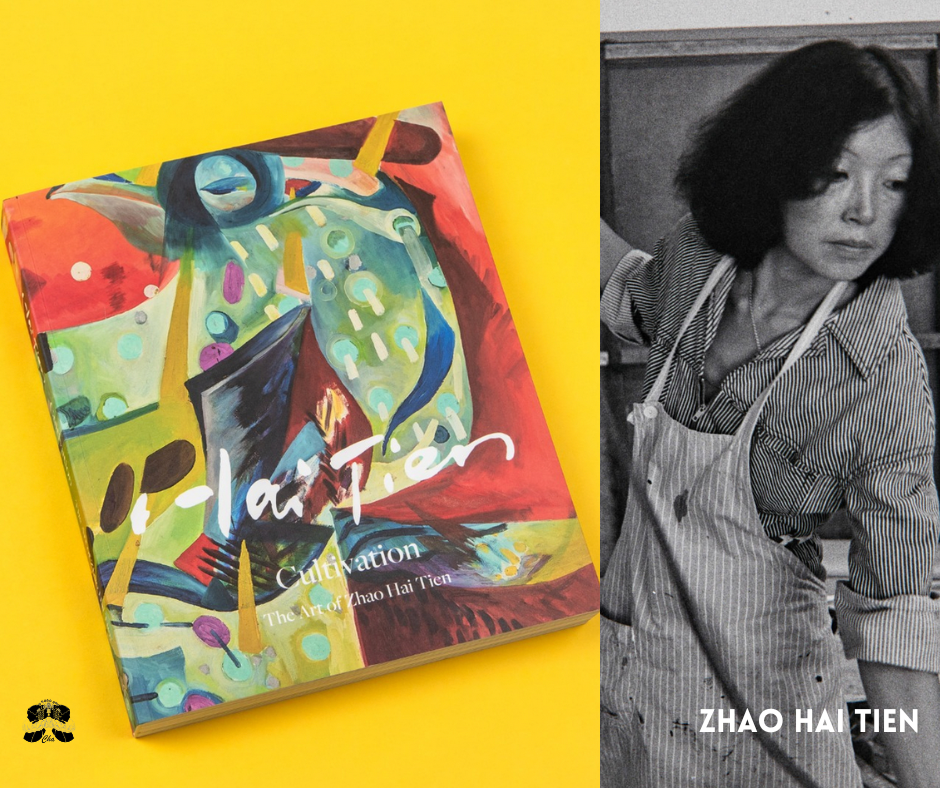
Cultivation: The Art of Zhao Hai Tien comprises a series of informative essays on the renowned contemporary artist Zhao Hai Tien, tracing her evolution and the development of her artistic practice and philosophy. The publication also serves as a guide to the recent exhibition entitled Zhao Hai Tien: Cultivation: 50 Years of Painting at the University Museum and Art Gallery of the University of Hong Kong (10 Dec 2025 – 1 Mar 2026), and includes numerous colourful photographs of her work.
Born in 1945, Zhao’s artistic journey reflects the major movements of twentieth-century art, including futurism, cubism, and abstract expressionism. As Alex Jovanovich in one essay observes, “yet she’s invented is hers, a stripe of painting that takes western formal chaos and marries it to Eastern equipoise” (p. 15).
Zhao’s creative exploration encompasses a striking diversity of media, ranging from airbrush on glass and collage to acrylic on canvas, calligraphic-like compositions, large-scale public murals, and oil paintings. Technical precision is evident in her minimalist works, while her later paintings embrace increasing abstraction. Both the semi-realist and the more abstract works mark her spiritual development in her attempt to distil the essence of a thing or concept rather than its external or physical shell, which she ultimately regards as an inadequate representation of its true nature.
The artist’s airbrushed minimalist paintings are concerned less with depicting the physical properties of objects than with evoking states of being such as calm, reflection, and enlightenment. Usually monochromatic, they invite a dialogue with space and time. The subtle shifts of colour and form suggest a journey towards the very essence of being. In Inner Light (1972), for example, a bright white line pierces a perpendicular square before diffusing into a white mist within a sea of blue. The square perhaps signifies a point of transformation into this essence.
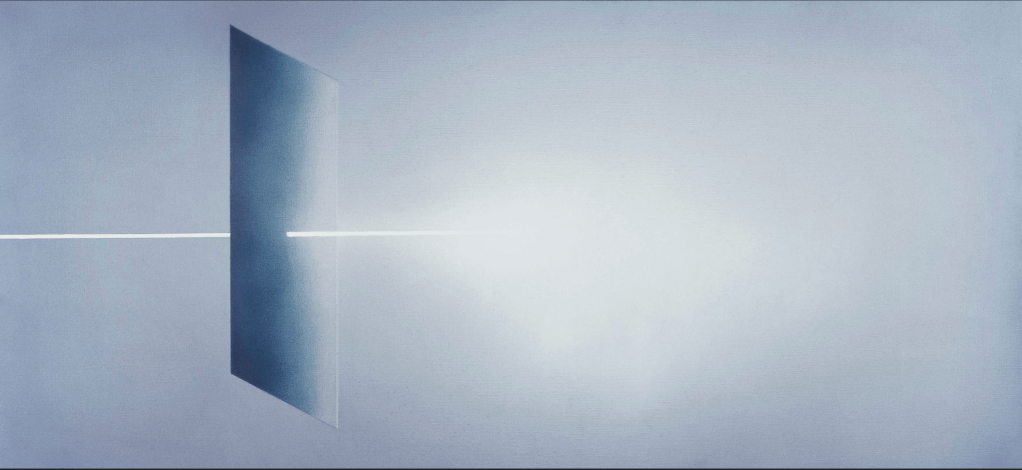
Inner Light
Zhao Hai Tien 趙海天
1972
Acrylic on canvas 塑膠彩布本
89.5 x 190.5 cm
Jones Family Collection
Such dialogue arises from Zhao’s rediscovery of her cultural roots in Buddhism and her adoption of Daoist practices such as qigong. Her work shifts from contemplative figurative airbrush compositions to more liberated works that ebb and flow with energy, expressed through flamboyant and colourful strokes. This transformation reflects the primary aim of Daoist practice, which seeks harmony with the Dao, understood as the natural underlying flow of the universe, through the cultivation of wu wei, or effortless action, and ziran, or naturalness.
Many of Zhao’s paintings embody life that is ever interacting, ever-changing, ever-mixing and matching, in a stream floating in space. In Activity of Atoms (1998), one almost perceives atoms in motion. At first glance the scene appears chaotic, yet closer inspection reveals an underlying order. The elements cohere despite their dynamism. In Things in Motion/Insight 7 (1993), the overlaying of ovoid and smooth-flowing shapes creates a three-dimensional effect. Each dot appears in a constant state of wave-like motion, mimicking contraction and expansion at the intercellular level. Humanity’s connection to the cosmic landscape at an emergent stage is suggested in Life Forming (2012), an oil-on-canvas triptych. Flowing lines and converging molecules link, from left to right, a pink oval with internal dots enclosed within a larger form, from which sprout pink tentacle-like structures that set off a chain reaction culminating in the formation of life.
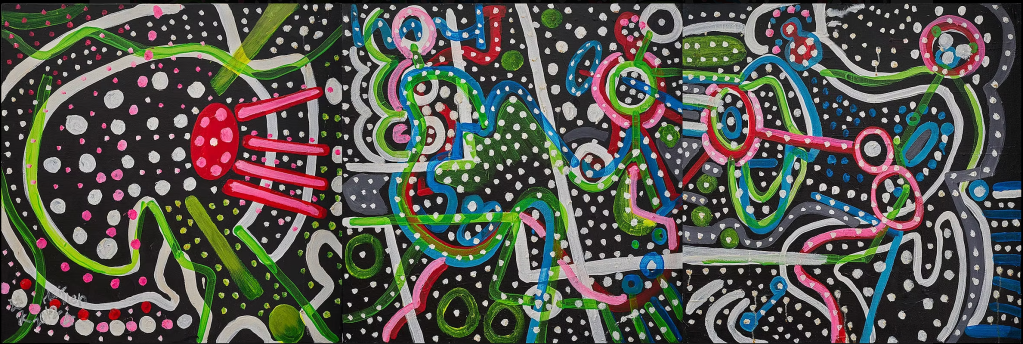
Life Forming
Zhao Hai Tien 趙海天
2012
Oil on canvas, triptych 油彩布本 ( 三聯畫 )
76 x 228 cm
Artist Collection 藝術家收藏
It is fitting that Zhao devotes considerable attention to painting the Buddha. Her representations evolve from a defined presence to a cosmic force and eventually towards a more meditative and universal figure integrated into public space, mirroring her own journey from painterly intensity to spiritual expansiveness.
In the spray-painted The Other Side of the River Series: Buddha 1 (1984), the sharply delineated lines of the Buddha’s face, with its semi-closed eyelids, gaze downward in contemplation upon a half-dome that may represent the world. A white line descends from near the neck of the Buddha, perhaps symbolising an unbreakable bond with the concerns of the earth. In The Other Side of the River Series, Northerner (1986), the Buddha’s head appears in profile, eyes closed, confronting thick black calligraphic-like strokes that may suggest chaos. Behind him, a sphere and a droplet containing traces of blackness could imply an act of transference, as if absorbing the cares of the world. In Buddha No. 10 (1986), the figure is rendered in gold, with furrowed brows, piercing eyes, and an upturned palm. Less serene than the earlier images, this depiction stands among the most unusual representations of the Buddha in the volume.
In The Buddha of Now: Mahāsthāma (1993), the figure becomes fully abstract, with only the hands immediately recognisable, one positioned in the upper-left corner and the other in the lower-right corner. Between them nestles a multitude of forms and colours. Careful observation may reveal structures in the upper-right corner that suggest the Buddha’s face. This abstraction implies a state of complete presence within the contemporary world.
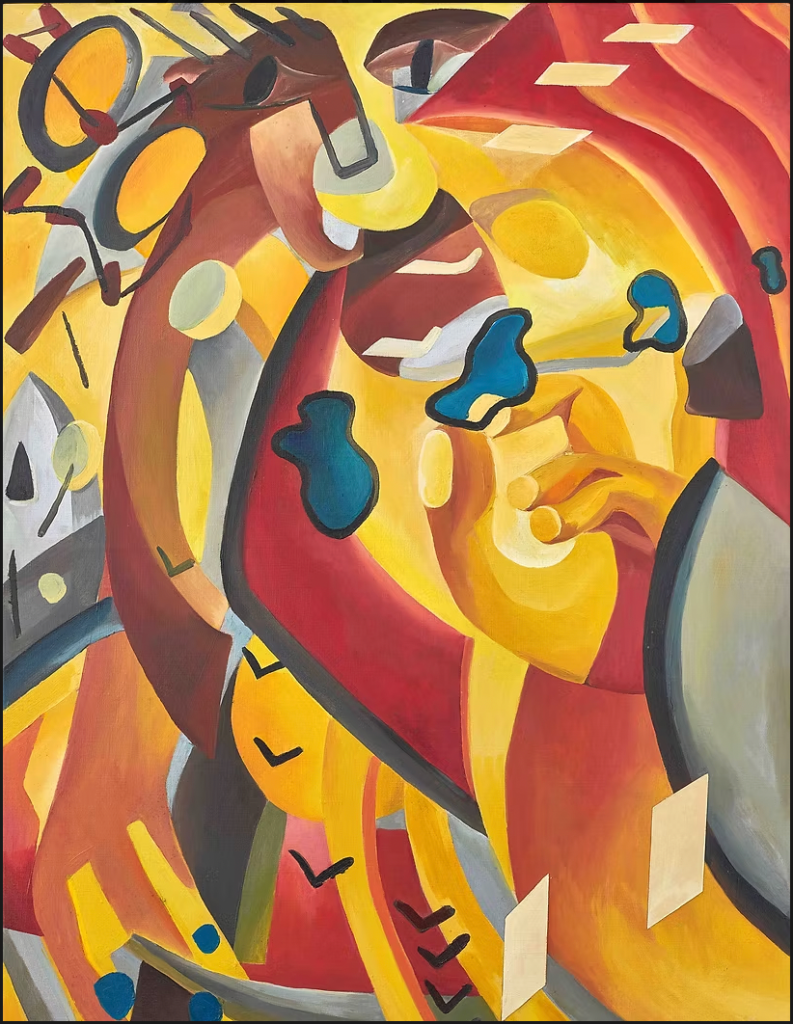
The Buddha of Now: Mahāsthāma
Zhao Hai Tien 趙海天
1993
Oil on canvas 油彩布本
117 x 81 cm
Jones Family Collection
Zhao’s depictions of physical journeys also reflect inner transformations. In Men in the Woods (1990), a painting dominated by a red-and-green palette, two men outlined in black appear transparent and insubstantial, blending into the surrounding forest in what may suggest a symbiotic relationship with nature. The artist also engages with modern social concerns. In Laughing Robot, vivid sharp colours and the fragmented artificial face anticipate the rise of new technologies and the anxieties accompanying increasing dependence on machines, as well as a corresponding alienation from nature that results in confusion and a loss of harmony.
Spanning decades of Zhao’s career, this book offers a panoramic view of her artistic evolution. It is more than an art book, possessing philosophical depth in its situating of her work within spiritual inquiry. It may also be read as a meditation on identity, resilience, and humanity’s relationship with the universe. Even readers who find the abstract spiritual concepts of Daoism and Buddhism challenging may discern her beliefs through the titles of works such as Meditation 1 (1993), Being (1997), Ocean of Worlds (1997-2008), Inner Landscape (1997), and Particle of Dust (1995). The high-quality reproductions enable a full appreciation of the vibrancy and texture of her art.
How to cite, Eagleton, Jennifer. “Cultivating the Infinite: The Art and Spiritual Vision of Zhao Hai Tien.” Cha: An Asian Literary Journal, 2 Mar. 2026. chajournal.com/2026/03/02/zhao-hai-tien.



Jennifer Eagleton, a Hong Kong resident since October 1997, is a close observer of Hong Kong society and politics. Jennifer has written for Hong Kong Free Press, Mekong Review, and Education about Asia. She has published two books on Hong Kong political discourse: Discursive Change in Hong Kong(Rowman & Littlefield, 2022) and Hong Kong’s Second Return to China, A Critical Discourse Study of the National Security Law and its Aftermath(Palgrave Macmillan, 2025). Her poetry has appeared in Voice & Verse Poetry Magazine, People, Pandemic & ####### (Verve Poetry Press, 2020), and Making Space: A Collection of Writing and Art (Cart Noodles Press, 2023). [All contributions by Jennifer Eagleton.]
 Cha
Cha 