

[SUNDANCE 2026] “The Pleasure Principal: A Conversation on Wregas Bhanuteja’s Levitating” by Nirris Nagendrarajah & Wregas Bhanuteja
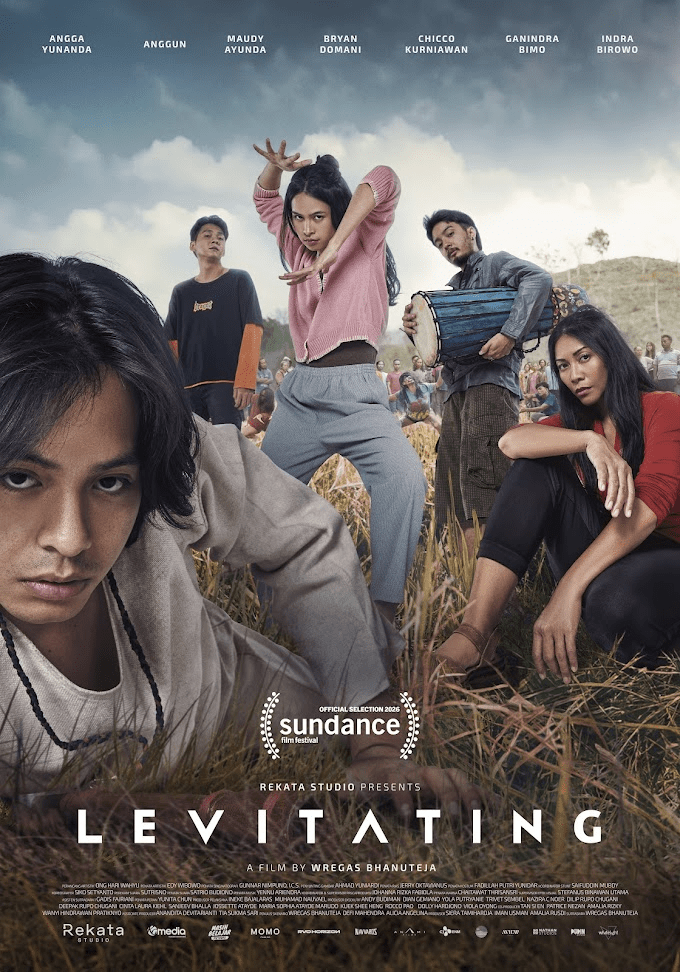
Wregas Bhanuteja (director), Levitating, 2026. 119 min.
INTRODUCTION
Nirris Nagendrarajah
Levitating, the third feature by the Indonesian filmmaker Wregas Bhanuteja, is set in Latas Village, a small town two hours from Jakarta that faces the threat of irrevocable change. Under the direction of Wanaria, a land developer, the inhabitants are, one by one, bought out and driven to the capital, where they either flourish or, more often than not, falter. The film’s protagonist, Bayu (Angga Yunanda), an aspiring spirit channeler, is intimately acquainted with the failed promises of modernity. He has watched his father (Indra Birowo) struggle to build a life for them after their matriarch abandoned the family, falling prey to one scam after another before ultimately landing in prison. For Bayu, whose vocation is bound to the village’s traditions, the stakes in resisting power are both personal and political, matters of life and death.
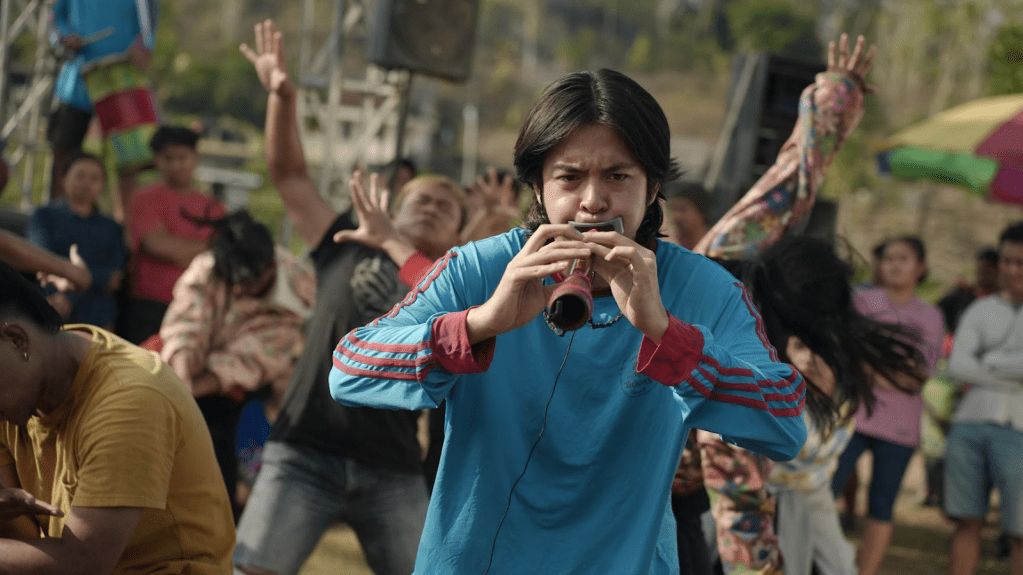
To become a successful spirit channeler, and to bring happiness to “spirit addicts”, one must possess a clear mind, and this proves Bayu’s greatest obstacle. His instrument of choice is the flute, while his friend Pawit (Chicco Kurniawan) favours the guitar. Time and again, we witness Bayu successfully possess participants and usher them into a meditative realm, only for his subconscious, a TikTok dance he has just seen, for instance, and his conscious anxieties about his family, to intrude upon the stage and shatter the trance, often with disastrous consequences. At one point, his love interest Laksmi (an entrancing Maudy Ayunda) endures blows to her back from which she had previously been immune.
Bhanuteja is intent on tracing this young man’s grand ambition, which, in the face of the modern world, is met with derision. “You still believe in that stuff,” one cousin scoffs, failing to grasp that this is not a matter of belief but of devotion. As Bayu strives to become a spirit channeler to Guru Asri (the popular singer Anggun, who commands the screen with natural authority), a position he believes will allow him to remain in Latas and care for his father, he pushes both mind and body to their furthest limits. He drinks cow’s blood and drags himself through the streets to embody a leech, collapsing the distance between artist and art.
What proves most surprising about Levitating, despite its outlandish and visceral imagery, is the care with which it constructs an emotional arc that genuinely moves the viewer. In a world riven by division, the film, over the course of its brisk 119 minutes, makes a case for forgiveness, community, and empathy as prerequisites for survival and resistance. It possesses the audience with its spiritual and deeply felt charm.
On the eve of its premiere in the World Cinema Dramatic Competition at the 2026 Sundance Film Festival, Bhanuteja took the time to answer a few questions by email about the making of Levitating.

A Conversation
on Levitating
Nirris Nagendrarajah & Wregas Bhanuteja
Nirris Nagendrarajah (NN): The opening sequence thrusts us into a “trance party” in medias res. It recurs throughout the film. With its entrancing score, immersive camera movements, and frenetic editing, the viewer is swiftly drawn into a tradition that will be unfamiliar to most, yet becomes strikingly accessible, since you establish its foundations with such assurance. What informed your approach to crafting the trance sequences and the “meditation realm,” which functions as a kind of stage upon which Bayu’s conscious and subconscious projections appear?
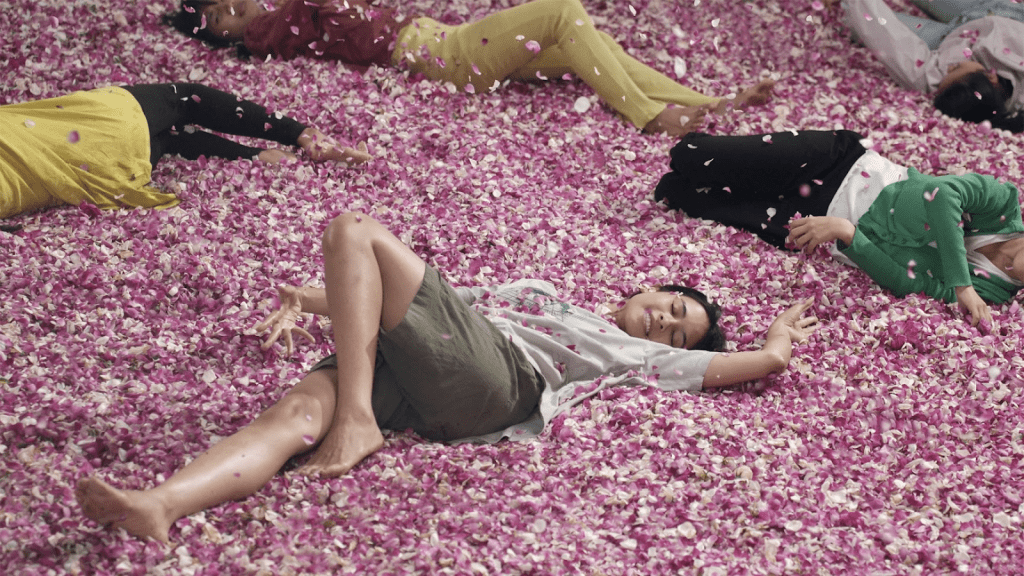
Wregas Bhanuteja (WB): My inspiration behind the hallucination realm is my daily daydreaming. Sometimes, when I get tired, I imagine something that makes me feel recharged. I imagine a realm that is full of fragrance, because I love many aromas. I also imagine my body being massaged automatically so that I will not be tired anymore. I imagine that there is a huge shower and, suddenly, my body is showered with a very refreshing and fragrant soap. So I tried to transfer that desire into the hallucination realm of the scene and mix and match it with the kind of animal spirits that can represent the realm. For example, the water buffalo spirit fits the shower realm.
The inspiration behind the meditation realm is my daily morning meditation. Every morning, I meditate for 1 hour before opening any social media. During the meditation, I see a black limbo, and whenever there is a disturbance in my mind, images appear, interrupting that black limbo. Usually, the pictures are objects from my past trauma, my jealousy, or something that makes me angry. I try to take a deep breath to get rid of those pictures. Sometimes they disappear, but they can come back if there is a trigger, such as hearing the sound of a motorcycle or the music that my neighbour plays.
NN: Beyond the personal, the film is shaped from the outset by political forces. Much is at stake: the loss of a childhood home, the disappearance of a ravine, the erosion of the trance tradition. Even towards the conclusion, rather than culminate in the resolution of Bayu’s narrative arc, the film reaches its apex in the moving scene in which the community unites to embody the turtle spirit. Could you speak about the looming threat of land development and gentrification in Indonesia and, in your collaboration with the screenwriter Alicia Angelina, explain why you chose to humanise figures such as the father and Wanaria rather than indict them?
WB: There is a lot of eviction of villages and communities that has happened in Indonesia because a company wants to open a factory or a mining plant. Usually, the villagers are forced to sell their land and move to another city. However, because farming is their natural habitat, it is often difficult for them to change to a new job and find work in the city.
I want to show that every human being has original kindness in their heart.
In the film’s ending, I tried to make Bayu hug Wanaria because I want to show that every human being has original kindness in their heart. Sometimes that kindness is corrupted by bad people or bad conditions that surround them. For example, the security guards in the film are forced to fight the villagers because they have to follow the instructions of their superiors. Bayu’s father decides to move to the city because he does not want to be a burden on Bayu. By trying to understand what happened in the background of each person, Bayu realises that they have kindness, but it is covered by their situation.
I found this contemplation in my morning meditation as well. Whenever I get angry with someone, I do not immediately judge them and conclude that they are a bad person. I try to discover what happened to this person in the past that has led them to be like this. There must be something that has hurt them, and what they need is compassion and love to heal.
NN: The film employs a range of special effects, alongside dream sequences that intensify reality. What was the process of crafting these passages, which render the world of the film more dynamic, vivid, and fully alive? From the opening image of sausages and hot oil raining from the sky to the later moment when Bayu drinks cow’s blood and begins stabbing those around him, there is a wildness that feels both bracing and entirely coherent within the film’s internal logic. How did you arrive at and develop this aesthetic?
When I ride my motorcycle home at midnight, sometimes my mind is disturbed by the fear of seeing ghosts in the middle of the road.
WB: I often modify my mind or imagination in order to make it better. For example, when I ride my motorcycle home at midnight, sometimes my mind is disturbed by the fear of seeing ghosts in the middle of the road. The scary face of a ghost appears in my mind and I imagine it riding behind me or appearing in my rear-view mirror. So I try to distract that fearful thought with something funny. For example, I imagine a big teddy bear, or I imagine the ghost’s face becoming a watermelon. Sometimes this helps to reduce my fear. I tried to apply this to Bayu’s hallucination realm. Whenever he is distracted by the smell of food, the hallucination realm is also disturbed. So I chose elements that usually disturb me, such as the smell of delicious food or music from someone’s speaker.
Regarding Bayu’s mind, which is full of hatred, such as the blood waterfall that falls on his father’s head, this is also my way of calming my mind whenever there is a lot of noise from people I have problems with. For example, when I try to focus on my breathing during meditation and there is a visual image of an old friend who hurt me in the past, I try to wipe the memory from the black limbo in my mind. The form of wiping sometimes takes the shape of a giant hand that makes the image disappear. At other times, there is a giant vacuum that sucks the images away. I tried to modify this into Bayu’s character. For example, the giant blood waterfall appears because Bayu is trying to turn himself upside down and let his blood fill his brain.
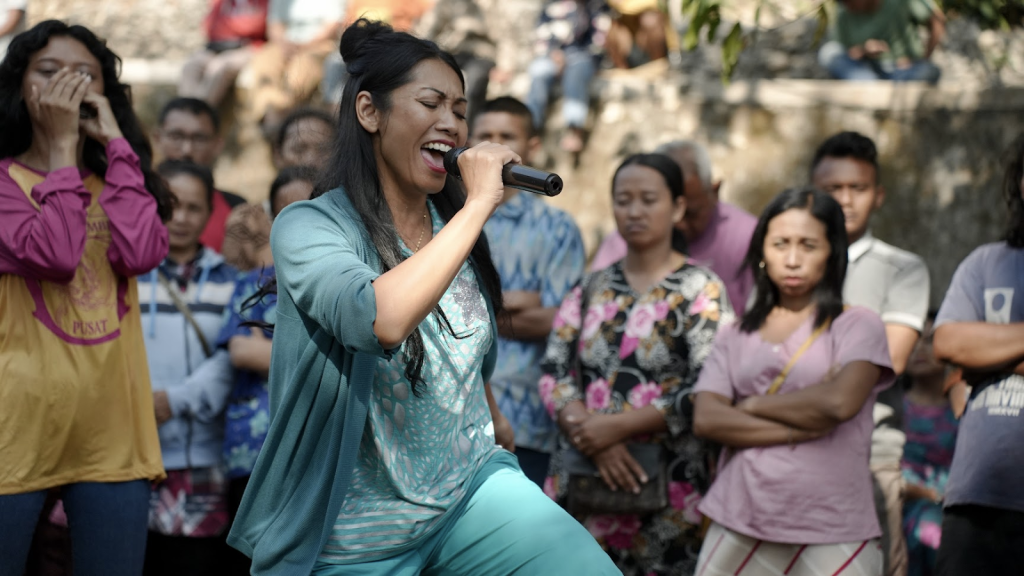
NN: Anggun is an acclaimed singer in Indonesia, a living legend, and I found her to possess a natural and radiant screen presence. Her character, Guru Asri, is necessarily strong willed, yet there is also a maternal undercurrent that consoles Bayu and sustains his hope. What was it like working with her, and what kinds of conversations did you have about shaping this character?
WB: I created 15 mantras with Anggun. The collaboration was mainly about trusting her intuition to create the mantras. I did not write any lyrics or intonations for them. I only asked her to listen to the music of each mantra and explained which animal it was for and what its effects were. For example, I said that the music was for the buffalo spirit and that the effect would be that you feel your whole body being showered with fresh water. After that, Anggun went into the recording booth. The music played and she started to sing whatever she wanted in response. Sometimes she made animal-like sounds, sometimes she created dynamic melodies, and sometimes she screamed. We only did one take per mantra and did not record a second take because we believed that the first take was the most organic and intuitive. I trusted Anggun’s intuition to create powerful mantras. In the end, we created 15 mantras that were used during the shooting of the film.
For the creation of Guru Asri’s character, I developed a character bible for her. It described her background, including her life journey after she was born, her time at trance school, her becoming the youngest spirit channeler ever, and later the best Guru in the village. Most of this background information does not appear in the film, but it helped Anggun to shape Guru Asri as a character full of charisma, power, and confidence. Anggun also combined this with her own past experiences as a young singer, moving to France and becoming a star there, and singing in front of thousands of audience members. This helped me to combine her authentic personality as an artist and performer with the fictional character of Guru Asri that I created.
It feels vital for filmmakers from the Global South to challenge the assumptions of our parents’ generation and to begin imagining alternative ways of living and organising one’s life.
NN: “I choose a different life. Work is not only for marriage and raising children,” Bayu says. The line has remained with me since seeing the film. It feels vital for filmmakers from the Global South to challenge the assumptions of our parents’ generation and to begin imagining alternative ways of living and organising one’s life. It was one of the reasons I felt such respect for, and connection with, Bayu: not only his ambition for his craft, which might be read as a metaphor for the creative process, but also his capacity to envision a world different from the one that surrounds him. Why was it important for you to include this heated exchange and to advocate for this world view?
Humans have the freedom to live their lives as long as they are not hurting others.
WB: Some people in Indonesia have their own values, believing that getting married and having children are standards that human beings should achieve. Sometimes they think that if you are not married and do not have children, you are not complete as a human being. Most of my friends or family members are asked these questions during the Eid holidays: “Where is your girlfriend?” “When will you get married?” “When will you have children?” These questions have started to put pressure on many people who have not achieved those standards.
What Bayu says here is a reminder that humans have the freedom to live their lives as long as they are not hurting others. I want to share that we should not impose our standards on other people, because each person has a different version of happiness.
NN: Two sequences particularly stood out to me, both relating to your work with your editor, Ahmad Yuniardi. The first is set in the rain, when Laksmi tells Bayu about the trauma from which she is fleeing. Rather than remain fixed on her face, you choose to focus on a series of nearby objects, observing the rain as it falls upon them. Later, when Bayu goes clubbing with his cousins, you abruptly cut back to memories of a trance party, forging a connection between the two realms. Is not clubbing culture, in some sense, an expression of the desire to enter a trance? Could you speak about your collaboration with Yuniardi in shaping these effective stylistic choices?
WB: First, the scene of Laksmi sharing her trauma in the middle of the rain. The decision to create a montage came later, after we saw the second draft of the edit. Previously, we did not have shots of the nearby objects. The focus was only on Laksmi crying. However, after several discussions, we felt that we needed to bring the audience closer to her past traumatic experience through additional visuals, since in the earlier scenes we consistently showed the visuals of Bayu’s mind. Here, we wanted to maintain that visual consistency. We would not show Laksmi’s mind because the film follows only Bayu’s perspective. The solution was to show nearby objects that represent the trauma. So we did a one-day B-roll shoot for those shots.
Second, the montage between the clubbing scene and the trance party. We had already discussed the editing treatment for this during pre-production. We wanted to show that clubbing and trance parties are almost similar. In clubs, people use alcohol to get drunk, whereas at trance parties, people use spirits. In clubs, people listen to a DJ, whereas at trance parties, they listen to a shaman. My editor suggested using a “match cut” method, in which we create similar forms or compositions in consecutive shots to make the audience feel the similarity between clubs and trance parties. I shared this idea with my cinematographer so that we could create the same composition and framing for the shaman and the DJ, the person drinking alcohol and the person inhaling burning incense, and so on. My cinematographer used an overlay composition feature in the camera to recreate the exact composition from the previous shot.
NN: In your debut feature, Photocopier (2021), an image becomes a weapon; in your sophomore film, Andragogy (2023), a video becomes an uncontrollable threat. In Levitating, too, screen culture and surveillance emerge as central concerns, from the spirit channeler whom Bayu idolises, to the TikTok dance that intrudes upon his meditation realm, or the moment when Laksmi uses a recording to self possess. Why do you find yourself repeatedly drawn to the narrative potential and latent power of these uncontrollable and seemingly unmediated forms of media, and to the influence they exert over our lives and our minds?
WB: I think this is because, in Indonesia, social media plays a significant role in society. Even within trance culture, there are many social-media accounts dedicated to sharing information about trance parties. Some accounts regularly announce the schedule of upcoming trance parties, highlight the person who was most impressively possessed, and share information about the next shaman. As long as this helps trance communities to preserve their events and grow their networks, I think it is a positive development.
However, there is also a habit of using social media that I do not agree with. Many people use their phones to record and document everything in their lives. Some take pictures of their food before eating it, record events such as traffic jams or inconveniences, and film people with whom they have a problem. They use these videos as proof or evidence if they want to make something go viral. People are no longer talking face to face; instead, they use their mobile phones as weapons or shields. Rather than resolving problems personally, they bring them into the public sphere of social media and allow everyone to judge. In my opinion, this creates misleading and inaccurate perceptions, such as in the scene where the security guard records a staged incident of spirit addicts attacking security staff.
NN: Finally, have you ever experienced possession yourself? And if you were to claim a spirit animal, what would it be, and why?
WB:: Not yet. I wanted to join a trance party during the research, but my producer did not allow me to be possessed. She was afraid that I would become addicted to it. I saw some of my friends being possessed at school, and most of the spirits were tigers or dogs.
If I imagine my own animal spirit, I think it would be a horse.
If I imagine my own animal spirit, I think it would be a horse. I do not know why, but since I was a child, I have loved horses. When I rode a horse, I felt that it could understand me, whether to run faster or slower. I felt a connection with it. Whenever it ran fast, I loved the sensation of the wind blowing against my face, which made me feel free.
How to cite: Nagendrarajan, Nirris and Wregas Bhanuteja. “The Pleasure Principal: A Conversation on Wregas Bhanuteja’s Levitating.” Cha: An Asian Literary Journal, 27 Feb. 2026, chajournal.com/2026/02/27/levitating.



Nirris Nagendrarajah is a writer and culture critic from Toronto. In addition to Metatron Press, his work has appeared in MUBI Notebook, Little White Lies, The Film Stage, Ricepaper, Notch, Polyester, Intermission, Ludwigvan, and In the Mood Magazine. He is currently part of Neworld Theatre’s Page Turn program and at work on a novel. [All contributions by Nirris Nagendrarajah.]

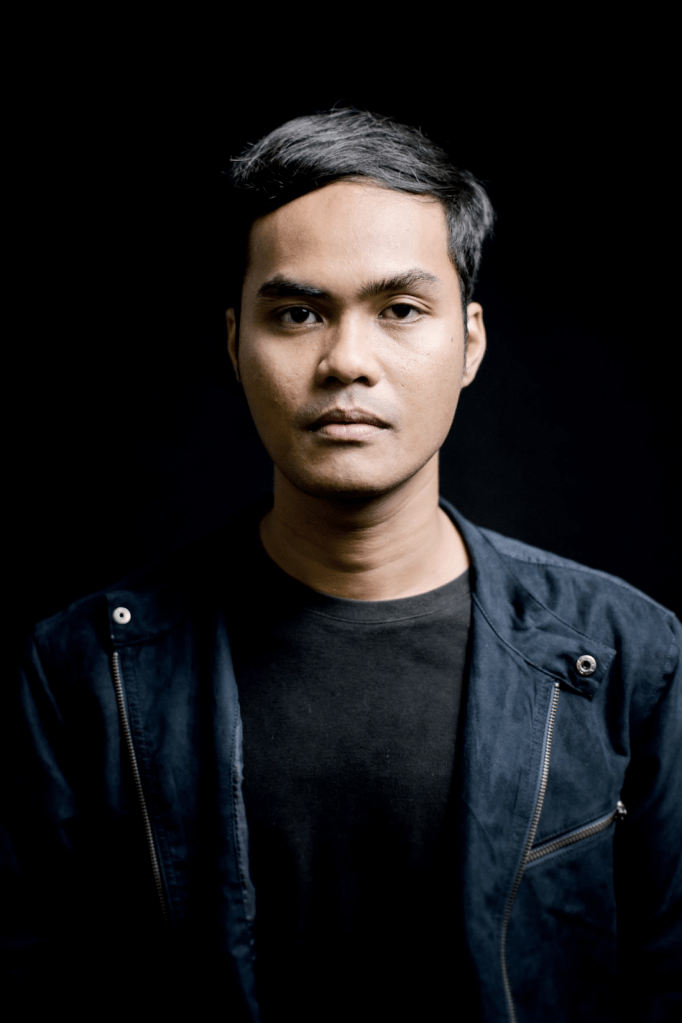
Wregas Bhanuteja was born in Jakarta on 20 October 1992. He graduated from the Jakarta Institute of the Arts in 2014, where he majored in film directing. He directed several short films, including Lembusura (2015), which competed at the Berlin International Film Festival in 2015, and Prenjak/In the Year of the Monkey (2016), which won the Best Short Film award at the Cannes Critics’ Week in 2016, as well as the Silver Screen Award for Best Short Film at the Singapore International Film Festival that same year. His short film No One Is Crazy in This Town (2019) competed at the Sundance Film Festival and the Clermont Ferrand International Short Film Festival in 2020. His first feature, Photocopier (2021), premiered at the Busan International Film Festival, went on to win twelve Citra Awards at the 2021 Festival Film Indonesia, and was subsequently acquired by Netflix for global distribution. His second feature, Andragogy (2023), had its world premiere at the Toronto International Film Festival and was later selected for numerous international festivals, including the 2023 Taipei Golden Horse Film Festival, the 2023 SXSW Sydney Screen Festival, the 2023 International Film Festival of India, the 2024 CinemAsia Film Festival, and the 2024 Santa Barbara International Film Festival, where it won the Best International Feature award. The film was released theatrically in Indonesia in November 2023 and premiered on Netflix in March 2024. Levitating is his third feature film.
 Cha
Cha 