

[SUNDANCE 2026] “Josef Kubota Wladyka’s Ha-Chan, Shake Your Booty!: A Bird, a Body, and the Illusion of Depth” by Nirris Nagendrarajah
Josef Kubota Wladyka (director), Ha-Chan, Shake Your Booty!, 2026. 122 min.
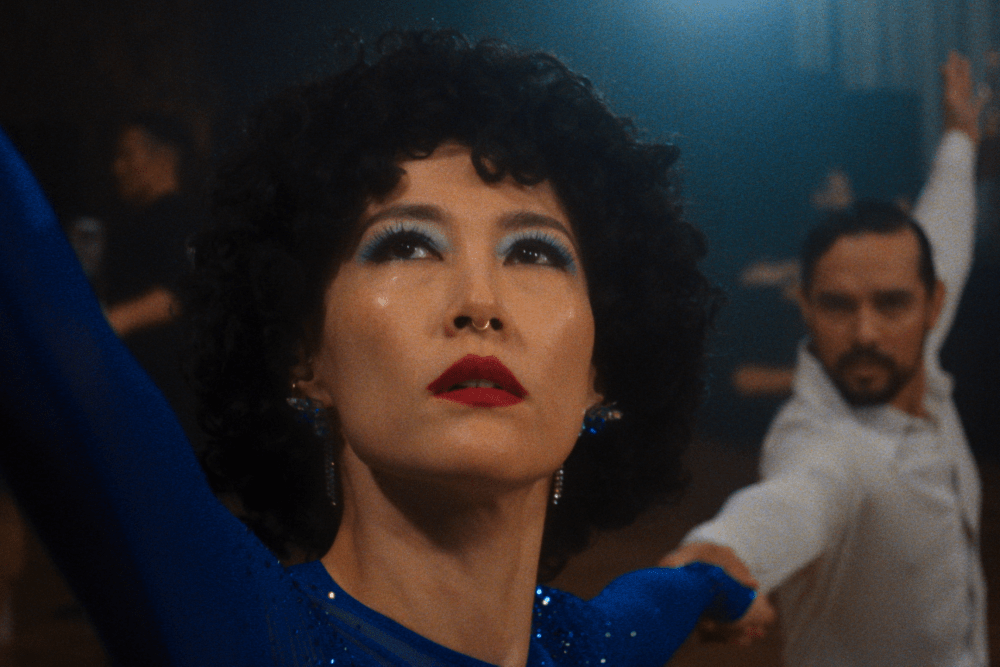
In Ha-Chan, Shake Your Booty!, grief is quite literally the thing with feathers.
Soon after her husband Luis, played by Alejandro Edda, dies of a heart attack, Haru, portrayed by Rinko Kikuchi, begins seeing an oversized, cutesy black bird. It serves as a metaphor for her grief, repeatedly asserting its intrusive presence at inopportune moments and demanding acknowledgement.
It is one of the many flights of fancy the film, directed by Josef Kubota Wladyka and co-written with Nicholas Huynh, indulges across its 122-minute running time. These include visualisations of Haru’s fantasies and episodes of levitation, the charm of which depends largely on one’s tolerance for the saccharine.
We observe the grimness of her year of mourning, during which she mechanically re-enacts their daily routines, even preparing a plate for him, the love of her life. The film then traces her gradual thawing, her tentative return to society, and her discovery that life continues for the living. This shift in perspective is facilitated by her sisters Yuki, played by Yoh Yoshida, and Hiromi, played by You, and most significantly by Fedir, portrayed by Alberto Guerra, a smouldering Latin dance instructor.
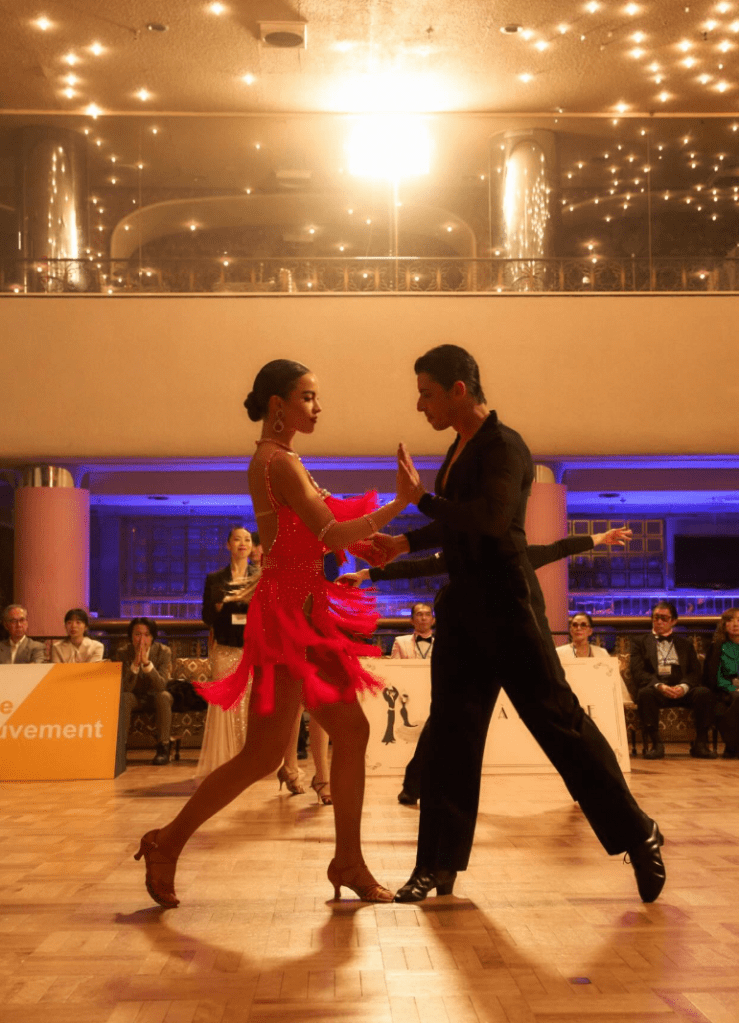
The most decisive awakening Haru requires is an erotic one, which Fedir, who is in an open relationship, is willing to provide, at least temporarily. Complications arise when she tells him that her husband is still alive and that they too are in an open relationship. The lie fuels her growing obsession, revealing that she lacks the emotional steadiness required for such an arrangement.
What follows, regrettably, are farcical sequences illustrating the lengths to which Haru will go to assuage her anxiety. In one set piece, indebted to the conventions of American comedy, she climbs onto the couple’s balcony, breaks into their flat, damages their property, and hides beneath their mattress while they have sex above her. I found myself exasperated that the narrative had descended into such cliché.
The film’s chief failing, despite its light, airy sensibility and its insistently deployed needle drops, is its confusion of slowness with profundity and of depth with flamboyant, hollow imagination. Edited by Benjamin Rodriguez Jr., it aspires to resonance but settles for affectation. This did not hinder its reception at Sundance, where it won the U.S. Dramatic Directing Award and was acquired by Sony Pictures Classics.
The trade press labelled it a “crowd-pleaser”. I was part of that crowd, and I was not especially pleased.
How to cite: Nagendrarajan, Nirris. “Josef Kubota Wladyka’s Ha-Chan, Shake Your Booty!: A Bird, a Body, and the Illusion of Depth.” Cha: An Asian Literary Journal, 13 Feb. 2026, chajournal.com/2026/02/13/booty.



Nirris Nagendrarajah is a writer and culture critic from Toronto. In addition to Metatron Press, his work has appeared in MUBI Notebook, Little White Lies, The Film Stage, Ricepaper, Notch, Polyester, Intermission, Ludwigvan, and In the Mood Magazine. He is currently part of Neworld Theatre’s Page Turn program and at work on a novel. [All contributions by Nirris Nagendrarajah.]
 Cha
Cha 