
茶 FIRST IMPRESSIONS
茶 REVIEW OF BOOKS & FILMS
[FIRST IMPRESSIONS] “What We Keep: Memory, Migration, and Survival in M Lin’s The Memory Museum” by Susan Blumberg-Kason
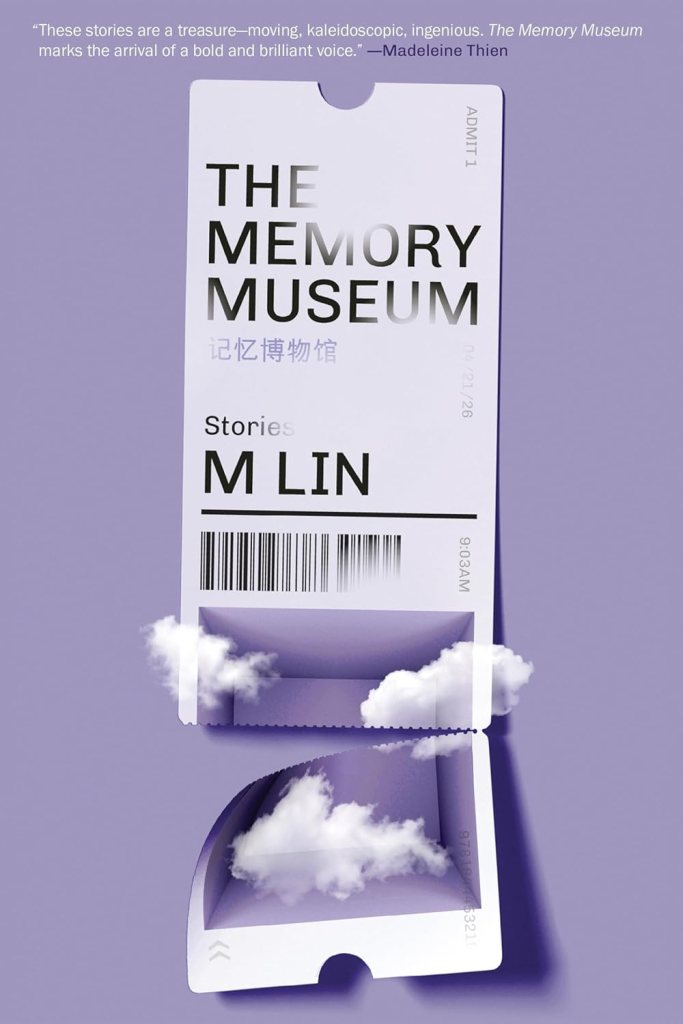
M Lin, The Memory Museum, Graywolf Press. 2026. 272 pgs.
Nostalgia is a powerful emotion. No matter how much progress we make, it often proves difficult not to look back and wish for a time when life moved at a slower pace, or when we could not be reached at any moment and in any place. Travel felt more adventurous when we were required to find our own way, without the convenience of a smartphone app. Even the daily ritual of checking the mailbox carried a quiet thrill, the possibility of receiving a letter from a close friend or relative.
Memory is central to this longing for the past, and it often operates selectively. We tend to recall its pleasures while overlooking the events or people that caused profound grief. M Lin addresses this tension in her new book, The Memory Museum, a collection of stories set across different locations and spanning the past, present, and future. Although the stories are distinct in form and setting, they are linked by a shared concern with how acts of remembering can help individuals endure more difficult circumstances in the present.
Lin’s opening story, “Scenes from Childhood”, offers a compelling illustration of nostalgia’s consolatory power. The protagonist lives in New Zealand, where she hopes to escape the worst effects of the global-warming crisis unfolding around the world, including in her home country of China. She recalls the simpler days of her grandparents’ village in north-east China, where her family slept together on a kang to keep warm. Although the house had no other source of heat and the family scarcely had enough to eat, she dwells on these memories with affection. As her recollections reach further back, however, they uncover a darker history. She remembers that a relative died from carbon-monoxide poisoning while sleeping on the kang, years before the protagonist herself was born.
“Magic, or Something Less Assuring” is a stunning story set in Morocco. A young Chinese couple has decided to divorce after being together for more than a decade, but before reaching this conclusion they had booked a non-refundable trip to Morocco to celebrate the loosening of China’s long-Covid restrictions. The beauty of Morocco is vividly rendered, and the couple begins to feel that the disagreement and despair that have come to define their marriage may not have been as insurmountable as they once believed. At the story’s conclusion, Lin leaves the reader to imagine what might happen next.
Other memorable stories include “You Won’t Read This in the News”, which follows two migrants in Shanghai who travel to another city and become involved with two further misfits in a scheme to rob passers-by in order to survive. With no viable prospects for employment, they feel compelled to turn to criminal activity. When they encounter a kind café proprietor who feeds them out of generosity rather than obligation, however, they begin to question their choices. The story serves as a reminder of the importance of attending to the present, rather than deferring happiness to some imagined future.
“Lucy” centres on a young academic flying home to Shanghai to visit her parents. Recently diagnosed with a brain tumour, she is unable to bring herself to share the news, knowing the devastation it would cause. During the flight from JFK, she forms a bond with a young girl seated beside her and comes to recognise that the truth can sometimes be less painful than allowing loved ones to believe that everything is fine. The girl is returning to China for her grandfather’s funeral, after her family in the United States was informed of his illness only when it was almost too late.
The collection takes its title from its final story, “The Memory Museum”, a work of speculative fiction set in a future in which the past has all but vanished from human memory. Each of these stories, along with the others in the collection, is sufficiently strong to stand on its own, and many could readily be expanded into novellas or other forms of longer fiction. Across the book, Lin addresses a wide range of contemporary concerns, including global warming, the aftermath of Covid, wealth disparity, censorship, and more.
How to cite: Blumberg-Kason, Susan “What We Keep: Memory, Migration, and Survival in M Lin’s The Memory Museum.” Cha: An Asian Literary Journal, 12 Feb. 2026. chajournal.com/2026/02/12/memory-museum.


Susan Blumberg-Kason is the author of Bernardine’s Shanghai Salon: The Story of the Doyenne of Old China, a 2023 Zibby Awards finalist for Best Book for the History Lover. She is also the author of Good Chinese Wife: A Love Affair With China Gone Wrong and the 2024 Zibby Awards winner When Friends Come From Afar: The Remarkable Story of Bernie Wong and Chicago’s Chinese American Service League (University of Illinois Press, 2024). She is the co-editor of Hong Kong Noir and a regular contributor to the Asian Review of Books, Cha and World Literature Today. Her work has also appeared in the Los Angeles Review of Books and PopMatters. Visit her website for more information. (Photo credit: Annette Patko) [Susan Blumberg-Kason and ChaJournal.]
 Cha
Cha 