
Editor’s note: Daniel Gauss treats Prambanan Temple as a ninth-century political technology, where ritual, architecture, and kingship converged to naturalise obedience by embedding rule within Shaivite cosmology. Built by the Sanjaya dynasty as a counter to Borobudur Temple, it functioned as an apparatus of legitimacy rather than a site of devotion. The claim gains force beside Gauss’s earlier essay on Borobudur, which presents that monument as a disciplined pedagogy of Buddhist enlightenment, now attenuated by tourism and bureaucratic management.

[ESSAY] “Prambanan: A Temple in Java that Turned Faith into Obedience” by Daniel Gauss
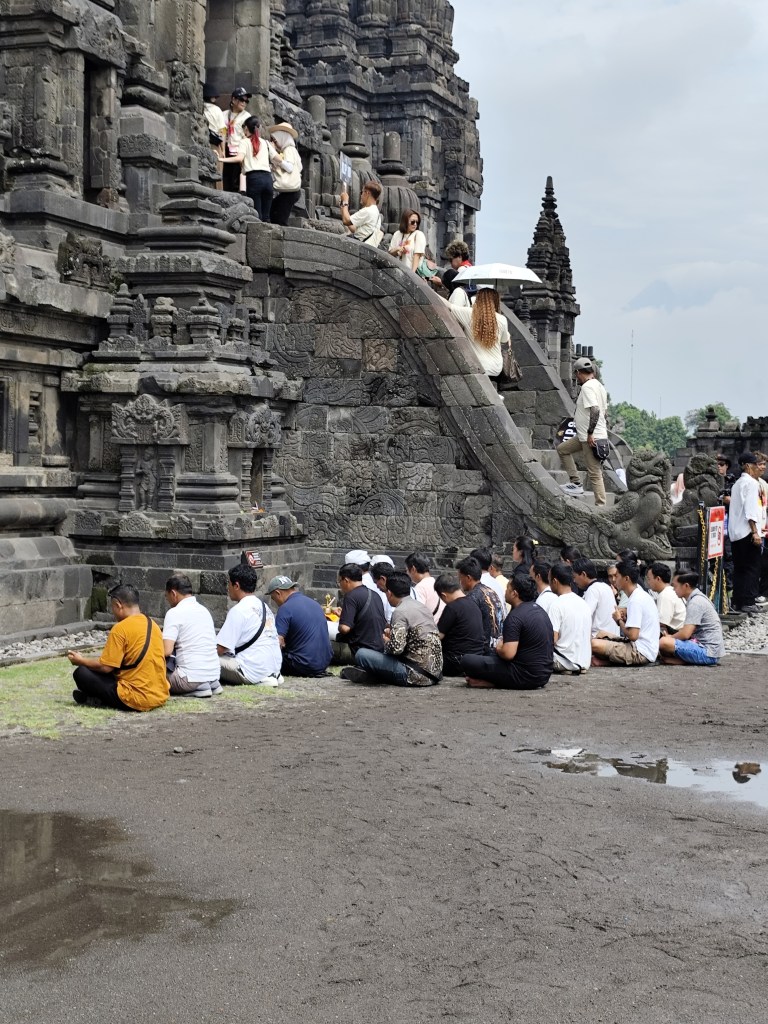
When I visited Prambanan Temple, I was surprised to see a group of about 30 men kneeling in front of the structure that houses the statue of Shiva. Indeed, most visitors to Prambanan assume they are entering a sacred Hindu complex, but Prambanan was created to support a political regime within a worldview in which religious practice and royal authority were understood as mutually reinforcing.
This overt union of politics and religion is a hallmark of ancient regimes, and it is of considerable value for people to understand this. Prambanan supported a specific political order by situating political authority within a religious framework that conferred cosmic legitimacy. This legitimised political power, positioned the king within cosmic law, and rendered governmental authority unquestionable to the populace through ritual, architecture, and sacred geography.
Most scholars think that Prambanan was partly a political and religious response to Borobudur, which lies relatively nearby. Borobudur was a massive Mahayana Buddhist monument supported by the Sailendra dynasty, and Prambanan was built soon afterwards by the rival Sanjaya dynasty as a declaration of Shaivite Hindu power.
It was a deliberate counter-monument, asserting who ruled and which gods mattered. Today, both temples are relegated to cash-cow tourist attractions on Java in Indonesia, treated more as exotic visual spectacles than as structures to be understood in terms of their original forms and functions.
0
A Temple Built for Earthly Power
Prambanan, constructed in the mid ninth century by the Sanjaya dynasty, was a political project from the outset. In Central Java, a ruler’s authority depended on demonstrating control over religious institutions, labour, and territory. Lineage alone was insufficient, and a king had to prove that he possessed the resources, alliances, and ritual authority required to govern effectively.
A ninth-century Javanese king did not “believe” in Shiva in the way belief is commonly understood today. His world did not separate religion from politics or faith from public office. What mattered was his participation in a system in which ritual practice, cosmic order, and royal authority were inseparable and essential to the validation and reinforcement of power.
By founding temples, sponsoring consecrations, performing royal rites, and controlling the priesthood, the king ensured the order that endowed his rule with legitimacy. Belief, in this context, was not a private sentiment but a public performance ostensibly aligned with Shiva’s cosmic law. Prambanan asserted, in physical and monumental form, that the universe was stable and that kingship was legitimate.
A monumental temple complex served as tangible proof of royal power.
A monumental temple complex served as tangible proof of royal power. It demonstrated that the dynasty could mobilise thousands of workers, command the priesthood, and establish a permanent ceremonial centre that rival groups could not ignore. Prambanan established the Sanjaya dynasty as the dominant force in Central Java, formalised a partnership with religious elites, and transformed religious authority into a visible and potent political instrument.
0
The King as Shiva’s Representative
The king stood at the centre of this system and was understood as Shiva’s earthly representative. He was not literally Shiva, nor a reincarnation of the god, but the agent through whom Shiva’s cosmic order was enacted on earth. Shiva was the cosmic sovereign, whereas the king was the earthly sovereign authorised by him.
The temple complex functioned as the physical proof of this relationship, which was sustained through ritual control. The king did not merely “believe in Shiva.” He controlled the priesthood, the ritual calendar, the temple economy, and the sacred geography that defined Shiva’s presence in the world. By controlling the cult of Shiva, he could claim the cosmic mandate that justified his rule.
0
Ritual as Statecraft

History books will tell you that Prambanan made the people feel part of a sacred order, witnessing and participating in rituals that rendered the universe meaningful and orderly. In reality, these ceremonies consolidated the king’s power, reinforced popular subservience, and perpetuated centuries of manipulation by elites claiming divine sanction. This is what people probably ought now to understand: for much of human history, across the world, rulers used the gods to control the rest of us.
Ritual functioned as a form of statecraft, created through a kind of sacred choreography. Every action within the temple complex was designed to make Shiva seem present, to stabilise the cosmos, and above all to publicly confirm the king’s right to rule. A temple such as Prambanan proclaimed that opposition to the king was opposition to Shiva. Religion was thoroughly corrupted and appropriated from the people by these ancient despots.
For the elites, the full ritual programme of “puja” awakened the deity and set in motion the daily sequence of bathing, feeding, adorning, and invoking Shiva, actions that made his presence appear real within the sanctuary. In the Shiva temple, priests bathed a “linga” with water, milk, honey, and butter, adorned it with flowers and incense, recited mantras, offered food, and rang bells to draw the god’s attention.
These acts were not symbolic, as in this worldview ritual was believed literally to activate Shiva’s presence. A temple without ritual was merely a building, whereas a temple with ritual became something perceived as a dynamic force in the world, functioning to sustain and empower the king.
On major festival days, ritual expanded into public political theatre. Processions carried Shiva’s image around the temple grounds. The king presented offerings before assembled crowds. Priests recited sacred texts linking royal authority to cosmic order. Temple specialists performed ritual dances and music. These events made the king visible as the mediator between the human and divine realms.
Consecration rituals, especially prāṇa pratiṣṭhā, the “installation of breath,” transformed stone into a living presence. Only a legitimate king could sponsor such rites. Other rituals addressed rainfall, fertility, and protection from disease.
0
A Device for Producing Legitimacy
Prambanan was not a place for casual prayer. It was a ritual machine that made Shiva seem present, stabilised the cosmos, legitimised the king, displayed royal power, organised the economy, structured the calendar, and situated the kingdom within a divinely ordered plan. Religious ritual functioned as the operating system of the state.
Prambanan did not offer a pilgrim’s path to enlightenment, as Borobudur did. What it offered was something more revealing about how power operated in early Southeast Asia. If Borobudur teaches how to transform oneself into a more humane being, and Angkor Wat teaches how a king wished to be remembered and immortalised, Prambanan teaches how a king expected to be obeyed.
0
Standing Where Only Kings Once Stood
Today, simply wandering through Prambanan renders one an honoured visitor, as climbing the steps into the sanctuary of Shiva places you in a space once reserved exclusively for the king and the highest-ranking priests. It was the most restricted chamber in the entire complex, the point at which cosmic authority and royal power converged.
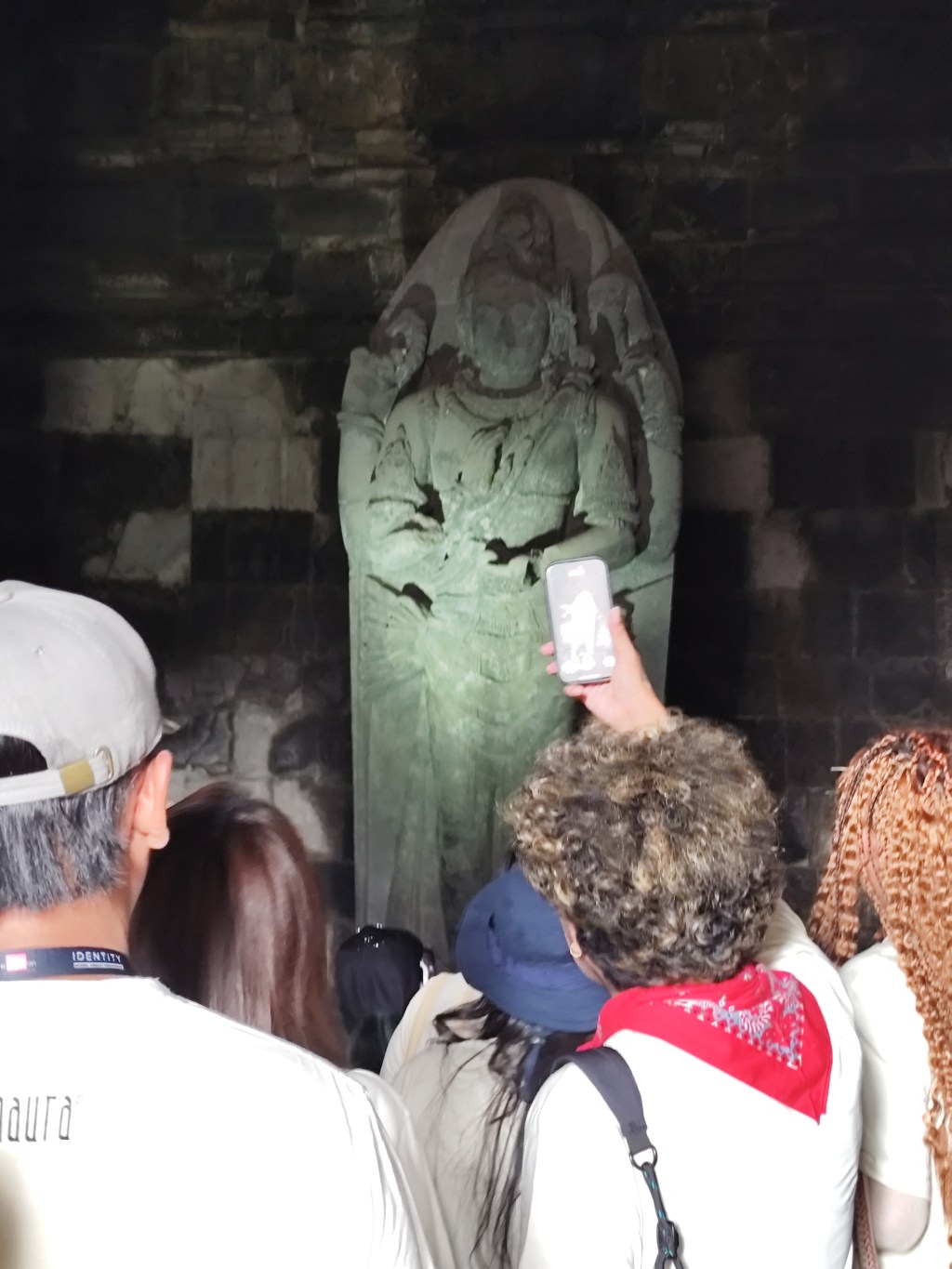
The statue of Shiva inside surprised me with its plainness.
The statue of Shiva inside surprised me with its plainness. It is not a masterpiece of sculptural art, but a simple, crude, workmanlike image. That simplicity was intentional. The statue was not meant to impress; it was meant to be inhabited. It needed only to be sufficient for the spirit of Shiva to recognise it, anything beyond that was superfluous.
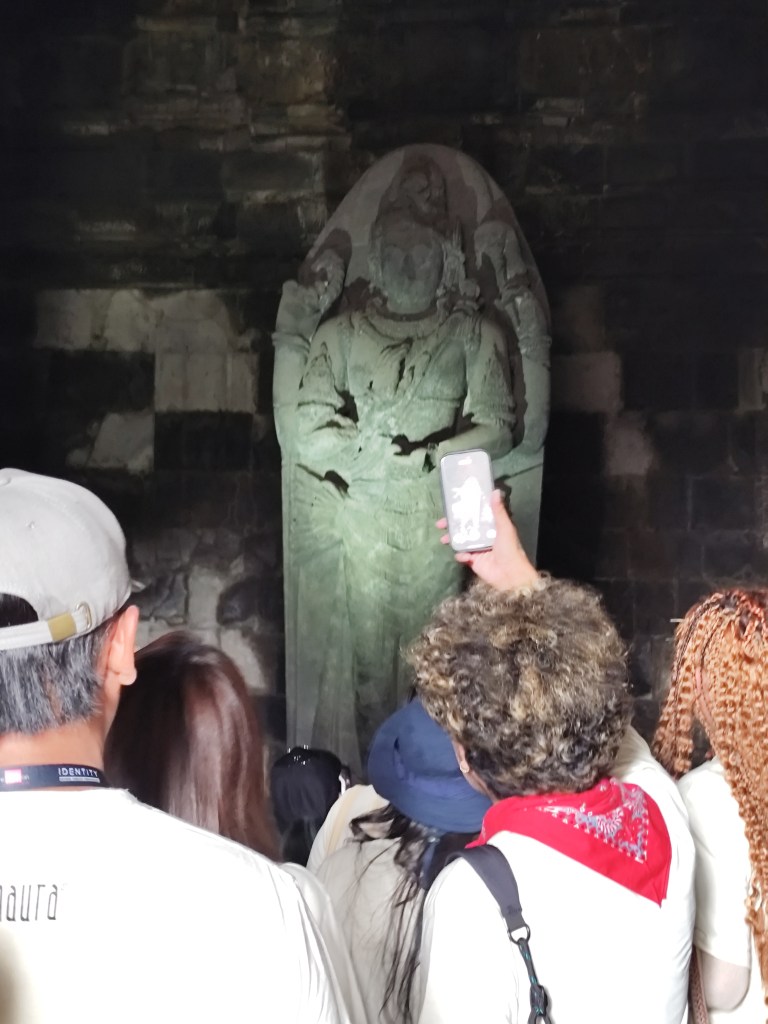
Once consecrated, it was believed to contain Shiva’s presence. Its power derived from ritual activation, not from artistic brilliance. The people did not need to be impressed by its beauty, as they were never meant to see it.
Standing there today, in a place once accessible only to the ruler of the kingdom, you confront an object that once embodied the most powerful presence in Java. The fact that you can now enter casually is a reminder of how radically the world has changed, and of how much of Prambanan’s original meaning has slipped out of everyday experience.
Ironically, Prambanan functioned as an active royal temple complex for only roughly a century. Construction began in the mid ninth century, but by the mid tenth century the site had been effectively abandoned when the court was forced to relocate to East Java.
Central Java had become politically unstable because of rival factions, shifting loyalties, and pressure from the maritime empire of Srivijaya. It also became environmentally unreliable owing to volcanic activity from Mount Merapi, which disrupted agriculture, damaged irrigation systems, and rendered the region’s food supply precarious.
The temple complex then entered a rapid decline. Its towers began to collapse as a result of earthquakes, and volcanic debris from Mount Merapi partially buried the site. By the time Europeans rediscovered it in the eighteenth and nineteenth centuries, Prambanan was no longer a visibly standing temple complex, and its reconstruction required decades of archaeological excavation and the sorting of millions of fallen blocks.
The people engaged in prayer today before the Shiva shrine bear no connection to the way Prambanan functioned in the past. They are modern Hindu worshippers, mostly Javanese and Balinese, using the shrine as a place for personal prayer, meditation, and offerings. Their presence demonstrates that a site once used to prop up a ruling dynasty has become a contemporary spiritual refuge in which individuals seek connection and blessings on their own terms.
Borobudur stands only a few hours away by car, yet it is even more misunderstood than Prambanan. If you travel halfway around the world to walk the path of Buddhist enlightenment created there, you will be charged 28 US dollars, placed into a group of 15, and escorted, possibly, by a cliché-spouting tour guide through tiny sections of the structure. You will be permitted one hour of this empty exercise in a complex comprising five kilometres of terraces, originally designed to reveal profound humane insights through visual imagery carved into volcanic stone.
The original purpose of Prambanan was social control, whereas the original purpose of Borobudur was enlightenment. We can bid a grateful farewell to the one and mourn the loss of meaning in the other, as so much of the ancient world now appears misunderstood and reduced to financial exploitation by contemporary governments and their tourist industries.
How to cite: Gauss, Daniel. “Prambanan: A Temple in Java that Turned Faith into Obedience.” Cha: An Asian Literary Journal, 28 Jan. 2026, chajournal.com/2026/01/28/prambanan.



Daniel Gauss was born in Chicago and studied at UW–Madison and Columbia University. He has worked in the field of education for over twenty years and has published non-fiction in 3 Quarks Daily, The Good Men Project, Daily Philosophy and E: The Environmental Magazine, among other platforms. He has also published fiction and poetry. Daniel currently lives and teaches in China. See his writing portfolio for more information. [All contributions by Daniel Gauss.]
 Cha
Cha 