

Editor’s note: Troy Cabida reflects on his debut poetry collection Neon Manila, exploring queer Filipino-immigrant embodiment, pop music, resistance, as glamour and violence coexist. Some poems from the collection can be found HERE.

[ESSAY] “On Neon Manila: A Balancing Act Between Sparkle and Substance” by Troy Cabida
Troy Cabida, Neon Manila, Nine Arches Press, 2025. 72 pgs.
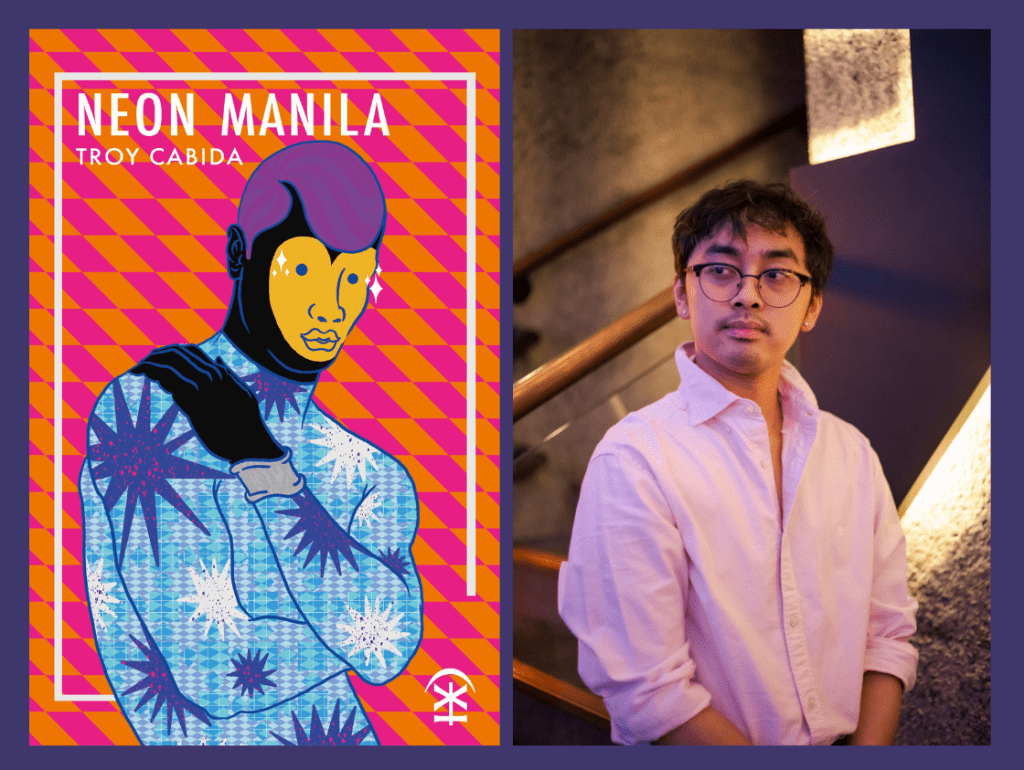
At the start of November last year, I spoke with the poet David Nash in an Instagram Live interview about Neon Manila, my debut poetry collection, published by Nine Arches Press. One of his questions concerned the interconnecting themes that underpin the book, namely intimacy and loneliness, grime and glamour, shame and desire. He asked whether I had been conscious of these tensions while developing the manuscript.
When I introduce the book at the beginning of my readings, I often say that Neon Manila explores the queer, Filipino-immigrant lived experience through its relationship to clothing and jewellery, the formative role of pop music, the tactile nature of public urban space, and the lingering effects of sex and intimacy between queer male bodies. The duality and tension that David identified, I think, emerge from the poems’ conscious efforts to claim ownership of these objects, despite the politics imposed upon the speaker as an othered body. Neon Manila makes space for this refusal. It chooses to narrate a life shaped by migration, assimilation, and systemic violence through memories of being rejected by a Filipino family because of the impression given by a black turtleneck, unfortunate yet titillating Grindr encounters with married men, and the somatic pleasure of wearing a Bone Cuff by Elsa Peretti, a sensation heightened by the knowledge that it was not designed with the speaker’s specific body in mind.
By the time of this article’s conception, I will have completed ten readings in promotion of the book, a mixture of online and in-person events across London. More dates throughout 2026 still await me. Through this succession of poetry performances, I have learnt to become more mindful of my body while reading, a necessity that became increasingly apparent as I found myself returning home with oscillating feelings of accomplishment and embarrassment. There are evenings when I must actively resist shame after reading before an audience that appears unmoved by the humour and irony employed by my poems’ voice. Then there are nights when I savour the catharsis offered by a more receptive audience, people who immediately express solidarity with me and with the poems’ insistence on survival through laughter, even when laughing at a microaggression from a man one has, regrettably, begun to find attractive.
I have often had to silence the cynic in my mind and trust that people are laughing with me, rather than at me.
As affirming as these moments can be, I have often had to silence the cynic in my mind and trust that people are laughing with me, rather than at me, in response to the humour through which I choose to articulate these experiences. The solution I arrived at, perhaps predictably, was to take refuge in the space my poems offer me, to trust that the truths they carry are solid enough to hold onto when the demands of the work become overwhelming, and to believe in their objective force within subjectivity. The differing responses of audiences and readers feel to me like an organic consequence of the dualities David spoke of during our interview. I came to realise that I needed to come to terms with my position within these poems as I release them into the world, and to accept joy fully once I encounter it.
In thinking about the poems’ effervescent humour, set against lived experiences of othering, I am reminded of the pop music that shaped the genetic makeup of Neon Manila. There is the late-summer 2025 single “Tears,” in which Sabrina Carpenter sarcastically croons about feeling arousal in response to the below-zero, minimal effort a man invests in her happiness. Whenever I want to recall the full range of emotions contained within infatuation, I play Sunset Rollercoaster’s “My Jinji,” allowing it to guide me from gentle yearning, through an almost orgasmic connection at its centre, and towards its chaotic, abrupt ending. Then there is Troye Sivan’s “One of Your Girls,” a dedication to the toxic yet irresistible allure of the straight male body when viewed through a queer lens. And of course, there is Dua Lipa’s contribution to the 2023 Barbie film soundtrack, “Dance The Night,” a masterclass in pairing a nu-disco backdrop with an unflinching acknowledgement of emotional collapse.
Without the hook and irony provided by music, the stories shared here would render the speaker merely vulnerable to the audience’s sympathies, flattening them into something one-dimensional. The lightness and levity that music brings into these narratives does not deny reality, but rather introduces another facet of truth, namely that when we recount such stories to those we love, we more often than not do so with laughter or with a self-deprecating joke that seeks to create intimacy between us. One core memory from this year involves riding the tube home one evening, holding back tears from a sudden pang of heartbreak, only to give in when the ABBA deep cut “Angeleyes” blared through my AirPods. I remember with striking clarity how the upbeat melody, coupled with its cutting lyrics of betrayal, made me feel, in a darkly comic yet sincere way, deeply held.
These are poems that acknowledge the violence inflicted upon the body.
I feel that Neon Manila achieves a similar alchemy through its conviction in its chosen poetic objects and in its engagement with the tensions and pleasures that inhabit its poems. Just as the challenge in writing the book lay in believing in the space it claimed, the challenge I later encountered when reading the poems aloud was learning to trust that I possess the inherent right to embody them in the octave and watt they demand. This required faith that the right listeners would recognise their dualities and feel alongside them. These are poems that acknowledge the violence inflicted upon the body, while refusing to forget the power the speaker retains in the aftermath, laughing at the monster straight in the eye before walking away in their Celine Chelsea boots.
How to cite: Cabida, Troy. “On Neon Manila: A Balancing Act Between Sparkle and Substance.” Cha: An Asian Literary Journal, 27 Jan. 2026. chajournal.com/2026/01/27/neon-manila.



Troy Cabida is the author of Neon Manila (2025), a Poetry Book Society Recommendation. His pamphlets include War Dove (2020) and Symmetric of Bone: poems after Elsa Peretti (2024), a Poetry Book Society Pamphlet Choice. [All contributions by Troy Cabida.]
 Cha
Cha 