

茶 FIRST IMPRESSIONS
茶 REVIEW OF BOOKS & FILMS
[REVIEW] “The GPA of Youth: On Boredom, Brilliance and the Cost of Conformity in Chetan Bhagat’s Five Point Someone” by Abhinav Tulachan
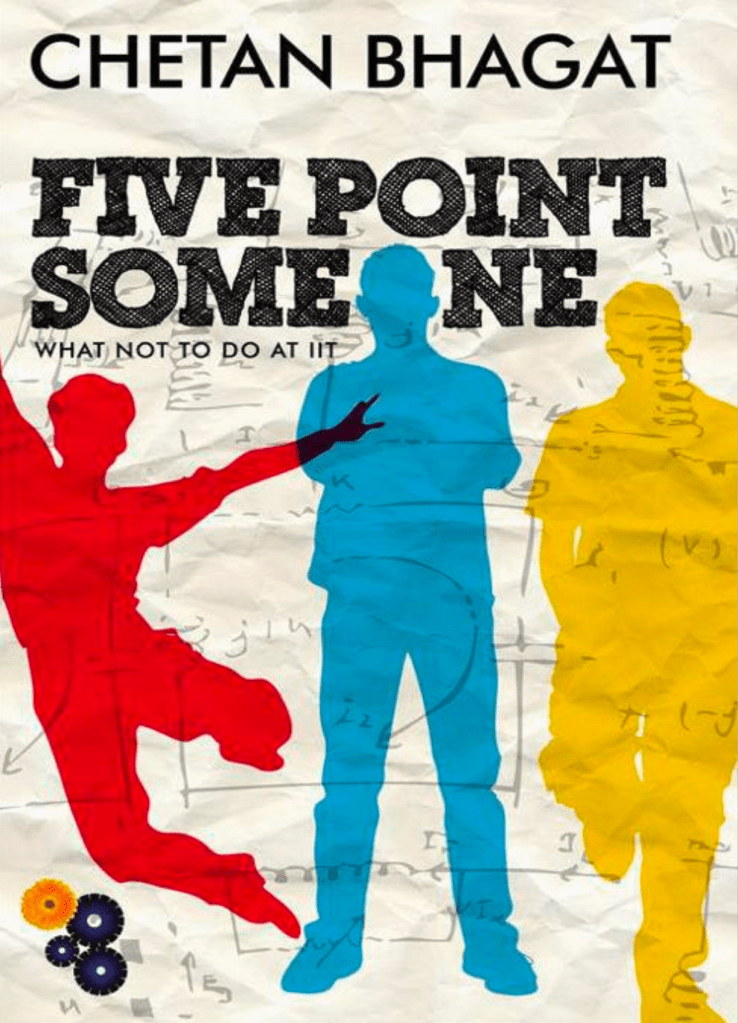
Chetan Bhagat, Five Point Someone, Rupa Publications India, 2004. 270 pgs.
If you were growing up around 2009 in India or in nearby parts of South-East Asia, you have likely heard of the film 3 Idiots, a widely popular Hindi-language comedy-drama directed by Rajkumar Hirani. If you are unaware of it, which would be surprising given that almost everyone I knew had watched it (a group that includes my grandfather, who refuses to watch anything beyond the news or cricket), 3 Idiots is an Indian coming-of-age comedy-drama film centred on the Indian education system. It gained immense popularity for its satirical portrayal of that system.

If you were among those who watched and enjoyed the film, you may be pleased to know that the novel which inspired it is an equally enjoyable experience. In fact, one might even argue that its roughly 270 pages can be devoured in a single sitting.
Five Point Someone is a timeless novel, published in 2004 and written by Chetan Bhagat. The narrative follows three unlikely friends, Hari, Alok, and Ryan, who attend the most prestigious engineering institution in India, only to discover how brutal and deeply unfair the academic system can be, particularly towards those who show even a modicum of idleness. It is a system that rewards students who memorise relentlessly and study for ten hours a day, effectively turning them into social outcasts.
How do these three friends respond to such a system? By ignoring it entirely.
The reader follows the trio as they notoriously skip classes in search of amusement. They bunk lectures, eat at the same restaurant every day, and would rather sneak onto the campus rooftop at midnight and get thoroughly drunk than open a textbook. As Ryan himself puts it, this is the period in their lives when they will have the most fun.
It is this trio, their individuality, and the friendship that develops between them, combined with Bhagat’s engaging prose, that makes the story so compelling and entertaining. Hari is the ordinary, likeable narrator, often insecure and prone to self-deprecating humour. He envies his friend Ryan, who is brilliant, cunning, and charismatic, yet he would still follow him blindly into trouble if it promised enjoyment along the way. Alok, by contrast, is a gentle and earnest young man from a poor family who desperately wants a high GPA, a desire intensified by his family’s circumstances. Despite this, he repeatedly finds himself drawn into Ryan’s schemes. Together, they form a classic college group that readers cannot help but support as they attempt the most foolish of plans, even at the risk of expulsion. At some level, these are the very acts many readers once wished they had dared to attempt themselves. Reading the novel feels like living out a shared student fantasy.
Naturally, by the end of the semester, their first academic year collapses into complete disaster. All three students earn a GPA of 5.0 out of 10, which gives the novel its title. For context, top-performing students score closer to 9 or 10. This places the trio in what might be described as academic purgatory. They face the prospect of repeating a year or more if they fail to recover, a possibility that fills Alok with particular dread.
One might assume that this would finally prompt them to mend their ways, but that is not the case. One of the most memorable moments in the novel occurs when Ryan decides that he would rather cheat a system that judges students solely on grades rather than individual creativity than submit to it unquestioningly. To elaborate on his schemes, Ryan devises a plan to divide lecture attendance among the three of them. Each attends two of their six lectures, diligently taking notes and recording homework for the others to copy. It sounds as reckless as it reads, and it struck me as foolish from the outset, yet the reader remains engrossed because Bhagat renders these disasters irresistibly entertaining. Each scheme unfolds like a cinematic heist, escalating in intensity through surprisingly careful planning, which makes even the most foolhardy ideas feel daring. While this can be read as a critique of how far the system pushes students to rebel in absurd ways, my interpretation is that Bhagat suggests learning should be driven by curiosity and innovation, not by the mechanical consumption and regurgitation of information. This idea is reinforced by the fact that, despite their elaborate attempts to game the system, the trio continue to hover around the five-GPA mark. As Rafi Mohammad observes in his review, “They are always five-point something.”
This leads to Ryan’s plans escalating further in danger and risk. With no viable alternative, the other two fully commit to his ideas. One notable example occurs during their third-year courses, when Hari attends Professor Cherian’s class with exceptional diligence in an effort to impress him, largely because he is secretly dating the professor’s daughter. The problem is that Hari cannot summon confidence during oral examinations, paralysed by his own anxiety. At Ryan’s suggestion, he gets drunk to “boost his confidence”, a decision that results in him failing the exam and earning Cherian’s lasting hostility. One attempt at damage control leads to another, each more reckless than the last, until the boys find themselves caught in the middle of the night while stealing examination papers from Cherian’s office.
At this point, the narrative takes a markedly serious turn. Cheating is amusing until someone else pays a heavy price, and the humour curdles when real consequences arrive. What had previously felt like a rowdy college anecdote suddenly tightens into a stark and deeply adult tragedy involving family pressure and a friend who jumps from a building rooftop when confronted with the prospect of expulsion and the destruction of his future.
Throughout the novel, Hari, Ryan, and Alok repeatedly lament that the IIT system is “stifling our creativity” and that their futures are being determined solely by grades. The deeper problem lies in a system that forces them to improvise at their own expense in search of loopholes. When they are finally allowed to apply their curiosity after the fallout of a tragic incident, teaming up with a professor on a scooter-lubricant project in their final year, they succeed. This demonstrates that they are not inherently lazy but profoundly opposed to rote learning.
Bhagat does not shy away from this message by the novel’s conclusion. He argues that educational institutions should encourage unconventional thinking and should not punish students for enjoying themselves. At one point, even Professor Cherian is compelled to question whether a relentless grind for marks is truly worthwhile. These moments lend the novel unexpected emotional depth amid its comedy. The story is at its strongest when it illustrates how thin the line can be between what is funny and what is heartbreaking in student life.
In the end, Five Point Someone is a strong and engaging read. It is a fast-paced and entertaining novel that keeps the pages turning, regardless of whether one has an engineering background. I say this with confidence as an English student, very much removed from the technical field. For anyone curious about what life at IIT might feel like, the novel offers an amusing glimpse. It is not advice on surviving university, nor a guide to achieving a perfect 10.0, but a story about three misguided friends who demonstrate that learning without curiosity is hollow, and that a hidden stash of alcohol on a campus rooftop can sometimes feel like the only refuge from academic despair.
How to cite: Tulachan, Abhinav. “The GPA of Youth: On Boredom, Brilliance and the Cost of Conformity in Chetan Bhagat’s Five Point Someone.” Cha: An Asian Literary Journal, 21 Jan. 2026, chajournal.com/2026/01/21/five-point.



Abhinav Tulachan is an undergraduate student in the Department of English Language and Literature at Hong Kong Baptist University. He loves reading, writing, and sharing the knowledge he has gained through his academic journey. [All contributions by Abhinav Tulachan.]
 Cha
Cha 