
[ESSAY] “Fieldnotes: Bund and Flood” by Aizuddin Anuar
Translator’s note: This is a translation of my own work, originally written in Malay and titled “Nota lapangan: ban dan banjir” (2025), which was published in MediaSelangor in Malaysia. Through a series of fragmentary fieldnotes, I reflect ambivalently on the government’s construction of a bund to address the increasing incidence of monsoon flooding along the Jelai River, near my mother’s ancestral home in the north-west of Pahang, Malaysia. Drawing on history, memory, and intertextuality, the essay weaves personal anecdotes of loss and survival in rural Malaysia with a broader commentary on the contradictions of “development”, including its watery and monetary costs across the country. The original Malay text carries a poetic, spoken-word quality of lamentation. In this English translation, I have attempted to retain that quality.

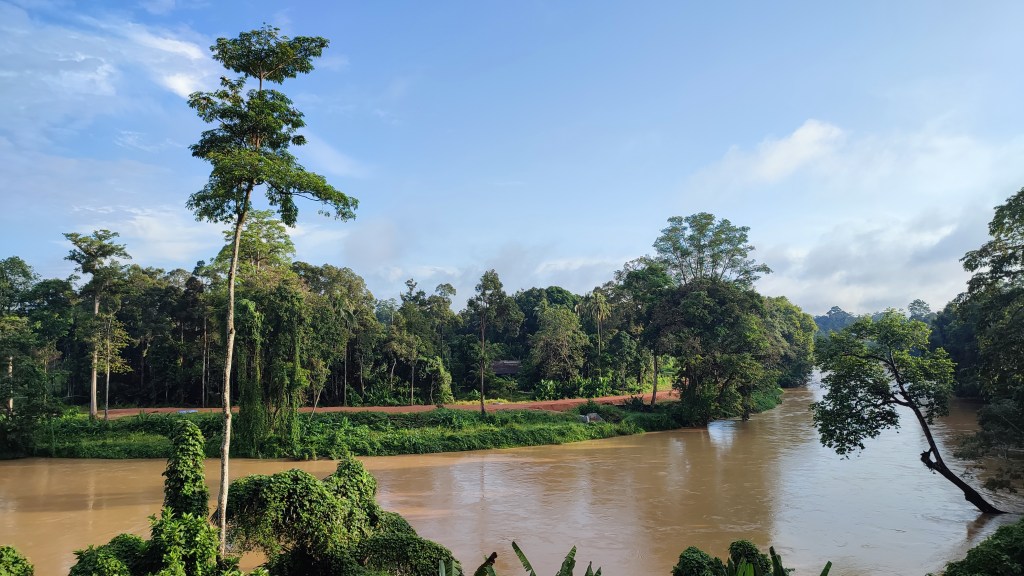
Jelai River, Pahang, Malaysia
1.
Life in the development era is akin to a golden tightrope stretched above a river of fire, steeped in mystery. Once, that river’s beauty was a dream that has since aged into a well of nostalgia. Today, the heat of memory carries both grief and comedy.
2.
The river that was once calm turns threatening, devouring land in rapacious rain. Its intuitions are murky, its temperament increasingly unpredictable with the passing years. The sky hikes up her waistcloth, unsettling the heart. One witnesses with heartache as the river is dissected by the tools of technology. Trees along the banks are felled to build the bund, to ward off water as an adversary. In this duel between technology and nature, who dies in between?
It is comical to witness ever more destruction offered as penance for past destruction.
3.
It is comical to witness ever more destruction offered as penance for past destruction. The river runs violent from a blockage of the heart, built-up mud flowing down from the highlands. From up there, development moves swiftly, delivering pain to those downstream. Rumour has it that the colonial English winter has dissipated from the highlands. Our soothing laughter accompanies nature’s nostalgia. Without it, life grows too heavy, quietly sinking to the riverbed.
4.
Do you recall the drama of Taman Sri Muda? Bunds and other insulating infrastructure, including concrete ditches, pump houses, retention ponds, trash traps, and warning systems, were developed after the major flood of 1995 at a cost of RM38 million. In 2021, the major flood reprised its role. The whole country turned its attention to Selangor, the most developed state. Local residents sued the government, demanding RM3.8 million in compensation. The response was delivered in the language of the law: the flood was deemed an act of God, beyond human control. Pray tell, what occurs in this life that is not an act of God?
5.
The construction site for the bund in my mother’s village lies prim and flat after the trees planted by her late father were razed: durian, duku, langsat, petai, jering, salak, bamboo, banana, rambutan, mango, mata kucing. Twenty durian trees were sacrificed to ward off the wrath of the monsoon flood, my mother recounts. She squats to gather the exposed topsoil, shovelling earth into polybags. Perhaps she is working through the substance of memory for the good of her children and grandchildren beyond her lifetime. Bit by bit, she shepherds the saplings. Prayers follow along the barren riverbank, now a distant relative no longer greeted with warmth and wetness. What human choice remains other than supine surrender?
6.
They say the bund is built as an act of welfare for the villagers; just wait and see. Seized land and felled trees are compensated by the government. A golden handshake and safety from the monsoon flood. Rumour has it that some villagers requested additional money from the contractor to lubricate entry into their land, to carry out the deed. The truth of this cannot be confirmed. Regardless, no money means no conversation. Flood or no flood, the heart requires soothing to endure life in this crook of the woods.
A fragment of history, a life bound in dependence with the river as kin.
7.
A fragment of history, a life bound in dependence with the river as kin: “The connection of Pahang with other states around it once upon a time depended on the course of rivers. Those who wished to travel to the state of Kelantan followed the Tanum River, a tributary of the Jelai River, or followed the Sat River and the Sepia River, both tributaries of the Tembeling River. The connection with the state of Perak was more arduous, following the Bertam River and the Lipis River, both tributaries of the Jelai River. The connection with the state of Selangor was made by the Semantan River and its branches.”
8.
Construction of the bund pauses during the year-end monsoon season. At the neighbourhood café, flood-water levels from the great monsoons of 2014 and 2021 are etched in marker pen on the wall. Grief becomes a vessel of memory, resisting acts of forgetting through anecdotes laced with laughter and coffee. Villagers across the river tell us they can see fruits sprouting from durian trees on my mother’s plot of land, sacrificed for the bund. We walk onto the construction site to inspect the remaining trees, spared destruction. Human footprints press into the red earth, interwoven with smaller ones, perhaps from stray dogs. Unripe durian falling to the ground is not an act of God, but the work of notorious monkeys raiding the area. Perhaps they too are protesting the loss of the familiar land. We make peace. Unripe durian can be collected, aged, and cooked into a stew with coconut milk. Safely at home, a whisper lingers: those were not the footsteps of stray dogs, but of panthers.
9.
The government promises: “Since achieving independence, Malaysia has continued to develop rapidly by implementing various signature programmes in the agriculture, infrastructure, industrial, and commercial sectors. To address flooding problems that occur naturally or as a result of unplanned development, flood insulation programmes have been planned and implemented with greater urgency.” For decades, flooding and development have been bedfellows. The 12th Malaysia Plan allocated RM22 billion to build bunds along the Pahang River, the Langat River, and the Likas River. If one searches for the symbols of development, do not look only to the blue sky for towers. Look instead to rivers and floods. Bunds bear witness to the acts of humans, not to acts of God.
10.
As we walk atop the construction site, safely observing the river in the distance below, my mother says the bund will be built far higher than the projected flood levels of the next 50 years. When this development is complete, one will look out from the house and see a 15-foot fortress wall defending us from the river beyond. We will be neighbours without needing to face one another, without exchanging niceties. This bund, my mother says, can withstand flood levels projected for 100 years, a refrain she repeats to soothe herself whenever the rain falls heavily. In that distant future, when all of us have expired, who will stand atop this bund to bear witness to that proof?
How to cite: Anuar, Aizuddin. “Fieldnotes: Bund and Flood.” Cha: An Asian Literary Journal, 20 Jan. 2026. chajournal.com/2026/01/20/fieldnotes.


Aizuddin Anuar is a Malaysian writer and academic. His short stories, poems, and essays, written in English and Malay, explore questions of home, witnessing, memory, and development, and have appeared in publications such as FreshEd, After Progress, Rusted Radishes: Beirut Literary & Art Journal, The Mekong Review, SVARA, and Dewan Sastera. Over the past decade, his work has also been featured in several anthologies, including The Best of Malaysian Short Fiction in English 2010-2020, Tapau: The Best of Malaysian Food Writing 2000-2022, and Malaysian Places & Spaces. His first collection of stories and reflections, The Towering Petai Tree, was published by Laras99 in 2020.
 Cha
Cha 