
茶 FIRST IMPRESSIONS
茶 REVIEW OF BOOKS & FILMS
[FIRST IMPRESSIONS] “Circumnavigation Without Glory: Lav Diaz’s Magellan and the Violence of Discovery” by Oliver Farry
Click HERE to read all entries in Cha
on Magellan.
Lav Diaz (director), Magellan, 2025. 165 min.
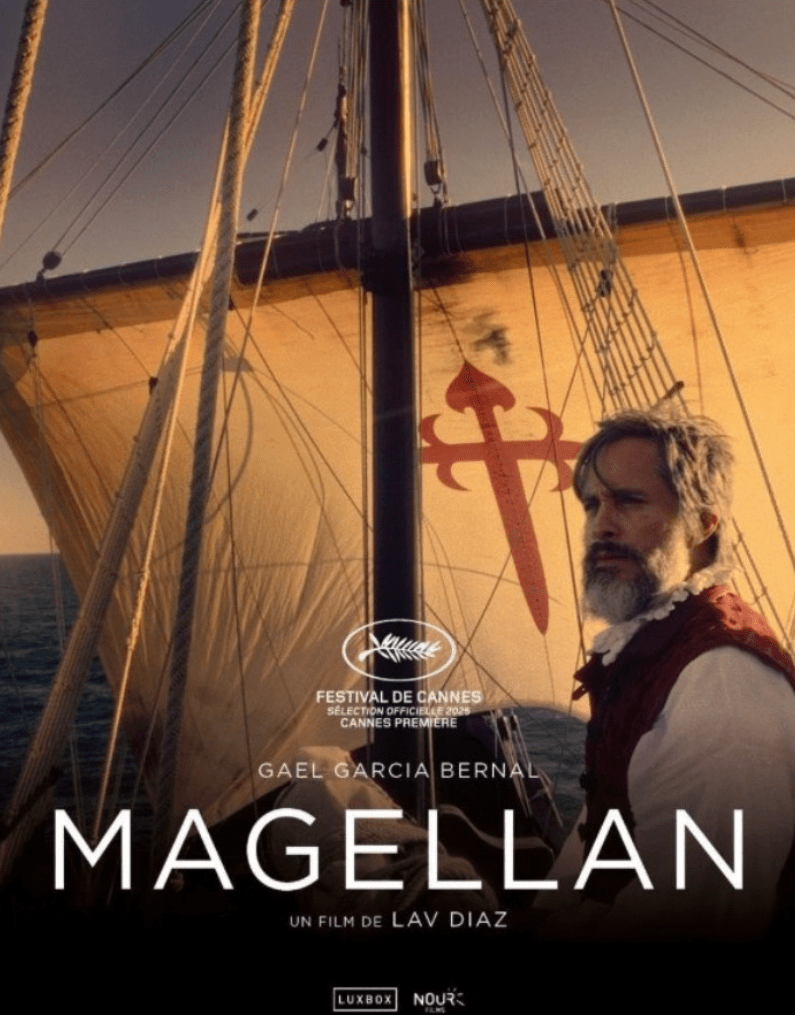
Lav Diaz’s Magellan is a chronicle of a death foretold. This is unsurprising, given that the two things most schoolchildren learn about the film’s subject are that he led the first circumnavigation of the globe and that he met a violent end in the Philippines.
Schoolchildren in the Philippines, one imagines, learn rather more about him, given that his landing on their shores brought such upheaval and heralded five centuries of colonialism.
Consequently, the few films that appear to exist about Magellan, or Fernão de Magalhães, as he would have called himself, are all Filipino.
The latest is by the Philippines’ most internationally renowned filmmaker and was a long-brewing personal project that, much like the navigator’s own expeditions, was brought to fruition with the help of Portuguese and Spanish financing, with Joaquim Sapinho and Albert Serra among the producers.
Premiering to significant international attention, Magellan went on to win the Golden Spike for Best Picture, awarded ex aequo, at the seventieth Valladolid International Film Festival, received nominations for Best Film and Best Cinematography at the Asia Pacific Screen Awards, and was selected as the Philippines’ official submission for the Academy Award for Best International Feature Film.
The film’s narrative trajectory is itself a circumnavigation of sorts, beginning in Malacca in 1511, where Magellan, played by Gael García Bernal, is wounded in a victorious battle and, before he sets sail for home, takes a Malay slave, Enrique, played by Amado Arjay Babon. It ends in Cebu, in the modern Philippines, where Magellan tentatively converts the locals to Christianity by introducing them to the Holy Infant, who “saves” the child of the local chieftain Rajah Humabon. This proselytism proves short-lived, however, as the Iberian colonists hubristically destroy the natives’ idols, provoking their ire and ultimately paying the price, save for a handful who survive to return to Spain.
Though it is Diaz’s first foray into filmmaking outside Tagalog and short by his standards, at two hours forty-four minutes, Magellan is every inch a Lav Diaz film. The encounters between natives and conquerors recall those between provincial villagers and security forces in Melancholia (2008) and Evolution of a Filipino Family (2005), reflecting a structural similarity in systems of oppression. The film shares the languid pace of Diaz’s longer works, defusing whatever spirit of adventurism might otherwise animate an explorer film.
There are echoes of other directors’ work, including that of producer Albert Serra, and the interiors, particularly those featuring Magellan and his wife Beatriz, are framed in a similarly Flemish fashion by Diaz and by Serra’s regular director of photography, Artur Tort. The film is also largely faithful to the languages concerned, with García Bernal learning Portuguese for the role and the Filipino actors speaking Cebuano, in sharp contrast to Martin Scorsese’s Silence, which was hampered by Andrew Garfield and Adam Driver struggling to convince as Portuguese missionaries.
We are left to judge Magellan’s actions for ourselves, as there is only one voice of contemporary dissent within the film itself. The explorer, who is in no way portrayed as larger than life, emerges instead as the harbinger of forces greater than himself, or than the Cebuano natives who rout him and his men, yet who are nonetheless doomed to a future of colonial domination and exploitation.
How to cite: Farry, Oliver. “Circumnavigation Without Glory: Lav Diaz’s Magellan and the Violence of Discovery.” Cha: An Asian Literary Journal, 17 Jan. 2026, chajournal.com/2026/01/17/circumnavigation.


Oliver Farry is from Sligo, Ireland. He works as a writer, journalist, translator and photographer. His writing has appeared in The Guardian, The New Statesman, The New Republic, The Irish Times, Winter Papers, The Dublin Review, The Stinging Fly and gorse, among other publications. Visit his website for more information. [All texts by Oliver Farry.] [Oliver Farry and chajournal.blog.]
 Cha
Cha 