
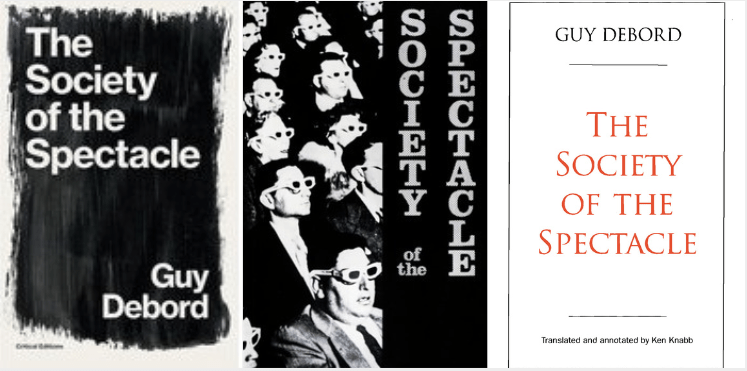
Editor’s note: In Matt Turner’s essay, he recounts organising and leading a Tuesday-evening reading group in November 2025 at Accent Sisters, a Union Square gallery with a Chinese and feminist focus. The group, composed largely of Chinese participants and socially diverse in profession, met to read The Society of the Spectacle by Guy Debord. Turner charts fluctuating attendance, open discussion, and moments of recognition, alongside hesitation about revolutionary praxis and its relevance to contemporary life.

[ESSAY] “Debord at Union Square” by Matt Turner

In the spring of 2025, I gave an online seminar in China on the journal Internationale Situationniste and the activities of the Situationist International. I had previously taken part in several in-person events at Accent Sisters, a Union Square, Manhattan gallery and Chinese and feminist space that hosted the seminar. The seminar formed part of a series of online events designed to raise funds for the critic Ou Ning’s Isogloss group, and I was already acquainted with the gallery’s owners. Nine months later, I asked the gallery whether I might lead an in-person reading group devoted to Guy Debord’s 1967 book The Society of the Spectacle. They responded with enthusiasm.
The reading group met for two hours every Tuesday evening in November. Each session combined discussion of the assigned reading with more general conversation about the themes and problematics raised by the book. I was determined that it should not become a lecture course, in which I would act as a designated authority instructing students in correct interpretations. It needed to be open and honest. I wanted lively discussion and contending interpretations, which would naturally lead us towards the work of others.
Every Tuesday at seven we gathered around the rectangular folding table that the gallery had set out for us. Around halfway through the session, tea was brought in. For the first meeting, we had all been asked to read the first three chapters of the Nicholson-Smith translation of the book, although in practice only about half had done so. The remainder had read whichever translation they could find freely available online.
We began by introducing ourselves, an exercise that initially made me feel childish but proved to be genuinely useful. I had assumed that everyone would be an artist, given the setting, but the group included a landscape architect, a nurse, and a software engineer. The rest were artists supporting themselves through other means. As nearly everyone was from China, I had expected a more sceptical engagement with Debord’s Marxism, yet only once did someone accuse Debord of Marxist “utopianism.”
)
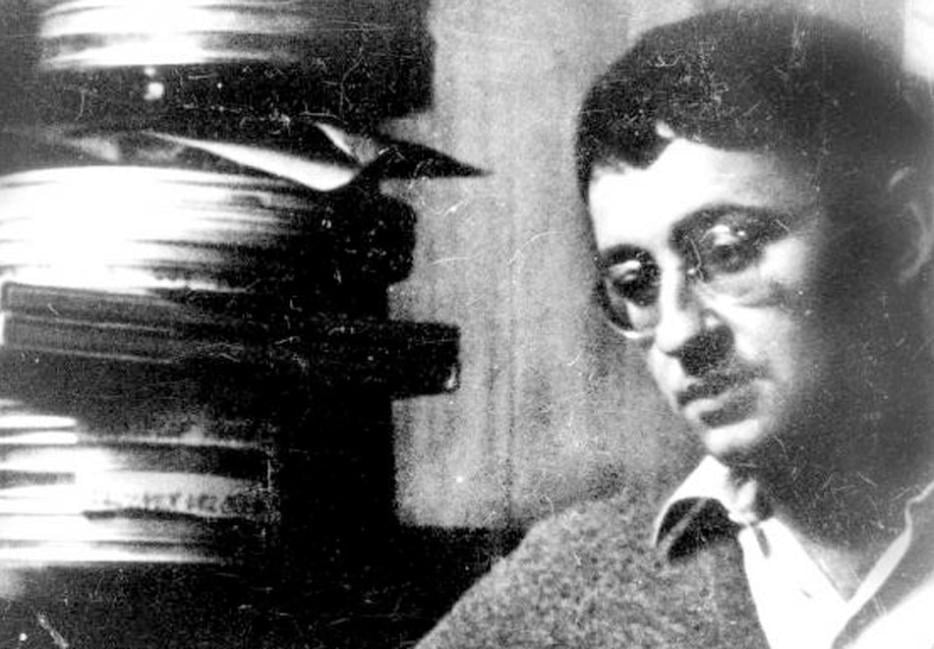
Guy Debord (1931-1994)
Each week we began with a basic question, starting with “What is the spectacle?” None of these questions was answered definitively, nor could they have been. What mattered was directness and the absence of pretension, so that we could genuinely speak to one another. In the first week, the most accessible discussion centred on the media and “the image,” the book’s most obvious tropes. We spent more time grappling with Debord’s terminology as rendered in English: the “whole life” of a nation, “representation” in political decision-making, detachment, and “non-life.” The two issues, possibly related, that occupied us most were Marx’s distinction between use value and exchange value, and the possibility that the disembodied spectacle, having overcome technological limitations and mastered nature, came to embody its own message. It was also suggested that the movement of the spectacle through space not only imitates the movement of money, as seen in the generation of money through derivatives, but that the movement and effects of money are themselves extensions of the spectacle. Seven people attended the first session. The second session, devoted to “the proletariat as subject and representation,” was attended by two.
I was conscious that the first three chapters are the most widely read sections of the book, and that the first ten theses of the opening chapter, where a summary definition of the spectacle can be discerned, are all that many readers ever reach. Chapter four attempts to account for the historical development of the proletariat and the seizure of history from the group, first by the bourgeoisie and then by a disembodied spectacle. It is possible that this bleak account of history contributed to the decline in attendance.
That, however, is not all that the chapter addresses. We began with the question, “What is the role of the proletariat?” The central theme of our discussion was Debord’s historical account, not the Marxian narrative of the development of guild trade and capitalism, with which the participants were already well familiar, and not Debord’s assertion that the spectacle emerged from bourgeois techniques of profit and management. Our focus was instead on the proletariat acting as the “subject” of history, that is, as the agent determining its own role by overthrowing the existing order in order to assert subjectivity.
We asked whether such action was itself historically determined, in the manner of economic development, or whether the production of history was individually determined. Writing about revolutionary organisation at the end of the chapter, Debord introduces dialectical method as praxis. A collectivity of individuals, he argues, can come to understand the world as a totality through their conscious participation in it. Even under “the sign of the spectacle,” the revolutionary worker overturns the language of the spectacle.
During this session, one participant raised the question of Deleuzian immanence. Yet comparing revolutionary praxis to philosophers who “seek to interpret the world,” depending on how one reads Deleuze, is only helpful to a point. Debord invokes the “absolute image” of the spectacle, implicitly asking his readers to view their own lives historically. We concluded the session by asking what our individual roles are within the contemporary economy and its representations.
Weeks three and four both brought new faces to the reading group, and attendance rose again. Understanding chapters five and six, which deal with Debord’s theory of historical and spectacular time, however, depends on a grasp of chapter four. We therefore had to revisit some of its themes briefly before moving on.
On the naturalising of history, we discussed the assumption that history is the way it is because we have been conditioned to think of it as such. We are so thoroughly conditioned that even the idea that history is produced, rather than simply unfolding, is difficult to comprehend, as it demands revolutionary praxis. As the commodity economy developed out of the revolutionary activity of the bourgeoisie, it acquired a particular form, becoming what Debord calls “the time of things.”
It was at this point that, for the first time in three weeks, I began to hear genuine enthusiasm. I had advertised The Society of the Spectacle as prescient, but I had not expected it to resonate so strongly in the suggestion that the way we spend our days, even the way we imagine our days, lies at the feet of the enforced production and consumption of commodities. If this diagnosis found resonance, however, the way out, including workers’ councils and political revolution, proved far more demanding and even mood-dampening. Debord’s discussion of the overthrow of “pseudo-life,” as he calls it, is described as “the dream … [that] has yet to come into possession of the consciousness that will allow it to experience its reality.” On this topic, Debord even quotes Shakespeare: “If we live, we live to tread on kings.”
)
Yet at no point during the reading group did we enter into a sustained discussion of the efficacy of adopting a revolutionary position.
The final three chapters can be read as applied theory. They address cities, criticism, and art, topics that had all been explored previously in Internationale Situationniste. For our group, however, they were framed through The Society of the Spectacle. Curiously, only one participant had any prior familiarity with the Situationists. A few others had heard of the group by name alone and tended to associate Debord with media theorists such as McLuhan. As a result, there was some surprise at Debord’s antipathy towards the fields of media and art studies, and at his sustained emphasis on economics, historiography, and social critique.
Chapter seven discusses the homogenisation of geographical space and the ways in which city development, or urbanisation, is used to reinforce social isolation. Yet, in a dialectical reversal, Debord demonstrates that although urbanisation as a discipline serves the spectacular commodity economy, it is also only in cities that social power concentrates, at times accumulating revolutionary momentum. The small town and the countryside, by contrast, are feudal.
Similarly, culture, the subject of chapters eight and nine, is often the spectacle made concrete. At the same time, it is culture’s capacity for broad generalisation that allows it to negate its own specific instantiation, that is, to move beyond the commodity form and offer critique. In his stimulating discussion of the Situationist technique of détournement as a “dialectical style,” Debord proposes that avant-garde art is art that “is not.” It negates itself, transforming into the practice of social critique rather than novelty. Parallels can be found in Lukács, whom Debord admired, but it is only in The Society of the Spectacle that the avant-garde is theorised as becoming more than itself through the denial of its own existence. Social critique, like revolutionary activity, must “know how to bide its time.”
In all successful reading groups, the leader, whether de facto or formally designated, guides discussion through prompts, alternating between close reading and open conversation, and emphasising key moments in the text. In our group, my sense was that participants struggled most with Debord’s more open-ended and existential statements and questions, yet they also responded to this difficulty with enthusiasm. In the end, not everyone connected the book directly to their own specific social or artistic practices, but there was a concerted effort to apply our discussions on a global scale. While The Society of the Spectacle can at times read as a pessimistic indictment of a closed system, our conversations about the total system of history and liberation that Debord describes were unexpectedly exploratory and flexible. We also agreed that the global character of spectacular capitalism, as Debord presents it, requires modification. Had we read Comments on the Society of the Spectacle, I suspect we would have found ample examples.
)
It should be noted that democratic socialist Zohran Mamdani was elected mayor during this period, although the event barely surfaced in our discussions. When it did, it appeared to represent a markedly different vision of socialism from that proposed by Debord: democratic, pragmatic, organised, and deservedly successful, but lacking edge or creative-critical ambition. My impression is that, for our reading group, future successes in socialist art and cultural critique remained offstage, perhaps actively suppressed, perhaps biding their time.
How to cite: Turner, Matt. “Debord at Union Square.” Cha: An Asian Literary Journal. 9 Jan. 2026, chajournal.com/2026/01/09/debord



Matt Turner is a writer and translator based in New York City. He is the author of 6AMING (Antiphony, forthcoming 2026) and four other full poetry collections. With Weng Haiying, he has co-translated Ou Ning, Yan Jun, Wan Xia, and other figures of China’s contemporary avant-garde. He writes essays for Cha. [All contributions by Matt Turner.]
 Cha
Cha 