
Editor’s note: In “Autoethnography of a Hermit Crab”, Mark Alden Arcenal traces a childhood friendship shaped by monsoon seasons, coastal rituals, and shared literary dreams, gradually unfolding into a meditation on queerness, faith, illness, and loss. Through the recurring metaphor of the hermit crab, the essay explores how vulnerability, love, and identity are negotiated within hostile social and religious structures.

[ESSAY] “Autoethnography of a Hermit Crab” by Mark Alden Arcenal
Disclaimer: The names used in this personal essay are fictional to protect identities.
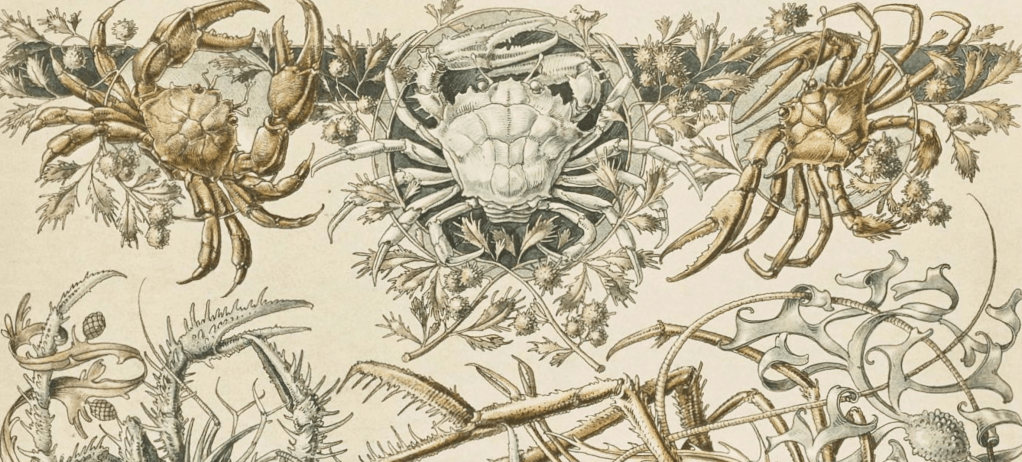
THE ARRIVAL OF THE HABAGAT is my most anticipated season.
The Southwest Monsoon is said to signify a kind of sea cleansing, for it returns all discarded objects to the shore with the waves. Harold and I used to stroll along the rugged shoreline of Dakdak, searching for empty sigay, which Lola Bebe would buy for a centavo to use in some chandeliers she intended to make. Every morning, we would watch the sun stretch its arms toward the lush Pagatpat trees and settle over a nearby tide pool. During this season, the sea generously gifts us a handful of sigay. The only thing I dislike about the Habagat is that it always brings a windstorm. After a heavy downpour, a rainbow would be painted across the shoreline. Harold and I would then compete to see who could collect the most sigay and earn the most money.
It was already dusk when I heard Nanay Rosalie’s sharp whistle during one of our search sessions. Harold and I hurriedly ran and jumped over the rough shoreline. My mother’s whistling served as a signal that it was time to go home back then, and as an indication that she was not angry yet, or that a measure of patience was keeping her calm. But I knew I had to brace myself for a pinch once she shouted my name. The thought of getting home quickly was interrupted when we stumbled upon a peach-coloured, palm-sized spiral shell. I picked it up and sensed something moving inside. Then a claw shot out directly at my finger, causing me to drop the creature. It did not bleed, but the tingling sensation took a moment to subside.
It was a hermit crab.
)
I learned that hermit crabs love to venture into the world during the Southwest Monsoon, perhaps because the sea is a welcoming place for them at this time, and they feel a sense of belonging. I often wonder why hermit crabs cannot grow their own shells and must rely on what others leave behind, conchs, bottle caps, and even sigay. Once, I tried putting a relatively small hermit crab in an aquarium. I then placed a disposable plastic cup inside, and the crab immediately found its way into it. It feels as though hermit crabs enter the world with their vulnerability laid bare. In my peculiar fondness for hermit crabs, I realised that many people resemble these creatures, including Harold.
Harold was like a brother to me. We had known each other for over a decade, and our bond deepened through our shared love of writing poems and stories. It was Harold who ignited my passion for writing. If it were not for him, I might still be aimlessly wandering through computer shops, wasting hours playing DOTA.
He also possessed a remarkable intelligence that often mesmerised and intimidated our teachers. When you heard him speak in English, it felt almost magical. I do not know how he did it, but he had a way of drawing you in and leaving you in awe. Yet his intellect lost some of its lustre when some people discovered that he was gay. It still pains me to recall how many turned away from him because of this.
When we were young, I witnessed Harold endure harsh judgement simply for being himself. I have lost count of how many times I saw him struggle to reshape himself into what others wanted him to be. Aside from collecting sigay, he would join us and the other local boys in diving for sea urchins and shellfish. At one point, he even helped us gather our neighbour’s hollow blocks for a measly twenty-five centavos per pair. He also dared to play basketball with us. At the time, I observed that the sport had become a measure of a man’s masculinity. Even one of Dumaguete’s prolific writers, Ian Rosales Casocot, described basketball as coded with toxic and performative masculinity in an article published by Rappler, such that anyone who did not know how to play, or was not fond of it, would be judged or labelled as gay.
One of my most memorable basketball experiences was when Harold and I faced each other in a one-on-one game. We used both basketball hoops on the court under the scorching sun. I could barely catch my breath as I laughed at the way he dribbled the ball, his hips swaying to the rhythm. What happened next remains unclear to me, because my vision suddenly went black and the basketball court plunged into darkness. When I regained consciousness, the first thing I saw was Nanay Rosalie tending to the wound on my left cheek. Beside her stood Harold, smirking at me.
“Gaba nimo (Karma is on you)!” he laughed loudly. His laughter echoed from corner to corner, leaving the scar on my left cheek to hold its ghost forever.
)
I heard this derision toward gay people not only from others, but also from Harold’s father. Apparently, he weaponised the word gay as a form of mockery. Whenever he ridiculed his son, Harold would act as though there were dust in his eyes. There were also times when Harold had bruises on his face, near his right eye and lips, as well as on his legs and back. Whenever asked, he would simply shrug it off and casually say, “Nadalispang ra ko sa CR bay (I just slipped on something inside the CR),” despite the clear mark of a hateful blow on his skin. The bruises on his back told stories passed from body to body like a cruel inheritance.
His father even jokingly prophesied that, before long, I would be infected by his son’s gayness if I continued to spend time with Harold. How contagious could being gay be? From whom did Harold acquire this so-called infection? If we were to trace his roots, we would find that he is the youngest of three siblings. His eldest brother already has five children, while his other sibling is married to a foreigner. Meanwhile, Harold’s childhood playmates, including myself, none of us, or perhaps not yet, have come out as gay. I wonder whether there is a gay virus I never knew about.
I once read a research article suggesting that various biological mechanisms play a critical role in shaping an individual’s identity. I learned that, inside a mother’s womb, hormones shift in ways that make some boys appear softer in the eyes of the world. I suppose Harold’s softness must have been written into his bones long before he ever spoke of it. This challenged my societal assumptions and made me reflect on how little I truly understand about sexuality and identity.
Harold and I were once members of the church choir and attended Mass every Sunday. Our Sunday devotions ended one day when a church leader declared in front of us that God did not create gay people. The leader claimed, “Wala sa Bibliya ang mga bayot (Gay people are not mentioned in the Bible).” I vividly remember how Harold’s eyes could not hide his fear. Perhaps it was because, at the time, people said there were no gays in heaven, only figures sliding up and down the rainbow. Who would not be frightened by the thought of not going to heaven? Is that not the ultimate prayer of a believer? Harold then begged me, almost kneeling, to accompany him to a church confession.
“Basin mao ni ang pamaagi nga dili nako mabayot (Maybe this is the only way that will cure my gayness),” Harold said.
We were in our first year of high school when it happened. We inquired about the church confession schedules and learned that we could attend on Tuesdays and Fridays. Right after class one Friday, we hurried to the church. Father Aureliu’s words have remained deeply rooted in my mind. He said that it was not Harold’s fault that he was born gay. Nor was it gay people’s fault that they feel the way they do.
Father Aureliu’s sentiment was echoed in a conversation I had last week with a former colleague. Dr Abon is both a physician and a church leader. She believes that everyone deserves to be in heaven. Dr Abon asserted that those who claim that no gay people will enter heaven are the ones who have not yet received God’s grace. We also discussed the science behind biological mechanisms. She affirmed, as Father Aureliu believed, that it is not gay people’s fault to be who they are. However, as we were about to conclude our conversation, Dr Abon emphasised that a man is only for a woman, and a woman is only for a man.
While Gender and Development initiatives in schools have gained traction globally, many people continue to show disdain for gay people. There appears to be a disconnect. In the Philippines, I have observed that church leaders wield more influence than teachers. If the former claim that being gay is not wrong, yet insist that a man in love with another man is sinful, how can the latter confidently teach that gay people are free to express themselves? In a religious country like ours, questioning a church leader feels akin to questioning God. This creates what is often called a belief trap.
)
On the other hand, hermit crabs are nocturnal animals. Perhaps they favour the night because it allows them to remain hidden from view. In darkness, they go unnoticed, free from judgement or mockery. No one can mistreat them then, allowing them to be hermit crabs without concern for others. I recall a moment when my fisherman uncle brought home a net full of shellfish. He was furious to find a couple of hermit crabs among the catch. He picked them up one by one and ruthlessly grabbed their claws and legs until each crab met a swift demise.
Fables have long celebrated snails as symbols of consistency and perseverance, portraying them as determined creatures navigating the earth. In these stories, hermit crabs are often cast as antagonists or copycats. I suspect that some people are captivated by aesthetic beauty, and anything that fails to meet this standard is deemed unworthy. Is this not also true for gay people? How often have they been labelled worthless, pest-like, or abnormal?
I read a 2022 report by Equaldex noting that only nineteen per cent of Filipinos found homosexuality justifiable. Although being gay is not illegal, the law still implies that their love is not real. I recall a story in which one member of a gay couple fell ill, and the hospital did not recognise the partner as someone authorised to make decisions. How selfish can people be to deny, or even control, how gay people live their lives? Who gave us the authority to dictate whom they are allowed to love?
To gain insight into love from the perspective of a gay person, I had the privilege of discussing it with Al, a fellow writer who has since become a dear friend, during a writing workshop at UP Cebu. He described love as an act of courage, the bravest decision a gay person can make. What intrigued me most was his admission that gay people are hungry for love. Al explained that, for many, physical intimacy serves as a crucial bridge to emotional connection. That is why, when opportunity knocks, no matter how fleeting it may be, they seize it. He concluded that some gay individuals resort to buying love simply to feel that connection.
Finding someone with genuine intentions, someone who truly understands our aspirations and history in this rapidly changing world, feels increasingly elusive. I often reflect on Al’s and Harold’s experiences and consider how daunting it must be for them to find someone they can genuinely trust. How do gay people begin to reclaim the fragments of themselves that they poured into such connections, along with the dreams and hopes entwined within them? To borrow a question from Bob Marley, why do we still choose someone worth choosing when the truth remains that each of us will encounter heartbreak along the way?
)
When Harold and I graduated from high school, I felt heartbroken at the thought of entering college alone. His parents did not support his dreams, and the long-anticipated free tuition law for state universities was still buried in folders at the time. Only one state university was near Dakdak, but the eight-thousand-peso semester tuition was a barrier too high for him to overcome. This was the moment when our lives began to diverge. I embarked on my journey towards an education degree, while he moved to the city to work at a call centre.
Harold would call me on his days off. I remember how proudly he displayed his growing command of English, even correcting my pronunciation and teasing me about my Bisaya accent. Then, one day, in the middle of one of our routine calls, his tone shifted. He revealed something that struck me like a thunderbolt. Harold had found love.
“Nasabtan na nako karon, bay (I finally understand now),” he said, his voice filled with a warmth I could feel despite the distance. “Nindota gyod diay sa feeling bay kon mahigugma ug higugmaon, hilabi na kon giisip tang tinuod nga babaye sa usa ka lalaki (It really feels good to love and be loved, especially when we are treated like a real woman by a man).”
Harold often confided in me about the gifts he showered upon his beloved, shoes, mobile phones, jeans, T-shirts, and countless other tokens of affection. Yet I lost count of the nights he called me in tears, devastated by the relentless cycle of love that seemed always to slip through his fingers. What price do some gay people have to pay to sustain their relationships? Despite the heartache, Harold continued to search for love in every fleeting encounter.
I later discovered that hermit crabs also exert great effort to sustain relationships. They emerge from their shells only when it feels safe enough, exposing their most vulnerable parts for a brief promise of connection. This seems true of humans as well. Are we not all willing to give away a part of ourselves for love?
In my final year of study, I was surprised to see Harold return to Dakdak one day. Yet it was not his return that made the headlines, but the passage of the free tuition law. Despite my repeated encouragement for him to pursue a degree in education, he refused, having observed how many of our relatives struggled to secure teaching positions with the Department of Education. Instead, Harold chose to enrol in a degree related to fisheries, believing that he could make a difference by helping our local fisherfolk.
Harold seemed to blossom in ways I had never seen before after he returned home. There was a newfound brightness in his eyes, a spark that radiated from his very being. He confidently wore vibrant lipstick, making it an essential part of his daily routine before stepping outside. Every step he took was infused with a boldness that set his hips swaying in an unmistakable rhythm. What was even more reassuring was the thought that he never again slipped on something inside their CR, as no bruises could any longer be seen on his face, legs, or back.
Harold organised several initiatives, including clean-up drives, outreach programmes, and feeding programmes outside school. I participated in all his activities. However, everything changed when he developed a fever one day. The fever persisted for a week without relief. When he recovered, the weight he had lost was immediately noticeable. As the weeks passed, the fever returned, and during this time Harold’s eyes and skin began to appear jaundiced.
)
I still remember what happened that August night. It was the town fiesta, and I invited Harold over despite his illness. Old friends and acquaintances gathered, sharing stories, enjoying food, and sipping cans of beer. In that gathering, Harold was the only one who did not drink. Then someone asked a question that made us burst into laughter.
“Kadaot na man nimo, Day? Pa-HIV test kaha (Why are you so sickly, Sis? You should consider getting tested for HIV).”
Harold walked away from the group in silence, and I quickly followed him. To be honest, the remark did not seem particularly significant, as that kind of joke had become common among us. Yet I realised that the timing was deeply inappropriate. The night ended without a word between us.
A few weeks later, blisters appeared all over his body. During this period, I facilitated an HIV symposium at our school, where free testing was offered. I invited Harold to attend. He responded by yelling, “Ingon ana na lang ba gyod ko kahugaw (Do you really think that I am dirty)?!” With a deep sigh, I explained that it was simply an invitation and that I had no ill intentions. My words, however, did not ease his feelings at that moment.
Months passed, and Harold developed serious bowel problems. He was rushed to our district hospital for evaluation, which included an examination of his blisters. Afterwards, the doctor issued a prescription, and Harold returned home the same day. The next morning, as the sun rose over the rugged shoreline of Dakdak, Harold came to my house and woke me. He had a request, though I did not fully understand it at first.
“Unsa bay (What did you say)?” I asked.
Harold wanted to be tested for the virus, so we went around town. First, we inquired at the district hospital, then at our school, and finally at private clinics. Unfortunately, we were unable to secure a test. Days passed, and the blisters turned into sores. It was during this time that he was taken to a tertiary hospital in the city.
I called Harold during his first week in the hospital, but it was his mother who answered the phone. I learned that several diagnostic tests had already been completed. He had pneumonia, and his CD4 count was as low as twelve cells per cubic millimetre. I asked my cousin to accompany me to the city. We left Dakdak early in the morning on a motorcycle, navigating long, bumpy roads for four hours. We arrived just before noon and discovered that Harold was confined to a room in the north district wing. When we entered the ward, I could not hold back my tears. Harold looked painfully frail. His skin seemed to be the only thing holding his bones together, and the blisters on his body had developed into large, pus-filled sores.
)
It was a Monday when Harold returned home to Dakdak, two weeks after his admission. It was his personal decision, and he signed hospital waivers to make it possible. Each evening, when I visited him, Harold invited me to join him in novena prayers. He kept a small booklet for reference, with the final page indicating the timing of the last bead of the rosary. On the second day, however, my tears fell silently, because it was no longer Harold’s voice that I heard, but the voice of a mananabtan, someone who prays for the dead.
Friday was the day I cried my heart out, as though my tears could undo everything that had happened. That morning, Harold texted me to say that he had something important to share. After my class, I went straight to his house. It was dusk when I arrived. When I opened the door to his room, Harold greeted me with a smile I will never forget.
“Bay, palihog ko sa akong tambal (Could you please hand me my meds)?” he asked, pointing to a bottle on top of a cabinet. The bottle was white, and Harold knew that I would read its label.
Not for sale. For HIV/AIDS patients only.
“Mao ba ni imong iingon kanako (Is this what you wanted to share with me)?” My eyes filled with tears.
Harold responded at first with a faint smile. He then said that perhaps it was true that someone like him had no place in heaven, which he believed was reserved for those who had forgiven their sins. He added that, as a gay person, he often felt like a walking sin in the eyes of others. Harold even asked me to write his story, “Kana kon dili na sala ang magpakatinuod sa kaugalingon (But only if the time comes when it is no longer seen as a sin to be true to oneself).” I wanted to disagree with him, but the weight of his illness overwhelmed me.
That night, a mixture of voices crowded my mind: regret, the sense that I had not helped him enough, and the shame of being an irresponsible friend. I mourned every missed opportunity. If only I had urged him again and again to get tested earlier, he might not have reached this point.
Harold also insisted that he would rather slide up and down the rainbow than go to heaven, because he believed that “Ang tanang adunay kalagot sa mga bayot anaa sa langit (Everyone who harbours hatred toward gay people is present in heaven).” He smiled as he told me that those who had been true to themselves were in the rainbow, along with all those willing to love and accept gay people. He reminded me of the Habagat season, our sigay sessions, the heavy downpour after the windstorm, and the rainbow that always followed.
Heaven remains an abstract concept and continues to be debated. Yet seeing a rainbow as a kind of heaven feels deeply reassuring, because it exists within our sight.
“Nalipay kaayo ko, Bay, nga nakaila tika. Hinaot mahinumdoman ko nimo kon makakita kag rainbow. Naa ra ko diha, mopakpak sa imong mga makab-ot (I am so grateful to have met you in this lifetime. Remember me when you see a rainbow. I will be there, clapping for your achievements),” Harold said as he held me tightly.
Harold discovered the virus too late. It was beyond the point at which it could be confronted with the care that comes from early awareness. I keep thinking that if he had not grown up believing his truth needed to be hidden or treated as a sickness, he might still be here. He might have been thriving, managing the virus as many people now do with proper medication and support. But he stayed too long inside that shell, and hermit crabs die when they fail to find a new place to grow.
He was taken back to the city, where he spent the final days of his life in the hospital. According to his father, he looked for me. When his body was brought home to Dakdak, no one dared to carry his coffin except us, his childhood playmates. Only a few people attended his funeral, as the neighbourhood had learned about the virus. We spent two years on contact tracing, yet the person who carried the virus may still be out there, alone and in need of care.
There is a particular ache I feel whenever I watch hermit crabs crawl into shells that do not belong to them. It reminds me of Harold, and of how he slipped in and out of lives he never felt entitled to claim.
It has been nearly six years. No one collects sigay in Dakdak anymore. Lola Bebe no longer makes sigay chandeliers, and Nanay Rosalie no longer whistles us home. Some things return with the waves, while others do not.
The sky is now painted in shades of grey as relentless downpours follow each windstorm. There is a quiet truth in this, as though nature is cleansing her burdens, like tears shaped by familiar weather. I think of Harold, no longer living like a hermit crab, as he once did when sigay gleamed in his hands. He once said that those who are true to themselves do not wait for heaven, but slide across the rainbow instead. As I finish writing this, a rainbow appears through my window.
THE HABAGAT SEASON HAS FINALLY ARRIVED.
How to cite: Arcenal, Mark Alden. “Autoethnography of a Hermit Crab.” Cha: An Asian Literary Journal, 7 Jan. 2026. chajournal.com/2026/01/07/hermit-crab.



Mark Alden Arcenal, also known by his byline Alden Arsèn, was born in Zamboanga City, Philippines, where the croak of frogs served as the first lullaby to usher him into sleep. Yet his navel is deeply rooted in Daanbantayan, Cebu, where he spent most of his life. His works have appeared in various periodicals and have likewise garnered several literary awards. At present, and for the rest of his life, he lives for Sally and his three dogs, Nala, Deib, and Luci.
 Cha
Cha 