
茶 FIRST IMPRESSIONS
茶 REVIEW OF BOOKS & FILMS
[REVIEW] “Tibet as an Imagined Nation: Myth, Reclamation, and Literary Politics in Koushik Goswami’s Reimagining Tibet” by Jyotirmoy Sil
Koushik Goswami, Reimagining Tibet: Politics of Literary Representation, Routledge, 2023. 228 pgs.

Koushik Goswami’s Reimagining Tibet: Politics of Literary Representation critically engages in disentangling the complex threads of literary positionalities that have exoticised Tibet as an imagined elsewhere.
Tibet, a territorially aloof and culturally distinct Himalayan region surrounded by mountain ranges, has been historically shaped by successive waves of migration and displacement and by contested political relations with its neighbouring countries. Tibet’s geocultural seclusion until the mid-twentieth century generated enduring external curiosity about its terrain and people and functioned in mythologising it as the “Forbidden Land” (Goswami, p. 1). Western epistemic formations have essentialised Tibet through romanticised tropes, construing it as “Shangri-La”, a terrestrial paradise, or a mythical Himalayan “utopia” (Goswami, p. 1), and as a “locus of spirituality” (Harris , p. 16).
In recent decades, Chinese control over the region, which has rendered a large number of Tibetan nationalists homeless, has engendered a corpus of diasporic Tibetan writings. Contemporary Tibetan literary production and activism by its own members function as acts of representational counter-discourse, seeking to resurrect marginalised histories and to reassert Tibetan cultural and political subjectivities. Goswami’s book maps the contested terrain of literary representation through which Tibet has been persistently figured as a domain of myth and fantasy, while tracing parallel efforts towards the discursive reconstruction of Tibetan identity and nationhood.
Goswami assesses the politics of the literary imagination of Tibet across both insider and outsider categories through a study of select fictional texts. The book offers a comparative analysis of Tibetan representation in three novels by a British writer, a United States-based Tibetan writer, and an Indian writer, respectively: James Hilton’s Lost Horizon (1933), Kaushik Barua’s Windhorse (2013), and Jamyang Norbu’s The Mandala of Sherlock Holmes (1999). The author evaluates varied modalities of gaze, namely the outsider, the hybrid insider-outsider, and the insider perspective, and situates these perceptions within the narratorial economy of the contemporary Tibetan imagination. Representations are shaped by the author’s ideological position, with outsiders often stereotyping and exoticising their subjects, while insiders rely on familiarity. However, the insider-outsider position remains hybrid and shifting, a complexity that informs Goswami’s reading of Kaushik Barua’s novel as rooted in long Indo-Tibetan familiarity yet reshaped through empathetic engagement with Tibetan lives in exile, resulting in a more balanced and humane representation.

The first major case study, James Hilton’s Lost Horizon (1933), is read as the quintessential Western fantasy of Tibet. Hilton’s narrative, which follows four Westerners’ encounter with the mystic valley of Shangri-La after surviving a plane crash, becomes, in Goswami’s assessment, a blueprint for the enduring global imaginary of Tibet as utopian, depoliticised, and available for imperial appropriation. Hilton’s Shangri-La, Goswami contends, is not merely a literary invention but a re-inscription of the Saidian “silent Other” (Said, p. 215), a mythic Tibet refracted through imperial desire, exoticist nostalgia, and racial paternalism. Goswami dissects the ideological work performed by this spatial mythos, wherein serenity and the promise of longevity submerge a deeper colonial logic that renders Tibet in ahistorical temporality. Hilton’s portrayal of Tibetans, as Goswami observes, as spiritually and civilisationally subordinated custodians of a European High Lama contributes to conventional Orientalist imagination (p. 49), concealing the West’s own longing for spiritual repair. Such illustrative grammar, Goswami argues, exemplifies a broader Western epistemic framework that fixes Tibet within a mythic register through the process of stereotyping which, as Stuart Hall reminds us, “reduces, essentialises, naturalises and fixes ‘difference’” (Hall, p. 258).
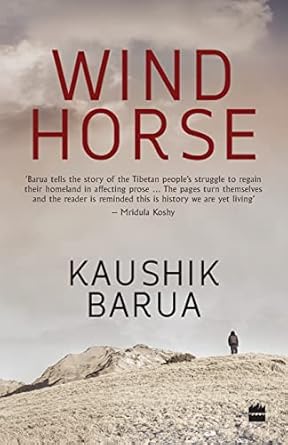
With Goswami’s turn to Kaushik Barua’s Windhorse (2013), the gaze shifts from Euro-American to Indian, neither fully exterior nor wholly embedded. Barua’s narrative bears the clear imprints of a national political consciousness grounded in India’s historical sympathy towards the Tibetan cause and its sceptical appraisal of China’s authoritarian aggression. His Assamese positionality, shaped by the Northeast’s own strained histories of marginalisation and insurgency, generates, as Goswami suggests, a mutually informing vantage point (Goswami 63). This dual vantage, national political and regionally experiential, shapes both Barua’s imaginative orientation and his reciprocal encounters with Tibetan refugees during the research process for the novel. The novel’s portrayal of Tibetan resistance from the 1940s to the 1970s thus emerges not as a continuation of Western utopian fantasy but as a postcolonial reckoning with borderland politics, displacement, militarised statecraft, and the ambiguities of inter-Asian solidarity. This constitutes one of the study’s most significant contributions, as it disrupts the conventional West and Tibet binary by demonstrating the capacity of South Asian literary imaginaries to subvert established representational grids.

The chapter on Jamyang Norbu’s The Mandala of Sherlock Holmes (1999) reads the deployment of pastiche, writing Tibet into the lacunae of the Sherlockian canon, not merely as playful homage but as counter-hegemonic historiography. By appropriating Holmes, an icon of Western rationality, and embedding him within a framework of Tibetan moral philosophical reasoning, as Goswami argues, Norbu reverses the usual direction of cultural translation. Instead of Tibet being rendered legible through Western categories, it is the Western canon that becomes reinterpreted and provincialised from within Tibetan narrative logic (Goswami, p. 91). This strategic hypertextuality allows, Goswami contends, the production of a narrative that simultaneously contests British colonial epistemologies and challenges Chinese state claims over Tibet. Although the novel does not alter Doyle’s narratorial strategy, Norbu’s strategic inclusion of footnotes positions him as a secondary narrator who not only supplements the text with contextual knowledge of Tibet but also actively corrects the misinformation given by characters within the narrative (Goswami 89). Norbu’s pastiche, as Goswami suggests, functions as an epistemic reversal by unsettling the authority of colonial knowledge systems. Rather than merely imitating or parodying inherited narrative forms, it fractures their claim to truth, exposing how Tibet has been rendered knowable only through borrowed, externally imposed discourses (Goswami, p. 107).
The subsequent chapter, titled “Reconfiguring Tibet: Tibetan Activism in Diaspora”, focuses on new expressive terrains of the “Free Tibet” movement taken up by writer activists within twenty-first-century media ecologies. Goswami demonstrates how three forms of Tibetan activism, literary, political, and virtual, decisively contest the stereotype of Tibetan “non-violent” (Goswami, p. 111) passivity, with digital networks engendering a pan-Tibetan identity and an emergent diasporic consciousness attuned to transnational realities. The author further contends that Tibetans, both within Tibet and across the diaspora, continue to support the “Free Tibet” movement even as they acknowledge the irrecoverability of an earlier Tibet, given the prolonged assertion of Chinese control that has profoundly unsettled Tibetan cultural life (Goswami, p. 112).
In the concluding chapter, the study advances the provocative claim that Tibet, denied territorial sovereignty, persists as an “imagined” nation (Goswami, p. 139), resonating with Benedict Anderson’s formulation of the nation as an “imagined community”, whose existence is sustained less through cartographic legibility than through the discursive, imaginative, and political labour of its dispersed subjects. Goswami argues that “coevality is denied” (p. 132) in imaginary constructions of Tibet, particularly in Western literary representations such as Hilton’s, where Tibet is figured as a realm of spirituality and enchantment and as lagging behind in modernity. Extending this critique to contemporary Anglophone Tibetan fiction, Goswami interrogates the paradoxes that haunt diasporic literary production, wherein authors typically write from conditions of displacement, linguistic mediation, and inherited memory rather than from direct experience of the homeland. While these conditions complicate questions of authenticity, Goswami situates contemporary Anglophone Tibetan literature within a millennium-long textual archive and, rather than labelling it as derivative, recognises its development as a process of transformation rather than rupture (Goswami, p. 137). As Thubten Samphel, the Tibetan writer activist, clarifies this position in his exchange with Goswami, “Activism and Tibetans writing in both Tibetan and English keep the Tibetan struggle alive and relevant […] to tell the Tibet story to the outside world” (Goswami, p. 184). Goswami’s analysis ultimately demonstrates how diasporic narratives negotiate the ethical burden of representing an inaccessible homeland while simultaneously contesting the sedimented histories of misrepresentation that have long shaped Tibet’s literary imaginary.
The book’s central claims are reinforced through interviews that reflect the perspectives and concerns of the very community whose representational challenges it subjects to critical scrutiny. Featuring Kaushik Barua alongside seven Anglophone Tibetan writer activists in exile, Jamyang Norbu, Tenzin Tsundue, Bhuchung D. Sonam, Thubten Samphel, Tsering Namgyal Khortsa, Tsering Wangmo Dhompa, and Tenzin Dickie, these conversations yield rare insight into the affective, creative, and ideological negotiations shaping Tibetan cultural production beyond the homeland, thereby endowing the study with significant documentary and archival value.
However, the volume’s engagement with Chinese literary articulations of Tibet remains largely confined to passing references. While Goswami acknowledges Tibet’s presence in the works of Chinese writers such as Yang Zhijun (Sea Retreated Yesterday, 1988), Ma Jian (Stick out Your Tongue or Everything is Just a Void, 1987), and Zhaxi Dawa (“Tibet: A Soul Knotted on a Leather Thong”, 1985), as well as Ma Yuan and Alai, the geopolitical role of China in shaping Tibet’s modern conditions demands a more sustained and explicit analysis of Chinese literary representational politics. Even so, Reimagining Tibet: Politics of Literary Representation constitutes a theoretically attuned, stylistically lucid, and historically grounded intervention in the fields of Asian borderlands studies, postcolonial critique, and the cultural politics of statelessness. Goswami’s monograph is poised to become an indelible resource for scholars interested in exploring contested imaginaries in new Tibetan writing and the diaspora.
Works cited
▚ Anderson, Benedict. Imagined Communities. Verso, 1983.
▚ Goswami, Koushik. Reimagining Tibet: Politics of Literary Representation. Routledge, 2023.
▚ Hall, Stuart. “The Spectacle of the ‘Other’.” Representation: Cultural Representations and Signifying Practices, edited by Stuart Hall. SAGE, 1997, pp. 223-90.
▚ Harris, Clare. In the Image of Tibet: Tibetan Painting After 1959. Reaktion Books, 1999.
▚ Said, Edward W. “Orientalism reconsidered.” Literature, Politics and Theory, edited by Francis Barker et al.,Routledge, 1986, pp. 210-29
How to cite: Sil, Jyotirmoy. “Tibet as an Imagined Nation: Myth, Reclamation, and Literary Politics in Koushik Goswami’s Reimagining Tibet.” Cha: An Asian Literary Journal, 29 Dec. 2025, chajournal.com/2025/12/29/reimagining-tibet.


Jyotirmoy Sil is currently an Assistant Professor of English at Malda College, Malda, West Bengal. His scholarly articles have appeared in several international journals. His research interests include Neo-Victorianism, posthumanism, South Asian literature, and Bengali culture. Email: siljyotirmoy@gmail.com
 Cha
Cha 