
茶 FIRST IMPRESSIONS
茶 REVIEW OF BOOKS & FILMS
[FIRST IMPRESSIONS] “Everyday Movement: Gigi L. Leung’s Love Letter to Hong Kong” by Susan Blumberg-Kason
Click HERE to read all entries in Cha on Everyday Movement.
Gigi L. Leung (author), Jennifer Feeley (translator), Everyday Movement, Riverhead Books. 2026.
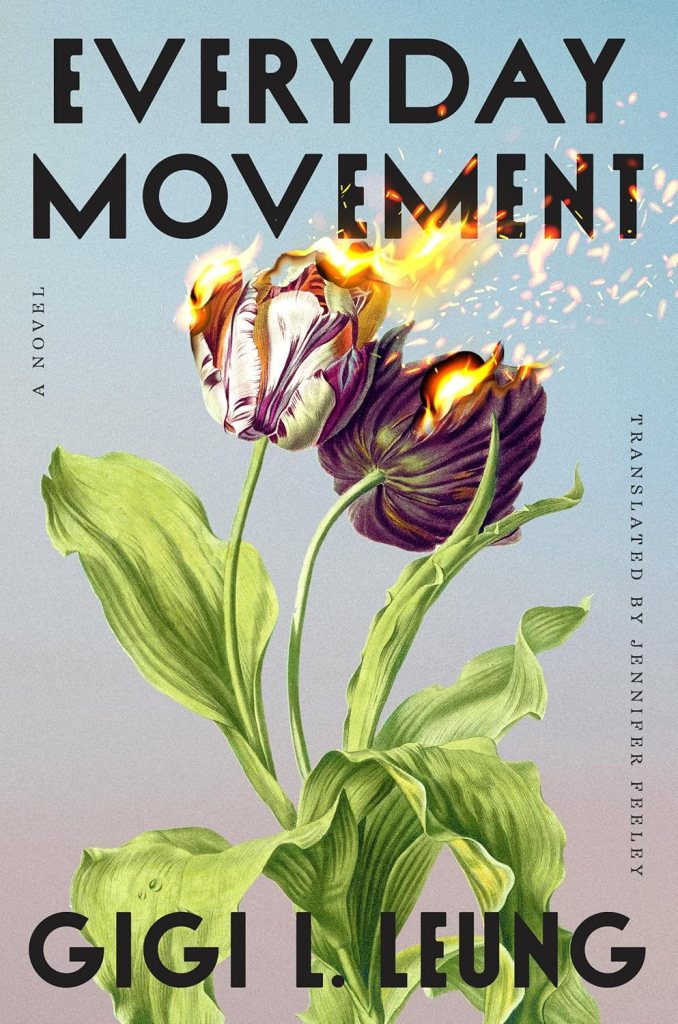
When I moved to Hong Kong at the age of nineteen to attend the Chinese University of Hong Kong, I would make several trips to New Town Plaza each week. It had just about everything a teenager could want, from hair salons to contact lens shops to bakeries and stationery shops. There were also clothing stores, food courts, and a connected cinema. The mall has since become quite upscale and even made international news during the 2019 protests.1 Now it appears in the opening scene of Gigi L. Leung’s new novel, Everyday Movement, translated by Jennifer Feeley and forthcoming in February 2026.
At first glance, the novel may seem to present a tale of interconnected characters who find themselves drawn into the protests in one way or another, yet such a reading would be reductive. I must acknowledge that it is bold of Leung to place the protests at the centre of her narrative, although it is difficult to write about younger generations in Hong Kong without addressing this aspect of the city’s recent history. Leung’s characters are nuanced and sympathetic, and many are in search of belonging.
When the book opens, roommates Ah Lei and Panda are lounging in their hostel room at the Chinese University of Hong Kong. Although Panda was initially more politically engaged than Ah Lei, by the time the story begins the two young women are equally committed to the movement. They return to the mall after a recent confrontation between protestors and police to meet Ah Lei’s cousin, Ah Mak, whose story continues in the following chapter. The mall is just as vibrant as I remember.
The seven‐story glass building was like a glistening gift box. Air‐conditioned and showered in bright light, the plaza was oblivious to the shifting of the seasons, or day giving way to night. They walked across the spacious lobby toward the restaurant area in the back. It was lunchtime, and every corner of this global village—eateries serving Japanese ramen, Southeast EAsian curry, Italian pizza, and Taiwanese hotpot—was packed with well‐dressed diners, chatting, laughing, and eating with elegant manners.
Each chapter introduces a character whose life intersects with others, although each could also stand alone as part of a collection of short stories. Ah Mak becomes an accidental activist after his ex-girlfriend Chan Yeuk ends their relationship in a text message that proves more impulsive than he realises. Chan Yeuk seeks belonging, as does Ah Mak, and it is unfortunate that they fail to recognise this in each other. Leung leaves the reader with the sense that the couple might well have remained together if they had communicated more effectively.
One of the more vivid figures is known as the Little Professor. He dates a friend of Panda’s mother and joins the protest movement for reasons that serve his own interests. His persona develops in a way that ultimately gives him a sense of belonging.
He wasn’t actually a professor, or a lecturer. He wasn’t even a PhD or master’s candidate. He studied social sciences in college and used to be a theory nerd. He spoke in an old‐ fashioned way and loved to lecture, lending him a professorial air. His classmates teasingly called him Little Professor, assuming he would find a bright future in academia. He believed it too. After being called Little Professor for a few years, he practically forgot his actual name.
Other characters in the book become activists for various reasons, although not always because they genuinely believe in the cause. Even those who feel deeply committed to making sacrifices for their beloved city still appreciate the comforts of life, such as acquiring the newest iPhone and dining at New Town Plaza. There is nothing to resent here, and it is commendable that Leung portrays both younger and older generations with such humanity while offering a realistic commentary that people are rarely all or nothing. There is usually a grey area that makes us more alike than different.
Leung also explores other dichotomies, such as yellow versus blue establishments, referring to retail shops and restaurants that align with protestors or the police, respectively. Yet the boundaries between these categories are sometimes blurred. For example, a salon becomes yellow by accident, motivated solely by the desire to attract more customers. Leung also writes about mainland students in Hong Kong and their similarities and differences with local students. All of these binaries relate to belonging in some form.
By the end of the book, it becomes clear that Leung has crafted these stories as a love letter to the younger generations in Hong Kong and their ongoing search for belonging in a city that seems forever in motion, forever changing.
- “Hundreds of people gathered in New Town Plaza shopping mall on Wednesday, peacefully singing in support of anti-government rallies[.]” Agence France Presse, “Hong Kong protesters sing ‘Glory to Hong Kong’ in shopping malls,” ABC News (Australia), September 12, 2019, https://www.abc.net.au/news/2019-09-12/hong-kong-protesters-sing-protest-anthem-glory-to-hong-kong/11504666 ↩︎
How to cite: Blumberg-Kason, Susan “Everyday Movement: Gigi L. Leung’s Love Letter to Hong Kong.” Cha: An Asian Literary Journal, 25 Dec. 2025. chajournal.com/2025/12/25/everyday-movement.


Susan Blumberg-Kason is the author of Bernardine’s Shanghai Salon: The Story of the Doyenne of Old China, a 2023 Zibby Awards finalist for Best Book for the History Lover. She is also the author of Good Chinese Wife: A Love Affair With China Gone Wrong and the 2024 Zibby Awards winner When Friends Come From Afar: The Remarkable Story of Bernie Wong and Chicago’s Chinese American Service League (University of Illinois Press, 2024). She is the co-editor of Hong Kong Noir and a regular contributor to the Asian Review of Books, Cha and World Literature Today. Her work has also appeared in the Los Angeles Review of Books and PopMatters. Visit her website for more information. (Photo credit: Annette Patko) [Susan Blumberg-Kason and ChaJournal.]
 Cha
Cha 