
茶 FIRST IMPRESSIONS
茶 REVIEW OF BOOKS & FILMS
[REVIEW] “You Are My Friend: On Ocean Vuong’s The Emperor of Gladness” by Nirris Nagendrarajah
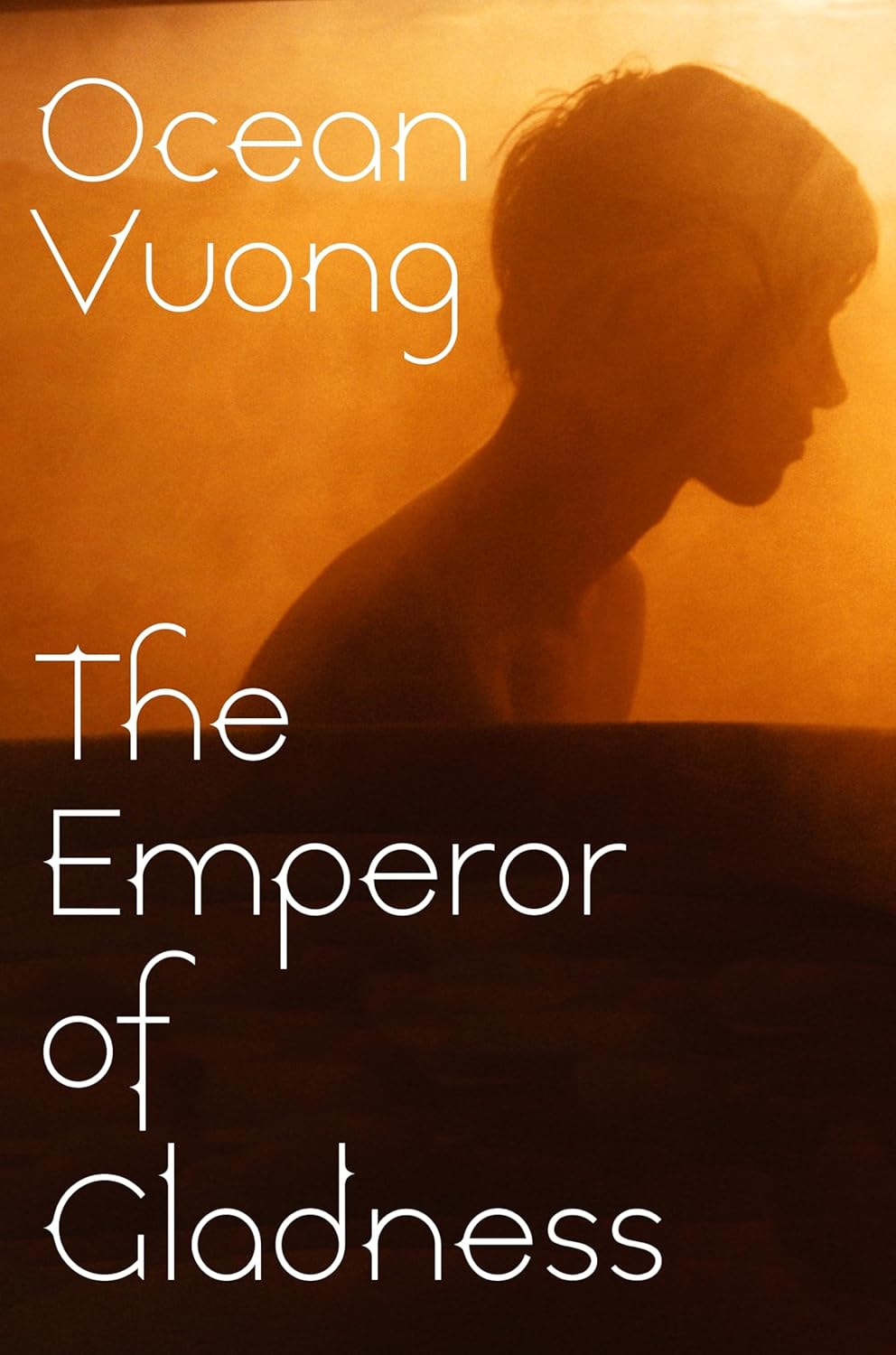
Ocean Vuong, The Emperor of Gladness, Penguin, 2025. 416 pgs.

For Ocean Vuong, the critically acclaimed poet turned commercially successful novelist, it is the dreamers who exist on the margins of American life, these “beautiful, short losers”, as he writes in his sophomore novel The Emperor of Gladness, who attract his most affectionate attention and animate an imagination inclined towards autofiction.
Here, we encounter “folks who had no time to cook, with two or three jobs, nurses on night shifts who slept during the day, veterans from the soldier’s home by the mill, maids who worked overnight cleaning the business park, and truck drivers who would spend Thanksgiving in the backs of gas stations, video calling their families from oil sticky laptops.” Driving through his landscape, a town called East Gladness, Connecticut, we pass “Dollar General, Burger King, Super 8, the water tower with its gleaming satellite dishes, and the power plant, its flares winking like monstrous eyes.” Reading Vuong, one becomes aware of how accustomed one has grown to identifying with the privileged, the straight, and the intellectual, to the extent of excluding the majority, whose thoughts can feel, as the third person narrator observes, “like it was coming from somewhere else, from a cesspool collected from shitty movies at the base of his skull.”
Vuong’s characters are people who relate to the world through outlandish metaphors, ranging from the relevance of the events of the Civil War to the universality of Star Wars, or even, in one telling scene, the signature cornbread served at HomeMarket, where the protagonist, Hai, a medical school drop out with an opioid addiction, begins working after a failed suicide attempt on a rail bridge in late September. “Listen,” Maureen, a co worker and aspiring wrestler with a tragic past, says to him, “we deceive people by calling this bread. Bread sounds wholesome. You tell the public this is boring old bread, but then it hits their tongues and boom, it’s cake. And even if it’s the shittiest kind of cake, which it is, they’d think they’ve eaten the best bread in the world. But the question is, at what point, my friend, does the cornbread become corn cake?”
It is a moment that might easily slip one’s mind in a novel teeming with signs and their corresponding significations, with overwrought descriptions of nature and long, branching sentences of philosophical diatribe that sit awkwardly within the broader tapestry. Yet the construction of that question recurs throughout the novel. “At what point does childhood sadness become adult sadness anyway,” Hai wonders, and later, towards the end, “I don’t know which crumb of the cornbread becomes corn cake. I don’t know when a person becomes someone else.” This expansive novel is preoccupied with the moment at which fantasy yields to a sense of reality.
In the middle of The Emperor of Gladness, Hai, along with his HomeMarket co workers Maureen and Russia, find themselves working in a slaughterhouse one weekend to earn extra money. “You even got an Ornamental,” a butcher remarks, one of the many microaggressions directed at Asian Americans throughout the novel, serving as a reminder not only of the protagonist’s race but of the fact that his identity in a dominantly white environment does not go unremarked. They are each given bacon flavoured dog treats to entice the hogs and instructed to stuff mints into their nostrils to block out the stench, which the narrator describes as “as if someone had shoved a handful of pennies” into their mouths, as they descend into the underworld. Despite the initial shock, Hai, gun in hand, becomes accustomed to the act of violence. “That’s it, that’s what he told himself while pulling the trigger, that he was stapling fabric. He was pinning death onto nothing. And it worked. Though he could still hear their torqued and anguished gurgling, which the heavy metal barely drowned out, this gave the killing enough distance for him to keep going.”
The idea of slaughter appears earlier in the novel, when the narrator reflects on the opioid crisis that claimed the life of Hai’s best friend, Noah. “It did not have a name, this slaughter, and yet your loved ones were slowly being erased, even teachers and lunch ladies overdosing overnight, then cremated without ceremony, their faces soon existing only in your mind. Those were the times, those who lived through it would say, years later, not knowing what it was they meant.” This sentiment is later transposed onto a pig gone rogue from the pen. “It looked younger than the rest and probably had no idea its friends and family were being executed… Hai reached into his pocket and tossed a handful of dog treats, missing her mouth and landing on her belly, which was streaked with Maureen’s dried vomit.” What Vuong proves most perceptive about is the innocence of living beings when set against the cruelties imposed by capitalism and colonialism.
On a lunch break, however, in a manner characteristic of the novel as a whole, research is placed in the mouths of these idiosyncratic characters, each guided by personal obsessions and private beliefs as they navigate a world that steadily erodes their self esteem and renders them smaller than they already feel, despite their desire for something more. Maureen dreams of becoming a professional wrestler; Sony believes he will be the one to free his mother from prison; Hai harbours the ambition of becoming a writer as great as Dostoyevsky. “When England was trying to get into Japan, you know, to do missionary shit or whatever, they tried to win over the emperor by giving him these Berkshire hogs. Well, the emperor was so amazed by the flavour of these hogs, so rich with fat, sweet and juicy, he opened his doors wide open. And that’s how Christianity came to Japan. Through pork. That’s why they call them ’emperor hogs.’”
It is the first moment in the novel when the title, The Emperor of Gladness, begins to clarify itself, deepened by one of Hai’s extended ruminations, which takes place within a public space. “He wondered how far the hogs’ souls had travelled by now. He wondered if they’d ever catch up to the human dead, if there even was a difference between them. How silly, he thought, to believe souls go anywhere at all. Why should they? What if they just lay down like this pig here and decided enough was enough? What if the soul is just as tired as the body? Just as worn out from seeing its family get tricked into a tent with dog treats only to come out emptied, soon to be roasted by a political candidate who will spend 50 million dollars on a campaign she’d end up losing anyway? Where’s the soul in that?” This metaphor aligns with the visceral flashbacks of the Second World War that Grazina suffers, her displacement, the loss of her husband, and the trauma that persists long after the event.
It is only towards the end of the novel, when Hai, Sony, Maureen, Grazina, and BJ make their way to the site where Sony’s father died in a car crash, in the hope of recovering the diamond said to have lodged itself in his hand during a wartime explosion, that the symbol of the hog, or perhaps the soul, returns. It is the middle of the night. Hai hears a whistled version of “Silent Night”, rises to find its source, and encounters a hog. “I don’t know how to be,” Hai declares, articulating with sudden clarity a thought that has been gestating throughout the novel. “Where on earth was elsewhere possible? Is that what the pills do, in the end? Is that what was happening to Grazina? The brain’s derangement of itself to other reckonings,” the narrator asks, in a sequence that prompts reflection on Vuong’s choice to write in third person omniscient, despite rarely straying far from Hai’s consciousness. When Hai begins to sing in response, the hog, like an otherworldly creature from a Studio Ghibli film, or a fleeing muse from Ovid’s Metamorphoses, turns to stone, leaving only “a fractal of green light glowing there. And it was the light of the morning.”
What Vuong ultimately achieves is the use of the novel’s structure, four parts named after the seasons, each spanning roughly one hundred pages, to animate a constellation of ideas. There is the recovering addict who relapses and lies to his mother, yet finds solace in a found family that gives his life meaning; the woman on the brink of psychosis who, in her fleeting moments of lucidity, offers him a maternal bond free of expectation; a group of damaged individuals with expansive dreams who survive by remaining themselves and caring for one another. Above all, there is the extended metaphor of the emperor hog, “so named not to signify the act of ruling, but to feed the ruler with their lives”, an encounter that allows Hai to recognise himself, to break down before he can break through. “He was a container inside a container filled with containers contained by space, and somehow this made him full,” the narrator observes. Empty yourself, then fill yourself again, Vuong seems to suggest, as a light of love passes through Hai. To exist, finally, is enough to rule one’s own life.
How to cite: Nagendrarajah, Nirris. “You Are My Friend: On Ocean Vuong’s The Emperor of Gladness.” Cha: An Asian Literary Journal, 19 Dec. 2025. chajournal.com/2025/12/19/gladness.



Nirris Nagendrarajah is a writer and culture critic from Toronto. In addition to Metatron Press, his work has appeared in MUBI Notebook, Little White Lies, The Film Stage, Ricepaper, Notch, Polyester, Intermission, Ludwigvan, and In the Mood Magazine. He is currently part of Neworld Theatre’s Page Turn program and at work on a novel. [All contributions by Nirris Nagendrarajah.]
 Cha
Cha 