

[ESSAY] “Sixteen Dead, Zero Justice: Cambodia’s Monument to a Silenced Crime” by Daniel Gauss

In 2009, Cambodia experienced a rare moment of national pride when Duch, the Khmer Rouge official who oversaw the notorious S-21 prison, was finally brought to trial for his role in its horrors. S-21 was a former high school transformed into a torture centre following the rise of the Khmer Rouge in the 1970s. After decades of delay, his conviction in 2010 was viewed by many as a symbolic step towards justice, offering the nation a fragile sense of “closure”, even as other wounds remained unhealed.
Yet Cambodia’s pursuit of justice remains deeply uneven. While Duch’s conviction provided a measure of closure, the country continues to grapple with unresolved crimes, most notably the 1997 grenade attack on a peaceful political rally that left sixteen people dead and more than one hundred wounded. Does not this tragedy also demand a sense of closure, particularly given that the FBI conducted an investigation in the late 1990s and that multiple inquiries by the FBI and the United Nations and Human Rights Watch pointed to the involvement of Hun Sen’s personal bodyguard unit during his time as Prime Minister?
This story is uniquely Cambodian, a tale of a nation persistently marked by suffering and injustice, where justice is delayed until it risks becoming almost meaningless.
I grappled with the idea of visiting Cambodia a few years ago, given its political climate. Although I was drawn to its historic temples, including Angkor Wat, I struggled with the thought of spending money in a country ruled by a dictator for thirty-nine years, one who had done little to alleviate his people’s poverty. I was aware that many expatriates travel to Cambodia for leisure against a backdrop of poverty and injustice.
A substantial portion of Cambodia’s population survives on only a few dollars a day, with poverty concentrated in rural areas where families often live on less than US $150 a month. Even in the country’s cities, where incomes are assumed to be higher, thousands of families continue to scrape by on low wages, living in crowded rooms and pursuing unstable informal work. Urban poverty remains widespread.
Meanwhile, Hun Sen and his family are widely reported to control vast hidden wealth, estimated by some investigations to exceed US $1 billion, while his inner circle continues to benefit from entrenched political and economic privilege. In recent years, Cambodia has also emerged as a regional hub for transnational scam compounds, where trafficked workers are coerced into running online fraud schemes commonly known as “pig-butchering”.
Investigations by NGOs, journalists, and regional law enforcement agencies indicate that many of these scam centres are operated or financed by Chinese linked criminal networks, often working in cooperation with local power brokers. Some reports have even alleged that individuals connected to Cambodia’s political elite, including members of the Senate, hold stakes in, or provide protection for, such operations.
Across the landscape, glittering casino complexes, many built with foreign capital, tower over provinces marked by poverty, highlighting the chasm between a super rich elite and the millions of Cambodians struggling simply to get by.
Despite my reservations, the allure of the temples proved irresistible, and I obtained a travel visa online. It was a historic moment in Cambodia, as the dictator was handing power to his son. Posters of father and son, proclaiming this wondrously peaceful transfer of power, were everywhere. There were, of course, no posters for any opposition party. An election was held, but the main rival political party had been declared illegal, ensuring the son’s easy victory, much like the methods his father had employed for years.
Upon arriving in Phnom Penh, I was confronted by the city’s stark reality. I saw what a place looks like when the absence of government sponsored economic development forces residents to depend on irresponsible, pleasure seeking Western expatriates who flock there for cheap living, cheap alcohol, and sex tourism.
There were inexpensive hotels and hostels, restaurants with English language menus, and numerous red light districts where women born into poverty turn to bar work and prostitution out of necessity. When it rained, the streets around my hotel regularly flooded. Many men became tuk tuk drivers by default, competing fiercely for the comfort of expatriates.
Certain images from Cambodia remain with me: hungry stray dogs, families living on the streets, children begging at a brand new market praised by Western YouTubers, elderly Western men chatting with teenage girls at outdoor cafés, and the monument. I will never forget the monument.
It is the most important monument in Cambodia. If you visit, please take a moment to reflect on the misery that these people still endure in a land cursed by history. I will not ask you to pray. The people of Cambodia have been praying for a long time, and it has not helped.
I stumbled upon the monument by chance. It does not appear in any guidebooks, which tend to focus on beaches and cheap living for Westerners seeking to exploit the poverty and suffering of an oppressed people for their own pleasure. I have yet to encounter a travel guidebook with a moral compass.
The monument commemorates the political massacre in Phnom Penh in 1997, which I mentioned above. What stunned me was the presence of a monument to martyrs for democracy at the heart of a dictatorship. I could not understand how Hun Sen, who had not held a legitimate election for decades, would allow such a monument to remain standing.
The horrible truth slowly dawned on me. The monument serves as political camouflage for a regime that likely caused the massacre. Gullible tourists are meant to see it and conclude that Cambodia is a democracy.
There is strong evidence that individuals within the current regime were involved in killing the people memorialised by this monument. There was considerable positive publicity when Duch was put on trial decades after the fall of the Khmer Rouge, but why have the murderers of March 1997 never been brought to justice? Some historical background is necessary.
In 1970, the USA supported a coup that placed General Lon Nol in power, overthrowing Prince Norodom Sihanouk. The United States believed that Sihanouk’s policy of neutrality allowed North Vietnamese and Viet Cong forces to operate within Cambodia. Washington regarded him as unreliable in the Cold War context and wanted a government that would align firmly with US strategy in Vietnam and block communist influence. This marked the beginning of the short lived Khmer Republic and Cambodia’s brief alignment with the USA during the war.
In 1975, the Khmer Rouge, led by Pol Pot, seized control, aided by Lon Nol’s corruption, a general economic collapse marked by soaring inflation and poor governance, and widespread resentment over the US bombing of Cambodia in an attempt to cut Vietnamese supply lines.
This ushered in a brutal regime that killed an estimated two million people. Cities were emptied because Pol Pot believed in an agricultural utopia, in which people were ultimately worked to death or starved.
Vietnam invaded Cambodia in late 1978 and early 1979 because the Khmer Rouge regime under Pol Pot was carrying out brutal cross border attacks against Vietnam, massacring civilians and destabilising the region. The invasion was both a defensive move to protect Vietnam’s sovereignty and a means of toppling a genocidal regime that had killed nearly two million Cambodians, while installing a government friendly to Vietnam.
Vietnam moved quickly to elevate Hun Sen after overthrowing the Khmer Rouge. He defected to Vietnam in 1977 and, when Vietnamese forces established the People’s Republic of Kampuchea in January 1979, Hun Sen was appointed foreign minister almost immediately. Within six years, he rose further to become Prime Minister in 1985.
In 1993, the Royalist Party led by Prince Norodom Ranariddh won United Nations supervised elections, but Hun Sen refused to cede power, forcing the creation of a coalition government with himself as second prime minister.
In 1997, Hun Sen orchestrated a coup against Prince Ranariddh, consolidating his power. Despite losing the 1993 elections, Hun Sen has remained the dominant political figure ever since. He now serves as President of the Senate, while his son functions as Prime Minister.
Over the years, there has been strong evidence that Hun Sen has maintained his grip on power through the suppression of opposition parties and the manipulation of elections. The 2023 elections saw his party, the Cambodian People’s Party, win a landslide victory amid allegations of opposition suppression.
I was at Wat Botum Park, near the Royal Palace and the Silver Pagoda. Off to one side of the park, on a small cemented area, stood the monument. On a rectangular base rose a gilded, stupa like structure pointing towards an immaculately blue sky. On a plaque, I read:
TO THE HEROIC DEMONSTRATORS WHO LOST THEIR LIVES ON 30 MARCH 1997. FOR THE CAUSE OF JUSTICE AND DEMOCRACY. THE TRAGEDY OCCURRED 60 METERS FROM THIS MONUMENT. ON THE SIDEWALK OF THE PARK ACROSS FROM THE NATIONAL ASSEMBLY.
On the opposite side was a list of the names of those killed on 30 March 1997, sixty metres away. Over one hundred people were also injured.
The Vietnamese had appointed an ex Khmer Rouge puppet who eventually took over the government and ruled for thirty nine years, now with his son in nominal control. After losing an election in the 1990s, he staged a coup to seize absolute power. This is all documented history. How, then, did this monument come to exist, and why is it still standing?
I almost thought it was a mirage, something I wanted to see in Cambodia, something that would prove that things had changed. A monument to martyrs of democracy implies a democracy honouring those martyrs, but this was clearly not the case.
I learned that on 30 March 1997, a small group gathered near the park for a legal political rally ahead of what many believed would be the first genuinely meaningful elections in Cambodia’s history. A leading opposition candidate was due to speak. It appeared that the dictator might be removed from power. Cambodia seemed poised to guide its own destiny and begin developing economically in a healthy direction.
Yet, according to the FBI, members of the dictator’s bodyguard arrived and threw hand grenades into the crowd and at the opposition candidate. Sixteen people were killed, and scores were severely injured and maimed for life. A United Nations aid worker witnessed what happened to a young girl who had attended the rally simply to sell sugar cane juice. A grenade tore off her legs. She lived for a short time in absolute horror before dying in an ambulance. When I think of Hun Sen and his son, I think of how this poor girl died.
One French citizen was killed in the attack, granting France the right to investigate and hold a trial. French court documents and reporting by Human Rights Watch note that a summons for Hun Sen was issued by an investigating judge in France, but the French government declined to deliver it, citing head of state immunity.
Two of Hun Sen’s senior bodyguards, Hing Bun Heang and Huy Piseth, were formally indicted in France for their alleged roles in the 1997 grenade attack. Despite these indictments, neither was ever brought to trial, and the case stalled amid Cambodia’s refusal to cooperate and France’s unwillingness to pursue the matter further.
The attack’s clear target was Sam Rainsy, Hun Sen’s chief political rival, who survived the grenades but has since spent much of his life in exile. The failure to prosecute anyone for the assault underscored Cambodia’s entrenched culture of impunity. While Duch’s trial offered a fragile sense of closure, the attempt to assassinate Rainsy remains a wound that has never healed.
To this day, those who run for office are frequently arrested and imprisoned on a range of alleged charges. The dictator’s son will seemingly rule the country for the foreseeable future, following one sham election after another.
The monument has been described online as a stone pillar topped with a stylised, gilded flame, with plaques bearing the names of the dead. The Cambodia Daily and other sources documented the repeated removal and destruction of opposition memorial stupas, culminating in the unveiling of a permanent stupa in October 2000.
After five such monuments were destroyed by the government, Phnom Penh officials finally granted permission for the construction of a sixth, opposition party backed stupa commemorating the victims of the 1997 grenade attack. Opposition leader Sam Rainsy was required to comply with a series of conditions, including restrictions on size and placement.
Much has been written about the trial of Duch for Khmer Rouge crimes. Why, then, have the criminals of March 1997 never been brought to justice? Why does the mainstream press remain largely silent on this question? Hun Sen and Hun Manet now allow the monument to stand. This tacitly suggests that they too mourn those who died there, despite the fact that five previous monuments were destroyed.
If they truly mourned, they would finally act to arrest the murderers. The blood of innocent victims cries out for justice, yet the dictator duo remains silent and inactive. Justice will plainly be delayed for as long as they remain in power.
So, if you go to Cambodia for its temples and history, and to meet the kind and gentle people who have endured extreme hardship for so long, seek out this monument. Lay flowers there if you can. Pray anyway. Remember the girl whose legs were torn off by a hand grenade in a calculated effort to destroy democracy. Understand what this monument signifies: that a reckoning is necessary, and that the human demand for justice will not be erased.
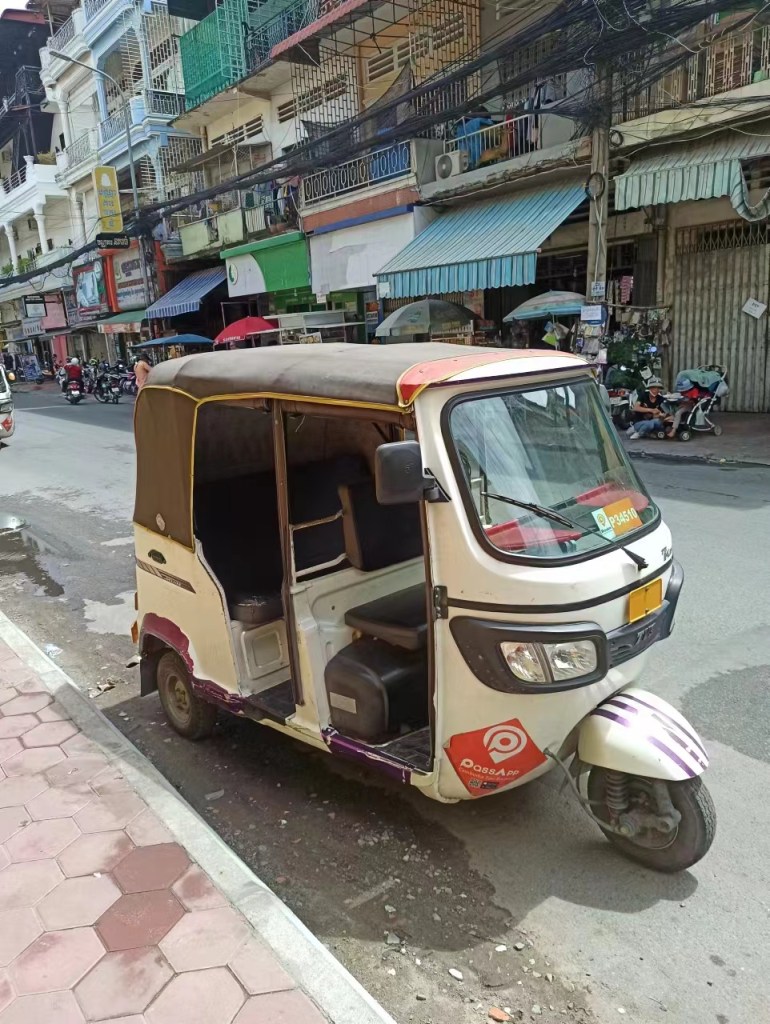
Many impoverished men in Phnom Penh take up driving this type of vehicle, “tuk tuk”, in order to earn a living from expatriates in Cambodia.
How to cite: Gauss, Daniel. “Sixteen Dead, Zero Justice: Cambodia’s Monument to a Silenced Crime.” Cha: An Asian Literary Journal, 16 Dec. 2025, chajournal.com/2025/12/16/cambodia-monument.


Daniel Gauss was born in Chicago and studied at UW–Madison and Columbia University. He has worked in the field of education for over twenty years and has published non-fiction in 3 Quarks Daily, The Good Men Project, Daily Philosophy and E: The Environmental Magazine, among other platforms. He has also published fiction and poetry. Daniel currently lives and teaches in China. See his writing portfolio for more information. [All contributions by Daniel Gauss.]
 Cha
Cha 