
茶 FIRST IMPRESSIONS
茶 REVIEW OF BOOKS & FILMS
[REVIEW] “The Personal ‘I’ and Conflicted Identities: Paritosh Sen’s A Tree in My Village” by Dustin Pickering
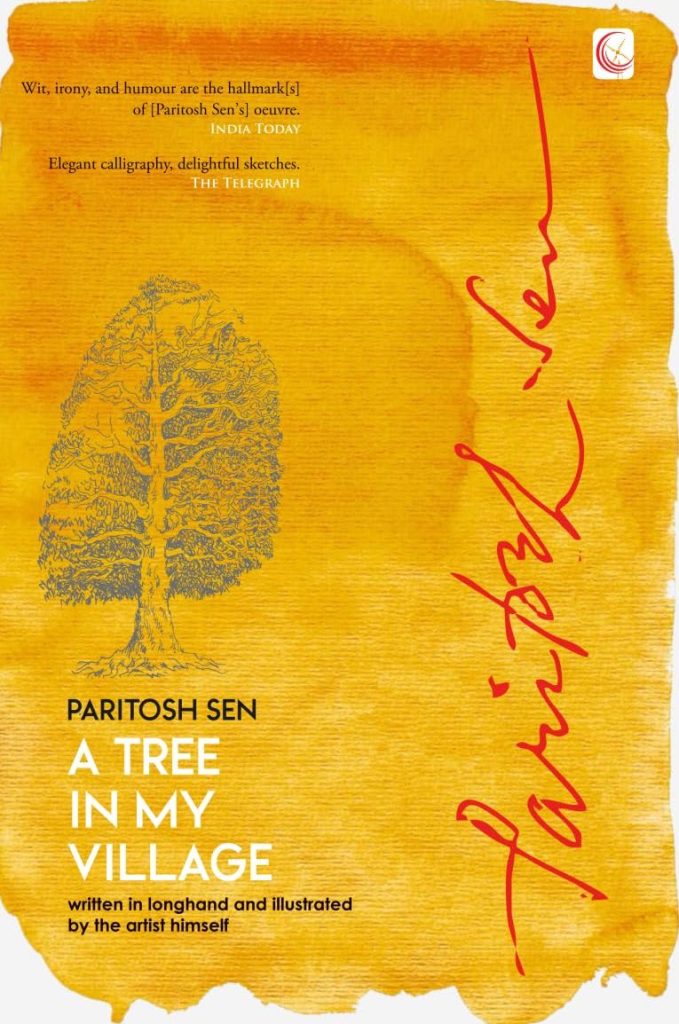
Paritosh Sen, A Tree in My Village, CLASSIX, 2025. 79 pgs.
Many contemporary texts explore identity and meaning through crisis, a lineage that can be traced to existential literature by Camus, Gide, and Kafka, as well as to psychologists such as Viktor Frankl. Literature frequently links identity to the pursuit of meaning. Colonial history, moreover, has reshaped human identity and purpose within a globalist framework, as illustrated in novels such as Arundhati Roy’s The God of Small Things (1997) and Barbara Kingsolver’s The Poisonwood Bible (1998). Frankl observes that suffering can be endured if it is endowed with meaning. Colonial dispossession, however, produced a cultural vacuum of meaning among its victims.1
Given this history, and the need for literature to present conflicting perspectives across the world, the emotional privacy of the confessional style appears irrelevant to highbrow readers. The confessional movement nevertheless sought to affirm that every human experience merits literary expression. Since the 1990s, memoirs such as Frank McCourt’s Angela’s Ashes (1996) have proliferated. Although intensely personal, Angela’s Ashes invites readers to consider Irish history under English domination and to recognise how political forces shape human experience.
Reality is often shaped by uncontrollable perspectives and events. Literature enables the imagination of resolutions to injustice by recording experience through the “personal I.” Identity lies at the core of who we are, yet it is not static. Literature reaffirms the self within cultural frameworks, even as historical forces threaten to destabilise it.
A Tree in My Village by the artist Paritosh Sen, originally published in 1985 by the National Institute of Design, Ahmedabad, and recently reintroduced to contemporary audiences by CLASSIX, an imprint of Hawakal, is a private journey of the mind, rooted in its particular time and place. The publisher, Bitan Chakraborty, describes it as “a lost and rare book,” adding that the significance of the new edition lies in features such as the preamble by Kiriti Sengupta, the Indian poet and the author’s great-nephew. This preamble characterises Sen as “a connoisseur of nature,” while resisting any narrowing of that description. Sengupta further describes the work itself as a “sign of his devotion to nature and its humanitarianism.” Sen’s visualisations emerge from “eyes that define an artist,” yet are also “not far from science.” From the outset, the reader is introduced to a confluence of art, nature, and science.
The narrative centres on an Arjuna tree in the author’s Bangladeshi village. While the descriptive mode incorporates elements of the confessional approach, it also revives an almost transcendentalist ethos. On the opening page, Sen writes, “The astounding variety of lush tropical flora and fauna was like a Vedic hymn in praise of Creation.” This description gains depth through its layered reference. A Vedic hymn is a human construction that gestures towards Creation, yet here Creation itself becomes the point of reference for the hymn. The linguistic structure thus simultaneously gestures towards and away from the object it evokes. The author then invokes a Mark Rothko painting to describe his boyhood days.
The Arjuna tree is central to the narrative, serving as an anchoring presence that lends weight to the author’s unfolding vision of beauty and calm. This memoir invites imaginative recollections of Henry David Thoreau’s Walden (1854). Almost invoking a surrealist image, Sen writes, “[..] the sun itself appeared green, in some unconscious moments.” As Paritosh Sen is also a visual artist, his attentiveness to visual detail accords naturally with his prose. He frequently compares natural landscapes to works of human art: “Its majestic height dwarfed every other tree in the village. Its powerful build, magnificent proportions and statuesque three-dimensionality were reminiscent of the monolithic ninth-century Jaina figure at Sravanabelgola in Mysore, one of the greatest landmarks in Indian classical sculpture.” Sen’s poetic tributes to the Arjuna tree evoke deep religious longing through sustained analogy. He writes, “The Arjuna tree was a world unto itself, as living and eventful as the human world, if not more so.” This description establishes a parallel between natural and social stratification. Following this observation, Sen explores the hierarchy of birds within the tree, noting that “The tree had an uncanny resemblance to a modern high-rise building, in which the more affluent own the best flats, enjoying light and air and the best view of the surrounding landscape.”
Sen’s visual descriptiveness extends beyond merely rendering appearance. His analogies are philosophically charged, offering insight into reality itself. In his exploration of the tree’s animal society, he describes their “acute sense of territoriality,” which often led to conflict among the “denizens of the tree.” He recounts instances in which he tended to injured animals after such confrontations, taking them home to recover. These anecdotes remind the reader of the holistic obligations each individual bears towards all of creation. One of the author’s guiding intentions is to communicate the beauty and harmony inherent in the natural world. Sen also records the disruptive behaviour of langurs, who are eventually repelled by the birds, which “transform themselves into fury incarnate.”
The author further explores the aesthetics of light and its capacity to alter “the appearance and mood of an object.” In the morning, the Arjuna tree sometimes appeared “like a great yogi in deep meditation facing the east, his right hand held in the posture of compassion, as one sees in a figure of Gautama Buddha,” while at sunset it resembled a “royal charioteer ready to set off in his many-splendored vehicle towards the western horizon.” Once again, Sen’s descriptive method yields analogies that gesture towards the nature of existence itself, revealed as a profound holiness resonating across time.
“It was under the Arjuna tree I first became aware of the mysteries and wonders of creation,” he writes. “It was there that I learned another fundamental truth, the inalienable right of all life to co-exist.” His statement resonates with Thoreau’s reflection from Walden: “I went to the woods because I wished to live deliberately, to front only the essential facts of life, and see if I could not learn what it had to teach, and not, when I came to die, discover that I had not lived.” Sen’s descriptiveness and purpose in writing are united by the frame from which he chooses to draw his observations. In describing the battle over a beetle carcass between red and black ants, he offers a parallel to human society. The red ants are larger than the black ones, but the black ants outnumber the red ones, and thus secure the carcass for themselves.
A cousin’s dark experience is later contrasted with Sen’s memory of moonlight filtering through the tree. He describes the sight as one of the most beautiful he has ever seen, before turning to his cousin’s account. His cousin was out late when the Arjuna tree appeared to him as the goddess Kali, who “looked terribly fearsome,” in the cousin’s words. Following the vivid description of the tree’s appearance, he sees a “skinny female figure” holding a fishing pole. She catches a bizarre, mystical-looking fish that terrifies the cousin. As he turns to return home, a hand stops him and a voice says, “We are having a picnic tonight … Do you know who is the cook? Poltu Ray’s wife, of course!” The wife in question was famous for her fish dinners, but had died a week earlier. The cousin was found unconscious beneath the tree the following morning. Sen also recounts a story about a singer who disappeared, but whose song was sometimes heard near the Arjuna tree.
Paritosh Sen winds his recollections down on an impressive note: “[…] the Arjuna tree always appeared to me as a unique creation full of wonders, a living monument to the unity of life and its music, an epic poem of universal love … Like so many other beautiful things which are thoughtlessly sacrificed at the altar of so-called progress, it too, perhaps, has inexorably vanished.” The tree becomes symbolic: “How often I wished that I could climb up to the top of the tree and experience the sensation of touching with my own hands the azure blue sky, and to see the world below as a falcon would see it.”
Paritosh Sen describes more than a tree in A Tree in My Village. He offers the reader a reality, bare and poetical, filtered through the lens of memory. The book is a memoir bearing deep naturalistic observations that reflect the human experience, suggesting that nature and human society are profoundly intertwined. The breach we experience towards nature is self-created. Sen’s narrative recollections are not strictly personal, but instead share the feelings of awe and separation that the contemporary mind subconsciously carries. By presenting these observations as memoir, the author creates a world of nostalgia and regret, allowing the reader to experience wonder in the present moment. As the narrative unfolds, Sen evokes emotions tied to the memory of the tree, while remaining unaware of its contemporary condition. This uncertainty stuns the reader into meditations on loss, civilisation, and the price we pay for progress.
This memoir is distinctive in its ability to combine personal reflection with much-needed social criticism without feeling invasive or demanding. By restraining his analogies, Sen conveys the idea that human society is indebted to nature and its unique characteristics. A Tree in My Village is highly visual, even including handwritten text and the author’s individually styled sketches in support of its conceptual simplicity. What this unique text ultimately presents is a confession that is both surreal and delightful, marked by introspective humour and vivid description.
- Viktor Frankl develops this argument most fully in Man’s Search for Meaning (1946), where he proposes that meaning can be found even in unavoidable suffering through one’s attitude towards it. The notion of a “cultural vacuum” draws on postcolonial theory, which examines how colonial rule disrupted indigenous systems of meaning, identity, and cultural continuity. ↩︎
How to cite: Pickering, Dustin. “The Personal ‘I’ and Conflicted Identities: Paritosh Sen’s A Tree in My Village.” Cha: An Asian Literary Journal, 12 Dec. 2025. chajournal.com/2025/12/12/tree.



Dustin Pickering is the founder of Transcendent Zero Press. He has contributed writing to The Huffington Post, Los Angeles Review, The Statesman (India), Journal of Liberty and International Affairs, The Colorado Review, World Literature Today, Asymptote Journal, and several other publications. He is the author of numerous poetry collections and books, including Salt and Sorrow (2016). He placed in the top one hundred for the erbacce prize in 2021 and 2023, and was a finalist in the Adelaide Literary Journal’s first short fiction contest. He was longlisted for the Rahim Karim World Prize in 2022 and was given the honour of Knight of World Peace by the World Institute for Peace in the same year. He hosts the popular interview series World Inkers Network on YouTube and co-founded World Inkers Printing and Publishing.
 Cha
Cha 