
茶 FIRST IMPRESSIONS
茶 REVIEW OF BOOKS & FILMS
[ESSAY] “The Female Researcher and Patriarchal Figures in Hon Lai Chu’s Mending Bodies” by Grace En-Yi Ting
Click HERE to read all entries in Cha on Mending Bodies.
Hon Lai Chu (author), Jacqueline Leung (translator), Mending Bodies, Two Lines Press, 2025. 240 pgs.
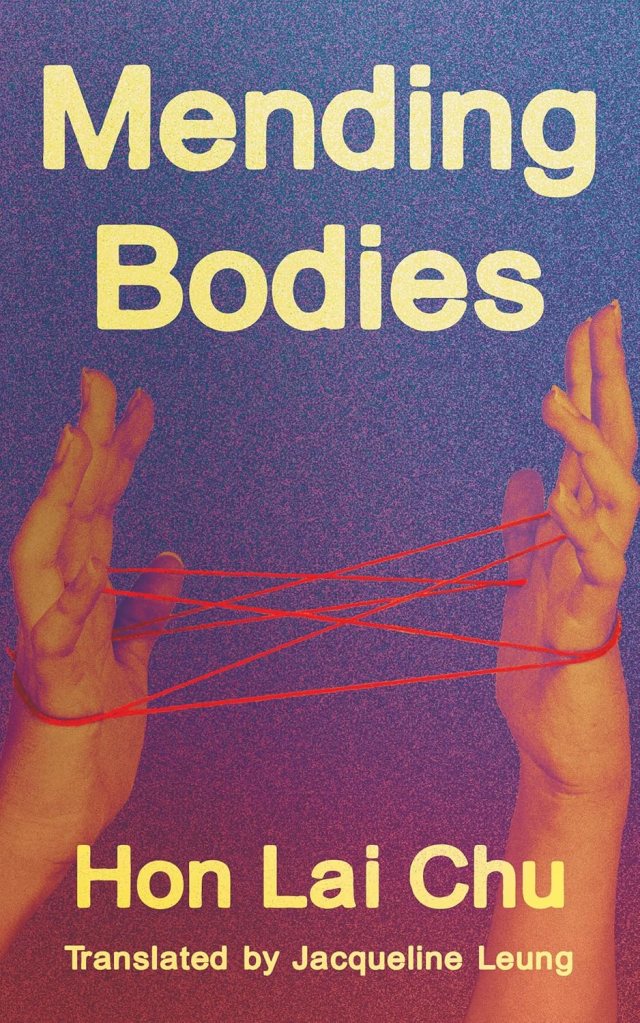
Hon Lai Chu’s Mending Bodies (translated by Jacqueline Leung in 2025 and originally published in 2010) is a Hong Kong novel. Although its dystopian qualities have prompted comparisons with Murata Sayaka’s Earthlings and Vanishing World, it is a disservice to overlook the ways in which this work emerges from a specific historical and cultural moment in Hong Kong. Yet Mending Bodies also raises questions concerning gender and sexuality that have seldom been addressed in readings centred on “Hong Kong”. My analysis therefore approaches the novel through this alternative perspective.

Mending Bodies is set in an unnamed city where citizens increasingly opt for conjoinment surgery, fusing their bodies with those of another person as part of a sweeping government initiative that has successfully restored economic prosperity. Once conjoined, a couple receives a new shared identity with a single name.
The female narrator is a graduate student writing a dissertation on the history of conjoinment. She first appears as part of a conjoined pair at the opening of the novel. Her name is never revealed, for it has been lost in the process. As the narrative moves backwards, we follow her development as a narrator and researcher while she encounters different male guides who represent figures of authority in academia, the arts, and medicine. Despite Leung’s elegant translation, Mending Bodies is not a straightforward work. The reader must navigate temporal shifts and the narrator’s movement between reality and dreams, while excerpts from the dissertation are interwoven throughout.
Professor Foot, the most overt example of authority in the novel, is an enigmatic and charismatic academic who supervises the narrator’s dissertation. His left leg has been amputated below the knee for reasons that remain unexplained, and he frequently and theatrically draws attention to its absence. He becomes a figure of fascination among students, who accept his hand rolled cigarettes to smoke with him on campus or boldly debate the politics of his missing leg, such as the perceived advantages it might offer in securing an academic post, while he smiles and laughs at them in a mockingly indulgent manner. Gathered around Professor Foot, the students, including the narrator, experience a sense of privileged belonging.
A crip or disability studies reading of Mending Bodies is possible; indeed, Professor Foot appears to be a disability studies scholar. In his class titled “The Necessity of Disability in Society”, he invites guest lecturers whom he describes as possessing “physical traits so incompatible with the urban landscape that they crashed and bled wherever they went” (p. 54). With “an imperious smile” (p. 54), he explains that these speakers will demonstrate how we each inhabit different worlds. This seems reasonable, perhaps as an exercise in empathy for marginalised communities. Yet his pedagogy largely turns both his own disability and the disabilities and suffering of others into spectacle. Hon portrays his group of student devotees as offensive and foolish as they joke and theorise about the professor’s leg. At the same time, she does not romanticise him or present him as a moral solution.
After the narrator seeks advice on her dissertation, Professor Foot encourages her to experiment through “fieldwork”. In the following passage, he drives her to a cheap-looking hotel. There, they “act out the selection of a conjoinment partner” (p. 45) by tying their legs together and stumbling around the room, then lying naked on top of each other while he continues lecturing her about conjoinment in a tone of unquestioned authority. When she challenges his assumed omniscience, he tells her about a camera hidden in the room that records many people for research purposes. Previously ambivalent, she now feels a sudden sense of violence so acute that “My only choice was to withdraw, to retreat within the perimeter of my body, and there, sleep overtook my consciousness” (p. 47).
Professor Foot represents knowledge and truth in the novel, especially as someone who claims to teach about disability and marginalisation, yet he is capricious, pretentious, self-serving, and exploitative. Universities are intended to be wellsprings of knowledge, but in Mending Bodies they appear distorted and broken, offering no sense of security. If a professor is meant to be a guide to understanding the world, there is no longer anyone whom we can trust as a conduit for truth.
At the next stage of her research, the narrator’s experience with the photographer Bak is less overtly disturbing, yet it also casts doubt on what she and other students are learning, and on what “fieldwork” entails. Bak first appears in her dream about a teenage boy named Ching who jumps to his death after authorities order the eviction of the building where he lives. Later, Bak appears as a guest speaker in Professor Foot’s class, showing photographs of the room of a dead boy who may or may not be Ching. Convinced that he is the same person despite his entirely different appearance, the narrator reflects, “Bak was talking about something that I suspected hadn’t actually happened, but then I thought how even if everything we were told in class was a blatant lie, it wouldn’t have much impact on our education” (p. 59).
As she begins to suffer from insomnia and loses her appetite, the narrator contacts Bak and attempts to make him into her research subject. They climb a large hill where she tries to “see” through his eyes. When he offers to become an object for her benefit, she uses him as a ladder, climbing up his body until her head aligns with his. Mentally and physically, she continues to deteriorate, eventually becoming unable to attend classes or progress with her dissertation. Dishevelled and desperate, she seeks help from Professor Foot, who merely laughs uncontrollably when she asks, “Aren’t you supposed to guide me, to help me finish my paper?” (p. 72). She meets Bak again and, before they part, takes out a rope and silently wraps it around him to measure his body, as if he has become an actual object of research.
Finally, her roommate May introduces her to a male sleep therapist. During her first appointment, he adopts a reassuring tone as he lectures her on the process of recovery from insomnia. He then recounts a story about his mother, a failed pianist who attempts to control every aspect of his intimacy with others and his emotions, forcing him to “explore the world through his fingertips” (p. 102), whether this involves walls or people. Along with the other male doctors in the novel, the sleep therapist assumes the superior attitude of a medical professional, a trait the narrator frequently notes. During her next treatment, he begins to treat her as a piano and runs his fingers across the surface of her body. At her final session, he introduces himself as “Lok”, a mirrored persona of another man she had encountered earlier, or perhaps the same man. She is overcome with shock at the thought that this has all been a plot leading her towards conjoinment surgery.
Names constitute one of the most challenging aspects of the translation, given the complexity and confusion of identity in Mending Bodies. Earlier, the narrator sends an application on a whim to a body-matching agency and is paired with a man who introduces himself as “‘Nok’ as in music, the sounds people use to numb their emotions” (p. 16). In this later passage, Leung cleverly uses the slippage between “n” and “l” sounds in Cantonese so that the sleep therapist introduces himself as “Lok”, as in “happiness”, not music. The character for happiness and music in Chinese 樂 is the same, but more easily distinguished for English readers by Leung in order to present “Nok” and “Lok” as mirror images. Each asserts the meaning of his own name by rejecting the alternative, yet they ultimately prove to be the same person.
Directly before her conjoinment surgery, the narrator and researcher loses her way to the university and asks dozens of people for directions, but no one knows anything or is willing to help. She eventually arrives at the “happiness” awaiting her through conjoinment with Lok, who expects her in time to become his assistant at the clinic. What is happiness in Mending Bodies? Notably, the government-promoted conjoinment surgery appears to be exclusively for heterosexual couples. We never see signs of romantic or sexual desire between conjoined pairs, nor do they display affection in general. Instead, they labour to tolerate one another, and the text offers numerous descriptions of physical difficulty and strain in conjoined life. The surgeries elicit grotesque joy from observers, whose “clouded expressions bloom like the sun, their mouths split into smiles and eyes shining a rare brilliance” (p. 127). Yet such “happiness” is manufactured by the government, which distributes leaflets encouraging conjoined couples to maintain eye contact and smile.
What, then, of the female characters within the novel? As with all figures, including the narrator, their motivations are often obscure, and their emotions appear only through an opaque veil that yields little clarity. Nonetheless, there are indications that the narrator’s relationships with women contain something more genuine, even if these bonds remain fragile.
The opening passage of Mending Bodies depicts the narrator, already conjoined with Lok, meeting her former roommate May, who is likewise conjoined to a man. Their relationship, and their shared memories, have by this point faded almost entirely, becoming one of the novel’s most profound losses. In another passage, after the surgery, the narrator suddenly remembers May and telephones her, but the two barely recognise each other. May seems “gone without a trace… swallowed by an insuperable black hole” (pp. 161 to 162). We learn that, together in resistance to conjoinment, she and May initially shared a space of freedom and exploration within their small dormitory room.
…we stood in our space behind closed doors and drawn curtains, and—I forget who did it first—started taking off our sweaters, coats, blouses, skirts, socks, underwear, and bras. We sat at our desks and worked, read a book, rank tea, and tidied our notes as usual. That was the moment when we realized that people weren’t bound by the gaze and criticism of others, but the habits we had normalized ourselves. (pp. 52-53)
At one point, she briefly considers speaking to May about her Aunt Myrtle. As a young woman, her aunt fell in love with an older man and elected to undergo conjoinment surgery, although she later separated herself from him and now advocates for “body independence”. Tellingly, May’s name 微 and one of the characters in Aunt Myrtle’s name 薇 differ in the original Chinese text by only a few strokes, and they share an implication of hope for liberation. Yet later, May appears complicit in leading the narrator to Lok and to the conjoinment surgery, while she herself also becomes conjoined.
The narrator’s mother benefits greatly from the Conjoinment Act, which brings her new business as a seamstress designing clothing for conjoined couples. When the narrator announces her decision to undergo surgery, her mother seems relieved. Aunt Myrtle exerts a stronger influence on the narrator’s imagination and on the drastic path she ultimately takes. After the conjoinment, the narrator drags Lok, who has agreed to fall asleep for a time, to her aunt’s office in a slanted and largely abandoned building. Aunt Myrtle, who lost one arm after her separation surgery, explains that she regarded this building as a kindred spirit. She tells the narrator of the extreme despair she felt while conjoined, preparing knives and pills with the intention of separating herself from her partner or killing him or herself, until a black-market doctor eventually separated them.
The narrator and researcher’s own feelings remain concealed for much of the novel. Instead, Aunt Myrtle’s story and the narrator’s dissertation, which appears to blend fact and fiction, relate tales of intense love and profound hatred. In stark contrast with present-day heterosexual conjoined couples, these accounts are often about conjoined sisters. Such relationships involve frustration, the continual difficulty of being physically attached to another person, but also intimacy and possibly deep affection. When doctors attempt to separate a pair of sisters, one of them frequently dies. In one instance, the surviving sister, Elisa C. Johansson, is left with a disability that a man finds attractive; he marries her and later beats her repeatedly in a marriage described as “a contract society had approved” (p. 150). In another, the sister who survives, Evelyn Fisherman, drowns herself in a pond. Although these accounts offer glimpses into the inner lives of these women, they are presented in a flat and unemotional “reportage” style, befitting the conventions of an academic thesis.
Nevertheless, relationships between women are not depicted as ideal, yet their presence brings forth emotional possibilities that differ markedly from the bleak orientation of the present-day heterosexual conjoinment surgeries. The narrator’s world contains few individuals granted substantial identities. Apart from her roommate May, other students remain undescribed, and before her surgery, acquaintances who celebrate the narrator’s conjoinment remain nameless. By contrast, her memories of May, the story of Aunt Myrtle, and the histories of the women in her dissertation possess far greater vitality. The narrative grants little access to the inner worlds of men such as Professor Foot, Bak, and Nok or Lok, yet it offers accounts of authentic pleasure, suffering, tragedy, and other experiences in the lives of women.
Commentators such as Tammy Lai-Ming Ho have written persuasively on Mending Bodies as a narrative concerned with the struggle for identity and freedom in Hong Kong. Hon’s imagining of conjoinment surgery, which merges two individuals into one with a single name and a single identity recognised by society, may be read as an allegory for efforts to bring Hong Kong closer to mainland Chinese cultural and political identity. Significantly, the Conjoinment Act leads to economic prosperity that encourages citizens, including the narrator’s mother, to set aside other concerns. The loss of original identities and names, which fade from memory before individuals notice, creates a sense of mourning for a society compelled to part from its culture, language, history, and collective memory. Yet without male characters who function largely as props and lack interiority, Hon’s critique of problematic forms of authority would resonate far less distinctly for many readers.
In the case of Professor Foot, the clearest façade of knowledge in the novel, we might consider how such symbolism would falter if he were replaced with a female professor. Our cultural image of the professor and of knowledge is overwhelmingly masculine in mainstream society, and realities within academia have changed only through sustained efforts from below. We have learned to doubt accepted vessels of knowledge, which is why the male professor appears so often in narratives that question established institutions and their power. Readers might compare Mending Bodies to Dorothy Tse’s Owlish (translated by Natascha Bruce), which presents a very different portrait of a failed male professor. Although such speculation lies beyond the scope of this essay, I am left wondering what kind of story, or what genre, might skilfully depict female professors and their more complex relationships with power and marginalisation. As a female professor, I am clear on how we are often not afforded such nuanced considerations.
Thus, nested within a narrative about Hong Kong, another story unfolds concerning the constraints of a heteronormative society that remains sexist towards women while also excluding, devaluing, and repressing more diverse forms of intimacy. One of the most striking passages in the novel occurs when the narrator turns to the photographer Bak and tells him a story about an unnamed person. Partway through, she asks, “Do you think that person is a man or a woman?” (p. 79), and she questions him about the nature of this person’s relationship with someone whose house they visit. Bak replies that gender does not matter, and perhaps this relationship is “so undefinable, they do not know how to be with each other” (p. 80). Satisfied, she continues her story. Before this moment, the protagonist had been identified more ambiguously as “they” 他, and only afterward is the figure depicted clearly as a man who has arrived at a woman’s home. Perhaps this signals the narrator’s imagined world, one in which gender and relationships are not predetermined from the outset.
Gender relations within the novel imply deep anxieties related to power and sexuality. What happens if we read the female narrator’s “fieldwork” with Professor Foot in the context of MeToo, or consider the sleep therapist Lok’s fingers “playing” on her like a piano during treatment? The subtleties of Hon’s writing would be lost if readers settled only upon obvious conclusions about the inappropriate nature of such interactions. Nor would the structure of her world be adequately captured by equating the state with the patriarchy and with men. Historical and contemporary forms of sexism make it intelligible for certain kinds of authority to be coded as masculine, yet the novel does not simply deliver a message about overthrowing patriarchy or about the anger that men might deserve. Hon’s male characters are rarely admirable or trustworthy, but at most they appear as slightly better positioned pawns, clinging to fragments of power within a world governed by larger systems of control and surveillance. These cannot be explained through patriarchy alone.
The narrator begins with scorn for conjoinment surgery, intending to study it as an academic object with detached intellectual interest, yet she soon undergoes phases of intense anxiety and confusion. Although Professor Foot irresponsibly suggests that a researcher should be willing to go to any length, she is deeply unsettled and irrevocably changed by her experiences of fieldwork and research. Both the female narrator and her roommate May drift almost unthinkingly into their decisions to be conjoined to different men, their uncertain and ambivalent desires shaped by a world that pushes them towards its own vision of happiness. As the narrator adjusts to life conjoined with Nok or Lok, she reflects on the scarcity of choices within the world they inhabit, including choices concerning gender:
It was not my decision, nor was it any individual’s decision. The stage must have been set a long time ago, and we were simply bearing the collective responsibility. It was a logic that applied to conjoinment and many other matters of the world, like being born and becoming a person, a woman, a man. (p. 8)
But at the end of the novel, the narrative takes an abrupt turn. After the narrator visits her Aunt Myrtle to hear her account, she finally feels ready to complete her dissertation. Swallowing a bottle of pills, she drags the sleeping Lok with her and goes to Professor Foot’s office to submit her work. As she begins to lose consciousness, she struggles to instruct the professor, “…he was to take me to the hospital, separate Lok from my body, and disseminate the parts of me following the instructions in the appendix of my paper” (p. 207). The final pages record the eventual destinations of her various body parts: her heart, used as a transplant for an unknown woman; her right arm, given to her aunt; her hair, claimed by Bak; one of her legs, taken by Professor Foot; and her remaining bones and flesh, left to her mother, who stores them in a bottle and sighs, “It is better to have a boy… Boys are stronger, have a daughter and this is all that is going to be left of her” (p. 209).
Arguably, her conclusion as a researcher, achieved at the expense of her own life, overturns both Professor Foot’s intellectual authority and the oppressive norms that govern conjoinment. Through self-destruction and self-separation, she liberates herself entirely from the totalising claims of knowledge and happiness in Hon’s dystopian world. In the author’s note in the original Chinese text, Hon writes, “I often think, if all of us stood by the river at the same time, then turned to face the flow of the river, then the flowing water would grind us all into fragments. This way, would things not be simpler?” (my translation).
How to cite: Ting, Grace En-Yi. “The Female Researcher and Patriarchal Figures in Hon Lai Chu’s Mending Bodies.” 5 Dec. 2025, chajournal.com/2025/12/05/female-researcher.



Grace En-Yi Ting (she/they) is a Taiwanese American queer/feminist studies scholar specialising in Japan, women writers, girls’ culture, cuteness, and crip/disability studies. She has written on Japanese literature and popular culture, as well as problems of race and gender in the academy. Recently, her work deals with transnational feminist and queer politics between greater China, Japan, and Asian America. They are particularly invested in the critique of discrimination and violence within feminist communities. Meanwhile, they are also a literary translator from the Japanese and Chinese and write book reviews, essays, and poetry sometimes.
 Cha
Cha 