
[ESSAY] “A Woman Named Summer: Rethinking Xu Hongfei’s Early Sculpture at the Guangzhou Museum of Art” by Daniel Gauss

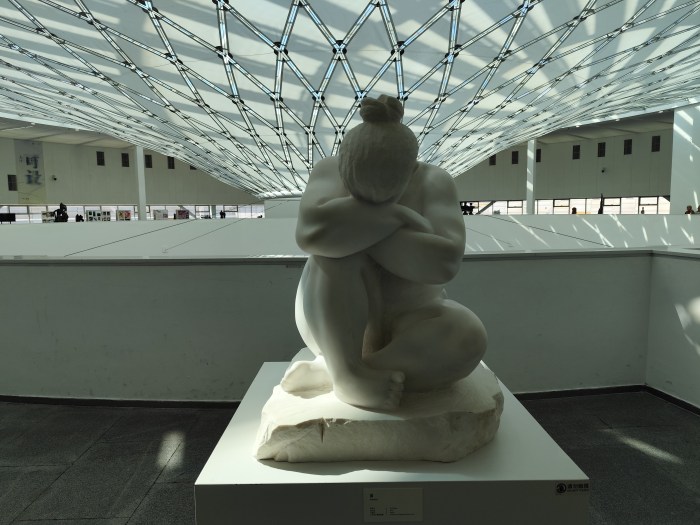
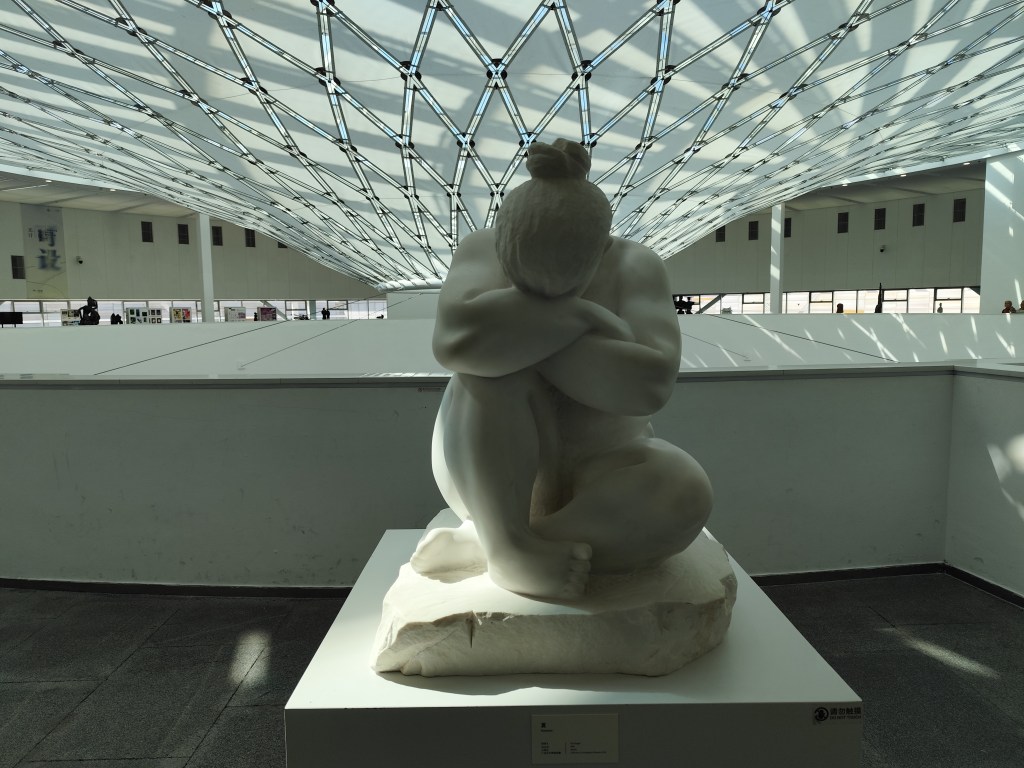
Xu Hongfei’s Summer, photos by Daniel Gauss
Among the many works displayed in the Guangzhou Museum of Art, one marble sculpture drew more attention than any other. Visitors who otherwise wandered through the collection paused here, not to reflect but to pose, raising their phones to capture a moment of amusement. Yet as I watched nearly every person who encountered the piece photograph themselves beside it, I began to sense that the sculpture was quietly resisting its audience, offering something far more serious than viewers assumed.
The sculpture is by Xu Hongfei 許鴻飛 (b. 1963), one of China’s most recognisable contemporary sculptors, best known for his ongoing Chubby Women series. This particular work, however, is not one of the cheerful, kinetic bronze figures for which he would later become famous. Created in 2000, the marble piece, titled Summer, appears to belong to the earliest stages of the aesthetic and conceptual direction that would come to define his career.
This historical placement matters. Summer predates the global exhibitions, the buoyant smiles, the comedic physicality. It marks an origin point, and its difference from the later works illuminates what Xu had not yet smoothed over or stylised.
The sculpture depicts a naked woman crouched down, her head buried deep in her folded arms. Her body is large, soft and heavy, with folds around her waist and loose flesh along her arms and legs. There is no attempt by the artist to idealise or beautify her form. Instead, he exposes every contour shaped by time, labour, economics and circumstance. The marble, cool and luminous, contrasts with the weight of her posture and the emotional density of her pose.
Her interior life is erased by the spectacle she unintentionally provides. What we see instead are the effects her life has had on her body. The world she inhabits has shaped that body. People gather to take selfies with her because she appears exaggerated, humorous or strange. Xu has not sculpted a fit, toned and seductive young woman; he has sculpted, essentially, a restaurant worker or street vendor, and this seems to amuse onlookers. Yet the humour is not hers. The laughter belongs entirely to the spectators.
This disconnect reveals the sculpture’s deeper tension. While Xu would later lean into irony and celebration in his portrayals of full-bodied women, Summer radiates a quiet tragedy. There is no smile, no playful exaggeration, no movement suggesting freedom. The posture is closed, protective and weary.
She is a figure withdrawing from the world, not performing for it. If there is humour to be found here, it is the audience’s imposition rather than the artist’s invitation.
Seen through this lens, Summer becomes a social portrait. The woman’s body, unadorned and unhidden, points us towards the realities of class and labour in contemporary China. Her moderate obesity is not a symbol of indulgence but of deprivation. It reflects a body shaped by stress, cheap calories, irregular schedules and the invisible demands placed on working-class women. She is the type of woman seen cleaning floors, preparing street food at dawn, serving noodles in late-night restaurants, present everywhere yet largely unnoticed.
Clothing, had Xu chosen to add it, would have provided a narrative shortcut. It would have allowed viewers to categorise her quickly, as a cleaner, a vendor, a mother, a middle-aged woman with a service job. Yet nudity denies that simplification. It compels us to confront her body not as that of a worker but as that of a person, human, vulnerable and affected.
The decision to hide her face reinforces this universality. With her head buried in her arms, she becomes not an individual but a type, a stand-in for the many women whose identities are blurred or erased by society’s routine indifference. Yet indifference is not quite the right word, for women like her are what we came to call during the pandemic essential workers.
They are the people we rely on daily, whose labour quietly sustains the ordinary functioning of life. Even so, we treat them with a level of disregard that mirrors the coldness of the most exploitative corporations toward their own workers. The anonymity is not dehumanising; it is accusatory. It tells viewers: You see women like this every day, and yet you do not see them at all. You use them, perhaps, without offering them honour or gratitude. The sculpture invites empathy where recognition has failed.
Then there is the title Summer. The word adds a layer of interpretive complexity. Summer in Chinese art and literature is often associated with abundance, heat, ripeness, energy and fullness. Yet this woman does not embody ease or warmth. If anything, she suggests the other side of summer, fatigue, oppressive heat, the bodily heaviness that comes from labouring through humid days.
She is the season’s exhaustion, not its exuberance. The title, perhaps intentionally, introduces a contradiction that deepens the sculpture’s emotional resonance. Xu may be signalling that the life of this woman, her body, her weight, her posture, is not merely an aesthetic decision but a seasonal condition, a cycle imposed by social climate rather than natural weather.
Placing Summer within Xu Hongfei’s broader oeuvre also clarifies its uniqueness. In later years, his Chubby Women sculptures would become globally known for their levity. His women dance, leap, fly and ride bicycles; their bodies are not burdens but engines of comic liberation. These works are empowering in a way, celebrating fleshiness in a culture steeped in thinness.
Yet they also risk being read as caricatures, their joy sometimes appearing detached from the struggles that shape real women’s lives. Summer, by contrast, does not attempt to compensate or uplift. It refuses any escape into humour. It is grounded in the weight of reality, literal and figurative.
If this sculpture is indeed from the beginning of Xu’s development of the Chubby Women concept, it suggests that he first saw the theme not as a joke but as a condition, perhaps even a symptom of social forces. The laughter in his later works may have arisen not from denial but from a desire to counterbalance the sadness present in this early piece.
Perhaps that is why Summer draws such an ironic response from museum visitors today. In a culture increasingly defined by surface reading, the quick image, the selfie, the punchline, the work’s sombreness becomes invisible. Spectators react to the shape, not the story. They pose beside her as if she were whimsical, not weary.
In doing so, they unknowingly re-enact the very dynamic the sculpture critiques, the tendency to notice without seeing, to look without understanding. Yet the sculpture remains patient. Marble does not answer back; it simply waits for a viewer willing to pause, to take in not only the form but the emotional architecture carved into it.
When viewed with attentiveness, Summer quietly invites sympathy for a woman whose life has been shaped more by circumstance than by choice. It offers a rare artistic acknowledgment of the working-class female body, not romanticised, not shamed, simply present with all its burdens visible.
In the end, what moved me most was the realisation that the sculpture’s true audience may not be the people snapping selfies at all. It may be the people who never set foot in the museum, the women whose invisible labour sustains daily life, who carry the physical evidence of their struggles on their bodies, and who, like the figure in Summer, crouch under the weight of responsibilities we rarely see.
To encounter this woman in marble is to encounter a truth often hidden, that behind every public gesture of humour or celebration, behind every stylised representation of “chubby women,” there lies a human story shaped by forces far larger than individual will. Xu Hongfei’s Summer, quiet, unadorned and unexpectedly solemn, reminds us that the most ordinary bodies can carry the most extraordinary burdens if only we take the time to look and to think.

Xu Hongfei, sculptor
How to cite: Gauss, Daniel. “A Woman Named Summer: Rethinking Xu Hongfei’s Early Sculpture at the Guangzhou Museum of Art.” Cha: An Asian Literary Journal, 4 Dec. 2025, chajournal.com/2025/12/04/xu-hongfei.


Daniel Gauss was born in Chicago and studied at UW–Madison and Columbia University. He has worked in the field of education for over twenty years and has published non-fiction in 3 Quarks Daily, The Good Men Project, Daily Philosophy and E: The Environmental Magazine, among other platforms. He has also published fiction and poetry. Daniel currently lives and teaches in China. See his writing portfolio for more information. [All contributions by Daniel Gauss.]
 Cha
Cha 