
茶 FIRST IMPRESSIONS
茶 REVIEW OF BOOKS & FILMS
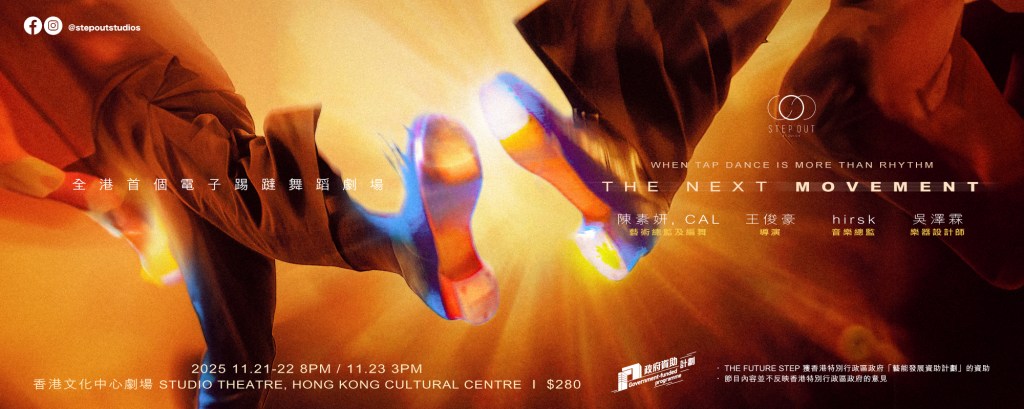
[REVIEW] “STEP OUT Studios’ The Next Movement Blasts Out Futuristic Sounds From the Dancers’ Feet” by by Dawna Fung
Wong Chun-ho (director), Zoe Chan & Cal Tang (artistic directors & choreographers), hirsk (music director), STEP OUT Studios, The Next Movement, 2025.

I was not alive when the acoustic guitar transformed into the electronic guitar and opened a new era for the instrument. I imagine that must have felt like a stunt. For tap dance, however, I was fortunate enough to witness its own historical breakthrough, thanks to STEP OUT Studios’ boldly experimental idea of creating a pair of “electronic tap shoes” and bringing them to the Hong Kong Cultural Centre in their production The Next Movement. When the creative directors Zoe Chan and CAL appeared and asked the audience to switch to aeroplane mode to avoid interrupting the electronic tap shoes’ transmission, I was already exhilarated.
The show began with all five dancers displaying their exceptional technique in traditional tap shoes, with strongly stressed rhythms. Their flawless synchronisation was almost magical. For someone like me, who struggles to keep time with a metronome’s ticking while playing musical instruments, the dancers’ sense of timing and tempo was astonishing. After a while, they replaced their conventional tap shoes with the electronic ones, which immediately shifted the performance into an experimental and futuristic soundscape. These electronic tap shoes were like “technology of extraterrestrial intelligence”, as CAL described, dispatching signals to an interface whenever the dancer struck the ground with the fourteen sensors embedded beneath each pair. Varying lighting effects and sounds were activated depending on the force and position of each strike.
The Next Movement, composed of six distinct dance pieces, captured the dancers’ exhilaration and frustration in exploring the electronic tap shoes and revealed the many expressive dimensions of the technology. There were gentle, melodic steps that created a harmonious song, alongside intense moments when two dancers grappled, producing metallic screeches and crashing sounds—jarring yet powerful. Without uttering a word, the performers conveyed deep, lingering and exaggerated emotional narratives through their feet.
The surprises continued. When Marc Ngan looked into the live camera and his face was projected prominently on the screen, he began narrating the history of tap dance in a silly-serious tone. What truly delighted the audience was that when his tap shoe touched the ground, it produced a sound effect shouting, “You’re very handsome!” (你好靚仔呀!). Ngan grinned smugly and revelled in the recurring joke, even prompting the audience to shout it back at him—an effortless display of improvisation and charm.
Laughter rippled through the auditorium until Ngan re-created Gene Kelly’s iconic dancing scene in Singing in the Rain (1952), while Chan and CAL supported him by producing the pattering sounds of raindrops falling on the ground or splashing in puddles. The adaptation was exhilarating and illustrated the remarkable versatility of the new tap-shoe technology.
Another highlight was Dominic Lee’s part. When CAL repeatedly recited words such as “disconnected”, “connected”, “success”, “failure”, he seemed to be issuing tyrannical commands to Lee’s feet. Despite his great efforts to synchronise and cooperate, Lee was still unable to meet CAL’s expectations perfectly. In the end, Lee rebelled and danced on his own terms, leaving a space for the audience to imagine their relationship. Did the two dancers represent human and electric devices, or the struggles between a rational mind and the soul?
Director Wong Chun-ho’s arrangement was impeccable. Each dancer had their own solo moment to shine. Meanwhile, STEP OUT Studios crafted the entire story in a minimalist style, using just a few chairs, toys and balloons as props. And yet, the dancers changed their outfits or accessories for each scene, which added more vibrant colours and variety to the performance. Beyond clapping, they also recited phrases like “we’re stuck”, “we dreamed”, “we’re touched” in a rhythmic pattern, turning words into a form of percussive accompaniment.
It was a slight pity that the dancers occasionally came too close to the audience, so that my view was obstructed by those seated in front of me. In a spoken theatre production this might be of lesser concern, as spectators primarily attend to the performers’ facial expressions and upper-body gestures. However, in tap dance, many audience members are likely to value, and even prioritise, a clear view of the dancers’ footwork. Had the performers maintained a position one or two steps further upstage, the visual experience would have been considerably improved.
After all these scenes, The Next Movement closed with a high-energy ensemble. All the dancers took off their shoes and ran with all their strength, posing an unspoken question: what will tap dance become from here? We may never know, yet we shall never cease searching, seeking and yearning together for whatever comes next. With the metal clanging and electronic effects falling away, the audience was left instead with open space for imagination and the warmth of the dancers’ sincerity.
The Next Movement marked a bold and imaginative step forward, stretching the boundaries of what tap dance could express. It brought fresh rhythm, daring ideas and a spirit of collaboration that pushed the art form into new territory. It left us inspired and curious about just how far we might go next.
How to cite: Fung, Dawna. “STEP OUT Studios’ The Next Movement Blasts Out Futuristic Sounds From the Dancers’ Feet.” Cha: An Asian Literary Journal, 29 Nov. 2025, chajournal.com/2025/11/29/next-movement.


Dawna Fung was born and raised in Hong Kong. She tried very hard to complete her degree in journalism but failed due to a small mistake calculating her credits calculation (maths is not her strength) and has been forced to defer for now. Her poems and prose have been featured in Voice & Verse Poetry Magazine, Fleurs de Lettres and Canto Cutie. In her free time, she writes as a freelance journalist and art critic (hmm, not so free at all) and has published in Hong Kong Free Press, The Theatre Times, Prestige Hong Kong, FairPlanet, and The Hong Kong Economic Journal. [All contributions by Dawna Fung.]
 Cha
Cha 