
茶 FIRST IMPRESSIONS
茶 REVIEW OF BOOKS & FILMS
[REVIEW] “When News Breaks: Carol Lin’s Memoir of Love and War” by Susan Blumberg-Kason
Carol Lin, When News Breaks, Third Rail Press, 2025. 284 pgs.
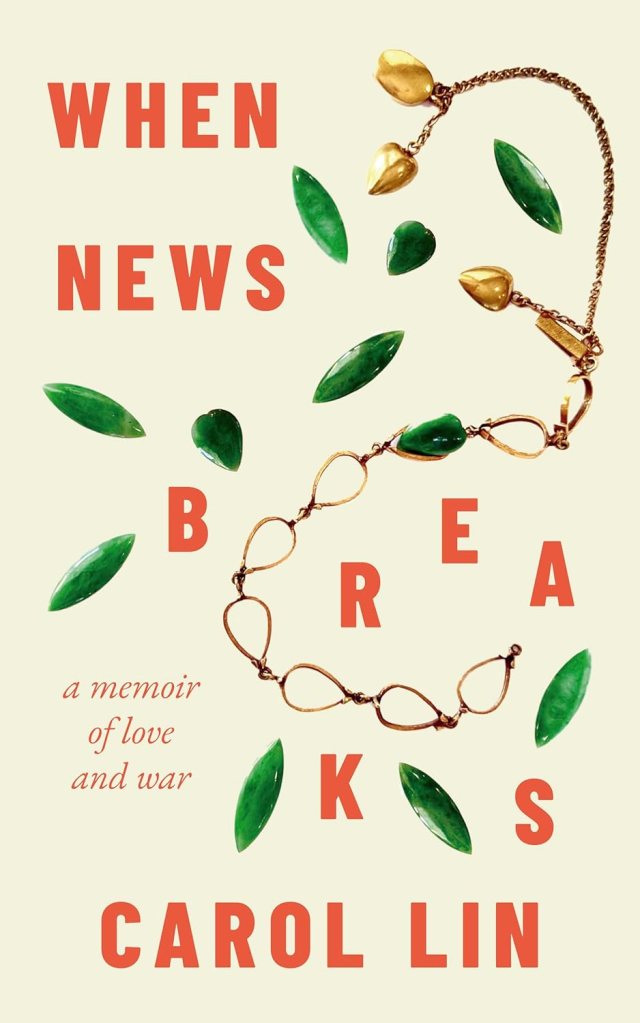
Carol Lin came of age in Southern California during the turbulent 1960s, a period in which Americans placed great trust in the anchors who presented the nightly news. As the young Lin watched the broadcasts each evening, and as her father told her that she could choose any career she wished, she began to imagine becoming a broadcast journalist herself. Her mother, however, was not so certain. Her parents had been separated for almost a decade in the 1940s when her father left China to study in the United States and her mother remained in Fuzhou. As the civil war in China continued, Lin’s mother fled through Hong Kong and was eventually able to reunite with Lin’s father in the United States. Her parents worked tirelessly to give Lin a secure life in California, and her mother felt that broadcast journalism would not provide the financial stability she desired for her daughter.
There were, moreover, no reporters or anchors on the various news channels who looked like the Lins. That changed in the early 1970s when Connie Chung began reporting on the nightly news. Lin chronicles the trajectory of her illustrious career in broadcast journalism in her new book When News Breaks: A Memoir of Love and War. As it turned out, she became a pioneer herself.
She opens her book with a harrowing scene on the border between Pakistan and Afghanistan. It is a month after 9/11, and she has been sent to the border to show the fluid movement between the two countries. She is not alone—her cameraman is at her side and the rest of her crew is tucked away in a satellite truck—but in this opening scene she is being scrutinised by a member of the Taliban. Lin knew full well that her life was expendable in the eyes of this terrorist. And, as she admits in the early pages, she was not yet a seasoned war correspondent, though she aspired to become as well regarded as her colleagues.
Yet I saw myself as an ambitious comet flying alongside a constellation of CNN stars instantly recognizable by their first names: Wolf, Christiane, and the up-and-coming Anderson. As the child of immigrants, I intuitively sought who had power and learned to bask in their adjacent light. It was a survival skill for people like my parents who had arrived in America with no long-term safety net.
Sometimes our most rewarding successes arise from immense hard work and the pure luck of being in the right place at the right time. For Lin, a UCLA student in the early 1980s, this happened when she came across an internship at a new network. Cable News Network, more commonly known as CNN, was just starting out, and Lin applied for a position in its Los Angeles office.
As Lin chronicles her rise in broadcast journalism, which would eventually culminate in the Pakistani Afghan border scene, she also writes of meeting her future husband while working after graduation at a Washington, DC satellite station. Will was a star journalist at a San Francisco network, and the two met during the 1988 presidential elections at the Iowa caucuses. Will was everything Carol was not: unpredictable, unreliable, and overconfident. She was smitten.
She moved to the San Francisco Bay Area to be closer to Will and to work for a network news station in San Jose. This was just before the 1989 earthquake in the Bay Area. It was also a time when few Asian Americans appeared on the news, and people often mistook Carol for Connie Chung, even though the latter reported from New York and was a generation older. Yet as Lin’s career progressed, from Good Morning America back to CNN, her marriage faltered. Lin kept telling herself that marriage was difficult enough without the geographical distances imposed by work, yet deep down she knew that she and Will had to work especially hard on their relationship because their personalities were so markedly different.
She recounts many stories of reporting on the biggest news events of the late 1980s and the 1990s, but her role as the morning anchor on CNN at the Atlanta headquarters would prove pivotal not only for her own career but for history itself. This is also the point at which her story comes full circle to the beginning of her memoir.
It was the morning of 11 September 2001, and Lin was anxious because CNN was preparing a new morning show to compete with other networks, and she knew her position as morning anchor was not secure. She was preparing to interview Amy Tan about Tan’s new cartoon show, SaGwa, and was excited to speak with one of her favourite authors. After they completed a mic check, the first plane flew into the World Trade Center, and everyone on set who was watching the live footage from New York City saw it happen. There was immediate confusion, and at first many believed that a small aircraft had accidentally crashed into the building. It was soon decided, however, to begin broadcasting rolling coverage of lower Manhattan, which meant CNN would not break for commercials.
Lin ran from the area where she was meant to interview Amy Tan to her anchor desk. She quickly took her position as her producer instructed her to begin speaking without a script. She would have to describe what she saw unfolding on the screen from New York. Lin remained on air for the first twenty minutes of the attacks before the Atlanta team switched over to local CNN anchors in New York. CNN’s live coverage of the second plane striking the South Tower was captured and replayed countless times from that day forward. From that moment, Lin was determined to report from the front lines, a resolve that brought her to the Afghan Pakistan border in the opening scene of her memoir.
Today, in 2025, it may not seem unusual for a woman to report from anywhere in the world, but in 2001 it was still almost unheard of.
I joined a cast of characters, international journalists who looked like actors rehearsing for the next James Bond movie. Dozens lurked in the hotel lobby dressed in more khaki and cargo pants that stocked at an army surplus. Alongside the tanned cotton crews were the local “businessmen” with the twitchiness of international drug runners and spies. They lingered in corners, smoked and eyed me suspiciously. A woman traveling alone was synonymous with being a prostitute. I had to move with the confidence of someone who belonged, especially as dusk turned to dark.
It is harrowing to read about Lin’s treatment by CNN staff and to realise that two months after she arrived in Pakistan, the Wall Street Journal’s Daniel Pearl would be murdered by terrorists in the region. After her own heartbreak, she wanted to leave everything behind in the United States and work at CNN’s Jerusalem bureau. She enjoyed reporting on Middle Eastern geopolitics and had even heard that a Jerusalem posting would provide a good work–life balance, despite the violence of the second intifada. By the end of the book, she makes choices that are best for her family and that prove to be just as monumental as the moment she first walked into the CNN offices in Los Angeles as a university student.
Reading Lin’s memoir raised questions I have been reflecting on over the last few years. It seems that the world is more divisive now in 2025 than at any other time in my life. As I read about Lin’s coverage of the genocide in Kosovo, the 9/11 terrorist attacks, the devastating 1989 Bay Area earthquake, and many other turbulent events, it was clear that the world was not at peace then either. There is also Lin’s work as a broadcast journalist and the distance we have travelled since she began her career. She stood out in Pakistan after 9/11 when she went to report on Al Qaeda in Afghanistan, but it seems that considerable progress has been made in the last quarter century, with more women war correspondents and nightly news anchors. It is also no longer unusual to see a woman of colour on television reporting from the field or in the news studio. For this, Lin’s book gives me hope.
How to cite: Blumberg-Kason, Susan. “When News Breaks: Carol Lin’s Memoir of Love and War.” Cha: An Asian Literary Journal, 29 Nov. 2025, chajournal.com/2025/11/29/news-breaks.


Susan Blumberg-Kason is the author of Bernardine’s Shanghai Salon: The Story of the Doyenne of Old China, a 2023 Zibby Awards finalist for Best Book for the History Lover. She is also the author of Good Chinese Wife: A Love Affair With China Gone Wrong and the 2024 Zibby Awards winner When Friends Come From Afar: The Remarkable Story of Bernie Wong and Chicago’s Chinese American Service League (University of Illinois Press, 2024). She is the co-editor of Hong Kong Noir and a regular contributor to the Asian Review of Books, Cha and World Literature Today. Her work has also appeared in the Los Angeles Review of Books and PopMatters. Visit her website for more information. (Photo credit: Annette Patko) [Susan Blumberg-Kason and ChaJournal.]
 Cha
Cha 