

茶 FIRST IMPRESSIONS
茶 REVIEW OF BOOKS & FILMS
[FIRST IMPRESSIONS] “Etienne Périer’s Bridge to the Sun and Extremism Abroad” by Jeremiah Dutch
Etenne Périer (director), Bridge to the Sun, 1961. 113 min.
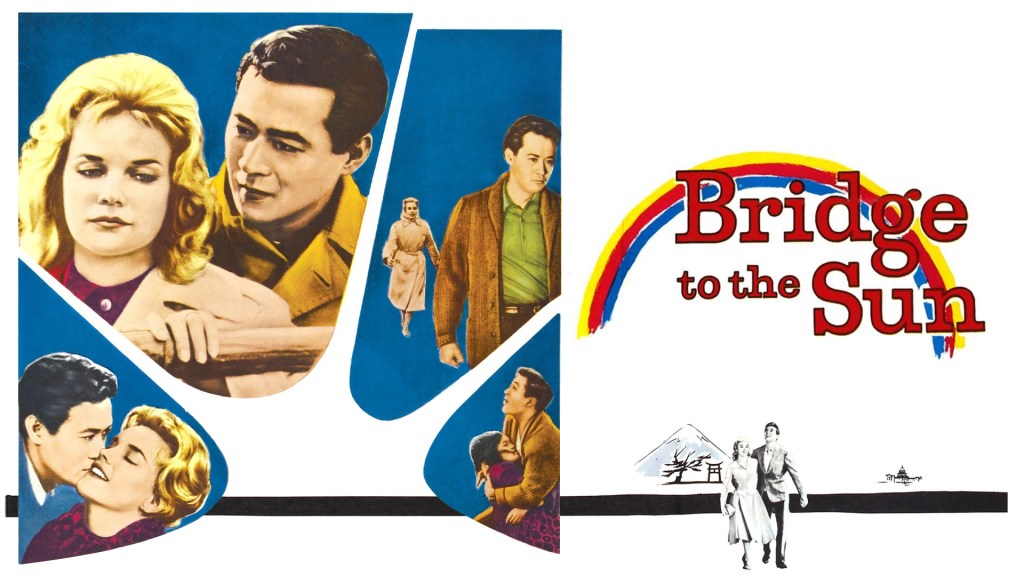

Living abroad and watching one’s homeland descend into extremism is distressing at best, yet it would be even harder to be a diplomat dispatched to represent one’s country, as was the case in the true story of Hidenori “Terry” Terasaki. However, Bridge to the Sun is not so much his story as that of his wife, a white Tennessean woman, Gwendolyn “Gwen” Harold. Her memoir of their marriage before, during, and just after the Second World War was published in 1956. The book was adapted into a film five years later, directed by Etienne Périer and starring Carroll Baker and James Shigeta.
Even at the time of the film’s release interracial marriages were controversial in America, if not illegal in some states. This is to say nothing of the 1930s, when Gwen first met Hidenori on a trip to Washington D.C. with her aunt. Moreover, the Japanese embassy also took a dim view of the match. “Terasaki’s Folly” they called it. However, race relations take a back seat to the threat, and then the reality, of war between Japan and the United States.
Terry, a liberal-minded pacifist, first watches his country descend into extremism and tries heroically, albeit in vain, to “hold two countries together with his bare hands.” When war does eventually break out, Gwen makes the agonising decision to follow her deported husband to Japan rather than remain in America with their young daughter Mariko “Mako” (Emi Florence Hirsch). Hatred runs deep on both sides of the Pacific and the film does not shy away from showing fear, distrust and death.
Bridge to the Sun is much better in its second half than it is in its first. At times the direction is rather pedestrian. Although the black-and-white photography blends well with wartime stock footage, the screen-process shots are rather obvious and distracting. It might have been interesting to see what Périer, a relatively inexperienced French director, could have achieved had he been more influenced by the European New Wave cinema of the time.
Shigeta plays his character with great dignity, perhaps picking up where Sessue Hayakawa left off as one of the great Japanese-American actors of his day. However, maybe Hollywood was not ready. Although he appeared in such films as Midway (1976) and Die Hard (1988), Shigeta was terribly underrated and underused as an actor.
Baker’s acting, on the other hand, is questionable. It is hard to tell whether she, or her character, is callow. She plays her role at first as a kind of B-movie Scarlett O’Hara caught up in events far beyond her depth. That said, it is fascinating to watch her portrayal of a rather immature southern belle growing into a brave woman in the face of adversity.
Perhaps one explanation for the film’s disjointedness is that there was a better unit filming on location in Japan. Moreover, Kyoto, a city undamaged during the war, lends Bridge to the Sun an air of pre-B-29 authenticity. The depiction of a traditional Japanese cremation is particularly moving. It is also a rather sensuous love story, which makes the stark contrast of the horror of war all the more palpable. The opening shot of two bare arms reaching across a tatami floor and slowly clasping hands is reminiscent of Spike Lee’s Jungle Fever (1991).
Less convincing is the very real physical toll of stress and starvation in wartime, and Baker’s hairstyle is straight out of the early 1960s rather than the 1940s. The film also takes some artistic licence with the facts and with Japanese culture and omits much from the book.
Bridge to the Sun was nominated for a Golden Globe and the Golden Lion at the Venice Film Festival, but it seems somewhat forgotten today. However, despite its flaws, Bridge to the Sun is well worth watching and is a decent adaptation of a captivating memoir that may be even more relevant in this era of political extremism than it was when it was first released.
How to cite: Dutch, Jeremiah. “Etienne Périer’s Bridge to the Sun and Extremism Abroad.” Cha: An Asian Literary Journal, 21 Nov. 2025, chajournal.com/2025/11/21/to-the-sun.


As an American who has called Japan home for over 25 years, Jeremiah Dutch’s writing crosses both cultures. He’s written about such diverse topics as horror films and climbing Mt. Fuji. While still an undergraduate, he wrote for The Haverhill (Massachusetts) Gazette and The Portsmouth (New Hampshire) Herald. In 1997, he graduated from the University of New Hampshire and moved to Japan to teach English the following year. In 2007 he earned a MS.Ed in Education from Temple University and for over seventeen years taught at the post-secondary level while continuing to write academic articles, fiction, and non-fiction. He currently teaches at Rikkyo University. In 2022, his short piece, Zen Failure in Kyoto won an Honourable Mention in the Seventh Annual Writers in Kyoto Competition. This was excerpted and adapted from his then novel-in-progress, Gaijin House. Another adapted excerpt was published this year under the name “Transported Souls in the Motel of Regret” in the anthology Mono no Aware: Stories on the Fleeting Nature of Beauty. These days he calls Yokohama home and lives there with his wife and two daughters. When not writing, teaching, or spending time with his family, he enjoys reading, exercising, and following baseball. Some more information about Jeremiah and his writing can be found on his website and Instagram. [All contributions by Jeremiah Dutch.]
 Cha
Cha 