

茶 FIRST IMPRESSIONS
茶 REVIEW OF BOOKS & FILMS
[REVIEW] “How Modern China Woke Up: A review of Martin Albers’s Britain, France, West Germany and the People’s Republic of China, 1969-1982” by Mario Rustan
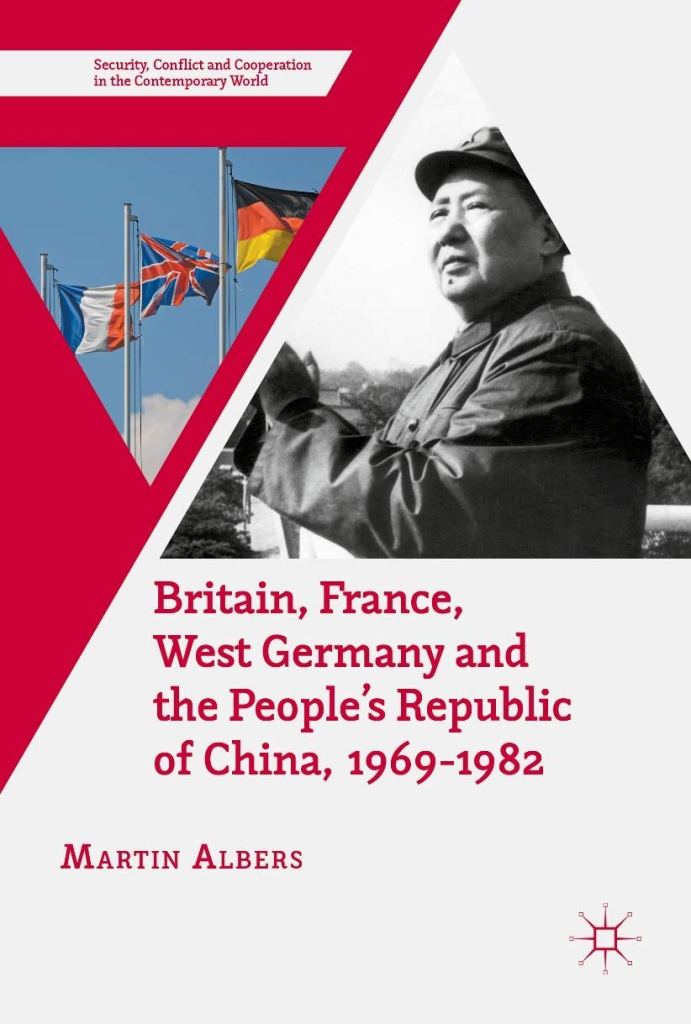
Martin Albers, Britain, France, West Germany and the People’s Republic of China, 1969–1982: The European Dimension of China’s Great Transition, Security, Conflict and Cooperation in the Contemporary World series, Palgrave Macmillan, 2016. 341 pgs.
A conventional wisdom in the 21st century is that China has superseded Europe in many aspects: political influence, military power, industrial magnitude, and technological innovation. In the words of Western pessimists, what Europe can offer are landmarks for Chinese tourists, academic degrees and tech employment opportunities for Chinese graduates, and football for Chinese spectators.
China needed only about fifty years to turn the table around and Martin Albers’s Britain, France, West Germany and the People’s Republic of China, 1969–1982 shows how it happened. Specifically, it examines how the three leading states of Europe approached the People’s Republic of China in the Cold War and how each party roughly got half of what they wanted.
Martin Albers worked for the city of Hamburg at the time of publication, and while there are several different people of the same name online, it seems that the author of this book is still working for the city and is a member of the Social Democratic Party of Germany.
Albers begins the book by remarking that his wife, Chen Mengyu, was born in the nineteenth century. This is not to suggest that he married a much older woman, but rather that her childhood in provincial Shandong in the early 1990s resembled a German vision of ecological living in the twenty-first century: chickens and vegetable patches in the backyard, meat reserved for festive occasions, and the bicycle as the sole form of transport. That changed quickly before her eyes, from motorcycle and rice cooker to air travel to Germany. Now it is possible that Albers and Chen have a Hisense television and a Lenovo computer at home while Germany’s Grundig and Siemens no longer rule European homes.
Drawing from this personal connection, Albers believes he can contribute to the study of China’s relations with western Europe in the second half of the 20th century and how they helped to boost China’s international legitimacy and speedy economic growth. The scope of his investigation begins in 1969, when the Cultural Revolution wound down, and ends in 1982, when Deng Xiaoping’s reform plan was approved by the Communist Party.
Albers believes that even as far as five decades ago, China had been confident of its rise as a major power while Europe was managing its decline, and the Cold War both motivated and hindered their actions and goals. While hardly criticising China’s decisions especially after Mao, Albers overall takes a realist position in observing Europe and China throughout this book. Despite its recurrence for the fourth and fifth time, I was still intrigued to read that China always found Russia to be a bigger menace than the United States.
It was a very different world when Mao Zedong and Deng Xiaoping grew up in the 1920s. It was a European world, and the Europeans did not only bring Christianity and beef steak but also communism. Mao was a true provincial communist while other figures studied in Europe, and in the future European leaders would use this history to build a rapport with both Deng and Premier Zhou Enlai.
After the Second World War, the United Kingdom became the first major Western power to acknowledge the People’s Republic of China for a practical reason, to appease a giant China that surrounded Hong Kong. Beijing also needed Hong Kong as its gateway to the outside world and to maintain economic stability in southern China. A cordial 1950s was followed by a radicalising China in the 1960s, and the Cultural Revolution spilled into the Hong Kong riots of 1967. The riots exposed the limit of British military power, as London had to rely on the local police and garrison to maintain order. The Royal Navy’s flagship HMS Hermes was there to help the police, but it had no firepower to intimidate the Red Guards, let alone the People’s Liberation Army.
France and West Germany also had interesting stories in the 1960s. Both Charles de Gaulle and Mao Zedong saw themselves as independent leaders who dared to defy both the USA and the USSR and presented themselves as the third option in international politics. Despite officially denouncing the Federal Republic of Germany as an American puppet, China was impressed with West Germany’s recovery by the 1950s and saw it as a viable model for China’s industrialisation rather than the German Democratic Republic. The West German government at the city of Bonn, however, had to be extra careful in balancing the capitalist and the communist blocs, being located on the frontline of the Cold War.
The 1960s was a dark decade in China as Mao’s paranoia grew after China lost influence in Cuba, Algeria, and Indonesia. Zhou Enlai was lucky to survive the Cultural Revolution. No foreigner wanted to be in Beijing in 1967, as Indian, Indonesian, and even East German diplomats were attacked as enemies of the revolution.
The change came following the deadly border clashes with the Soviet Union in 1969. During the funeral of former American president Dwight Eisenhower, Richard Nixon informed the new French president Georges Pompidou that the United States was interested in communicating with Beijing, meaning that Paris was free to do so. More than that, France saw an opportunity to turn its image from the former coloniser of Vietnam to the peacemaker in Vietnam.
Britain navigated a more treacherous path as the majority of the Hong Kong population preferred British over Chinese rule despite the riots, while London wanted a friendlier Beijing. Foreign Minister Alec Douglas-Home ordered Governor David Trench to pardon most of the rioters, and the Foreign Commonwealth Office thought about excluding the taipans of Hong Kong from negotiations since the CCP might see them as colonial figures, before finding out that Beijing had no problem with them.
The 1970s was a gloomy dawn for China, with the mysterious death of Lin Biao, a possible successor to Mao, and Zhou Enlai living with cancer. The détente, the easing of tension between the United States and the Soviet Union, was bad news for China, and Beijing reached out to Western conservatives who opposed détente.
Vice Chairman Deng Xiaoping visited Paris in 1975, and Pompidou returned the favour by visiting Beijing. Albers argues that Pompidou was the first Western head of state to officially visit China, since the United States and China had no formal relations in 1972 and so Nixon visited as an American citizen. Pompidou’s successor Valerie Giscard d’Estaing was eager to present France as a development model for China, with its nuclear reactors and mechanised farmlands.
I wish Albers had introduced key moments and figures inside China, as he seems to assume that his readers are familiar with Chinese history and does not bother to explain, for example, why it was Deng Xiaoping who became the successor to Mao Zedong instead of Hua Guofeng, and how Mao’s widow Jiang Qing and her Gang of Four rose and fell. After all, Albers neatly ends every chapter with a summary of how the three European nations performed so far, including their domestic politics and changes of leadership, so I am sure he could have spared some paragraphs explaining China.
1980 was an alarming year for China. Anticommunist conservatism was surging in the United States and United Kingdom, making the détente days seem better. Its border conflict with Vietnam did not go well and Russia invaded Afghanistan on its western border. France presented itself as China’s best friend again, and together they condemned the nuclear proliferation of both Washington and Moscow, while supporting each other’s interests in Africa.
France successfully sold armaments to China, while the Federal Republic of Germany used its states to develop regional cooperation with Chinese provinces in education, agriculture, and industry. Cooperation with the United Kingdom was hopeless due to the government of Margaret Thatcher, who had nothing good to say about China.
After the Red Guards, Thatcher is the second antagonist of this book and Albers sees no point in her hostility against China, which only ended with her humiliating slip on the steps of the Great Hall of the People and the confirmation of the handover of Hong Kong to China.
If we must pick a winner of the three contestants, it seems that West Germany was the most favoured western European nation for China in 1982. Indeed, until recently the world saw Germany as the most reasonable, level-headed, and generous nation, if only for the virtue that it was neither the United States nor Britain. More importantly for the Koreas and China, Germany was not Japan.
Albers seems to be happy with the good relations between Germany and China both in the scope of this book (1969–1982) and at the time of publication (2016), and he has nothing to complain about China apart from its past Maoism. It would have been better had this book included some illustrations, from the first contacts in the 1950s to how China finally achieved its great leap forward in political legitimacy, industrialisation, and beyond, helped by Western Europe.
How to cite: Rustan, Mario. “How modern China woke up: A review of Martin Albers’s Britain, France, West Germany and the People’s Republic of China, 1969–1982.” Cha: An Asian Literary Journal, 13 Nov. 2025, chajournal.com/2025/11/14/modern-china.


Mario Rustan is a writer and reviewer living in Bandung, Indonesia. [All contributions by Mario Rustan.]
 Cha
Cha 