

茶 FIRST IMPRESSIONS
茶 REVIEW OF BOOKS & FILMS
[REVIEW] “Impossible (Between) Girls: Lilly Hu’s One Girl Infinite” by Hongwei Bao
Lilly Hu (director), One Girl Infinite 不可能女孩, 2025. 102 min.

The Chinese title of Lilly Hu’s (also known in Mandarin as Jiaying Hu) 2025 film One Girl Infinite is an intentionally ambiguous one: 不可能女孩, which can be translated both as “impossible girl(s)” and “impossible between girls”. This ambiguity may well be a deliberate pun, for while the Chinese title gestures towards the idiosyncrasy of the female protagonists, it also alludes to the impossibility of such a relationship within the context of a heteropatriarchal Chinese society.
Premiered at the International Film Festival Rotterdam in January 2025, One Girl Infinite is the filmmaker Lilly Hu’s directorial debut. The film tells the consuming love story between two teenage girls, Yin Jia (performed by the director herself) and Tong Tong (Xuanyu Chen), set in the city of Changsha in South China during the 2010s. Changsha is known as one of the most relaxed, lively and youth-oriented cities in China, with a vibrant nightlife, youth culture and queer community. The film refers to the then newly released iPhone 4, situating the timeline at around 2010. The 2010s witnessed the rapid development of queer communities and cultures in urban China before the government tightened its control over queer activism and media production. In the film, Yin and Tong share a flat in a working-class neighbourhood and spend their days and nights together. The film also depicts a group of girls playing a social game in the open air, and the losers must kiss each other in front of everyone else, seemingly caring little about other people’s opinions. There seem to be endless energies and high hopes for a life shared by two young women.
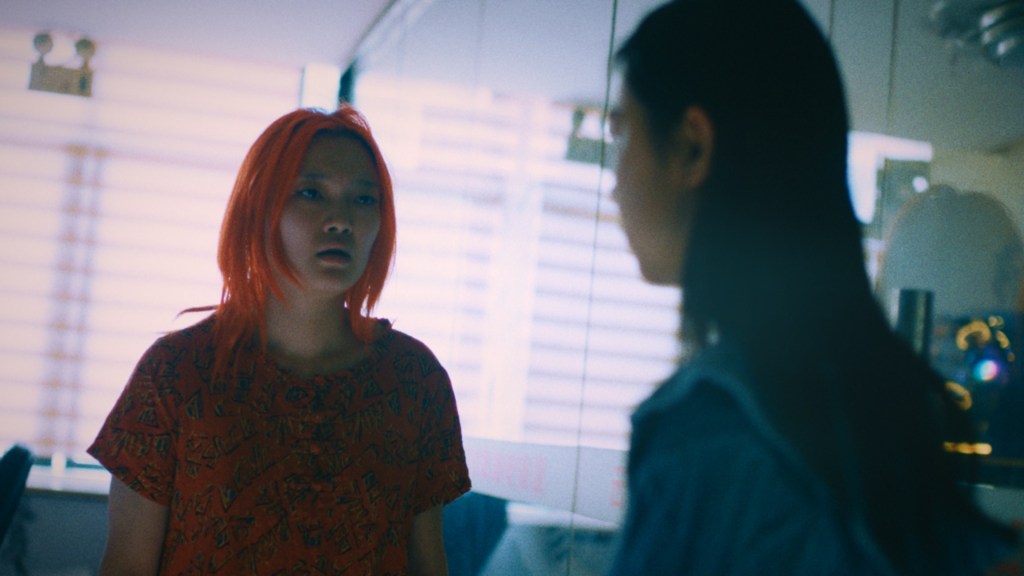
Xuanyu Chen (left) and Jiaying Hu (right), playing the characters Tong Tong and Yin Jia respectively.
Such a queer paradise does not last long. Tong meets a young man, the leader of a drug gang, falls in love with him and decides to leave Yin. Out of jealousy and despair, Yin sleeps with the gang leader so that Tong can leave him. After discovering the truth, Yin and Tong have a fight. The film ends with Tong sitting in an ambulance with Yin and reading Yin’s last words.
There has been a dearth of queer films featuring queer women’s lives in Mainland China, partly due to China’s censorship of queer cinema and partly due to the perceived small market for lesbian-themed films. Since the 1990s, queer films from Mainland China, limited but still present, have primarily centred on the lives of gay men. The danmei 耽美, or Boys’ Love, themed television dramas epitomise the popular fascination with beautiful young men. There were lesbian dramas such as Fish and Elephant 今年夏天 (dir. Li Yu, 2001) and documentaries such as The Box 盒子 (dir. Ying Weiwei, 2001) from the early 2000s. There have also been lesbian-identifying filmmakers such as He Xiaopei and Shi Tou who have produced documentaries representing queer women’s experiences. Yet films portraying female same-sex intimacy remain scarce. With such limited lesbian representation on Chinese screens, One Girl Infinite, which carries an American distribution licence and is therefore branded as an American film, making it screenable only outside China, is a work that warrants anticipation. It is at the same time burdened with what Song Hwee Lim (2006) calls the “burden of representation”—namely, to what extent can the film represent the lives of Chinese lesbians.
Perhaps the film does not, and cannot, represent the lives of most Chinese lesbians. Tong and Yin are without families, without employment and without money. They dye their hair, live by petty theft, smoke weed and associate with members of a drug-trafficking gang. They survive on the fringes of Chinese society and seem to revel in their marginality. There appears to be an inexhaustible sense of freedom in their lives.
Yet there remains an element of truth in the film’s depiction of lesbian life in China, particularly in its portrayal of the pressures faced by lesbian couples. Even without familial pressure to enter heterosexual marriages, the couple encounters insurmountable societal constraints that render a sustainable lesbian relationship difficult. The gang leader, symbolising the power of a heteropatriarchal society, easily severs the bond between the two women through money and phallic sex. One could argue that, set in 2010s China, where same-sex couples, especially those from the lower strata of society, find no imaginable future, the film is destined to conclude tragically on screen.
In many ways, the film recalls what B. Ruby Rich (1992) terms the “new queer cinema” and what Helen Hok-Sze Leung (2012) describes as the “new queer Chinese cinema”. With its handheld camera, documentary aesthetics, neo-noir sensibility and portrayal of queer lives situated on the social margins, accompanied by poverty, drugs and criminality, the film bears multiple parallels with Gus Van Sant’s 1991 film My Own Private Idaho, Wong Kar-wai’s 1997 film Happy Together 春光乍泄, and Harry Dodge and Silas Howard’s 2001 film By Hook or by Crook. Yet One Girl Infinite is nevertheless a different film. Shot underground without a filming licence in urban China, its handheld camera and dark, shaky, claustrophobic sequences reflect the material conditions of its production. The two girls’ rebellion against social norms is shaped partly by their own choices and partly by structural forces: deserted by their families, exploited by small business owners and discriminated against by middle-class customers, their radical defiance reveals not only the “no future” (Edelman, 2004) of queerness but also the “no future” of China’s working-class population. In neoliberal China, under conditions of homopostsocialism (Ye, 2025), working-class queer lives are rendered precarious and undesirable; they are fated to end violently and tragically.
The audience must be given the following content warnings: sex, drugs, violence and cruelty towards animals. Although the film features commendable examples of the “female gaze” (Dirse, 2013), depicting the two women’s intimacy in the shower and in bed, the heterosexual sex scenes appear excessively long and unduly violent for a queer-themed film. The scene in which a fish is killed alive at a wet market functions as a powerful visual metaphor, yet it is also extraordinarily brutal and visceral.
The cinematography and sound design are stunning. At the end of the film, Claude Debussy’s “Clair de Lune” has never sounded so heart-breaking. The story is fast paced, achieved through expert editing. Chen and Hu’s performances are remarkably natural. Even as a directorial debut, the film reveals Lilly Hu as a promising young filmmaker who brings distinctive feminist and queer perspectives to the depiction of Chinese women’s lives.
Bibliography
▚ Dirse, Zoe (2013). “Gender in Cinematography: Female Gaze Eyes Behind the Camera.” Journal of Research in Gender Studies 3 (1): 15–29.
▚ Edelman, Lee (2004). No Future: Queer Theory and Death Drive. Durham, NC: Duke University Press.
▚ IFFR (2025). “One Girl Infinite.” International Film Festival Rotterdam. https://iffr.com/en/iffr/2025/films/1-girl-infinite
▚ Leung, Helen Hok-Sze (2012). “Homosexuality and Queer Aesthetics.” In Yinjing Zhang (ed.). A Companion to Chinese Cinema. Hoboken, NJ: Wiley Blackwell. pp. 518–534.
▚ Lim, Song Hwee (2006). Celluloid Comrades: Representations of Male Homosexuality in Contemporary Chinese Cinemas. Honolulu, HI: University of Hawaii Press.
▚ Rich, B. Ruby (1992). “New Queer Cinema.” Sight & Sound 2 (5). https://www.bfi.org.uk/sight-and-sound/features/new-queer-cinema
How to cite: Bao, Hongwei. “Impossible (Between) Girls: Lilly Hu’s One Girl Infinite.” Cha: An Asian Literary Journal, 14 Nov. 2025, chajournal.com/2025/11/14/infinite.



Hongwei Bao is a queer Chinese writer, translator and academic based in Nottingham, UK. He is the author of Queer China: Lesbian and Gay Literature and Visual Culture under Postsocialism (Routledge, 2020) and Queering the Asian Diaspora (Sage, 2025) and co-editor of Queer Literature in the Sinosphere (Bloomsbury, 2024). His poetry books include The Passion of the Rabbit God (Valley Press, 2024) and Dream of the Orchid Pavilion (Big White Shed, 2024). [All contributions by Hongwei Bao.]
 Cha
Cha 